Recognition: unknown
Materials Informatics Across the Length Scales
Pith reviewed 2026-05-10 04:10 UTC · model grok-4.3
The pith
Reliability of materials informatics methods changes sharply across length scales from atoms to continuum.
A machine-rendered reading of the paper's core claim, the machinery that carries it, and where it could break.
Core claim
Materials informatics demonstrates established capabilities at individual length scales through methods such as machine-learning interatomic potentials at the nanoscale, operator-learning models at the mesoscale, and learning-based analysis of experimental microstructures at micro-to-continuum levels, but reliability and transferability vary strongly with scale due to issues in data quality, uncertainty, interpretability, and cross-scale consistency.
What carries the argument
Scale-stratified assessment of data-driven models, with emphasis on how data standards, ontologies, and autonomous laboratories affect multiscale consistency.
If this is right
- Adoption of shared data standards and ontologies would reduce inconsistencies when linking nanoscale simulations to continuum descriptions.
- Better uncertainty quantification at each scale would improve the trustworthiness of integrated predictions for materials design.
- Autonomous laboratories could supply higher-quality datasets that directly address current limitations in cross-scale transfer.
- Focus on interpretability would clarify which parts of the workflow remain reliable when moving from atomistic to engineering scales.
Where Pith is reading between the lines
- A fully integrated system might eventually allow inverse design where a target property at the continuum level directly informs atomic-scale choices without intermediate human intervention.
- Similar scale-dependent reliability patterns could appear in other domains that combine simulations and experiments, such as fluid dynamics or biological tissue modeling.
- Targeted benchmarks that quantify prediction error propagation across scales would provide concrete metrics for progress toward integration.
Load-bearing premise
The selected examples of methods at each scale are representative enough to support general statements about reliability and transferability across the field.
What would settle it
A documented workflow that combines machine-learning interatomic potentials, mesoscale surrogate models, and microstructure analysis into a single, consistent multiscale prediction without manual data reconciliation or scale-specific adjustments would challenge the identified obstacles.
Figures
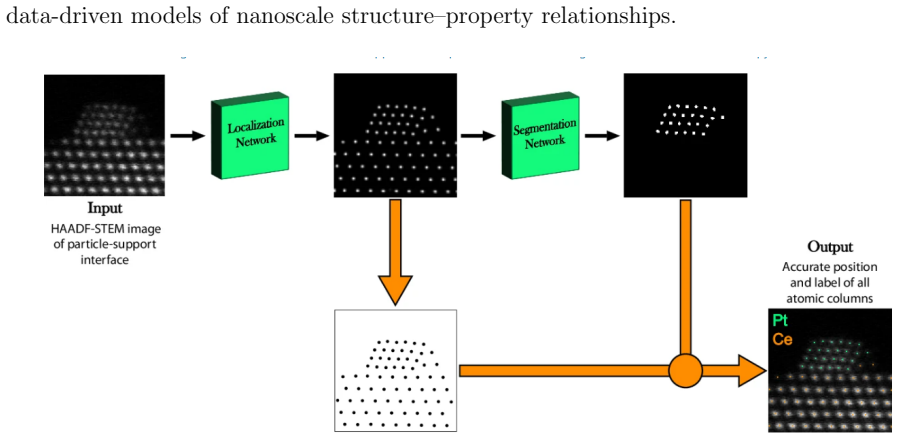


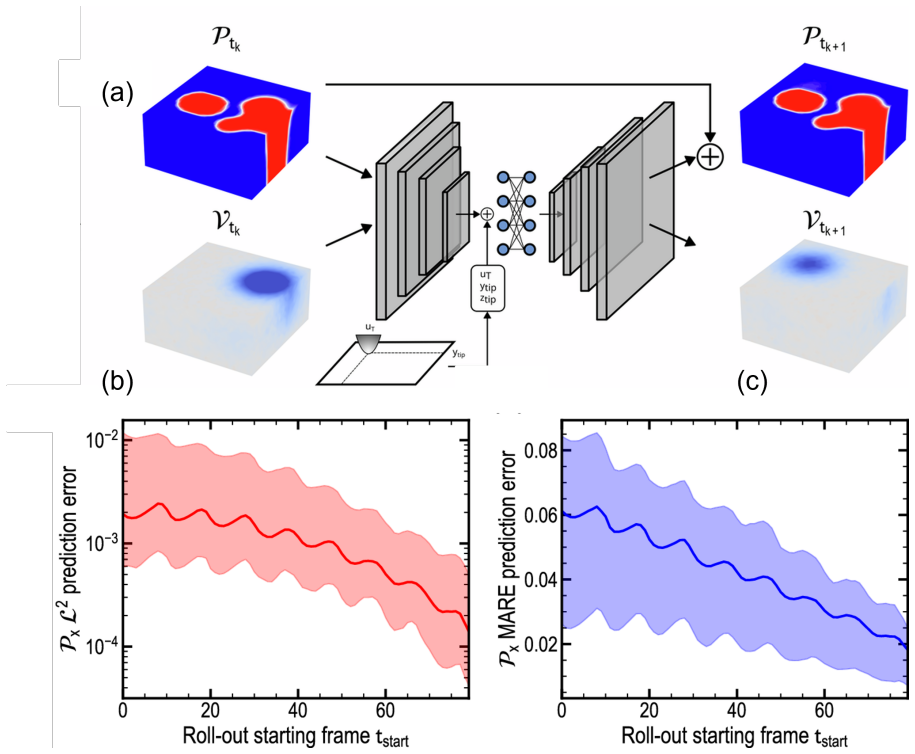


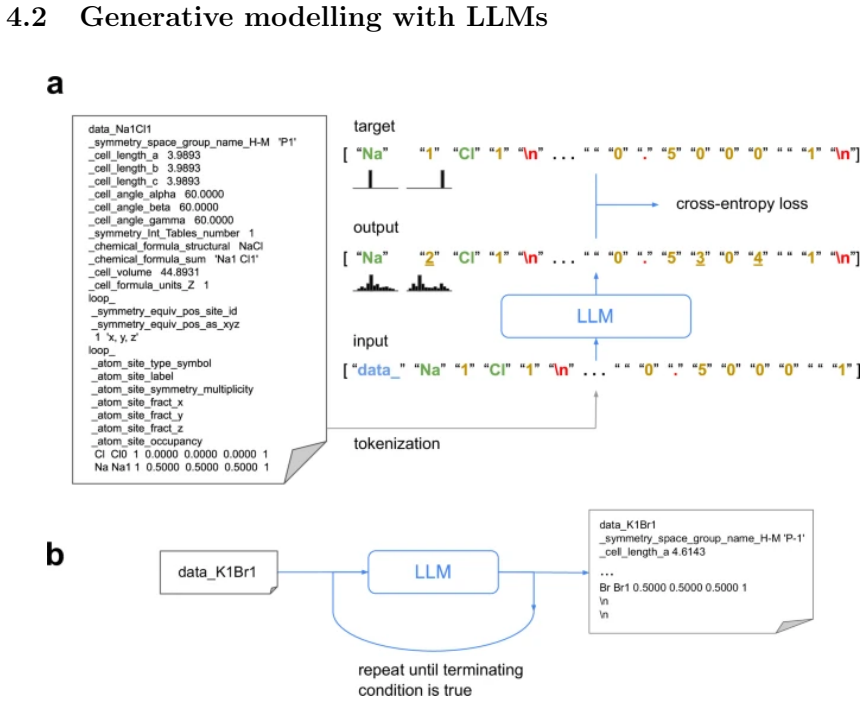


read the original abstract
Materials informatics is increasingly used to support modelling, analysis and design across the length scales of materials science, from atomistic simulations to microstructural characterisation and continuum descriptions. Despite rapid progress, the reliability and transferability of these approaches vary strongly with scale. Here we survey data-driven methods at the nanoscale, mesoscale, and micro-to-continuum levels, highlighting established capabilities as well as unresolved challenges. Machine-learning interatomic potentials, mesoscale surrogate and operator-learning models, and learning-based analysis of experimental microstructures are discussed, with emphasis on data quality, uncertainty, interpretability, and cross-scale consistency. We further examine the role of data standards, ontologies, and emerging tools, such as autonomous laboratories, where they directly affect multiscale workflows. This perspective clarifies what can be considered reliable today and identifies key obstacles to the broader integration of materials informatics across scales.
Editorial analysis
A structured set of objections, weighed in public.
Referee Report
Summary. The manuscript is a perspective survey of materials informatics methods applied across length scales, from atomistic to continuum. It reviews machine-learning interatomic potentials at the nanoscale, mesoscale surrogate and operator-learning models, and learning-based analysis of experimental microstructures. Emphasis is placed on data quality, uncertainty quantification, interpretability, cross-scale consistency, data standards, ontologies, and autonomous laboratories in multiscale workflows. The central claim is that the survey clarifies what can be considered reliable today while identifying key obstacles to broader integration of these approaches.
Significance. If the curated examples prove representative, the perspective could usefully synthesize progress and challenges in multiscale materials modeling for the community. It draws attention to practical issues such as transferability and uncertainty that affect integration across scales, and it connects informatics tools to emerging infrastructure like autonomous labs. As a non-systematic survey, its contribution rests on the breadth of cited literature and the clarity with which obstacles are framed rather than on new derivations or quantitative benchmarks.
major comments (2)
- [Introduction] Introduction and abstract: The claim that the perspective clarifies 'what can be considered reliable today' and identifies general obstacles rests on the assumption that the selected methods and challenges at each scale (ML interatomic potentials, surrogate/operator models, microstructure analysis) are representative. The manuscript provides no explicit inclusion criteria, coverage metrics, or discussion of omitted counter-examples, leaving statements on reliability, data quality, and transferability qualitative and potentially non-generalizable.
- [Abstract] Abstract and concluding sections: No quantitative metrics, systematic comparisons, or balanced assessment of the highlighted methods are supplied to support the reliability assessments. The evaluations of capabilities and challenges appear to derive from qualitative synthesis of selected citations rather than a structured review, which limits the strength of the central claim for readers seeking actionable guidance.
minor comments (2)
- The first mention of 'operator-learning models' and 'mesoscale surrogate models' would benefit from a brief definition or pointer to foundational references to assist readers outside the immediate subfield.
- Figure captions (where present) could more explicitly link the illustrated examples to the reliability and uncertainty issues discussed in the accompanying text.
Simulated Author's Rebuttal
We thank the referee for their constructive comments on our perspective manuscript. The feedback usefully highlights opportunities to better frame the scope and limitations of a non-systematic survey. We respond to each major comment below and indicate planned revisions.
read point-by-point responses
-
Referee: [Introduction] Introduction and abstract: The claim that the perspective clarifies 'what can be considered reliable today' and identifies general obstacles rests on the assumption that the selected methods and challenges at each scale (ML interatomic potentials, surrogate/operator models, microstructure analysis) are representative. The manuscript provides no explicit inclusion criteria, coverage metrics, or discussion of omitted counter-examples, leaving statements on reliability, data quality, and transferability qualitative and potentially non-generalizable.
Authors: We agree that the manuscript, as a perspective rather than a systematic review, does not supply explicit inclusion criteria, coverage metrics, or discussion of omitted cases. The examples were chosen to illustrate prominent methods and recurring issues across scales. We will add a dedicated paragraph to the introduction that states the selection rationale, notes the illustrative (rather than exhaustive) intent, and qualifies that reliability assessments are drawn from these representative cases. This revision will make the qualitative character of the claims explicit without changing the perspective format. revision: yes
-
Referee: [Abstract] Abstract and concluding sections: No quantitative metrics, systematic comparisons, or balanced assessment of the highlighted methods are supplied to support the reliability assessments. The evaluations of capabilities and challenges appear to derive from qualitative synthesis of selected citations rather than a structured review, which limits the strength of the central claim for readers seeking actionable guidance.
Authors: The manuscript is a perspective survey whose purpose is to synthesize trends and obstacles from the literature rather than to generate new quantitative benchmarks or perform systematic comparisons. We will revise the abstract and concluding sections to temper the central claim, explicitly noting that reliability evaluations rest on qualitative synthesis of selected examples and directing readers to the cited primary sources for quantitative details. A brief statement on the inherent limitations of such overviews will also be added to set appropriate expectations. revision: yes
Circularity Check
No circularity: literature survey with no derivations or self-referential reductions
full rationale
This perspective paper surveys existing methods for materials informatics at different scales, highlighting capabilities and challenges from the literature. It contains no original equations, predictions, fitted parameters, or derivations that could reduce to the paper's own inputs by construction. All statements draw on external citations rather than internal self-definitions or load-bearing self-citations. The central claims concern the current state of the field and obstacles to integration, which are qualitative assessments of published work and do not exhibit any of the enumerated circularity patterns.
Axiom & Free-Parameter Ledger
Reference graph
Works this paper leans on
-
[1]
Autonomous materials discovery driven by gaussian process regression with inhomogeneous measurement noise and anisotropic kernels.Scientific reports, 10(1):17663, 2020
Marcus M Noack, Gregory S Doerk, Ruipeng Li, Jason K Streit, Richard A Vaia, Kevin G Yager, and Masafumi Fukuto. Autonomous materials discovery driven by gaussian process regression with inhomogeneous measurement noise and anisotropic kernels.Scientific reports, 10(1):17663, 2020
2020
-
[2]
Materials informatics.Materials Today, 8(10):38–45, 2005
Krishna Rajan. Materials informatics.Materials Today, 8(10):38–45, 2005
2005
-
[3]
Materials informatics and data system for polymer nanocomposites analysis and design
Wei Chen, Linda Schadler, Cate Brinson, Yixing Wang, Yichi Zhang, Aditya Prasad, Xiaolin Li, and Akshay Iyer. Materials informatics and data system for polymer nanocomposites analysis and design. InHANDBOOK ON BIG DATA AND MACHINE LEARNING IN THE PHYSICAL SCIENCES: Volume 1. Big Data Methods in Experimental Materials Discovery, pages 65–125. World Scien- ...
2020
-
[4]
Learning two-phase microstructure evolution using neural operators and autoencoder architectures.npj Computational Materials, 8(1):190, 2022
Vivek Oommen, Khemraj Shukla, Somdatta Goswami, R´ emi Dingreville, and George Em Karniadakis. Learning two-phase microstructure evolution using neural operators and autoencoder architectures.npj Computational Materials, 8(1):190, 2022
2022
-
[5]
Machine learning in materials informatics: recent applications and prospects.npj Computational Materials, 3(1):54, 2017
Rampi Ramprasad, Rohit Batra, Ghanshyam Pilania, Arun Mannodi- Kanakkithodi, and Chiho Kim. Machine learning in materials informatics: recent applications and prospects.npj Computational Materials, 3(1):54, 2017
2017
-
[6]
Preisig, Yacine Rezgui, Natalia Konchakova, and Ali Daouadji
Iman Peivaste, Salim Belouettar, Francesco Mercuri, Nicholas Fantuzzi, Hamidreza Dehghani, Razie Izadi, Halliru Ibrahim, Jakub Lengiewicz, Ma¨ el Belouettar-Mathis, Kouider Bendine, Ahmed Makradi, Martin Horsch, Peter Klein, Mohamed El Ha- chemi, Heinz A. Preisig, Yacine Rezgui, Natalia Konchakova, and Ali Daouadji. Artificial intelligence in materials sc...
2025
-
[7]
E (3)- equivariant graph neural networks for data-efficient and accurate interatomic po- tentials.Nature communications, 13(1):2453, 2022
Simon Batzner, Albert Musaelian, Lixin Sun, Mario Geiger, Jonathan P Mailoa, Mordechai Kornbluth, Nicola Molinari, Tess E Smidt, and Boris Kozinsky. E (3)- equivariant graph neural networks for data-efficient and accurate interatomic po- tentials.Nature communications, 13(1):2453, 2022
2022
-
[8]
Machine learning for molecular and materials science.Nature, 559(7715):547–555, 2018
Keith T Butler, Daniel W Davies, Hugh Cartwright, Olexandr Isayev, and Aron Walsh. Machine learning for molecular and materials science.Nature, 559(7715):547–555, 2018. 30
2018
-
[9]
Commentary: The materials project: A materials genome approach to accelerating materials innovation.APL materials, 1(1), 2013
Anubhav Jain, Shyue Ping Ong, Geoffroy Hautier, Wei Chen, William Davidson Richards, Stephen Dacek, Shreyas Cholia, Dan Gunter, David Skinner, Gerbrand Ceder, et al. Commentary: The materials project: A materials genome approach to accelerating materials innovation.APL materials, 1(1), 2013
2013
-
[10]
Re- cent advances and applications of machine learning in solid-state materials science
Jonathan Schmidt, M´ ario RG Marques, Silvana Botti, and Miguel AL Marques. Re- cent advances and applications of machine learning in solid-state materials science. npj computational materials, 5(1):83, 2019
2019
-
[11]
Balachandran, Dezhen Xue, et al
Turab Lookman, Prasanna V. Balachandran, Dezhen Xue, et al. Active learning in materials science with emphasis on adaptive sampling using uncertainties for targeted design.npj Computational Materials, 5, 2019
2019
-
[12]
Fabio Le Piane, Mario Vozza, Matteo Baldoni, and Francesco Mercuri. Integrating high-performance computing, machine learning, data management workflows, and infrastructures for multiscale simulations and nanomaterials technologies.Beilstein Journal of Nanotechnology, 15:1498–1521, 2024
2024
-
[13]
Generalized neural-network representation of high-dimensional potential-energy surfaces.Physical review letters, 98(14):146401, 2007
J¨ org Behler and Michele Parrinello. Generalized neural-network representation of high-dimensional potential-energy surfaces.Physical review letters, 98(14):146401, 2007
2007
-
[14]
Gaussian ap- proximation potentials: The accuracy of quantum mechanics, without the electrons
Albert P Bart´ ok, Mike C Payne, Risi Kondor, and G´ abor Cs´ anyi. Gaussian ap- proximation potentials: The accuracy of quantum mechanics, without the electrons. Physical review letters, 104(13):136403, 2010
2010
-
[15]
Self-driving laboratory for accelerated discovery of thin-film materials.Science Advances, 6(20):eaaz8867, 2020
Benjamin P MacLeod, Fraser GL Parlane, Thomas D Morrissey, Florian H¨ ase, Lo¨ ıc M Roch, Kevan E Dettelbach, Raphaell Moreira, Lars PE Yunker, Michael B Rooney, Joseph R Deeth, et al. Self-driving laboratory for accelerated discovery of thin-film materials.Science Advances, 6(20):eaaz8867, 2020
2020
-
[16]
Advanced steel microstructural classification by deep learning methods
Seyed Majid Azimi, Dominik Britz, Michael Engstler, Mario Fritz, and Frank M¨ ucklich. Advanced steel microstructural classification by deep learning methods. Scientific reports, 8(1):2128, 2018
2018
-
[17]
Unsupervised word embeddings capture latent knowledge from materials science literature.Na- ture, 571(7763):95–98, 2019
Vahe Tshitoyan, John Dagdelen, Leigh Weston, Alexander Dunn, Ziqin Rong, Olga Kononova, Kristin A Persson, Gerbrand Ceder, and Anubhav Jain. Unsupervised word embeddings capture latent knowledge from materials science literature.Na- ture, 571(7763):95–98, 2019
2019
-
[18]
Cigdem Altintas and Seda Keskin. On the shoulders of high-throughput computa- tional screening and machine learning: Design and discovery of mofs for h2 storage and purification.Materials Today Energy, 38:101426, 2023
2023
-
[19]
Machine learning approaches for the prediction of materials properties.Apl Materials, 8(8), 2020
Siwar Chibani and Fran¸ cois-Xavier Coudert. Machine learning approaches for the prediction of materials properties.Apl Materials, 8(8), 2020
2020
-
[20]
Accelerated development of perovskite-inspired materials via high- throughput synthesis and machine-learning diagnosis.Joule, 3(6):1437–1451, 2019
Shijing Sun, Noor TP Hartono, Zekun D Ren, Felipe Oviedo, Antonio M Buscemi, Mariya Layurova, De Xin Chen, Tofunmi Ogunfunmi, Janak Thapa, Savitha Ra- masamy, et al. Accelerated development of perovskite-inspired materials via high- throughput synthesis and machine-learning diagnosis.Joule, 3(6):1437–1451, 2019. 31
2019
-
[21]
Scikit-learn: Machine learning in python.the Journal of machine Learning research, 12:2825–2830, 2011
Fabian Pedregosa, Ga¨ el Varoquaux, Alexandre Gramfort, Vincent Michel, Bertrand Thirion, Olivier Grisel, Mathieu Blondel, Peter Prettenhofer, Ron Weiss, Vincent Dubourg, et al. Scikit-learn: Machine learning in python.the Journal of machine Learning research, 12:2825–2830, 2011
2011
-
[22]
Pytorch: An imperative style, high-performance deep learning library.Advances in neural information processing systems, 32, 2019
Adam Paszke, Sam Gross, Francisco Massa, Adam Lerer, James Bradbury, Gre- gory Chanan, Trevor Killeen, Zeming Lin, Natalia Gimelshein, Luca Antiga, et al. Pytorch: An imperative style, high-performance deep learning library.Advances in neural information processing systems, 32, 2019
2019
-
[23]
The atomic simulation environment—a python library for working with atoms.Journal of Physics: Condensed Matter, 29(27):273002, 2017
Ask Hjorth Larsen, Jens Jørgen Mortensen, Jakob Blomqvist, Ivano E Castelli, Rune Christensen, Marcin Du lak, Jesper Friis, Michael N Groves, Bjørk Hammer, Cory Hargus, et al. The atomic simulation environment—a python library for working with atoms.Journal of Physics: Condensed Matter, 29(27):273002, 2017
2017
-
[24]
Optimade, an api for exchanging materials data
Casper W Andersen, Rickard Armiento, Evgeny Blokhin, Gareth J Conduit, Shyam Dwaraknath, Matthew L Evans, ´Ad´ am Fekete, Abhijith Gopakumar, Saulius Graˇ zulis, Andrius Merkys, et al. Optimade, an api for exchanging materials data. Scientific data, 8(1):217, 2021
2021
-
[25]
General-purpose machine learning potentials capturing nonlocal charge transfer.Accounts of Chem- ical Research, 54(4):808–817, 2021
Tsz Wai Ko, Jonas A Finkler, Stefan Goedecker, and J¨ org Behler. General-purpose machine learning potentials capturing nonlocal charge transfer.Accounts of Chem- ical Research, 54(4):808–817, 2021
2021
-
[26]
Four generations of high-dimensional neural network potentials.Chem- ical Reviews, 121(16):10037–10072, 2021
J¨ org Behler. Four generations of high-dimensional neural network potentials.Chem- ical Reviews, 121(16):10037–10072, 2021
2021
-
[27]
Nomad: The fair concept for big data-driven materials science.Mrs Bulletin, 43(9):676–682, 2018
Claudia Draxl and Matthias Scheffler. Nomad: The fair concept for big data-driven materials science.Mrs Bulletin, 43(9):676–682, 2018
2018
-
[28]
Multiscale modeling meets machine learning: What can we learn?Archives of computational methods in engineering: state of the art reviews, 28(3):1017, 2020
Grace CY Peng, Mark Alber, Adrian Buganza Tepole, William R Cannon, Suvranu De, Salvador Dura-Bernal, Krishna Garikipati, George Karniadakis, William W Lytton, Paris Perdikaris, et al. Multiscale modeling meets machine learning: What can we learn?Archives of computational methods in engineering: state of the art reviews, 28(3):1017, 2020
2020
-
[29]
Uncertainty prediction for machine learning models of material properties.ACS omega, 6(48):32431–32440, 2021
Francesca Tavazza, Brian DeCost, and Kamal Choudhary. Uncertainty prediction for machine learning models of material properties.ACS omega, 6(48):32431–32440, 2021
2021
-
[30]
Machine learning in elec- tron microscopy for advanced nanocharacterization: current developments, avail- able tools and future outlook.Nanoscale horizons, 7(12):1427–1477, 2022
Marc Botifoll, Ivan Pinto-Huguet, and Jordi Arbiol. Machine learning in elec- tron microscopy for advanced nanocharacterization: current developments, avail- able tools and future outlook.Nanoscale horizons, 7(12):1427–1477, 2022
2022
-
[31]
Perspective: Machine learning potentials for atomistic simulations
J¨ org Behler. Perspective: Machine learning potentials for atomistic simulations. The Journal of chemical physics, 145(17), 2016
2016
-
[32]
Molecular dynamics with on-the-fly machine learning of quantum-mechanical forces.Physical review letters, 114(9):096405, 2015
Zhenwei Li, James R Kermode, and Alessandro De Vita. Molecular dynamics with on-the-fly machine learning of quantum-mechanical forces.Physical review letters, 114(9):096405, 2015. 32
2015
-
[33]
Zijiang Yang, Yuksel C Yabansu, Dipendra Jha, Wei-keng Liao, Alok N Choudhary, Surya R Kalidindi, and Ankit Agrawal. Establishing structure-property localization linkages for elastic deformation of three-dimensional high contrast composites using deep learning approaches.Acta Materialia, 166:335–345, 2019
2019
-
[34]
Predicting compressive strength of consolidated molecular solids using computer vision and deep learning.Materials & Design, 190:108541, 2020
Brian Gallagher, Matthew Rever, Donald Loveland, T Nathan Mundhenk, Brock Beauchamp, Emily Robertson, Golam G Jaman, Anna M Hiszpanski, and T Yong- Jin Han. Predicting compressive strength of consolidated molecular solids using computer vision and deep learning.Materials & Design, 190:108541, 2020
2020
-
[35]
Dramatically enhanced combination of ultimate tensile strength and electric conductivity of alloys via machine learning screening.Acta Materialia, 200:803–810, 2020
Hongtao Zhang, Huadong Fu, Xingqun He, Changsheng Wang, Lei Jiang, Long- Qing Chen, and Jianxin Xie. Dramatically enhanced combination of ultimate tensile strength and electric conductivity of alloys via machine learning screening.Acta Materialia, 200:803–810, 2020
2020
-
[36]
Interpretable machine- learning strategy for soft-magnetic property and thermal stability in fe-based metal- lic glasses.npj Computational Materials, 6(1):187, 2020
Zhichao Lu, Xin Chen, Xiongjun Liu, Deye Lin, Yuan Wu, Yibo Zhang, Hui Wang, Suihe Jiang, Hongxiang Li, Xianzhen Wang, et al. Interpretable machine- learning strategy for soft-magnetic property and thermal stability in fe-based metal- lic glasses.npj Computational Materials, 6(1):187, 2020
2020
-
[37]
Machine learning boosts the design and discovery of nanomaterials.ACS Sustainable Chemistry & Engineering, 9(18):6130–6147, 2021
Yuying Jia, Xuan Hou, Zhongwei Wang, and Xiangang Hu. Machine learning boosts the design and discovery of nanomaterials.ACS Sustainable Chemistry & Engineering, 9(18):6130–6147, 2021
2021
-
[38]
Optimization of mechanical properties of multiscale hybrid polymer nanocomposites: A combination of experimental and machine learning techniques
Elizabeth Champa-Bujaico, Ana M D´ ıez-Pascual, Alba Lomas Redondo, and Pilar Garcia-Diaz. Optimization of mechanical properties of multiscale hybrid polymer nanocomposites: A combination of experimental and machine learning techniques. Composites Part B: Engineering, 269:111099, 2024
2024
-
[39]
A machine-learning-enhanced hierarchical multiscale method for bridging from molecular dynamics to continua.Neural Computing and Appli- cations, 32:14359–14373, 2020
Shaoping Xiao, Renjie Hu, Zhen Li, Siamak Attarian, Kaj-Mikael Bj¨ ork, and Amaury Lendasse. A machine-learning-enhanced hierarchical multiscale method for bridging from molecular dynamics to continua.Neural Computing and Appli- cations, 32:14359–14373, 2020
2020
-
[40]
Localization and segmentation of atomic columns in supported nanoparticles for fast scanning transmission electron microscopy.npj Computational Materials, 10(1):168, 2024
Henrik Eliasson and Rolf Erni. Localization and segmentation of atomic columns in supported nanoparticles for fast scanning transmission electron microscopy.npj Computational Materials, 10(1):168, 2024
2024
-
[41]
Atomistic modeling of the mechanical properties: the rise of machine learning in- teratomic potentials.Materials horizons, 10(6):1956–1968, 2023
Bohayra Mortazavi, Xiaoying Zhuang, Timon Rabczuk, and Alexander V Shapeev. Atomistic modeling of the mechanical properties: the rise of machine learning in- teratomic potentials.Materials horizons, 10(6):1956–1968, 2023
1956
-
[42]
Capturing the complexities of catalyst–support interactions with the help of machine learning, 2025
Andrew S Rosen. Capturing the complexities of catalyst–support interactions with the help of machine learning, 2025
2025
-
[43]
Study of friction and wear behavior of graphene-reinforced aa7075 nanocomposites by machine learning.Journal of Nanomaterials, 2023(1):5723730, 2023
ISNVR Prasanth, Prabahar Jeevanandam, P Selvaraju, K Sathish, SK Hasane Ahammad, P Sujatha, M Kaarthik, S Mayakannan, and Bashyam Sasikumar. Study of friction and wear behavior of graphene-reinforced aa7075 nanocomposites by machine learning.Journal of Nanomaterials, 2023(1):5723730, 2023. 33
2023
-
[44]
Nanoscale engineering of catalytic materials for sustainable technologies.Nature nanotechnology, 16(2):129–139, 2021
Sharon Mitchell, Ruixuan Qin, Nanfeng Zheng, and Javier P´ erez-Ram´ ırez. Nanoscale engineering of catalytic materials for sustainable technologies.Nature nanotechnology, 16(2):129–139, 2021
2021
-
[45]
Construction of high accuracy machine learning interatomic potential for surface/interface of nanomaterials—a review.Ad- vanced Materials, 36(22):2305758, 2024
Kaiwei Wan, Jianxin He, and Xinghua Shi. Construction of high accuracy machine learning interatomic potential for surface/interface of nanomaterials—a review.Ad- vanced Materials, 36(22):2305758, 2024
2024
-
[46]
7×7 reconstruction on si (111) resolved in real space.Physical review letters, 50(2):120, 1983
Gerd Binnig, Heinrich Rohrer, Ch Gerber, and Eduard Weibel. 7×7 reconstruction on si (111) resolved in real space.Physical review letters, 50(2):120, 1983
1983
-
[47]
Machine learning unifies the modeling of materials and molecules.Science advances, 3(12):e1701816, 2017
Albert P Bart´ ok, Sandip De, Carl Poelking, Noam Bernstein, James R Kermode, G´ abor Cs´ anyi, and Michele Ceriotti. Machine learning unifies the modeling of materials and molecules.Science advances, 3(12):e1701816, 2017
2017
-
[48]
Machine learning a general-purpose interatomic potential for silicon.Physical Review X, 8(4):041048, 2018
Albert P Bart´ ok, James Kermode, Noam Bernstein, and G´ abor Cs´ anyi. Machine learning a general-purpose interatomic potential for silicon.Physical Review X, 8(4):041048, 2018
2018
-
[49]
A genetic algorithm trained machine-learned interatomic potential for the silicon–carbon sys- tem.The Journal of Physical Chemistry C, 128(29):12213–12226, 2024
Michael MacIsaac, Salil Bavdekar, Douglas Spearot, and Ghatu Subhash. A genetic algorithm trained machine-learned interatomic potential for the silicon–carbon sys- tem.The Journal of Physical Chemistry C, 128(29):12213–12226, 2024
2024
-
[50]
How to validate machine- learned interatomic potentials.The Journal of chemical physics, 158(12), 2023
Joe D Morrow, John LA Gardner, and Volker L Deringer. How to validate machine- learned interatomic potentials.The Journal of chemical physics, 158(12), 2023
2023
-
[51]
Plasmonic heating of nanostructures.Chemical reviews, 119(13):8087–8130, 2019
Liselotte Jauffred, Akbar Samadi, Henrik Klingberg, Poul Martin Bendix, and Lene B Oddershede. Plasmonic heating of nanostructures.Chemical reviews, 119(13):8087–8130, 2019
2019
-
[52]
Marie-Christine Daniel and Didier Astruc. Gold nanoparticles: assembly, supramolecular chemistry, quantum-size-related properties, and applications to- ward biology, catalysis, and nanotechnology.Chemical reviews, 104(1):293–346, 2004
2004
-
[53]
Data-driven simulation and characterisation of gold nanoparticle melting.Nature Communications, 12(1):6056, 2021
Claudio Zeni, Kevin Rossi, Theodore Pavloudis, Joseph Kioseoglou, Stefano de Gironcoli, Richard E Palmer, and Francesca Baletto. Data-driven simulation and characterisation of gold nanoparticle melting.Nature Communications, 12(1):6056, 2021
2021
-
[54]
A consistent and accurate ab initio parametrization of density functional dispersion correction (dft-d) for the 94 elements h-pu.The Journal of chemical physics, 132(15), 2010
Stefan Grimme, Jens Antony, Stephan Ehrlich, and Helge Krieg. A consistent and accurate ab initio parametrization of density functional dispersion correction (dft-d) for the 94 elements h-pu.The Journal of chemical physics, 132(15), 2010
2010
-
[55]
The tensormol-0.1 model chemistry: a neural network augmented with long-range physics.Chemical science, 9(8):2261–2269, 2018
Kun Yao, John E Herr, David W Toth, Ryker Mckintyre, and John Parkhill. The tensormol-0.1 model chemistry: a neural network augmented with long-range physics.Chemical science, 9(8):2261–2269, 2018
2018
-
[56]
Physnet: A neural network for predicting energies, forces, dipole moments, and partial charges.Journal of chemical theory and computation, 15(6):3678–3693, 2019
Oliver T Unke and Markus Meuwly. Physnet: A neural network for predicting energies, forces, dipole moments, and partial charges.Journal of chemical theory and computation, 15(6):3678–3693, 2019. 34
2019
-
[57]
Charge equilibration for molecular dynamics simulations.The Journal of Physical Chemistry, 95(8):3358–3363, 1991
Anthony K Rappe and William A Goddard III. Charge equilibration for molecular dynamics simulations.The Journal of Physical Chemistry, 95(8):3358–3363, 1991
1991
-
[58]
Reaxff: a reactive force field for hydrocarbons.The Journal of Physical Chemistry A, 105(41):9396–9409, 2001
Adri CT Van Duin, Siddharth Dasgupta, Francois Lorant, and William A Goddard. Reaxff: a reactive force field for hydrocarbons.The Journal of Physical Chemistry A, 105(41):9396–9409, 2001
2001
-
[59]
In- teratomic potentials for ionic systems with density functional accuracy based on charge densities obtained by a neural network.Physical review B, 92(4):045131, 2015
S Alireza Ghasemi, Albert Hofstetter, Santanu Saha, and Stefan Goedecker. In- teratomic potentials for ionic systems with density functional accuracy based on charge densities obtained by a neural network.Physical review B, 92(4):045131, 2015
2015
-
[60]
On the role of long-range electrostatics in machine-learned interatomic potentials for complex battery materials.ACS Ap- plied Energy Materials, 4(11):12562–12569, 2021
Carsten G Staacke, Hendrik H Heenen, Christoph Scheurer, G´ abor Cs´ anyi, Karsten Reuter, and Johannes T Margraf. On the role of long-range electrostatics in machine-learned interatomic potentials for complex battery materials.ACS Ap- plied Energy Materials, 4(11):12562–12569, 2021
2021
-
[61]
Chen Wang, Li Wang, Allan Soo, Nirenkumar Bansidhar Pathak, and Ho Kyong Shon. Machine learning based prediction and optimization of thin film nanocom- posite membranes for organic solvent nanofiltration.Separation and Purification Technology, 304:122328, 2023
2023
-
[62]
Machine learning guided dopant selection for metal oxide-based photoelectrochemical water splitting: the case study of fe2o3 and cuo
Zhiliang Wang, Yuang Gu, Lingxia Zheng, Jingwei Hou, Huajun Zheng, Shijing Sun, and Lianzhou Wang. Machine learning guided dopant selection for metal oxide-based photoelectrochemical water splitting: the case study of fe2o3 and cuo. Advanced Materials, 34(10):2106776, 2022
2022
-
[63]
In- terpretable and explainable machine learning for materials science and chemistry
Felipe Oviedo, Juan Lavista Ferres, Tonio Buonassisi, and Keith T Butler. In- terpretable and explainable machine learning for materials science and chemistry. Accounts of Materials Research, 3(6):597–607, 2022
2022
-
[64]
In- terpretable, calibrated neural networks for analysis and understanding of inelastic neutron scattering data.Journal of Physics: Condensed Matter, 33(19):194006, 2021
Keith T Butler, Manh Duc Le, Jeyan Thiyagalingam, and Toby G Perring. In- terpretable, calibrated neural networks for analysis and understanding of inelastic neutron scattering data.Journal of Physics: Condensed Matter, 33(19):194006, 2021
2021
-
[65]
Forecasting the strength of nanocomposite concrete containing carbon nanotubes by interpretable machine learning approaches with graphical user interface
Tianlong Li, Jianyu Yang, Pengxiao Jiang, Mohammed Awad Abuhussain, Athar Zaman, Muhammad Fawad, and Furqan Farooq. Forecasting the strength of nanocomposite concrete containing carbon nanotubes by interpretable machine learning approaches with graphical user interface. InStructures, volume 59, page 105821. Elsevier, 2024
2024
-
[66]
Sulfur poisoning mechanism of lscf cathode material in the presence of so2: a computational and experimental study
Rui Wang, Lucas R Parent, and Yu Zhong. Sulfur poisoning mechanism of lscf cathode material in the presence of so2: a computational and experimental study. Journal of Materials Informatics (Online), 3(1), 2023
2023
-
[67]
J.Y. Choi, T. Xue, S. Liao, and J. Cao. Accelerating phase-field simulation of three- dimensional microstructure evolution in laser powder bed fusion with composable machine learning predictions.Additive Manufacturing, 79:103938, 2024. 35
2024
-
[68]
Exploiting machine learning in multiscale modelling of materials.Journal of The Institution of Engineers (India): Series D, 104(2):867–877, 2023
Gautam Anand, Swarnava Ghosh, Liwei Zhang, Angesh Anupam, Colin L Free- man, Christoph Ortner, Markus Eisenbach, and James R Kermode. Exploiting machine learning in multiscale modelling of materials.Journal of The Institution of Engineers (India): Series D, 104(2):867–877, 2023
2023
-
[69]
Weiye Jin, Jiayun Pei, Pu Xie, Jincong Chen, and Haiyan Zhao. Machine learning- based prediction of mechanical properties and performance of nickel–graphene nanocomposites using molecular dynamics simulation data.ACS Applied Nano Materials, 6(13):12190–12199, 2023
2023
-
[70]
Mesoscopic and multiscale mod- elling in materials.Nature materials, 20(6):774–786, 2021
Jacob Fish, Gregory J Wagner, and Sinan Keten. Mesoscopic and multiscale mod- elling in materials.Nature materials, 20(6):774–786, 2021
2021
-
[71]
A highly interpretable materials informatics approach for predicting microstructure-property relationship in fabric composites
Tina Olfatbakhsh and Abbas S Milani. A highly interpretable materials informatics approach for predicting microstructure-property relationship in fabric composites. Composites Science and Technology, 217:109080, 2022
2022
-
[72]
Lattice metamaterials with mesoscale motifs: exploration of property charts by bayesian optimization
Roman Kulagin, Patrick Reiser, Kyryl Truskovskyi, Arnd Koeppe, Yan Beygelz- imer, Yuri Estrin, Pascal Friederich, and Peter Gumbsch. Lattice metamaterials with mesoscale motifs: exploration of property charts by bayesian optimization. Advanced Engineering Materials, 25(13):2300048, 2023
2023
-
[73]
Mesoscale informed parameter estimation through machine learning: A case-study in fracture modeling.Journal of Computational Physics, 420:109719, 2020
Nishant Panda, Dave Osthus, Gowri Srinivasan, Daniel O’Malley, Viet Chau, Diane Oyen, and Humberto Godinez. Mesoscale informed parameter estimation through machine learning: A case-study in fracture modeling.Journal of Computational Physics, 420:109719, 2020
2020
-
[74]
Data-driven multi-scale modeling and optimization for elastic properties of cubic microstructures.Integrating Materials and Manufacturing Innovation, 11(2):230– 240, 2022
M Hasan, Y Mao, K Choudhary, F Tavazza, A Choudhary, A Agrawal, and P Acar. Data-driven multi-scale modeling and optimization for elastic properties of cubic microstructures.Integrating Materials and Manufacturing Innovation, 11(2):230– 240, 2022
2022
-
[75]
Understanding and design of metallic alloys guided by phase-field simulations.npj Computational Materials, 9(1):94, 2023
Yuhong Zhao. Understanding and design of metallic alloys guided by phase-field simulations.npj Computational Materials, 9(1):94, 2023
2023
-
[76]
Accelerating phase-field-based microstructure evolution predictions via surrogate models trained by machine learning methods.npj Computational Materials, 7(1):3, 2021
David Montes de Oca Zapiain, James A Stewart, and R´ emi Dingreville. Accelerating phase-field-based microstructure evolution predictions via surrogate models trained by machine learning methods.npj Computational Materials, 7(1):3, 2021
2021
-
[77]
Machine learning surrogate for 3d phase-field modeling of ferroelectric tip-induced electrical switch- ing.npj Computational Materials, 10(1):197, 2024
K´ evin Alhada-Lahbabi, Damien Deleruyelle, and Brice Gautier. Machine learning surrogate for 3d phase-field modeling of ferroelectric tip-induced electrical switch- ing.npj Computational Materials, 10(1):197, 2024
2024
-
[78]
Machine-learning-based surrogate modeling of microstructure evolution using phase-field.Computational Materials Science, 214:111750, 2022
Iman Peivaste, Nima H Siboni, Ghasem Alahyarizadeh, Reza Ghaderi, Bob Svend- sen, Dierk Raabe, and Jaber Rezaei Mianroodi. Machine-learning-based surrogate modeling of microstructure evolution using phase-field.Computational Materials Science, 214:111750, 2022
2022
-
[79]
Learning nonlinear operators via deeponet based on the universal approxi- mation theorem of operators.Nature machine intelligence, 3(3):218–229, 2021
Lu Lu, Pengzhan Jin, Guofei Pang, Zhongqiang Zhang, and George Em Karni- adakis. Learning nonlinear operators via deeponet based on the universal approxi- mation theorem of operators.Nature machine intelligence, 3(3):218–229, 2021. 36
2021
-
[80]
Rethinking materials simulations: Blending direct numerical simula- tions with neural operators.npj Computational Materials, 10(1):145, 2024
Vivek Oommen, Khemraj Shukla, Saaketh Desai, R´ emi Dingreville, and George Em Karniadakis. Rethinking materials simulations: Blending direct numerical simula- tions with neural operators.npj Computational Materials, 10(1):145, 2024
2024
discussion (0)
Sign in with ORCID, Apple, or X to comment. Anyone can read and Pith papers without signing in.