Recognition: unknown
Constraining the trend of the N = 50 shell gap towards ¹⁰⁰Sn with the masses of ⁹⁶⁻⁹⁸Cd
Pith reviewed 2026-05-10 03:08 UTC · model grok-4.3
The pith
Mass measurements of 96-98Cd show the N=50 shell gap strengthening toward 100Sn.
A machine-rendered reading of the paper's core claim, the machinery that carries it, and where it could break.
Core claim
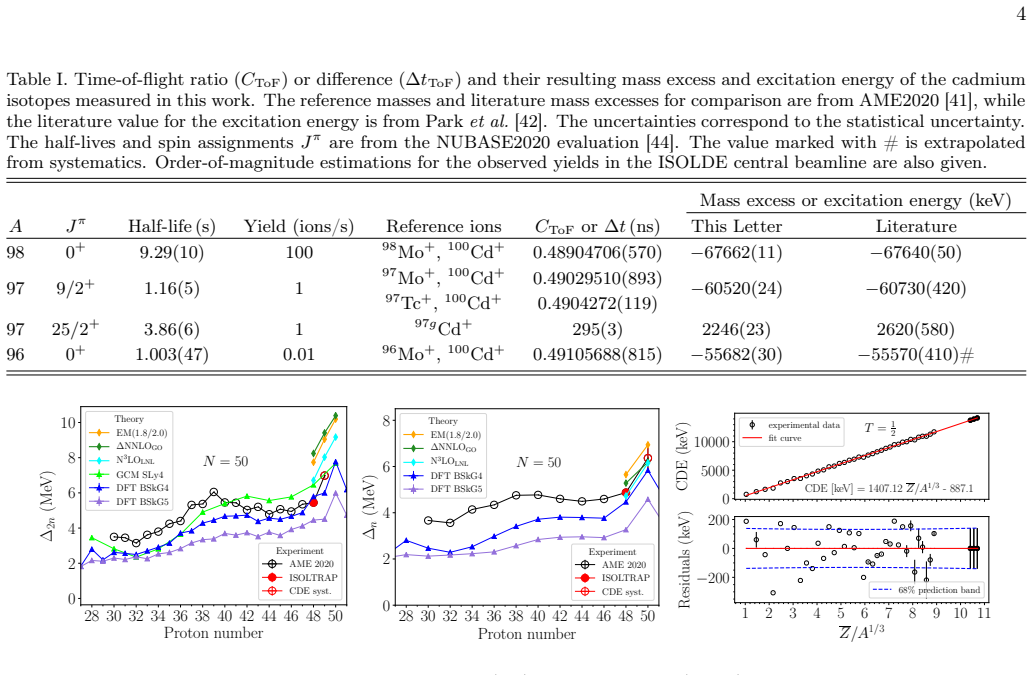
Precise binding-energy measurements of 96-98Cd allow the empirical N=50 shell gap to be determined at Z=48 for the first time. Coulomb Displacement Energy systematics are then used to infer the gap values at higher proton numbers, producing a tightly constrained mass surface in the 100Sn region. The data indicate an enhancement of the gap as Z increases toward 50, a trend that is placed in direct comparison with state-of-the-art theoretical calculations.
What carries the argument
Empirical shell gap extracted from mass differences, extended to higher-Z nuclei via Coulomb Displacement Energy systematics.
If this is right
- The mass surface near 100Sn is now more tightly bounded, reducing uncertainty in predictions for nearby nuclei.
- Theoretical models must reproduce an increasing rather than shrinking N=50 gap when moving from Z=48 to Z=50.
- Input for r-process calculations involving nuclei around tin-100 is improved.
- The excitation energy of the 25/2+ isomer in 97Cd is fixed, providing a new benchmark for nuclear structure calculations.
Where Pith is reading between the lines
- If the enhancement persists all the way to 100Sn, the nucleus may be more robustly magic than some models have assumed.
- Direct mass measurements of 99Cd or 100Sn would test the extrapolation without relying on Coulomb Displacement Energy assumptions.
- The observed trend may help discriminate between different parameterizations of energy-density functionals in the Z=50 region.
- Ab initio approaches that currently underpredict the gap size would need adjustments to the underlying nuclear interactions or many-body methods.
Load-bearing premise
Coulomb Displacement Energies can be extrapolated smoothly from the measured cadmium region to higher proton numbers without introducing large additional uncertainties.
What would settle it
A direct, high-precision mass measurement of 100Sn or 99In that yields a shell-gap value falling well outside the extrapolated trend band.
Figures

read the original abstract
We present the first determination of the $N = 50$ empirical shell gap at $Z = 48$ by precise mass measurements of the neutron-deficient cadmium isotopes $^{96-98}$Cd with the ISOLTRAP mass spectrometer at ISOLDE-CERN, including the first precise determination of the excitation energy of the $25/2^+$ isomer in $^{97}$Cd. Through the systematics of Coulomb Displacement Energies, we further deduce the empirical shell gap in the higher-$Z$ isotopic chains, tightly constraining the $^{100}$Sn mass-surface region. The new experimental data suggest an enhancement of the gap towards $^{100}$Sn, which is discussed in comparison to state-of-the-art calculations using energy-density functional and new ab initio approaches.
Editorial analysis
A structured set of objections, weighed in public.
Referee Report
Summary. The manuscript reports high-precision Penning-trap mass measurements of the neutron-deficient cadmium isotopes 96Cd, 97Cd and 98Cd performed with ISOLTRAP at ISOLDE-CERN. These data yield the first determination of the N=50 empirical shell gap at Z=48 together with the excitation energy of the 25/2+ isomer in 97Cd. Using established Coulomb Displacement Energy systematics the authors extrapolate the gap to the In (Z=49) and Sn (Z=50) chains, thereby constraining the mass surface around 100Sn. The results indicate an enhancement of the N=50 gap towards 100Sn that is compared with energy-density-functional and ab-initio calculations.
Significance. If the central claims hold, the work supplies the first experimental anchor for the N=50 gap at Z=48 and extends it to the 100Sn region via a standard extrapolation technique. Such constraints are valuable for testing shell-evolution predictions in a region where data remain sparse and for discriminating among modern EDF and ab-initio approaches.
major comments (1)
- [CDE systematics and deduced shell gaps] The claim of an enhanced N=50 gap towards 100Sn rests on the extrapolation of Coulomb Displacement Energies from the newly measured Z=48 Cd masses to Z=49 and Z=50. The manuscript does not provide a quantitative uncertainty budget or sensitivity analysis for possible Z-dependent deviations or additional model dependence in this step (see the section on CDE systematics and the deduced gaps). Because this extrapolation is load-bearing for the enhancement trend and the subsequent theory comparison, the additional uncertainties must be explicitly evaluated and propagated.
Simulated Author's Rebuttal
We thank the referee for the careful review and positive evaluation of the significance of our measurements. We address the single major comment below and will revise the manuscript to incorporate the requested analysis.
read point-by-point responses
-
Referee: The claim of an enhanced N=50 gap towards 100Sn rests on the extrapolation of Coulomb Displacement Energies from the newly measured Z=48 Cd masses to Z=49 and Z=50. The manuscript does not provide a quantitative uncertainty budget or sensitivity analysis for possible Z-dependent deviations or additional model dependence in this step (see the section on CDE systematics and the deduced gaps). Because this extrapolation is load-bearing for the enhancement trend and the subsequent theory comparison, the additional uncertainties must be explicitly evaluated and propagated.
Authors: We agree that an explicit quantitative uncertainty budget and sensitivity analysis for the CDE extrapolation would improve the robustness of the manuscript. Although the CDE approach follows established systematics used in prior works on this mass region, the current text does not detail possible Z-dependent deviations or propagate associated model uncertainties. In the revised version we will add a dedicated paragraph (or short subsection) that: (i) quantifies the uncertainty from the linear CDE fit to known data, (ii) tests sensitivity to alternative parametrizations reported in the literature, and (iii) propagates the resulting uncertainties to the extrapolated N=50 gaps at Z=49 and Z=50, including their effect on the trend toward 100Sn and on the theory comparisons. These additions will not alter the central experimental results or the qualitative conclusion of gap enhancement, but will make the extrapolation step fully transparent. revision: yes
Circularity Check
No significant circularity; derivation rests on direct measurements and external systematics
full rationale
The paper's core results are new experimental masses of 96-98Cd obtained with ISOLTRAP, from which the N=50 gap at Z=48 follows directly via standard binding-energy differences. Extension to Z=49 and Z=50 uses Coulomb Displacement Energy systematics drawn from prior literature, not redefined or fitted within this work. No equations or steps equate a claimed prediction to its own input by construction, and no load-bearing uniqueness theorem or ansatz is imported solely via self-citation. The comparison to EDF and ab initio models is an external benchmark, leaving the derivation chain self-contained against independent data.
Axiom & Free-Parameter Ledger
axioms (2)
- domain assumption Empirical shell gap can be extracted from differences in two-neutron separation energies derived from measured masses.
- domain assumption Coulomb Displacement Energy systematics remain valid for extrapolating the N=50 gap from Z=48 to higher Z up to 50.
Reference graph
Works this paper leans on
-
[1]
unknown isobars
(green triangles) and Density Functional Theory (DFT) [47, 48] (blue and violet triangles) using Skyrme interactions, as well as newab initiocalculations (in diamonds) using different chiral interactions in the valence-space in-medium similarity renormalization group (VS-IMSRG): EM(1.8/2.0) [49, 50] (orange),∆NNLOGO [51] (dark green) and N3LOLNL [52] (cya...
2020
-
[2]
T. Faestermann, M. Górska, and H. Grawe. The struc- ture of 100Snand neighbouring nuclei.Prog. Part. Nucl. Phys., 69:85–130, 2013. ISSN 0146-6410. doi: 10.1016/j.ppnp.2012.10.002
-
[3]
M. Górska. Trends in the Structure of Nuclei near 100Sn.Physics, 4(1):364–382, 2022. ISSN 2624-8174. doi:10.3390/physics4010024
-
[4]
T. D. Morris, J. Simonis, S. R. Stroberg, C. Stumpf, G. Hagen, J. D. Holt, G. R. Jansen, T. Papenbrock, R. Roth, and A. Schwenk. Structure of the Lightest Tin Isotopes.Phys. Rev. Lett., 120:152503, 2018. doi: 10.1103/PhysRevLett.120.152503
-
[5]
T. Miyagi, S.R. Stroberg, J.D. Holt, and N. Shimizu. Ab initiomultishell valence-space Hamiltonians and the island of inversion.Phys. Rev. C, 102:034320, Sep 2020. doi:10.1103/PhysRevC.102.034320
-
[6]
M. Mougeot, D. Atanasov, J. Karthein, R.N. Wolf, et al. Mass measurements of 99−101In challengeab initionu- clear theory of the nuclide 100Sn.Nat. Phys., 17(10): 1099–1103, 9 2021. doi:10.1038/s41567-021-01326-9
-
[7]
J. Karthein et al. Electromagnetic properties of indium isotopes illuminate the doubly magic character of100Sn. Nat. Phys., 20(11):1719–1725, 2024. doi:10.1038/s41567- 024-02612-y
-
[8]
Z. Ge, M. Reponen, et al. High-Precision Mass Measurements of Neutron Deficient Silver Isotopes Probe the Robustness of theN= 50Shell Clo- sure.Phys. Rev. Lett., 133:132503, Sep 2024. doi: 10.1103/PhysRevLett.133.132503
-
[9]
F.P. Gustafsson et al. Charge Radii Measurements of Exotic Tin Isotopes in the Proximity ofN= 50and N= 82.Phys. Rev. Lett., 135(22):222501, 2025. doi: 10.1103/wbdx-k3cd
-
[10]
L. Nies et al. Isomeric Excitation Energy for 99In m from Mass Spectrometry Reveals Constant Trend Next to Doubly Magic 100Sn.Phys. Rev. Lett., 131:022502, Jul 2023. doi:10.1103/PhysRevLett.131.022502
-
[11]
B. Maheshwari, P. Van Isacker, and P.M. Walker. Quan- tifying neutron-proton interactions inN= 51isotones: From the NEEC candidate93Moto 99Cd.Phys. Rev. C, 112:024308, Aug 2025. doi:10.1103/3knl-yywc
-
[12]
B. Cederwall et al. Evidence for a spin-aligned neutron– proton paired phase from the level structure of 92Pd. Nature, 469(7328):68–71, Jan2011. ISSN1476-4687. doi: 10.1038/nature09644
-
[13]
R.H. Cyburt, A.M. Amthor, A. Heger, E. Johnson, L. Keek, Z. Meisel, H. Schatz, and K. Smith. De- pendence of X-Ray Burst Models on Nuclear Reac- tion Rates.Astrophys. J., 830(2):55, oct 2016. doi: 10.3847/0004-637X/830/2/55
-
[14]
H. Schatz and W.-J. Ong. Dependence of X-Ray Burst Models on Nuclear Masses.Astrophys. J., 844(2):139, aug 2017. doi:10.3847/1538-4357/aa7de9
-
[15]
C.M. Ireland et al. Mass of 101Snand Bayesian ex- trapolations to the proton drip line.Phys. Rev. C, 113: L021302, Feb 2026. doi:10.1103/vck7-1c4t
-
[16]
Y.M. Xing et al. Isochronous mass measurements of neutron-deficient nuclei from 112Snprojectile fragmen- tation.Phys. Rev. C, 107:014304, Jan 2023. doi: 10.1103/PhysRevC.107.014304
-
[17]
L. Nies et al. Refining the nuclear mass surface with the mass of103Sn.Phys. Rev. C, 111:014315, Jan 2025. doi:10.1103/PhysRevC.111.014315
-
[18]
C.M. Ireland, F.M. Maier, et al. High-precision mass measurement of 103Snrestores smoothness of the mass surface.Phys. Rev. C, 111:014314, Jan 2025. doi: 7 10.1103/PhysRevC.111.014314
-
[19]
Lubos, J
D. Lubos, J. Park, T. Faestermann, R. Gernhäuser, R. Krücken, M. Lewitowicz, S. Nishimura, H. Sakurai, et al. Improved Value for the Gamow-Teller Strength of the 100SnBeta Decay.Phys. Rev. Lett., 122:222502, Jun
-
[20]
doi:10.1103/PhysRevLett.122.222502
-
[21]
C.B. Hinke et al. Superallowed Gamow–Teller de- cay of the doubly magic nucleus 100Sn.Nature, 486 (7403):341–345, Jun 2012. ISSN 1476-4687. doi: 10.1038/nature11116
-
[22]
W. Satuła, D.J. Dean, J. Gary, S. Mizutori, and W. Nazarewicz. On the origin of the Wigner energy. Phys. Lett. B, 407(2):103–109, 1997. ISSN 0370-2693. doi:10.1016/S0370-2693(97)00711-9
-
[23]
A. Mollaebrahimi, Ch. Hornung, T. Dickel, D. Aman- bayev, G. Kripko-Koncz, W.R. Plaß, et al. Study- ing Gamow-Teller transitions and the assignment of isomeric and ground states atN= 50.Phys. Lett. B, 839:137833, 2023. ISSN 0370-2693. doi: 10.1016/j.physletb.2023.137833
-
[24]
H. Hergert, S.K. Bogner, T.D. Morris, A. Schwenk, and K. Tsukiyama. The In-Medium Similarity Renormaliza- tion Group: A novelab initiomethod for nuclei.Phys. Rept., 621:165, 2016. doi:10.1016/j.physrep.2015.12.007
-
[25]
R. Catherall, W. Andreazza, M. Breitenfeldt, A. Dor- sival, G.J. Focker, T.P. Gharsa, T.J. Giles, J.-L. Grenard, F. Locci, P. Martins, S. Marzari, J. Schipper, A. Shornikov, and T. Stora. The ISOLDE facility.J. Phys. G: Nucl. and Part. Phys., 44(9):094002, aug 2017. doi:10.1088/1361-6471/aa7eba
-
[27]
The strong coupling constant: state of the art and the decade ahead,
V. Fedosseev, K. Chrysalidis, T. Day Goodacre, B. Marsh, S. Rothe, C. Seiffert, and K. Wendt. Ion beam production and study of radioactive isotopes with the laser ion source at ISOLDE.J. Phys. G: Nucl. and Part. Phys., 44(8):084006, jul 2017. doi:10.1088/1361- 6471/aa78e0
-
[28]
F. Herfurth, J. Dilling, A. Kellerbauer, G. Bollen, S. Henry, H.-J. Kluge, E. Lamour, D. Lunney, R.B. Moore, C. Scheidenberger, S. Schwarz, G. Sikler, and J. Szerypo. A linear radiofrequency ion trap for ac- cumulation, bunching, and emittance improvement of radioactive ion beams.Nucl. Instrum. Methods Phys. Res. A, 469(2):254–275, 2001. ISSN 0168-9002. d...
-
[29]
A. Kellerbauer, T. Kim, R.B. Moore, and P. Varfalvy. Buffer gas cooling of ion beams.Nucl. Instrum. Methods Phys. Res. A, 469(2):276–285, 2001. ISSN 0168-9002. doi:10.1016/S0168-9002(01)00286-8
-
[30]
Lunney and (on behalf of the ISOLTRAP Collabora- tion)
D. Lunney and (on behalf of the ISOLTRAP Collabora- tion). Extending and refining the nuclear mass surface with ISOLTRAP.J. Phys. G: Nucl. Part. Phys., 44(6): 064008, may 2017. doi:10.1088/1361-6471/aa6752
-
[31]
R.N. Wolf, F. Wienholtz, et al. ISOLTRAP’s multi- reflection time-of-flight mass separator/spectrometer. Int. J. Mass Spectrom., 349-350:123–133, 2013. ISSN 1387-3806. doi:10.1016/j.ijms.2013.03.020
-
[32]
R.N. Wolf, G. Marx, M. Rosenbusch, and L. Schweikhard. Static-mirror ion capture and time focusing for electrostatic ion-beam traps and multi-reflection time-of-flight mass analyzers by use of an in-trap potential lift.Int. J. Mass Spectrom., 313: 8–14, 3 2012. doi:10.1016/j.ijms.2011.12.006
-
[33]
F.Wienholtz, S.Kreim, M.Rosenbusch, L.Schweikhard, and R.N. Wolf. Mass-selective ion ejection from multi- reflection time-of-flight devices via a pulsed in-trap lift. Int. J. Mass Spectrom., 421:285–293, 10 2017. doi: 10.1016/J.IJMS.2017.07.016
-
[34]
F. Wienholtz et al. Masses of exotic calcium isotopes pin down nuclear forces.Nature, 498:346–349, 2013. doi: 10.1038/nature12226
-
[35]
S. Purushothaman, S. Ayet San Andrés, J. Bergmann, T. Dickel, J. Ebert, H. Geissel, C. Hornung, W.R. Plaß, C. Rappold, C. Scheidenberger, Y.K. Tanaka, and M.I. Yavor. Hyper-EMG: A new probability distribution function composed of Exponentially Modified Gaussian distributionstoanalyzeasymmetricpeakshapesinhigh- resolution time-of-flight mass spectrometry.I...
-
[36]
F. Wienholtz, K. Blaum, J. Karthein, D. Lunney, S. Malbrunot-Ettenauer, V. Manea, M. Mougeot, L. Schweikhard, T. Steinsberger, and R.N. Wolf. Im- proved stability of multi-reflection time-of-flight mass spectrometers through passive and active voltage sta- bilization.Nucl. Instrum. Methods Phys. Res. B, 463: 348–356, 1 2019. doi:10.1016/J.NIMB.2019.04.061
-
[37]
Schweiger et al
Ch. Schweiger et al. in preparation. 2026
2026
-
[38]
P. Fischer, S. Knauer, G. Marx, and L. Schweikhard. Non-isobaric time-of-flight correction for isobar resolv- ing in MR-ToF mass spectrometry.Int. J. Mass Spectrom., 432:44–51, 2018. ISSN 1387-3806. doi: 10.1016/j.ijms.2018.07.004
-
[39]
H. Dembinski and P. Ongmongkolkul et al. scikit- hep/iminuit. Dec 2020. doi:10.5281/zenodo.3949207
-
[40]
James and M
F. James and M. Roos. Minuit - A System for Func- tion Minimization and Analysis of the Parameter Errors and Correlations.Comput. Phys. Commun., 10:343–367,
-
[41]
doi:10.1016/0010-4655(75)90039-9
-
[42]
S. Nagy, K. Blaum, and R. Schuch.Trapped Charged Particles and Fundamental Interactions, volume 749 of Lecture Notes in Physics. Springer, Berlin, Heidelberg,
-
[43]
doi: 10.1007/978-3-540-77817-2
ISBN 978-3-540-77816-5 978-3-540-77817-2. doi: 10.1007/978-3-540-77817-2
-
[44]
R.T. Birge. The Calculation of Errors by the Method of Least Squares.Phys. Rev., 40:207–227, Apr 1932. doi: 10.1103/PhysRev.40.207
-
[45]
M. Wang, W.J. Huang, F.G. Kondev, G. Audi, and S. Naimi. The AME 2020 atomic mass evaluation (II). Tables, graphs and references.Chin. Phys. C, 45(3): 8 030003, mar 2021. doi:10.1088/1674-1137/abddaf
-
[46]
J. Park, R. Krücken, D. Lubos, R. Gernhäuser, M. Le- witowicz, S. Nishimura, et al. New and comprehen- siveβ- andβp-decay spectroscopy results in the vicin- ity of 100Sn.Phys. Rev. C, 99:034313, Mar 2019. doi: 10.1103/PhysRevC.99.034313
-
[47]
K. Ogawa. Shell-model calculations of high-spin isomers in neutron-deficient1g 9 2 -shell nuclei.Phys. Rev. C, 28: 958–960, Aug 1983. doi:10.1103/PhysRevC.28.958
-
[48]
Kondev, M
F.G. Kondev, M. Wang, W.J. Huang, S. Naimi, and G. Audi. The NUBASE2020 evaluation of nuclear physics properties.Chin. Phys. C, 45(3):030001, mar
-
[49]
doi:10.1088/1674-1137/abddae
-
[50]
V. Manea, J. Karthein, et al. First Glimpse of theN= 82Shell Closure belowZ= 50from Masses of Neutron-Rich Cadmium Isotopes and Iso- mers.Phys. Rev. Lett., 124:092502, Mar 2020. doi: 10.1103/PhysRevLett.124.092502
-
[51]
M. Bender, G.F. Bertsch, and P.-H. Heenen. Global study of quadrupole correlation effects.Phys. Rev. C, 73:034322, 2006. doi:10.1103/PhysRevC.73.034322
-
[52]
G. Grams, N.N. Shchechilin, A. Sánchez- Fernández, W. Ryssens, N. Chamel, and S. Goriely. Skyrme–Hartree–Fock–Bogoliubov mass models on a 3D mesh: IV. Improved description of the isospin depen- dence of pairing.Eur. Phys. J. A, 61(2):35–, feb 2025. ISSN 1434601X. doi:10.1140/epja/s10050-025-01503-x
-
[53]
G. Grams, W. Ryssens, A. Sánchez-Fernández, N.N. Shchechilin, L. González-Miret Zaragoza, P. Demol, N. Chamel, S. Goriely, and M. Bender. Skyrme-Hartree- Fock-Bogoliubov mass models on a 3D mesh: V. The N2LO extension of the Skyrme EDF, 2026. URLhttps: //arxiv.org/abs/2601.05968
-
[54]
Entem and R
D.R. Entem and R. Machleidt. Accurate charge- dependent nucleon-nucleon potential at fourth order of chiral perturbation theory.Phys. Rev. C, 68:041001, Oct
-
[55]
doi:10.1103/PhysRevC.68.041001
-
[56]
K. Hebeler, S.K. Bogner, R.J. Furnstahl, A. Nogga, and A. Schwenk. Improved nuclear matter calcula- tions from chiral low-momentum interactions.Phys. Rev. C, 83(3):031301, mar 2011. ISSN 0556-2813. doi: 10.1103/PhysRevC.83.031301
-
[57]
W.G. Jiang, A. Ekström, C. Forssén, G. Hagen, G.R. Jansen, and T. Papenbrock. Accurate bulk proper- ties of nuclei fromA= 2to∞from potentials with ∆isobars.Phys. Rev. C, 102:054301, Nov 2020. doi: 10.1103/PhysRevC.102.054301
-
[58]
V. Somà, P. Navrátil, F. Raimondi, C. Barbieri, and T. Duguet. Novel chiral Hamiltonian and observables in light and medium-mass nuclei.Phys. Rev. C, 101: 014318, Jan 2020. doi:10.1103/PhysRevC.101.014318
-
[59]
M. S. Antony, A. Pape, and J. Britz. Coulomb displace- ment energies between analog levels for3≤A≤239. At. Data Nucl. Data Tab., 66(1):1–63, 1997. ISSN 0092- 640X. doi:10.1006/adnd.1997.0740
-
[60]
Z. Hockenbery, T. Murböck, et al. Precision mass measurements of 74−76Srusing the multiple reflection time-of-flight mass spectrometer at TI- TAN.Phys. Rev. C, 111:014327, Jan 2025. doi: 10.1103/PhysRevC.111.014327
-
[61]
1998, NuPhA, 635, 231, doi: 10.1016/S0375-9474(98)00180-8
E. Chabanat, P. Bonche, P. Haensel, J. Meyer, and R. Schaeffer. A Skyrme parametrization from subnu- clear to neutron star densities Part II. Nuclei far from stabilities.Nucl. Phys. A, 635(1):231–256, 1998. ISSN 0375-9474. doi:10.1016/S0375-9474(98)00180-8
-
[62]
E. Epelbaum, H.-W. Hammer, and Ulf-G. Meißner. Modern Theory of Nuclear Forces.Rev. Mod. Phys., 81:1773, 2009. doi:10.1103/RevModPhys.81.1773
-
[63]
R. Machleidt and D.R. Entem. Chiral effective field the- ory and nuclear forces.Phys. Rep., 503:1–75, 2011. doi: 10.1016/j.physrep.2011.02.001
-
[64]
S.R. Stroberg, A. Calci, H. Hergert, J.D. Holt, S.K. Bogner, R. Roth, and A. Schwenk. Nucleus- Dependent Valence-Space Approach to Nuclear Struc- ture.Phys. Rev. Lett., 118:032502, Jan 2017. doi: 10.1103/PhysRevLett.118.032502
-
[65]
S.R. Stroberg, H. Hergert, S.K. Bogner, and J.D. Holt. Nonempirical Interactions for the Nuclear Shell Model: An Update.Annu. Rev. Nucl. Part. Sci., 69 (Volume 69, 2019):307–362, 2019. ISSN 1545-4134. doi: 10.1146/annurev-nucl-101917-021120
-
[66]
Simonis, S.R
J. Simonis, S.R. Stroberg, K. Hebeler, J.D. Holt, and A. Schwenk. Saturation with chiral interactions and con- sequences for finite nuclei.Phys. Rev. C, 96(1):014303,
-
[67]
doi:10.1103/PhysRevC.96.014303
-
[68]
E. Leistenschneider et al. Dawning of theN= 32Shell Closure Seen through Precision Mass Measurements of Neutron-Rich Titanium Isotopes.Phys. Rev. Lett., 120 (6):062503, 2018. doi:10.1103/PhysRevLett.120.062503
-
[69]
N. Shimizu, T. Mizusaki, Y. Utsuno, and Y. Tsun- oda. Thick-restart block Lanczos method for large- scale shell-model calculations.Comput. Phys. Com- mun., 244:372–384, 2019. ISSN 0010-4655. doi: 10.1016/j.cpc.2019.06.011
-
[70]
T. Miyagi, S.R. Stroberg, P. Navrátil, K. Hebeler, and J. D. Holt. Convergedab initiocalculations of heavy nuclei.Phys. Rev. C, 105(1):014302, 2022. doi: 10.1103/PhysRevC.105.014302
-
[71]
B.C. He and S.R. Stroberg. Factorized approximation to the in-medium similarity renormalization group IM- SRG(3).Phys. Rev. C, 110:044317, Oct 2024. doi: 10.1103/PhysRevC.110.044317
-
[72]
F. Hildenbrand, S. Elhatisari, Ulf-G. Meißner, H. Meyer, Z. Ren, A. Herten, and M. Bode. Lattice Calculation of the Sn Isotopes near the Proton Dripline.Phys. Rev. Lett., 136:062501, Feb 2026. doi:10.1103/n7nt-s64t
discussion (0)
Sign in with ORCID, Apple, or X to comment. Anyone can read and Pith papers without signing in.