Recognition: unknown
Phonon number relaxation in a 3D superfluid with a concave acoustic branch
Pith reviewed 2026-05-10 03:16 UTC · model grok-4.3
The pith
Five-phonon collisions drive the phonon gas from partial to full equilibrium in a superfluid with concave acoustic branch.
A machine-rendered reading of the paper's core claim, the machinery that carries it, and where it could break.
Core claim
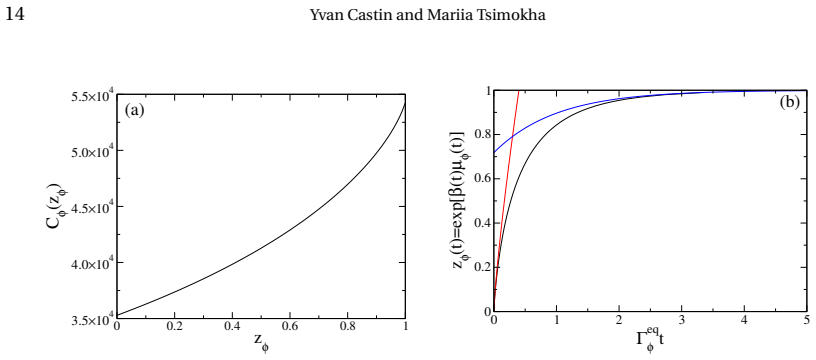
Using kinetic equations on the occupation numbers of the phonon modes and explicitly calculating the 2φ↔3φ collisional amplitude with quantum hydrodynamics at low temperature, the fugacity z_φ evolves from the non-degenerate regime z_φ=0^+ to complete equilibrium z_φ=1^-, varying with a non-integer power law ∝ t^{4/5} at short times and an exponential law at long times; the speed of change of entropy satisfies (dS_φ/dt) ∝ [(d z_φ/dt)]^2.
What carries the argument
The five-phonon collision processes 2φ ↔ 3φ whose amplitude is obtained from quantum hydrodynamics and inserted into the kinetic equations for phonon occupation numbers.
Load-bearing premise
The acoustic branch must stay concave at the thermally relevant wave-vectors so three-phonon processes remain forbidden while five-phonon processes occur, and quantum hydrodynamics must remain valid for the collision amplitude at arbitrarily low but nonzero temperature.
What would settle it
A time-resolved measurement of phonon population in a homogeneous superfluid showing that the fugacity does not grow initially as t to the 4/5, or that the relaxation time does not scale as T to the minus nine, would falsify the predicted dynamics.
Figures

read the original abstract
We consider the collisional evolution towards equilibrium of a spatially homogeneous and isotropic phonon gas of a three-dimensional superfluid with a concave acoustic excitation branch, at a non-zero but arbitrarily low temperature $T$. Three-phonon collisions $1\phi\leftrightarrow 2\phi$ are forbidden by conservation of energy-momentum. Four-phonon collisions $2\phi\to 2\phi$ of Landau and Khalatnikov lead, after a time $\propto T^{-7}$, only to a partial thermal equilibrium, a Bose law of non-zero chemical potential for the phonons, because they conserve the total number of phonons. Relaxation towards complete thermochemical equilibrium is therefore ensured by the much slower five-phonon collisions $2\phi\leftrightarrow 3\phi$ of Khalatnikov, in a time $\propto T^{-9}$. Using kinetic equations on the occupation numbers of the phonon modes and explicitly calculating the $2\phi\to 3\phi$ collisional amplitude with quantum hydrodynamics at low temperature, we determine the corresponding evolution of the fugacity $z_\phi$ of the phonon gas from the non-degenerate regime $z_\phi=0^+$ to complete equilibrium $z_\phi=1^-$. Using the conservation of total energy, we find that the fugacity varies with a non-integer power law $\propto t^{4/5}$ at short times and an exponential law at long times; the speed of change of entropy, always positive, is asymptotically proportional to the square of the speed of change of fugacity, $(\mathrm{d}/\mathrm{d}t)S_\phi\propto[(\mathrm{d}/\mathrm{d}t)z_\phi]^2$, as Landau predicted for an arbitrarily slow adiabatic transformation. Our results bring to a close the study initiated by Khalatnikov in 1950 and could be experimentally verified in a gas of cold fermionic atoms on the BCS side of the BEC-BCS crossover, or in superfluid liquid helium-4 at sufficiently high pressure.
Editorial analysis
A structured set of objections, weighed in public.
Referee Report
Summary. The manuscript derives the collisional relaxation of a homogeneous isotropic phonon gas in a 3D superfluid with concave acoustic dispersion at low but nonzero temperature. Three-phonon processes are kinematically forbidden; four-phonon processes reach only partial equilibrium with nonzero chemical potential. Five-phonon 2φ↔3φ processes, whose amplitude is computed explicitly from quantum hydrodynamics, drive the fugacity z_φ from near zero to near one. Using energy conservation to close the kinetic equation, the authors obtain z_φ(t) ∝ t^{4/5} at short times and exponential relaxation at long times, together with the relation dS_φ/dt ∝ (dz_φ/dt)^2.
Significance. If the hydrodynamic amplitude remains accurate over the relevant thermal wave-vectors, the work supplies the first explicit, parameter-free time dependence for the final stage of phonon thermalization, completing the program begun by Khalatnikov in 1950. The entropy-production identity confirms a general prediction of Landau for slow processes. The results are directly relevant to phonon kinetics in pressurized 4He and in the BCS regime of ultracold Fermi gases.
major comments (2)
- [Quantum-hydrodynamics amplitude calculation] Quantum-hydrodynamics section: the 2φ↔3φ matrix element is evaluated in the strict long-wavelength limit. The collision integral, however, receives contributions from phonons with |k| up to ~T. No estimate is supplied for the relative magnitude of k^2 (or higher) corrections to the vertex that arise from the gradient expansion or from microscopic corrections. Because these corrections would rescale the overall collision rate, they directly affect the prefactors in the short-time power law and the relaxation time, and could in principle alter the functional form if they become order-one.
- [Kinetic-equation setup and conservation laws] Dispersion and kinematic constraints: the assumption that the acoustic branch remains sufficiently concave to forbid all 1φ↔2φ processes while permitting 2φ↔3φ processes is stated but not quantified for the evolving non-equilibrium distribution at intermediate fugacity. A check that the effective dispersion (including possible self-energy shifts) preserves the required concavity throughout the trajectory from z_φ=0 to z_φ=1 is needed to justify the restriction to five-phonon processes.
minor comments (2)
- [Abstract] Abstract: the short-time scaling is described only as a 'non-integer power law'; stating the explicit exponent 4/5 would improve immediate readability.
- [Introduction] Notation: the fugacity z_φ is introduced without an explicit definition in terms of the chemical potential; a one-line reminder in the introduction would help readers unfamiliar with phonon kinetics.
Simulated Author's Rebuttal
We thank the referee for the careful reading, the positive summary, and the constructive major comments. We address each point below and have incorporated revisions to clarify the approximations and assumptions in the manuscript.
read point-by-point responses
-
Referee: Quantum-hydrodynamics section: the 2φ↔3φ matrix element is evaluated in the strict long-wavelength limit. The collision integral, however, receives contributions from phonons with |k| up to ~T. No estimate is supplied for the relative magnitude of k^2 (or higher) corrections to the vertex that arise from the gradient expansion or from microscopic corrections. Because these corrections would rescale the overall collision rate, they directly affect the prefactors in the short-time power law and the relaxation time, and could in principle alter the functional form if they become order-one.
Authors: We agree that an explicit discussion of higher-order corrections is useful. The long-wavelength limit is the leading term in the gradient expansion of quantum hydrodynamics, valid when thermal wave-vectors k ~ T/c_s are small compared with the inverse microscopic length (healing length or interparticle spacing). In the revised manuscript we have added a paragraph after Eq. (12) estimating the relative size of k^2 corrections as O((T/Δ)^2), where Δ is the characteristic microscopic energy (roton gap in 4He or pairing gap on the BCS side). This correction rescales the overall five-phonon rate but leaves the functional forms of z_φ(t) unchanged: the t^{4/5} power law follows from energy conservation and the phase-space scaling of the collision integral, while the late-time exponential follows from linearization around z_φ=1. Order-one corrections would require a fully microscopic vertex, which lies outside the hydrodynamic framework; we have noted this limitation. revision: partial
-
Referee: Dispersion and kinematic constraints: the assumption that the acoustic branch remains sufficiently concave to forbid all 1φ↔2φ processes while permitting 2φ↔3φ processes is stated but not quantified for the evolving non-equilibrium distribution at intermediate fugacity. A check that the effective dispersion (including possible self-energy shifts) preserves the required concavity throughout the trajectory from z_φ=0 to z_φ=1 is needed to justify the restriction to five-phonon processes.
Authors: The concavity is an input property of the superfluid dispersion at the pressures or interaction strengths considered. Throughout the evolution the four-phonon processes maintain a Bose distribution with time-dependent fugacity z_φ(t) and fixed temperature (set by energy conservation). Self-energy shifts arising from this distribution are O(T^2) or higher in the low-T hydrodynamic regime and do not reverse the sign of the curvature for the momenta that dominate the integrals. We have added a clarifying sentence in the paragraph following Eq. (3) stating that the kinematic constraints remain valid along the entire trajectory because the effective temperature stays low and the distribution never deviates far from a thermal form. A quantitative self-energy calculation for arbitrary z_φ would require a microscopic model beyond quantum hydrodynamics and is therefore not performed here. revision: partial
Circularity Check
No significant circularity; derivation self-contained from QHD and kinetic theory
full rationale
The paper explicitly computes the 2φ↔3φ matrix element from quantum hydrodynamics in the long-wavelength limit, substitutes it into the Boltzmann kinetic equations for the phonon distribution, and reduces the problem via energy-momentum conservation to a closed ODE for the fugacity z_φ. The short-time power-law t^{4/5} and long-time exponential relaxation, as well as the entropy-production relation, follow directly from this integration without any fitted parameters, self-definitional loops, or load-bearing self-citations. The concavity assumption and QHD validity are stated as external inputs rather than derived from the target result. No step reduces the claimed prediction to its own inputs by construction.
Axiom & Free-Parameter Ledger
axioms (2)
- domain assumption Concave acoustic branch forbids three-phonon processes by energy-momentum conservation
- domain assumption Quantum hydrodynamics supplies the correct low-T collision amplitude for five-phonon processes
Reference graph
Works this paper leans on
-
[3]
Amortissement des phonons dans un superfluide 2D : insuffisance de la règle d’or de Fermi à basse température
Y. Castin, A. Serafin, A. Sinatra, “ Amortissement des phonons dans un superfluide 2D : insuffisance de la règle d’or de Fermi à basse température”, Comptes Rendus. Physique 24 (2023), no. S3 (fr), p. 187-239, https://doi.org/10. 5802/crphys.169, English version “Phonon damping in a 2D superfluid: insufficiency of Fermi’ s golden rule at low temperature",...
2023
-
[4]
Landau, E
L. Landau, E. Lifchitz, Cours de Physique théorique tome IX - Physique statistique deuxième partie , Mir Editions, Moscow, 1990 (fr), volume written by E. Lifchitz and L. Pitayevski
1990
-
[5]
Teoriya vyazkosti Geliya-II
L. Landau, I. Khalatnikov, “Teoriya vyazkosti Geliya-II”, Zh. Eksp. Teor . Fiz. 19 (1949), p. 637, English version in Collected papers of L.D. Landau, chapitre 69, p.494, édité par D. ter Haar (Pergamon, New York, 1965)
1949
-
[12]
Pogloshcheniye zvuka v gelii II
I. Khalatnikov, “Pogloshcheniye zvuka v gelii II”, Zh. Eksp. Teor . Fiz.20 (1950) (ru), p. 243-266
1950
-
[13]
Étalement de la phase et cohérence temporelle d’un gaz de fermions condensé par paires à basse température
Y. Castin, “Étalement de la phase et cohérence temporelle d’un gaz de fermions condensé par paires à basse température”, Comptes Rendus. Physique 20 (2019), no. 6 (fr), p. 540-568, English version “Phase spreading and temporal coherence of a pair-condensed Fermi gas at low temperature", hal-01849311 v2 (2019)
2019
-
[15]
Excitation Spectrum and Superfluid Gap of an Ultracold Fermi Gas
H. Biss, L. Sobirey, N. Luick, M. Bohlen, J. Kinnunen, G. Bruun, T . Lompe, H. Moritz, “Excitation Spectrum and Superfluid Gap of an Ultracold Fermi Gas”, Phys. Rev. Lett. 128 (2022) (en), p. 100401, https://doi.org/10.1103/ PhysRevLett.128.100401. Yvan Castin and Mariia Tsimokha 31
2022
-
[20]
Landau, E
L. Landau, E. Lifchitz, Cours de Physique théorique tome V - Physique statistique première partie , Mir Editions, Moscow, 1984 (fr), Third edition completed by E. Lifchitz and L. Pitayevski
1984
-
[24]
Présentation du problème . . . . . . . . . . . . . . . . . . . . . . . . . . . . . . . . . . . . . . . . . . . . . . . . . . . . . . . . . . . 2
-
[25]
Équations cinétiques pour les collisions 2 φ ↔ 3φ et première expression de (d/dt)Nφ . . . . 4
-
[26]
Amplitude de collision 2 φ → 3φ et expression de (d/dt)Nφ à basse température . . . . . . . . . . 6
-
[27]
11 Annexe A
Cinétique de relaxation de la fugacité des phonons. . . . . . . . . . . . . . . . . . . . . . . . . . . . . . . . . . . . . 11 Annexe A. La règle d’or de Fermi généralisée . . . . . . . . . . . . . . . . . . . . . . . . . . . . . . . . . . . . . . . . . . . . . 14 A.1. Une subtilité de l’ordre sous-dominant . . . . . . . . . . . . . . . . . . . . . . . . ...
-
[28]
Présentation du problème Considérons un système tridimensionnel isolé de particules bosoniques ou fermioniques en in- teraction à courte portée, spatialement homogène dans la boîte de quantification arbitrairement grande [0, L]3, entièrement superfluide dans son état fondamental et admettant comme seule branche d’excitation sans bande interdite la branche...
-
[29]
Équations cinétiques pour les collisions 2φ ↔ 3φ et première expression de (d/dt)Nφ Écrivons, suivant la procédure habituelle (celle par exemple de la section 6.3.2.2 de [19]), les équations cinétiques (ou de taux ou de Boltzmann quantiques) donnant l’évolution du nombre de phonons nq1 du fluide dans le mode de vecteur d’onde q1 sous l’effet des collision...
-
[30]
Nous menons ici notre calcul à l’ordre dominant en température
Amplitude de collision 2φ → 3φ et expression de (d/dt)Nφ à basse température L ’ingrédient manquant dans l’expression (11) de la dérivée temporelle du nombre de phonons est l’amplitude de collision 2 φ → 3φ entre les phonons thermiques, c’est-à-dire l’amplitude de transition Ai→ f entre l’état initial à deux phonons |i〉 = |q1, q2〉et l’état final à trois p...
-
[31]
+ O(ϵ4 ln ϵ) ] (27) Seul le nombre d’onde réduit ¯k3 est inconnu, mais il s’obtient aisément à l’ordreϵ2 en prenant la norme du premier et du second membre de l’équation (7), avec l’astuce d’écriture exploitant le fait qu’on a q1 + q2 > k1 + k2 lorsque tous les vecteurs entrants et sortants sont quasi colinéaires et de même sens : k3 = (q1 + q2 − k1 − k2)...
-
[32]
Nous ne disposons que d’une seule équation d’évolution, celle (38) sur le nombre total de phonons Nφ
Cinétique de relaxation de la fugacité des phonons La loi de Bose (2) fait intervenir deux variables dépendant du temps, la température T (t) et la fugacité des phonons zφ(t) = exp(β(t)µ φ(t)) où µ φ(t) est le potentiel chimique des phonons. Nous ne disposons que d’une seule équation d’évolution, celle (38) sur le nombre total de phonons Nφ. Une seconde é...
-
[33]
− X ′ 0 ln(−X0) X0 − X ′ 0 1 b1b2a3a4 ] (135) en commettant une erreur qui tend vers zéro avec ( a2 1 + a2 2)1/2. Ici, X0 = − b1/a1 et X ′ 0 = −b2/a2 sont une approximation des pôles divergents dans la fraction rationnelle originelle R8(X ), et la fonction F6(X ) est la primitive de R6(X ) donnée par l’équation (130) après décomposition de R6(X ) en éléme...
-
[34]
D. Son, M. Wingate, « General coordinate invariance and conformal invariance in nonrelativistic physics : Unitary Fermi gas », Annals of Physics 321 (2006), no 1 (en), p. 197-224, https://doi.org/10.1016/j.aop.2005.11.001
-
[35]
M. A. Escobedo, C. Manuel, « Effective field theory and dispersion law of the phonons of a nonrelativistic superfluid », Phys. Rev. A 82 (2010) (en), p. 023614, https://doi.org/10.1103/PhysRevA.82.023614. 24Choisissons pour cela une coupure Λ beaucoup plus grande que l’unité et que les pôles bornés Xi ,1 ≤ i ≤ 6 de R8(X ), qui peuvent être approximés par ...
-
[36]
Phonon damping in a 2D superfluid: insufficiency of Fermi’ s golden rule at low temperature
Y. Castin, A. Serafin, A. Sinatra, « Amortissement des phonons dans un superfluide 2D : insuffisance de la règle d’or de Fermi à basse température », Comptes Rendus. Physique 24 (2023), n o S3 (fr), p. 187-239, https://doi.org/ 10.5802/crphys.169, version anglaise “Phonon damping in a 2D superfluid: insufficiency of Fermi’ s golden rule at low temperature...
-
[37]
Landau, E
L. Landau, E. Lifchitz, Cours de Physique théorique tome IX - Physique statistique deuxième partie , Éditions Mir, Moscou, 1990 (fr), tome rédigé par E. Lifchitz et L. Pitayevski
1990
-
[38]
Landau, I
L. Landau, I. Khalatnikov, « Teoriya vyazkosti Geliya-II », Zh. Eksp. Teor . Fiz.19 (1949), p. 637, version anglaise dans Collected papers of L.D. Landau, chapitre 69, p.494, édité par D. ter Haar (Pergamon, New York, 1965)
1949
-
[39]
Y. Castin, « Questions ouvertes pour les gaz de fermions en interaction forte et de portée nulle/Open questions for strongly interacting Fermi gases with zero-range interactions », Comptes Rendus. Physique 26 (2025) (fr/en), p. 393- 461, https://doi.org/10.5802/crphys.244
-
[40]
H. J. Maris, « Phonon-phonon interactions in liquid helium », Rev. Mod. Phys. 49 (1977) (en), p. 341-359, https: //doi.org/10.1103/RevModPhys.49.341
-
[41]
H. Kurkjian, Y. Castin, A. Sinatra, « Three-phonon and four-phonon interaction processes in a pair-condensed Fermi gas », Annalen der Physik 529 (2017) (en), p. 1600352, https://doi.org/10.1002/andp.201600352, version française : « Processus d’interaction à trois et quatre phonons dans un gaz de fermions condensé par paires », hal-01392846 v3 (2017)
-
[42]
Khalatnikov, An Introduction to the Theory of Superfluidity, CRC Press-Taylor & Francis, Boca Raton, 2018 (en)
I. Khalatnikov, An Introduction to the Theory of Superfluidity, CRC Press-Taylor & Francis, Boca Raton, 2018 (en)
2018
-
[43]
P . B. Patel, Z. Yan, B. Mukherjee, R. J. Fletcher, J. Struck, M. W . Zwierlein, « Universal sound diffusion in a strongly interacting Fermi gas », Science 370 (2020), no 6521 (en), p. 1222-1226, https://doi.org/10.1126/science.aaz5756
-
[44]
H. Kurkjian, Y. Castin, A. Sinatra, « Landau-Khalatnikov phonon damping in strongly interacting Fermi gases », Europhysics Letters 116 (2016), no 4 (en), p. 40002, https://doi.org/10.1209/0295-5075/116/40002
-
[45]
Khalatnikov, « Pogloshcheniye zvuka v gelii II », Zh
I. Khalatnikov, « Pogloshcheniye zvuka v gelii II », Zh. Eksp. Teor . Fiz.20 (1950) (ru), p. 243-266
1950
-
[46]
Phase spreading and temporal coherence of a pair-condensed Fermi gas at low temperature
Y. Castin, « Étalement de la phase et cohérence temporelle d’un gaz de fermions condensé par paires à basse température », Comptes Rendus. Physique 20 (2019), n o 6 (fr), p. 540-568, version anglaise “Phase spreading and temporal coherence of a pair-condensed Fermi gas at low temperature", hal-01849311 v2 (2019)
2019
-
[47]
H. Kurkjian, Y. Castin, A. Sinatra, « Concavity of the collective excitation branch of a Fermi gas in the BEC-BCS crossover », Phys. Rev. A 93 (2016) (en), p. 013623, https://doi.org/10.1103/PhysRevA.93.013623, version française : « Concavité de la branche d’excitation collective d’un gaz de fermions dans la zone de raccordement CBE-BCS », hal-01228798 v2 (2016)
-
[48]
H. Biss, L. Sobirey, N. Luick, M. Bohlen, J. Kinnunen, G. Bruun, T . Lompe, H. Moritz, « Excitation Spectrum and Superfluid Gap of an Ultracold Fermi Gas », Phys. Rev. Lett. 128 (2022) (en), p. 100401, https://doi.org/10.1103/ PhysRevLett.128.100401
2022
-
[49]
Excitation Spectrum and Superfluid Gap of an Ultracold Fermi Gas
Y. Castin, « Comment on “Excitation Spectrum and Superfluid Gap of an Ultracold Fermi Gas” », Phys. Rev. Lett. 133 (2024) (en), p. 109301, https://doi.org/10.1103/PhysRevLett.133.109301, version française : « Commentaire sur “Excitation Spectrum and Superfluid Gap of an Ultracold Fermi Gas” », hal-04336110 (2024)
-
[50]
E. C. Svensson, A. D. B. Woods, P . Martel, « Phonon Dispersion in Liquid Helium under Pressure »,Phys. Rev. Lett. 29 (1972) (en), p. 1148-1149, https://doi.org/10.1103/PhysRevLett.29.1148
-
[51]
D. Rugar, J. S. Foster, « Accurate measurement of low-energy phonon dispersion in liquid4He »,Phys. Rev. B30 (1984) (en), p. 2595-2602, https://doi.org/10.1103/PhysRevB.30.2595
-
[52]
Castin, Condensats de Bose-Einstein – La théorie, des fondements aux applications, Tome II , EDP Sciences/CNRS Éditions, Les Ulis/Paris, 2025 (fr)
Y. Castin, Condensats de Bose-Einstein – La théorie, des fondements aux applications, Tome II , EDP Sciences/CNRS Éditions, Les Ulis/Paris, 2025 (fr)
2025
-
[53]
Landau, E
L. Landau, E. Lifchitz, Cours de Physique théorique tome V - Physique statistique première partie , Éditions Mir, Moscou, 1984 (fr), troisième édition complétée par E. Lifchitz et L. Pitayevski
1984
-
[54]
Cohen-Tannoudji, J
C. Cohen-Tannoudji, J. Dupont-Roc, G. Grynberg, Processus d’interaction entre photons et atomes , InterEdi- tions/Editions du CNRS, Paris, 1988 (fr)
1988
-
[55]
Random walk of a massive quasiparticle in the phonon gas of an ultralow temperature superfluid
Y. Castin, « Marche au hasard d’une quasi-particule massive dans le gaz de phonons d’un superfluide à très basse température », Comptes Rendus. Physique 21 (2020), no 6 (fr), p. 571-618, https://doi.org/10.5802/crphys.37, version anglaise “Random walk of a massive quasiparticle in the phonon gas of an ultralow temperature superfluid", hal- 02895083 v2 (2021)
-
[56]
I. N. Adamenko, Y. A. Kitsenko, K. E. Nemchenko, A. F . G. Wyatt, « Theory of scattering between two phonon beams in superfluid helium », Phys. Rev. B 80 (2009) (en), p. 014509, https://doi.org/10.1103/PhysRevB.80.014509
discussion (0)
Sign in with ORCID, Apple, or X to comment. Anyone can read and Pith papers without signing in.