Recognition: unknown
Pseudo-Substitutability: A Maximal Domain for Pairwise Stability in Matching Markets with Contracts
Pith reviewed 2026-05-10 03:14 UTC · model grok-4.3
The pith
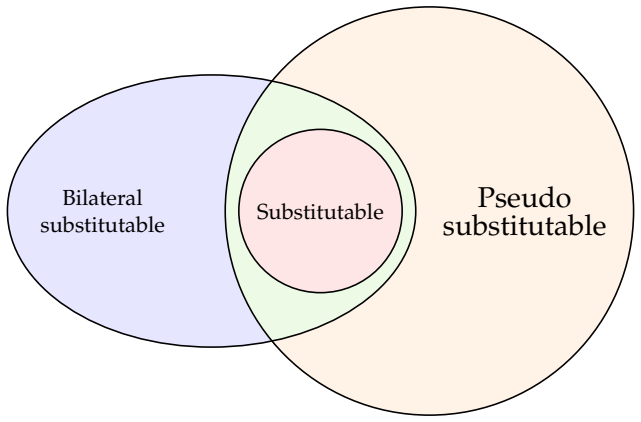
Pseudo-substitutable preferences form the maximal domain containing substitutability that guarantees pairwise stable allocations.
A machine-rendered reading of the paper's core claim, the machinery that carries it, and where it could break.
Core claim
Pseudo-substitutable preferences strictly extend the substitutable domain while still ensuring the existence of pairwise stable allocations in matching markets with contracts. The domain is maximal among all domains containing substitutability for which pairwise stability is guaranteed to exist.
What carries the argument
The pseudo-substitutability restriction on preferences, which permits limited complementarities without destroying the properties that support pairwise stability.
Load-bearing premise
The particular way pseudo-substitutability is defined captures exactly the largest possible addition of complementarities without creating profiles that lack pairwise stable allocations.
What would settle it
A concrete preference profile that is pseudo-substitutable yet has no pairwise stable allocation, or a strictly larger domain containing substitutability where stable allocations always exist.
Figures


read the original abstract
We study the existence of pairwise stable allocations in matching markets with contracts and propose a domain restriction that guarantees their existence. Specifically, we define pseudo-substitutable preferences, a domain that strictly extends the classical notion of substitutability while still preserving the existence of pairwise stable allocations. This domain accommodates limited complementarities among contracts while retaining enough structure to preserve the key stability properties of substitutable preferences. Moreover, we show that, among all preference domains that contain the classical substitutable domain and guarantee the existence of pairwise stable allocations, the pseudo-substitutable domain is maximal. Our results establish that pairwise stability extends well beyond the classical substitutable domain.
Editorial analysis
A structured set of objections, weighed in public.
Referee Report
Summary. The paper defines pseudo-substitutable preferences over contracts in matching markets, a domain that strictly contains the classical substitutable preferences while permitting limited complementarities. It proves existence of pairwise stable allocations for any market in which all agents have pseudo-substitutable preferences and shows maximality: for any preference relation that violates pseudo-substitutability, there exists a market (with all other agents having substitutable preferences) that admits no pairwise stable allocation. Thus the pseudo-substitutable domain is the largest domain containing substitutability that guarantees pairwise stability.
Significance. If the results hold, the paper supplies a sharp, maximal domain characterization for pairwise stability in markets with contracts. This extends the classical substitutability result in a controlled way and supplies explicit counterexample constructions that delineate the boundary. Such a tight characterization is valuable for theoretical work on stability and for applied market design where agents may exhibit mild complementarities.
minor comments (3)
- The abstract and introduction would benefit from explicit theorem numbers for the existence and maximality results so that readers can locate the formal statements immediately.
- An illustrative example early in the paper (perhaps in Section 3) showing a preference that is pseudo-substitutable but not substitutable would help readers grasp the limited complementarities allowed by the new domain.
- The maximality construction in the final section relies on a specific profile for each violating preference; a brief discussion of whether the construction can be made uniform across all violations would improve readability.
Simulated Author's Rebuttal
We thank the referee for the positive summary, significance assessment, and recommendation of minor revision. No specific major comments were provided in the report, so there are no individual points requiring detailed rebuttal or revision at this stage. We will address any editorial or minor suggestions from the editor in the revised manuscript.
Circularity Check
No significant circularity detected
full rationale
The paper introduces the pseudo-substitutable preference domain as a strict extension of the classical substitutable domain, proves that pairwise stable allocations exist under this domain, and establishes maximality by explicit counterexample construction: for any preference profile violating pseudo-substitutability, a market is built (with remaining agents holding substitutable preferences) that admits no pairwise stable allocation. This is a standard domain-characterization argument relying on definitions and direct logical constructions rather than any self-referential reduction, fitted parameters renamed as predictions, or load-bearing self-citations. The derivation chain is self-contained with independent steps from domain definition to existence theorem to maximality proof.
Axiom & Free-Parameter Ledger
axioms (1)
- domain assumption Agents have preferences over sets of contracts in a matching market
Reference graph
Works this paper leans on
-
[1]
Aizerman, M. and A. Malishevski (1981): General theory of best variants choice: Some aspects, IEEE Transactions on Automatic Control, 26, 1030--1040
1981
-
[2]
(2002): A class of multipartner matching markets with a strong lattice structure, Economic Theory, 19, 737--746
Alkan, A. (2002): A class of multipartner matching markets with a strong lattice structure, Economic Theory, 19, 737--746
2002
-
[3]
Bando, K. and T. Hirai (2025): Substitutes for Nonunitary Many-to-Many Matching with Contracts, SSRN working paper
2025
-
[4]
Hirai, and J
Bando, K., T. Hirai, and J. Zhang (2021): Substitutes and Stability for Many-to-Many Matching with Contracts, Games and Economic Behavior, 129, 263--290
2021
-
[5]
(1988): The lattice structure of the set of stable matchings with multiple partners, Mathematics of Operations Research, 13, 619--628
Blair, C. (1988): The lattice structure of the set of stable matchings with multiple partners, Mathematics of Operations Research, 13, 619--628
1988
-
[6]
Chambers, C. P. and M. B. Yenmez (2017): Choice and matching, American Economic Journal: Microeconomics, 9, 126--147
2017
-
[7]
Echenique, F. and J. Oviedo (2006): A theory of stability in many-to-many matching markets, Theoretical Economics, 1, 233--273
2006
-
[8]
Hatfield, J. W. and F. Kojima (2008): Matching with contracts: Comment, American Economic Review, 98, 1189--1194
2008
-
[9]
--- -.1pt --- -.1pt --- (2010): Substitutes and Stability for Matching with Contracts, Journal of Economic Theory, 145, 1704--1723
2010
-
[10]
Hatfield, J. W. and S. D. Kominers (2017): Contract Design and Stability in Many-to-Many Matching, Games and Economic Behavior, 101, 78--97
2017
-
[11]
--- -.1pt --- -.1pt --- (2019): Hidden Substitutes, Working paper
2019
-
[12]
--- -.1pt --- -.1pt --- (2025): The Theory of Matching with Contracts, Journal of Economic Literature, forthcoming
2025
-
[13]
Hatfield, J. W., S. D. Kominers, and A. Westkamp (2021): Stability, Strategy-Proofness, and Cumulative Offer Mechanisms, Review of Economic Studies, 88, 1457--1502
2021
-
[14]
Hatfield, J. W. and P. R. Milgrom (2005): Matching with Contracts, American Economic Review, 95, 913--935
2005
-
[15]
Kadam, S. V. (2017): Unilateral Substitutability Implies Substitutable Completability in Many-to-One Matching with Contracts, Games and Economic Behavior, 102, 56--68
2017
-
[16]
Kelso, A. and V. Crawford (1982): Job matching, coalition formation, and gross substitutes, Econometrica, 50, 1483--1504
1982
-
[17]
Klaus, B. and F. Klijn (2005): Stable Matchings and Preferences of Couples, Journal of Economic Theory, 121, 75--106
2005
-
[18]
Klaus, B. and M. Walzl (2009): Stable many-to-many matchings with contracts, Journal of Mathematical Economics, 45, 422--434
2009
-
[19]
Kominers, S. D. (2012): On the correspondence of contracts to salaries in (many-to-many) matching, Games and Economic Behavior, 75, 984--989
2012
-
[20]
Kominers, S. D. and T. S \"o nmez (2016): Matching with Slot-Specific Priorities: Theory, Theoretical Economics, 11, 683--710
2016
-
[21]
Mass \'o , A
Mart \' nez, R., J. Mass \'o , A. Neme, and J. Oviedo (2008): On the invariance of the set of stable matchings with respect to substitutable preference profiles, International Journal of Game Theory, 36, 497--518
2008
-
[22]
(2016): Matching with Contracts, Substitutes and Two-Unit Demand, Economics Letters, 146, 85--88
Tello, B. (2016): Matching with Contracts, Substitutes and Two-Unit Demand, Economics Letters, 146, 85--88
2016
-
[23]
Yenmez, M. B. (2018): A College Admissions Clearinghouse, Journal of Economic Theory, 176, 428--460
2018
-
[24]
(2016): On Sufficient Conditions for the Existence of Stable Matchings with Contracts, Economics Letters, 145, 230--234
Zhang, J. (2016): On Sufficient Conditions for the Existence of Stable Matchings with Contracts, Economics Letters, 145, 230--234
2016
discussion (0)
Sign in with ORCID, Apple, or X to comment. Anyone can read and Pith papers without signing in.