Recognition: unknown
Correcting radar meteor fluxes for observing biases
Pith reviewed 2026-05-10 03:40 UTC · model grok-4.3
The pith
Simultaneous optical and radar meteor observations show current radar flux corrections overcorrect mid-velocity showers and undercorrect high-velocity ones.
A machine-rendered reading of the paper's core claim, the machinery that carries it, and where it could break.
Core claim
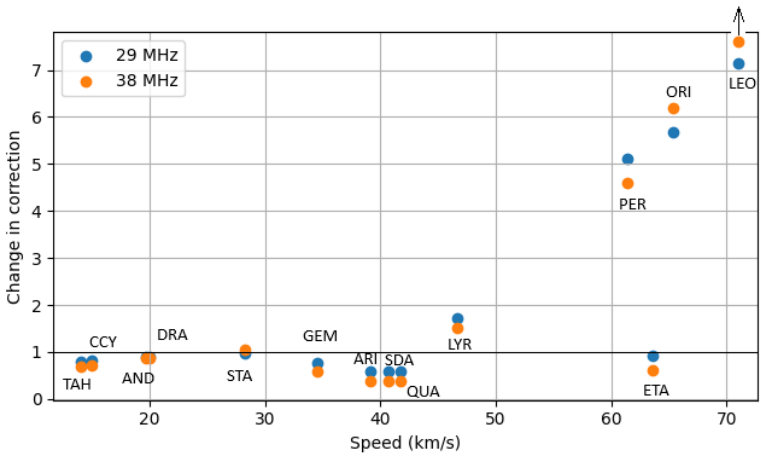
The optical height distributions for six velocity bins spanning 10-72 km/s were used to determine the fraction of potential radar echoes observed for meteors with higher and lower begin heights. When compared to the correction factors currently used in calculating shower fluxes with CMOR, mid-velocity showers such as the Geminids and South Delta Aquariids are found to have been overcorrected, while high velocity showers like the Perseids and Leonids are significantly undercorrected.
What carries the argument
Optical height distributions in velocity bins that calculate the fraction of radar echoes missed due to begin heights outside the EMCCD detection range.
If this is right
- Fluxes for mid-velocity showers such as the Geminids will be reduced when using the new corrections.
- Fluxes for high-velocity showers such as the Perseids and Leonids will be increased.
- The revised corrections apply specifically to the CMOR radar at 29 and 38 MHz.
- These changes affect estimates of meteoroid mass influx from different velocity populations.
Where Pith is reading between the lines
- Applying these corrections to other radar meteor surveys could improve consistency across datasets.
- The velocity-dependent bias suggests that radar detection efficiency changes with meteor speed due to height of ablation.
- Longer-term monitoring could test if these correction factors remain stable over time or with solar cycle.
Load-bearing premise
The EMCCD-detected meteors above +7 magnitude represent the population that produces specular radar echoes, with their height distributions accurately showing the missed fraction at higher and lower begin heights.
What would settle it
Recomputing shower fluxes with the new corrections and comparing them to independent flux measurements from other instruments or methods for the Geminids, Perseids, and similar showers.
Figures




read the original abstract
We report on an eight year survey of simultaneous optical and radar meteor detections with the goal of isolating the fraction of meteors missed by specular radars. A total of 10,503 Electron Multiplied Charge Couple Device (EMCCD) meteors with peak brightness above +7 were simultaneously detected by the Canadian Meteor Orbit Radar (CMOR) and used to estimate the fraction of radar echoes missed as a function of speed and height. During the time period that our cameras were recording, we found some 34,119 and 18,008 meteor echoes in total occurred within the field of view of the EMCCD cameras at 29 and 38 MHz respectively. This demonstrated that a significant fraction of the specular radar echoes remain below the detection threshold of the EMCCD cameras. We used these data to derive corrections for radar-specific observing biases. The optical height distributions for six velocity bins, spanning 10 - 72 km/s were used to determine the fraction of potential radar echoes which are observed for meteors with higher begin heights ($k_c$>96) and for those with lower begin heights. When compared to the correction factors currently used in calculating shower fluxes with CMOR, mid-velocity showers such as the Geminids and South Delta Aquariids are found to have been overcorrected, while high velocity showers like the Perseids and Leonids are significantly undercorrected.
Editorial analysis
A structured set of objections, weighed in public.
Referee Report
Summary. The paper reports an eight-year survey of 10,503 simultaneous EMCCD optical and CMOR radar meteor detections (with 34,119 and 18,008 total radar echoes in the camera FOV at 29 and 38 MHz). It derives new radar bias corrections from the begin-height distributions of these matched meteors, binned into six velocity intervals (10–72 km/s), to estimate the fraction of potential specular echoes missed at high and low begin heights (kc > 96). The resulting corrections are compared to those currently used for CMOR shower fluxes, concluding that mid-velocity showers (Geminids, South Delta Aquariids) have been overcorrected while high-velocity showers (Perseids, Leonids) have been significantly undercorrected.
Significance. If the derived corrections hold, they would revise meteoroid flux estimates for major showers, improving the accuracy of radar-based studies of stream structure, mass distributions, and solar-system dynamics. The work provides a direct empirical basis for bias corrections using a large simultaneous dataset, which is a strength relative to purely modeled approaches.
major comments (2)
- [Abstract and results (height-distribution analysis)] The central claim that the new corrections are more accurate than existing CMOR factors rests on the assumption that the height distributions of EMCCD meteors (peak brightness > +7) are representative of the full population capable of producing detectable specular radar echoes. This is not validated against independent datasets or radar-only samples, and the abstract provides no error bars or statistical methods for the missed-fraction estimates in each velocity bin.
- [Results section (velocity-binned corrections)] The comparison to existing CMOR corrections (overcorrection for Geminids/SDA, undercorrection for Perseids/Leonids) is load-bearing for the paper's main conclusion, yet the manuscript does not quantify uncertainties in the binned fractions or test sensitivity to the choice of velocity bin boundaries or the kc > 96 threshold.
minor comments (2)
- [Abstract] The abstract states concrete counts (10,503 matched meteors) but does not specify the exact time overlap or selection criteria for 'simultaneous' detections; this should be clarified with a methods subsection or table.
- [Methods] Notation for begin height (kc) and the definition of 'potential radar echoes' should be introduced with an equation or explicit formula in the methods to avoid ambiguity when readers compare to prior CMOR work.
Simulated Author's Rebuttal
We thank the referee for their constructive and detailed review of our manuscript. We address each major comment below and describe the revisions that will be made to improve the statistical presentation and discussion of assumptions.
read point-by-point responses
-
Referee: [Abstract and results (height-distribution analysis)] The central claim that the new corrections are more accurate than existing CMOR factors rests on the assumption that the height distributions of EMCCD meteors (peak brightness > +7) are representative of the full population capable of producing detectable specular radar echoes. This is not validated against independent datasets or radar-only samples, and the abstract provides no error bars or statistical methods for the missed-fraction estimates in each velocity bin.
Authors: The simultaneous detections provide direct empirical height distributions specifically for meteors that produce both optical and radar signatures, which forms the basis for estimating the missed specular fraction. We acknowledge that this sample does not encompass radar-only events and that external validation against independent datasets is not feasible with the current observations. We will revise the abstract to include error bars on the missed-fraction values per velocity bin and briefly describe the statistical approach (velocity binning of begin heights and fraction calculation for kc > 96). A dedicated paragraph on assumptions, limitations, and potential selection effects will be added to the results section. revision: partial
-
Referee: [Results section (velocity-binned corrections)] The comparison to existing CMOR corrections (overcorrection for Geminids/SDA, undercorrection for Perseids/Leonids) is load-bearing for the paper's main conclusion, yet the manuscript does not quantify uncertainties in the binned fractions or test sensitivity to the choice of velocity bin boundaries or the kc > 96 threshold.
Authors: We agree that explicit uncertainty quantification and sensitivity testing are needed to support the comparisons. In the revised manuscript we will add bootstrap-derived or binomial confidence intervals to the binned missed-fraction estimates. We will also perform and report sensitivity tests by re-deriving the corrections under alternative velocity bin boundaries and kc threshold values near 96, showing the resulting range in the over-/undercorrection factors for the example showers. These results will be presented in the results section alongside the existing comparisons. revision: yes
- Validation of the EMCCD height distributions against independent datasets or radar-only samples cannot be performed with the existing simultaneous dataset and would require additional observations or analyses outside the scope of this work.
Circularity Check
No significant circularity; empirical derivation from simultaneous detections is self-contained.
full rationale
The paper derives radar correction factors by directly counting simultaneous EMCCD+CMOR detections (10,503 events) against total radar echoes in the camera FOV (34,119 at 29 MHz, 18,008 at 38 MHz) and applying the observed optical height distributions binned by velocity (10-72 km/s) to estimate missed fractions at high/low begin heights (k_c > 96). These fractions are then compared to existing CMOR correction factors. No equation reduces the new corrections to previously fitted parameters, self-referential definitions, or a self-citation chain; the central result is a direct empirical ratio from the survey data. The method contains no fitted-input-called-prediction, ansatz smuggling, or renaming of known results. This is a standard calibration procedure whose validity rests on the representativeness assumption (addressed separately as a correctness issue) rather than any definitional loop.
Axiom & Free-Parameter Ledger
axioms (2)
- domain assumption EMCCD meteors brighter than +7 are representative of the population capable of producing detectable specular radar echoes
- domain assumption Optical height distributions in each velocity bin accurately predict the fraction of radar echoes missed at higher and lower begin heights
Reference graph
Works this paper leans on
-
[1]
Bulletin of the Astronomical Institutes of Czechoslovakia , keywords =
Measurements of the Velocity Dependence of the Initial Radii of Meteor Trains. Bulletin of the Astronomical Institutes of Czechoslovakia , keywords =
-
[2]
Journal of Atmospheric and Terrestrial Physics , author=
The thermalization of meteoric ionization , volume=. Journal of Atmospheric and Terrestrial Physics , author=. 1977 , pages=
1977
-
[3]
2011, MNRAS, 415, 2101, doi: 10.1111/j.1365-2966.2011.18820.x
A meteoroid stream survey using the Canadian Meteor Orbit Radar - III. Mass distribution indices of six major meteor showers. Monthly Notices of the Royal Astronomical Society , keywords =. doi:10.1111/j.1365-2966.2011.18633.x , adsurl =
-
[4]
Earth Moon and Planets , keywords =
The Canadian Meteor Orbit Radar Meteor Stream Catalogue. Earth Moon and Planets , keywords =. doi:10.1007/s11038-007-9162-6 , adsurl =
-
[5]
Monthly Notices of the Royal Astronomical Society , keywords =
A decadal survey of the Daytime Arietid meteor shower using the Canadian Meteor Orbit Radar. Monthly Notices of the Royal Astronomical Society , keywords =. doi:10.1093/mnras/stu2200 , adsurl =
-
[6]
Meteoroids 2001 Conference , year = 2001, editor =
Fragmentation and initial radius. Meteoroids 2001 Conference , year = 2001, editor =
2001
-
[7]
Monthly Notices of the Royal Astronomical Society , keywords =
Radar observations of Draconid outbursts. Monthly Notices of the Royal Astronomical Society , keywords =. doi:10.1093/mnras/stab2174 , adsurl =
-
[8]
Space Science Reviews , year = 1998, month = sep, volume =
Meteor Phenomena and Bodies , volume=. Space Science Reviews , author=. 1998 , pages=. doi:10.1023/A:1005069928850 , number=
-
[9]
Monthly Notices of the Royal Astronomical Society , keywords =
Radar observations of the daytime -Taurids and -Perseids. Monthly Notices of the Royal Astronomical Society , keywords =. doi:10.1093/mnras/stab2351 , adsurl =
-
[10]
Astronomy & Astrophysics , author=
Modeling the past and future activity of the Halleyid meteor showers , volume=. Astronomy & Astrophysics , author=. 2020 , month=oct, pages=. doi:10.1051/0004-6361/202038953 , abstractNote=
-
[11]
Journal of Atmospheric and Terrestrial Physics , keywords =
The height distribution of radio meteors: observations at 6 MHz. Journal of Atmospheric and Terrestrial Physics , keywords =. doi:10.1016/0021-9169(88)90103-1 , adsurl =
-
[12]
Meteoroids 2001 Conference , year = 2001, editor =
Probing the structure of the interplanetary dust cloud using the AMOR meteoroid orbit radar. Meteoroids 2001 Conference , year = 2001, editor =
2001
-
[13]
Monthly Notices of the Royal Astronomical Society , year = 1960, month = jan, volume =
The importance of initial trail radius on the apparent height and number distributions of meteor echoes. Monthly Notices of the Royal Astronomical Society , year = 1960, month = jan, volume =. doi:10.1093/mnras/121.2.183 , adsurl =
-
[14]
Experimental Astronomy , author=
Development of a very faint meteor detection system based on an EMCCD sensor and matched filter processing , volume=. Experimental Astronomy , author=. 2022 , month=. doi:10.1007/s10686-021-09828-3 , number=
-
[15]
and Fuller, B and Vandepeer, B , year=
Hocking, W.K. and Fuller, B and Vandepeer, B , year=. Real-time determination of meteor-related parameters utilizing modern digital technology , volume=. Journal of Atmospheric and Solar-Terrestrial Physics , publisher=
-
[16]
CAMS newly detected meteor showers and the sporadic background. Icarus , keywords =. doi:10.1016/j.icarus.2015.11.009 , adsurl =
-
[17]
doi:10.1111/j.1365-2966.2005.09360.x , eprint =
The initial train radius of sporadic meteors. Monthly Notices of the Royal Astronomical Society , keywords =. doi:10.1111/j.1365-2966.2005.08972.x , adsurl =
-
[18]
Monthly Notices of the Royal Astronomical Society , keywords =
Theory of the initial radius of meteor trains. Monthly Notices of the Royal Astronomical Society , keywords =. doi:10.1093/mnras/275.3.812 , adsurl =
-
[19]
and Brown, P G and Ellis, K J and Webster, AR and Campbell-Brown, M.D
Jones, J. and Brown, P G and Ellis, K J and Webster, AR and Campbell-Brown, M.D. and Krzemenski, Z and Weryk, R. J. , year=. The Canadian Meteor Orbit Radar: system overview and preliminary results , volume=. doi:10.1016/j.pss.2004.11.002 , journal=
-
[20]
Smithsonian Contributions to Astrophysics , year = 1963, month = jan, volume =
The initial radius of ionized meteor trails. Smithsonian Contributions to Astrophysics , year = 1963, month = jan, volume =
1963
-
[21]
Precision Measurements of Radar Transverse Scattering Speeds From Meteor Phase Characteristics , volume=. Radio Science , author=. 2020 , month=oct, pages=. doi:10.1029/2019RS006987 , number=
-
[22]
Journal of Atmospheric and Terrestrial Physics , keywords =
The height distribution of radio meteors: observations at 2 MHz. Journal of Atmospheric and Terrestrial Physics , keywords =. doi:10.1016/0021-9169(87)90060-2 , adsurl =
-
[23]
Astronomy & Astrophysics , author=
A reproducible method to determine the meteoroid mass index , volume=. Astronomy & Astrophysics , author=. 2016 , pages=. doi:10.1051/0004-6361/201628134 , number=
-
[24]
Measurements and comparison to theory
Triple-frequency meteor radar full wave scattering. Measurements and comparison to theory. Astronomy & Astrophysics , keywords =. doi:10.1051/0004-6361/202141470 , archivePrefix =. 2108.07647 , primaryClass =
-
[25]
and Šegon, Damir and Gural, P.S
Vida, D. and Šegon, Damir and Gural, P.S. and Brown, Peter G and McIntyre, Mark J M and Dijkema, Tammo Jan and Pavletić, Lovro and Kukić, Patrik and Mazur, Michael J and Eschman, Peter , year=. The Global Meteor Network–Methodology and first results , volume=. Monthly Notices of the Royal Astronomical Society , publisher=
-
[26]
Weryk, R. J. and Brown, P G , year=. Simultaneous radar and video meteors—I: Metric comparisons , volume=. Planetary and Space Science , publisher=. doi:10.1016/j.pss.2011.12.023 , number=
-
[27]
Weryk, R. J. and Campbell-Brown, M.D. and Wiegert, P.A. and Brown, P G and Krzeminski, Z. and Musci, R. , year=. The Canadian Automated Meteor Observatory (CAMO): System overview , volume=. Icarus , publisher=. doi:10.1016/j.icarus.2013.04.025 , number=
-
[28]
Monthly Notices of the Royal Astronomical Society , keywords =
Radar observations of the 2011 October Draconid outburst. Monthly Notices of the Royal Astronomical Society , keywords =. doi:10.1093/mnras/stt1605 , archivePrefix =. 1304.7841 , primaryClass =
-
[29]
Journal of Geophysical Research: Atmospheres , author=
The effects of deionization processes on meteor radar diffusion coefficients below 90 km , volume=. Journal of Geophysical Research: Atmospheres , author=. 2014 , month=aug, pages=. doi:10.1002/2014JD021787 , number=
discussion (0)
Sign in with ORCID, Apple, or X to comment. Anyone can read and Pith papers without signing in.