Recognition: unknown
Recurrence analysis of quantum many-body dynamics
Pith reviewed 2026-05-10 04:04 UTC · model grok-4.3
The pith
Recurrence analysis of two-site correlations detects the critical field in the transverse Ising model without prior knowledge.
A machine-rendered reading of the paper's core claim, the machinery that carries it, and where it could break.
Core claim
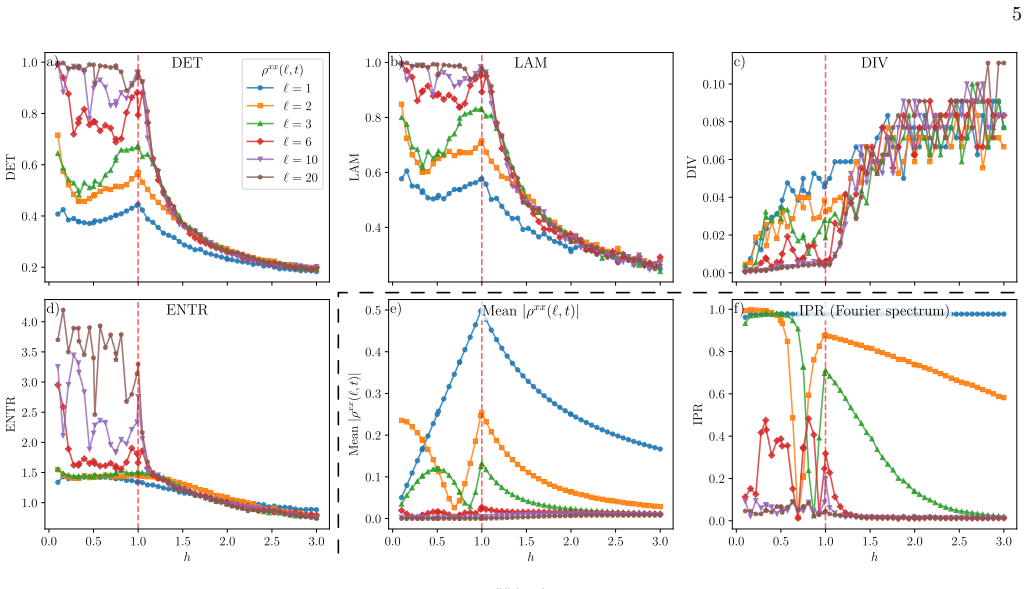
Recurrence plots of two-site correlations after quenches in the transverse-field Ising model display nearly periodic patterns in the deeply ferromagnetic phase that give way to multiscale temporal structures at criticality. Recurrence quantification analysis applied to these plots recovers the critical field strength without prior knowledge of the model.
What carries the argument
Recurrence plots and recurrence quantification analysis applied to time series of two-site correlation functions, which map temporal recurrences in the observable dynamics.
If this is right
- Recurrence plots give a qualitative visual fingerprint of quantum many-body dynamics from observables.
- Recurrence quantifiers locate the critical point of the Ising model unsupervised from quench data.
- The approach applies to both simulated and experimental time series without solving the full model.
- It characterizes out-of-equilibrium dynamics whose temporal structure resists direct interpretation.
Where Pith is reading between the lines
- The same recurrence measures might distinguish phases in other spin chains if the sensitivity to criticality persists beyond the Ising case.
- Experimental quantum simulators could use this on measured correlation traces to flag phase boundaries when the Hamiltonian parameters are unknown.
- Cross-checks with entanglement measures or Loschmidt echoes could test whether recurrence captures distinct dynamical information.
Load-bearing premise
The chosen recurrence measures remain sensitive to the underlying quantum phase structure rather than being dominated by finite-size effects, simulation errors, or the specific observable.
What would settle it
Numerical checks showing that the critical field recovered by the quantifiers shifts substantially when system size is increased or the two-site observable is changed would falsify the claim that the method detects the transition reliably.
Figures


read the original abstract
Observables of out-of-equilibrium quantum many-body systems display complex temporal behavior that encodes the underlying physical mechanisms but typically resists straightforward interpretations. We introduce recurrence analysis - a nonlinear time-series analysis framework long established for classical dynamical systems - to investigate correlated quantum many-body dynamics. Recurrence plots provide a qualitative fingerprint of simulated or experimental data, while recurrence quantification analysis extracts corresponding numerical descriptors. Applying this framework to quenches from the paramagnetic ground state in the one-dimensional transverse-field Ising model, we observe a clear progression in the recurrence plots of two-site correlations: nearly periodic patterns in the deeply ferromagnetic phase give way to multiscale temporal structures at criticality. Recurrence quantifiers further recover the critical field strength without prior knowledge of the model, establishing recurrence analysis as a versatile tool for characterizing quantum many-body dynamics, including unsupervised detection of quantum phase transitions.
Editorial analysis
A structured set of objections, weighed in public.
Referee Report
Summary. The paper introduces recurrence analysis—a framework from classical nonlinear dynamics consisting of recurrence plots and recurrence quantification analysis (RQA)—to out-of-equilibrium quantum many-body systems. Applied to quenches from the paramagnetic ground state in the 1D transverse-field Ising model, it reports a progression in recurrence plots of two-site correlations from nearly periodic patterns deep in the ferromagnetic phase to multiscale structures near criticality, and claims that RQA quantifiers recover the critical field h_c=1 without prior model knowledge, enabling unsupervised detection of quantum phase transitions.
Significance. If validated, the work offers a model-agnostic, data-driven tool for fingerprinting quantum dynamics and locating phase transitions from time series alone, with potential utility for experimental quantum simulators. The numerical demonstration on an exactly solvable model is a positive step, but the absence of quantitative controls limits the strength of the central claim.
major comments (2)
- [Abstract] Abstract: the claim that recurrence quantifiers 'recover the critical field strength without prior knowledge of the model' is load-bearing yet unsupported by any quantitative details—specific RQA measures (determinism, laminarity, recurrence rate, etc.), the precise extraction procedure (e.g., location of an extremum), system sizes L, Trotter step sizes, total evolution times, or error bars are not reported.
- [Numerical results] Numerical results section: the manuscript must demonstrate that the RQA-derived critical field is robust under finite-size scaling (i.e., the extracted h_c(L) extrapolates to the thermodynamic value 1 as L→∞) or is independent of L; otherwise the observed extremum may simply track the L-dependent finite-size gap closing rather than the underlying quantum phase structure, given that unitary evolution on finite chains is always quasiperiodic.
minor comments (2)
- [Introduction] Introduction: add explicit references to the foundational recurrence-plot literature (Eckmann et al., 1987) and any prior quantum applications to contextualize the novelty.
- [Figures] Figure captions: include time-axis scales, color-bar definitions, and the precise observable (two-site correlation function) used to generate each recurrence plot so readers can assess the reported multiscale structures.
Simulated Author's Rebuttal
We thank the referee for their careful reading and constructive feedback on our manuscript. We address each major comment below and have revised the manuscript to incorporate the suggested improvements.
read point-by-point responses
-
Referee: [Abstract] Abstract: the claim that recurrence quantifiers 'recover the critical field strength without prior knowledge of the model' is load-bearing yet unsupported by any quantitative details—specific RQA measures (determinism, laminarity, recurrence rate, etc.), the precise extraction procedure (e.g., location of an extremum), system sizes L, Trotter step sizes, total evolution times, or error bars are not reported.
Authors: We agree that the abstract claim would benefit from greater specificity to strengthen its transparency. In the revised manuscript, we update the abstract to explicitly name the primary RQA measures used (determinism and laminarity), describe the extraction procedure (identification of the extremum in the quantifier versus transverse-field curve), and reference the system sizes, Trotter discretization, total evolution times, and error estimation procedures that are detailed in the numerical results section and figure captions. These additions make the central claim self-contained without altering the abstract's length or focus. revision: yes
-
Referee: [Numerical results] Numerical results section: the manuscript must demonstrate that the RQA-derived critical field is robust under finite-size scaling (i.e., the extracted h_c(L) extrapolates to the thermodynamic value 1 as L→∞) or is independent of L; otherwise the observed extremum may simply track the L-dependent finite-size gap closing rather than the underlying quantum phase structure, given that unitary evolution on finite chains is always quasiperiodic.
Authors: We acknowledge the importance of this point, given the quasiperiodic character of finite-system unitary evolution. In the revised manuscript, we add a dedicated finite-size scaling subsection to the numerical results. We extract the apparent critical field h_c(L) from the RQA quantifiers for multiple system sizes (L = 8 to L = 32) and show that h_c(L) converges to the thermodynamic value 1 with increasing L; a linear extrapolation in 1/L is provided to confirm this limit. We also discuss how the recurrence structures reflect the underlying phase transition in the two-site correlation dynamics, beyond the finite-size gap scale. These results are supported by additional data and figures. revision: yes
Circularity Check
No circularity: recurrence analysis imported from classical dynamics and applied empirically to TFIM data
full rationale
The paper imports the established recurrence quantification analysis (RQA) framework from classical nonlinear dynamics and applies it to time series of two-site correlations generated by quenches in the transverse-field Ising model. The central observation—that RQA descriptors recover the critical field without prior model knowledge—is presented as an empirical outcome from the simulated data rather than a quantity defined by construction, fitted parameters renamed as predictions, or a self-citation chain. No load-bearing steps reduce to self-definition or ansatz smuggling; the method remains independent of the target result and is externally falsifiable against known TFIM properties.
Axiom & Free-Parameter Ledger
axioms (2)
- domain assumption The one-dimensional transverse-field Ising model can be numerically time-evolved from the paramagnetic ground state to produce reliable two-site correlation time series.
- domain assumption Recurrence plots and standard quantification measures developed for classical time series remain meaningful when applied to quantum correlation functions.
Reference graph
Works this paper leans on
-
[1]
(see [66] for a more general embedding of the signal into a respectived-dimensional effective phase space - here we resort to the simplest case of a triviald= 1 embedding). The recurrence matrix Rij = Θ(ε−D ij),(1) where Θ(·) is the Heaviside step function, captures pairs of times in which the values of the time series are the same within a predefined thr...
2000
-
[2]
J. M. Deutsch, Phys. Rev. A43, 2046 (1991)
2046
-
[3]
Srednicki, Phys
M. Srednicki, Phys. Rev. E50, 888 (1994)
1994
-
[4]
Orbach, Phys
R. Orbach, Phys. Rev.112, 309 (1958)
1958
-
[5]
E. H. Lieb and F. Y. Wu, Phys. Rev. Lett.20, 1445 (1968)
1968
-
[6]
Pfeuty, Ann
P. Pfeuty, Ann. Phys.57, 79 (1970)
1970
-
[7]
Basko, I
D. Basko, I. Aleiner, and B. Altshuler, Ann. Phys.321, 1126 (2006)
2006
-
[8]
I. V. Gornyi, A. D. Mirlin, and D. G. Polyakov, Phys. Rev. Lett.95, 206603 (2005)
2005
-
[9]
Oganesyan and D
V. Oganesyan and D. A. Huse, Phys. Rev. B75, 155111 (2007)
2007
-
[10]
Sierant, M
P. Sierant, M. Lewenstein, A. Scardicchio, L. Vidmar, and J. Zakrzewski, Rep. Prog. Phys.88, 026502 (2025)
2025
-
[11]
Bernien, S
H. Bernien, S. Schwartz, A. Keesling, H. Levine, A. Om- ran, H. Pichler, S. Choi, A. S. Zibrov, M. Endres, M. Greiner, V. Vuleti´ c, and M. D. Lukin, Nature551, 579 (2017)
2017
-
[12]
C. J. Turner, A. A. Michailidis, D. A. Abanin, M. Serbyn, and Z. Papi´ c, Nat. Phys.14, 745 (2018)
2018
-
[13]
Serbyn, D
M. Serbyn, D. A. Abanin, and Z. Papi´ c, Nat. Phys.17, 675 (2021)
2021
-
[14]
P. Sala, T. Rakovszky, R. Verresen, M. Knap, and F. Poll- mann, Phys. Rev. X10, 011047 (2020)
2020
-
[15]
M. H. Anderson, J. R. Ensher, M. R. Matthews, C. E. Wieman, and E. A. Cornell, Science269, 198 (1995)
1995
-
[16]
Lewenstein, A
M. Lewenstein, A. Sanpera, and V. Ahufinger,Ultracold Atoms in Optical Lattices: Simulating quantum many- body systems(Oxford University Press, 2012)
2012
-
[17]
Sch¨ afer, T
F. Sch¨ afer, T. Fukuhara, S. Sugawa, Y. Takasu, and Y. Takahashi, Nat. Rev. Phys.2, 411 (2020)
2020
-
[18]
J. I. Cirac and P. Zoller, Phys. Rev. Lett.74, 4091 (1995)
1995
-
[19]
Foss-Feig, G
M. Foss-Feig, G. Pagano, A. C. Potter, and N. Y. Yao, Annu. Rev. Condens. Matter Phys.16, 145 (2025)
2025
-
[20]
Nakamura, Y
Y. Nakamura, Y. A. Pashkin, and J. S. Tsai, Nature398, 786 (1999)
1999
-
[21]
Jiang, C
Y.-Y. Jiang, C. Deng, H. Fan, B.-Y. Li, L. Sun, X.-S. Tan, W. Wang, G.-M. Xue, F. Yan, H.-F. Yu, Y.-S. Zhang, Y.-R. Zhang, and C.-L. Zou, Natl. Sci. Rev.12, nwaf246 (2025)
2025
-
[22]
Dborin, V
J. Dborin, V. Wimalaweera, F. Barratt, E. Ostby, T. E. O’Brien, and A. G. Green, Nat. Commun.13, 5977 (2022)
2022
-
[23]
Ergodicity breaking meets crit- icality in a gauge-theory quantum simulator,
A. Hudomal, A. Daniel, T. S. do Espirito Santo, M. Ko- rnjaˇ ca, T. Macr` ı, J. C. Halimeh, G.-X. Su, A. Balaˇ z, and Z. Papi´ c, (2025), arXiv:2512.23794 [cond-mat.quant- gas]
-
[24]
Liang, Z
X. Liang, Z. Yue, Y.-X. Chao, Z.-X. Hua, Y. Lin, M. K. Tey, and L. You, Phys. Rev. Lett.135, 050201 (2025)
2025
-
[25]
L. E. Fischer, M. Leahy, A. Eddins, N. Keenan, D. Fer- racin, M. A. C. Rossi, Y. Kim, A. He, F. Pietracaprina, B. Sokolov, S. Dooley, Z. Zimbor´ as, F. Tacchino, S. Man- iscalco, J. Goold, G. Garc´ ıa-P´ erez, I. Tavernelli, A. Kan- dala, and S. N. Filippov, Nat. Phys.22, 302 (2026)
2026
-
[26]
Kottmann, P
K. Kottmann, P. Huembeli, M. Lewenstein, and A. Ac´ ın, Phys. Rev. Lett.125, 170603 (2020)
2020
-
[27]
Lidiak and Z
A. Lidiak and Z. Gong, Phys. Rev. Lett.125, 225701 (2020)
2020
-
[28]
K¨ aming, A
N. K¨ aming, A. Dawid, K. Kottmann, M. Lewenstein, K. Sengstock, A. Dauphin, and C. Weitenberg, Mach. Learn.: Sci. Technol.2, 035037 (2021)
2021
-
[29]
Kottmann, P
K. Kottmann, P. Corboz, M. Lewenstein, and A. Ac´ ın, SciPost Phys.11, 025 (2021)
2021
-
[30]
Kottmann, F
K. Kottmann, F. Metz, J. Fraxanet, and N. Baldelli, Phys. Rev. Res.3, 043184 (2021)
2021
- [31]
-
[32]
Yamada, E
R. Yamada, E. Pi˜ nol, S. Grandi, J. Zakrzewski, and M. Lewenstein, Exploring quantum phenomena through sound: Strategies, challenges, and insights, inAdvances in Quantum Computer Music(World Scientific Publish- ing Co. Pte. Ltd., 2025) Chap. 3, pp. 63–92
2025
-
[33]
Rodr´ ıguez-Laguna, P
J. Rodr´ ıguez-Laguna, P. Migda l, M. I. Berganza, M. Lewenstein, and G. Sierra, New J. Phys.14, 053028 (2012)
2012
-
[34]
Koczor, R
B. Koczor, R. Zeier, and S. J. Glaser, Phys. Rev. A102, 062421 (2020)
2020
- [35]
-
[36]
Szo ldra, P
T. Szo ldra, P. Sierant, K. Kottmann, M. Lewenstein, and J. Zakrzewski, Phys. Rev. B104, L140202 (2021)
2021
-
[37]
Szo ldra, P
T. Szo ldra, P. Sierant, M. Lewenstein, and J. Zakrzewski, Phys. Rev. B107, 054204 (2023)
2023
-
[38]
J. P. Eckmann, S. O. Kamphorst, and D. Ruelle, Euro- phys. Lett.4, 973 (1987)
1987
-
[39]
C. L. Webber Jr and J. P. Zbilut, Tutor. Contemp. Non- linear Methods Behav. Sci.94, 26 (2005)
2005
-
[40]
Marwan, M
N. Marwan, M. C. Romano, M. Thiel, and J. Kurths, Phys. Rep.438, 237 (2007)
2007
-
[41]
Marwan, Eur
N. Marwan, Eur. Phys. J. Spec. Top.164, 3 (2008)
2008
-
[42]
Marwan and J
N. Marwan and J. Webber, Charles L.,Recurrence Quan- tification Analysis: Theory and Best Practices(Springer, Cham, 2015)
2015
-
[43]
Thiel, M
M. Thiel, M. C. Romano, J. Kurths, R. Meucci, E. Al- laria, and F. T. Arecchi, Physica D171, 138 (2002)
2002
-
[44]
N. V. Zolotova and D. I. Ponyavin, Astron. Astrophys. 449, L1 (2006)
2006
-
[45]
M. S. Palmero and I. L. Caldas, Fundamental Plasma Physics8, 100027 (2023)
2023
-
[46]
Marwan, N
N. Marwan, N. Wessel, U. Meyerfeldt, A. Schirdewan, and J. Kurths, Phys. Rev. E66, 026702 (2002)
2002
-
[47]
Acharya U., O
R. Acharya U., O. Faust, N. Kannathal, T. Chua, and S. Laxminarayan, Comput. Methods Programs Biomed. 80, 37 (2005)
2005
-
[48]
Prabhu, A
P. Prabhu, A. K. Karunakar, H. Anitha, and N. Pradhan, Pattern Recognit. Lett.139, 10 (2020)
2020
-
[49]
Spiridonov, J
A. Spiridonov, J. Geol.125, 381 (2017)
2017
-
[50]
M. H. Trauth, A. Asrat, W. Duesing, V. Foerster, K. H. Kraemer, N. Marwan, M. A. Maslin, and F. Sch¨ abitz, Clim. Dyn.53, 2557 (2019)
2019
-
[51]
Fabretti and M
A. Fabretti and M. Ausloos, Int. J. Mod. Phys. C16, 671 (2005)
2005
-
[52]
J. A. Bastos and J. Caiado, Physica A390, 1315 (2011)
2011
-
[53]
J. M. Nichols, S. T. Trickey, and M. Seaver, Mech. Syst. Signal Process.20, 421 (2006)
2006
-
[54]
A. K. Sen, R. Longwic, G. Litak, and K. G´ orski, Mech. Syst. Signal Process.22, 362 (2008)
2008
-
[55]
Kasthuri, I
P. Kasthuri, I. Pavithran, S. A. Pawar, R. I. Sujith, R. Gejji, and W. Anderson, Chaos29, 103115 (2019)
2019
-
[56]
C. A. Ayers, P. R. Armsworth, and B. J. Brosi, Behav. Ecol. Sociobiol.69, 1395 (2015). 7
2015
-
[57]
Zurlini, N
G. Zurlini, N. Marwan, T. Semeraro, K. B. Jones, R. Are- tano, M. R. Pasimeni, D. Valente, C. Mulder, and I. Pet- rosillo, Landsc. Ecol.33, 1617 (2018)
2018
-
[58]
Semeraro, A
T. Semeraro, A. Luvisi, A. O. Lillo, R. Aretano, R. Buc- colieri, and N. Marwan, Remote Sens.12, 907 (2020)
2020
-
[59]
Semeraro, R
T. Semeraro, R. Buccolieri, M. Vergine, L. De Bellis, A. Luvisi, R. Emmanuel, and N. Marwan, Forests12, 1266 (2021)
2021
-
[60]
Vretenar, N
D. Vretenar, N. Paar, P. Ring, and G. A. Lalazissis, Phys. Rev. E60, 308 (1999)
1999
-
[61]
Sudheesh, S
C. Sudheesh, S. Lakshmibala, and V. Balakrishnan, Eu- rophys. Lett.90, 50001 (2010)
2010
-
[62]
P. Laha, S. Lakshmibala, and V. Balakrishnan, Phys. Lett. A384, 126565 (2020)
2020
-
[63]
P. Laha, S. Lakshmibala, and V. Balakrishnan, Int. J. Theor. Phys.59, 3476 (2020)
2020
-
[64]
Lakshmibala and V
S. Lakshmibala and V. Balakrishnan, inNonclassical Ef- fects and Dynamics of Quantum Observables, Springer- Briefs in Physics (Springer, Cham, 2022) Chap. 7, p. 107
2022
-
[65]
Pradeep, S
A. Pradeep, S. Anupama, and C. Sudheesh, Eur. Phys. J. D74, 3 (2020)
2020
-
[66]
Here we consider univariate time series for simplicity, but the definitions carry over to the multivariate case by re- placing the absolute value with a suitable norm
-
[67]
63, 92–95
See supplemental material at [URL will be inserted by publisher] for a note on time-delay embedding of time series, the IPR calculation of the Fourier spectrum, cor- recting for a change in timescale, and RP/RQA for the ZZ correlations, which includes Refs. 63, 92–95
-
[68]
Calabrese, F
P. Calabrese, F. H. L. Essler, and M. Fagotti, Phys. Rev. Lett.106, 227203 (2011)
2011
-
[69]
Calabrese, F
P. Calabrese, F. H. L. Essler, and M. Fagotti, J. Stat. Mech.: Theory Exp.2012, P07016
2012
-
[70]
M. Heyl, A. Polkovnikov, and S. Kehrein, Phys. Rev. Lett.110, 135704 (2013)
2013
-
[71]
Dutta, G
A. Dutta, G. Aeppli, B. K. Chakrabarti, U. Divakaran, T. F. Rosenbaum, and D. Sen,Quantum Phase Transi- tions in Transverse Field Spin Models: From Statistical Physics to Quantum Information(Cambridge University Press, Cambridge, 2015)
2015
-
[72]
Dziarmaga, Phys
J. Dziarmaga, Phys. Rev. Lett.95, 245701 (2005)
2005
-
[73]
Rossini, S
D. Rossini, S. Suzuki, G. Mussardo, G. E. Santoro, and A. Silva, Phys. Rev. B82, 144302 (2010)
2010
-
[74]
Sachdev,Quantum Phase Transitions, 2nd ed
S. Sachdev,Quantum Phase Transitions, 2nd ed. (Cam- bridge University Press, 2011)
2011
-
[75]
Barouch and B
E. Barouch and B. M. McCoy, Phys. Rev. A3, 786 (1971)
1971
-
[76]
Peschel and V
I. Peschel and V. Eisler, J. Phys. A: Math. Theor.42, 504003 (2009)
2009
-
[77]
Sierant and J
P. Sierant and J. Zakrzewski, Phys. Rev. B105, 224203 (2022)
2022
-
[78]
Zhang, G
J. Zhang, G. Pagano, P. W. Hess, A. Kyprianidis, P. Becker, H. Kaplan, A. V. Gorshkov, Z.-X. Gong, and C. Monroe, Nature551, 601 (2017)
2017
-
[79]
Lienhard, S
V. Lienhard, S. de L´ es´ eleuc, D. Barredo, T. Lahaye, A. Browaeys, M. Schuler, L.-P. Henry, and A. M. L¨ auchli, Phys. Rev. X8, 021070 (2018)
2018
-
[80]
Keesling, A
A. Keesling, A. Omran, H. Levine, H. Bernien, H. Pich- ler, S. Choi, R. Samajdar, S. Schwartz, P. Silvi, S. Sachdev, P. Zoller, M. Endres, M. Greiner, V. Vuleti´ c, and M. D. Lukin, Nature568, 207 (2019)
2019
discussion (0)
Sign in with ORCID, Apple, or X to comment. Anyone can read and Pith papers without signing in.