Multi-Scale Reversible Chaos Game Representation: A Unified Framework for Sequence Classification
Pith reviewed 2026-05-10 05:43 UTC · model grok-4.3
The pith
A reversible multi-scale geometric encoding improves biological sequence classification when combined with language model features.
A machine-rendered reading of the paper's core claim, the machinery that carries it, and where it could break.
Core claim
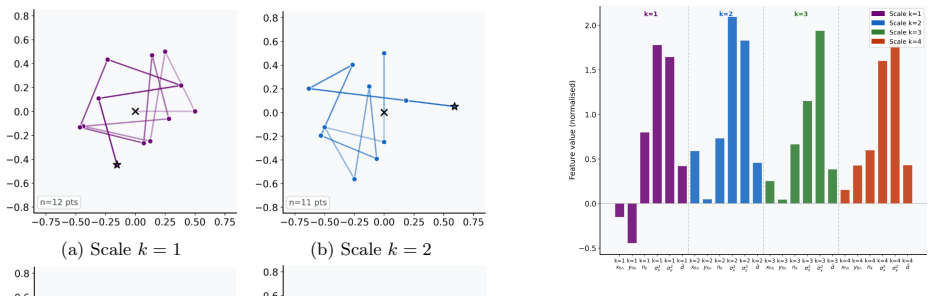
MS-RCGR transforms biological sequences into multi-resolution geometric representations using rational arithmetic and hierarchical k-mer decomposition. The resulting features are scale-invariant and fully reversible, so the original sequence can be recovered exactly. The framework unifies three analysis styles: traditional machine learning on the extracted geometric features, computer vision models applied to the generated images, and hybrid models that merge the geometric features with embeddings from pre-trained language models such as ESM2 and ProtT5. Experiments on synthetic DNA and protein datasets with seven distinct classes demonstrate that MS-RCGR features raise classification scores
What carries the argument
Multi-Scale Reversible Chaos Game Representation (MS-RCGR), which applies hierarchical k-mer decomposition and rational arithmetic to produce scale-invariant geometric features from sequences while preserving full reversibility.
If this is right
- MS-RCGR features raise classification accuracy when used alone in traditional machine learning pipelines.
- Images generated from MS-RCGR representations can be processed directly by computer vision models.
- Merging MS-RCGR features with protein language model embeddings produces higher accuracy than either source used separately.
- Because the encoding is reversible, every original sequence element remains recoverable and can be examined for interpretability.
- Multi-scale analysis captures both short nucleotide patterns and longer motif structures within the same representation.
Where Pith is reading between the lines
- The same reversible multi-scale construction could be tested on RNA sequences or full genomes to check whether the accuracy gains persist.
- Because the output is both numeric features and images, the method might be combined with other model families such as graph neural networks.
- The explicit reversibility property opens the possibility of using MS-RCGR inside generative models that must both classify and reconstruct sequences.
- If the complementary information claim holds, similar hybrid constructions could be explored for non-biological sequences such as text or time series.
Load-bearing premise
That the geometric features produced by MS-RCGR contain information that is genuinely complementary to the patterns already captured inside pre-trained language model embeddings.
What would settle it
An experiment on real biological sequences in which the hybrid model using both MS-RCGR features and language model embeddings fails to outperform the language model embeddings alone.
Figures



read the original abstract
Biological classification with interpretability remains a challenging task. For this, we introduce a novel encoding framework, Multi-Scale Reversible Chaos Game Representation (MS-RCGR), that transforms biological sequences into multi-resolution geometric representations with guaranteed reversibility. Unlike traditional sequence encoding methods, MS-RCGR employs rational arithmetic and hierarchical k-mer decomposition to generate scale-invariant features that preserve complete sequence information while enabling diverse analytical approaches. Our framework bridges three distinct paradigms for sequence analysis: (1) traditional machine learning using extracted geometric features, (2) computer vision models operating on CGR-generated images, and (3) hybrid approaches combining protein language model embeddings with CGR features. Through comprehensive experiments on synthetic DNA and protein datasets encompassing seven distinct sequence classes, we demonstrate that MS-RCGR features consistently enhance classification performance across all paradigms. Notably, our hybrid approach combining pre-trained language model embeddings (ESM2, ProtT5) with MS-RCGR features achieves superior performance compared to either method alone. The reversibility property of our encoding ensures no information loss during transformation, while multi-scale analysis captures patterns ranging from individual nucleotides to complex motif structures. Our results indicate that MS-RCGR provides a flexible, interpretable, and high-performing foundation for biological sequence analysis.
Editorial analysis
A structured set of objections, weighed in public.
Referee Report
Summary. The manuscript introduces Multi-Scale Reversible Chaos Game Representation (MS-RCGR), a framework that encodes biological sequences into multi-resolution geometric representations using rational arithmetic and hierarchical k-mer decomposition. It claims guaranteed reversibility with no information loss, scale-invariance, and the ability to bridge traditional ML on geometric features, computer vision on CGR images, and hybrid models combining pre-trained protein language model embeddings (ESM2, ProtT5) with MS-RCGR features. Experiments on synthetic DNA and protein datasets with seven artificial classes are said to show consistent performance gains across paradigms, with the hybrid approach outperforming either component alone.
Significance. If validated, the reversibility property and multi-scale decomposition could provide an interpretable, information-preserving alternative or complement to existing sequence encodings. The hybrid paradigm is a potentially useful direction for combining geometric and embedding-based features. However, the current evidence base is narrow, so the practical significance for biological sequence classification remains provisional pending broader validation.
major comments (2)
- [Experimental evaluation / Results] The central claim that the hybrid ESM2/ProtT5 + MS-RCGR approach achieves superior performance rests entirely on synthetic DNA/protein datasets with seven artificially constructed classes. No experiments on real biological sequences (e.g., from UniProt, NCBI, or standard benchmarks with evolutionary/structural noise) are reported, so it is unclear whether the observed complementarity is genuine or an artifact of the synthetic construction. This directly affects the applicability asserted in the abstract and conclusion.
- [Abstract] Abstract and experimental description: claims of 'consistent performance improvements' and 'superior performance' are made without any quantitative metrics, error bars, dataset sizes, cross-validation details, or statistical tests. This prevents assessment of effect size or reliability and is load-bearing for the hybrid-superiority assertion.
minor comments (1)
- Ensure all tables and figures in the full manuscript are explicitly referenced in the text and include clear captions describing the synthetic class definitions and evaluation protocol.
Simulated Author's Rebuttal
We thank the referee for their constructive comments, which help clarify the scope and presentation of our work. We address each major comment below and describe the revisions we will make.
read point-by-point responses
-
Referee: [Experimental evaluation / Results] The central claim that the hybrid ESM2/ProtT5 + MS-RCGR approach achieves superior performance rests entirely on synthetic DNA/protein datasets with seven artificially constructed classes. No experiments on real biological sequences (e.g., from UniProt, NCBI, or standard benchmarks with evolutionary/structural noise) are reported, so it is unclear whether the observed complementarity is genuine or an artifact of the synthetic construction. This directly affects the applicability asserted in the abstract and conclusion.
Authors: We thank the referee for this observation. The synthetic datasets with seven artificially constructed classes were deliberately chosen to enable rigorous, controlled evaluation of MS-RCGR's reversibility, scale-invariance, and complementarity with language model embeddings, free from the label noise and unknown evolutionary relationships present in real data. This design directly supports the paper's focus on demonstrating the framework's theoretical and methodological properties. We agree, however, that this limits immediate claims of broad applicability. In the revised manuscript we will qualify the abstract and conclusion to state that results are shown on synthetic data, add a limitations paragraph discussing generalization to real sequences, and include a brief outline of how MS-RCGR could be applied to benchmarks such as UniProt-derived tasks. revision: partial
-
Referee: [Abstract] Abstract and experimental description: claims of 'consistent performance improvements' and 'superior performance' are made without any quantitative metrics, error bars, dataset sizes, cross-validation details, or statistical tests. This prevents assessment of effect size or reliability and is load-bearing for the hybrid-superiority assertion.
Authors: We agree that the abstract would be strengthened by including quantitative details. In the revision we will update the abstract to report key metrics (e.g., accuracy or F1-score gains of the hybrid model relative to baselines), dataset sizes, and a concise reference to the cross-validation protocol and statistical tests used. The experimental section will be expanded to present error bars from repeated runs and any significance testing performed. revision: yes
Circularity Check
No significant circularity; MS-RCGR defined as independent transformation with empirical validation on synthetic data
full rationale
The paper introduces MS-RCGR as a novel encoding framework using rational arithmetic and hierarchical k-mer decomposition to produce reversible, multi-scale geometric representations of sequences. This definition stands on its own without reducing to fitted parameters or self-referential loops. Performance claims for the hybrid ESM2/ProtT5 + MS-RCGR approach are presented as outcomes of experiments on synthetic datasets with seven classes, not as predictions derived tautologically from the inputs. No load-bearing self-citations, uniqueness theorems from prior author work, or ansatzes smuggled via citation are evident in the provided text. The derivation chain (framework definition to experimental results) remains self-contained and externally falsifiable via the reported benchmarks.
Axiom & Free-Parameter Ledger
Reference graph
Works this paper leans on
-
[1]
Kraken: ultrafast metagenomic sequence classification using exact alignments , author=. Genome biology , volume=. 2014 , publisher=
work page 2014
-
[2]
Alignment-free sequence comparison: benefits, applications, and tools , author=. Genome biology , volume=. 2017 , publisher=
work page 2017
-
[3]
Biological sequence representation methods and recent advances: A review , author=. Biology , volume=. 2025 , publisher=
work page 2025
-
[4]
Nucleic acids research , volume=
Chaos game representation of gene structure , author=. Nucleic acids research , volume=. 1990 , publisher=
work page 1990
-
[5]
Analysis of genomic sequences by chaos game representation , author=. Bioinformatics , volume=. 2001 , publisher=
work page 2001
- [6]
-
[7]
Journal of theoretical biology , volume=
Chaos game representation of protein sequences based on the detailed HP model and their multifractal and correlation analyses , author=. Journal of theoretical biology , volume=. 2004 , publisher=
work page 2004
-
[8]
The spectrum kernel: A string kernel for SVM protein classification , author=. Biocomputing 2002 , pages=. 2001 , publisher=
work page 2002
-
[9]
Profile-based direct kernels for remote homology detection and fold recognition , author=. Bioinformatics , volume=. 2005 , publisher=
work page 2005
-
[10]
Nucleic acids research , volume=
Gapped BLAST and PSI-BLAST: a new generation of protein database search programs , author=. Nucleic acids research , volume=. 1997 , publisher=
work page 1997
-
[11]
Deep learning on chaos game representation for proteins , author=. Bioinformatics , volume=. 2020 , publisher=
work page 2020
-
[12]
Evolutionary-scale prediction of atomic-level protein structure with a language model , author=. Science , volume=. 2023 , publisher=
work page 2023
-
[13]
IEEE transactions on pattern analysis and machine intelligence , volume=
ProtTrans: toward understanding the language of life through self-supervised learning , author=. IEEE transactions on pattern analysis and machine intelligence , volume=. 2021 , publisher=
work page 2021
-
[14]
ProteinBERT: a universal deep-learning model of protein sequence and function , author=. Bioinformatics , volume=. 2022 , publisher=
work page 2022
-
[15]
iFeature: a python package and web server for features extraction and selection from protein and peptide sequences , author=. Bioinformatics , volume=. 2018 , publisher=
work page 2018
-
[16]
Briefings in bioinformatics , volume=
iLearn: an integrated platform and meta-learner for feature engineering, machine-learning analysis and modeling of DNA, RNA and protein sequence data , author=. Briefings in bioinformatics , volume=. 2020 , publisher=
work page 2020
-
[17]
BioSeq-Analysis2. 0: an updated platform for analyzing DNA, RNA and protein sequences at sequence level and residue level based on machine learning approaches , author=. Nucleic acids research , volume=. 2019 , publisher=
work page 2019
-
[18]
Cui, Lulu and Zheng, Dengning and Tao, Liwei and Zhang, Ying , title =. BMC Bioinformatics , year =
- [19]
-
[20]
Highly accurate protein structure prediction with AlphaFold , author=. nature , volume=. 2021 , publisher=
work page 2021
-
[21]
Language models of protein sequences at the scale of evolution enable accurate structure prediction , author=. bioRxiv , year=
-
[22]
IEEE/ACM Transactions on Computational Biology and Bioinformatics , year=
Efficient approximate kernel based spike sequence classification , author=. IEEE/ACM Transactions on Computational Biology and Bioinformatics , year=
-
[23]
AAAI conference on artificial intelligence , year=
Wasserstein distance guided representation learning for domain adaptation , author=. AAAI conference on artificial intelligence , year=
-
[24]
International conference on machine learning , pages=
Unsupervised deep embedding for clustering analysis , author=. International conference on machine learning , pages=
-
[25]
Advances in neural information processing systems , volume=
Evaluating protein transfer learning with TAPE , author=. Advances in neural information processing systems , volume=
discussion (0)
Sign in with ORCID, Apple, or X to comment. Anyone can read and Pith papers without signing in.