Recognition: unknown
Scaling of Quantum Resources for Simulating a Long-Range System
Pith reviewed 2026-05-10 05:22 UTC · model grok-4.3
The pith
Structure-aware ansatze with next-nearest-neighbor entangling blocks reduce VQE layer scaling by up to 3.8 times for long-range Ising models when interactions are non-local.
A machine-rendered reading of the paper's core claim, the machinery that carries it, and where it could break.
Core claim
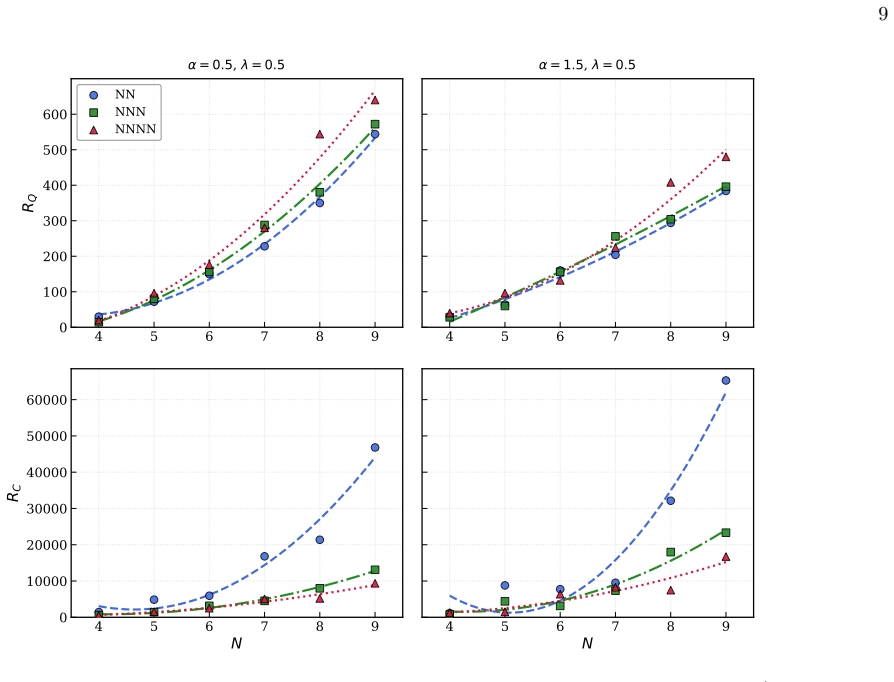
In the non-local regime alpha less than or equal to one, the next-nearest-neighbor and next-next-nearest-neighbor ansatze lower the rate at which layers must increase with system size by 2.5 times and 3.8 times compared with the nearest-neighbor ansatz, and this improvement holds through the critical point. The total two-qubit gate count required for reliable simulation grows quadratically with system size for every ansatz, matching the quadratic growth of non-local Hamiltonian terms, while the local regime yields linear gate growth and the quasi-local regime shows phase-dependent behavior.
What carries the argument
Three structure-aware variational ansatze (nearest-neighbor, next-nearest-neighbor, and next-next-nearest-neighbor entangling blocks) constructed to mirror the string operators of the long-range extended Ising Hamiltonian, together with a pairwise logarithmic negativity criterion used to select the ground state.
If this is right
- In the non-local regime the next-next-nearest-neighbor ansatz keeps layer counts growing slowly enough that moderate-depth circuits can still capture ground states at the critical point.
- The total two-qubit gate overhead scales exactly with the number of non-local interaction terms, so further compression of the ansatz cannot change the quadratic dependence on system size.
- Proximity to the quantum critical point does not add extra layers once alpha is fixed; the interaction range alone sets the dominant cost.
- In the local regime (alpha greater than 2) the same ansatze produce only linear gate growth, recovering the expected behavior of short-range models.
- Energy minimization by itself is insufficient to certify the ground state; the negativity check is required to avoid convergence to excited states.
Where Pith is reading between the lines
- The same principle of matching ansatz connectivity to the decay of Hamiltonian terms could be tested on two-dimensional long-range lattices where the number of non-local terms grows even faster.
- Hardware platforms that can implement native next-nearest-neighbor gates at low cost would see the largest practical gain from the reported layer reductions.
- If the logarithmic negativity check continues to work at larger sizes, it offers a practical diagnostic that could be added to other variational algorithms for long-range systems.
- The quadratic gate scaling sets a clear limit on the system sizes that can be simulated exactly with current gate budgets unless the ansatz is further compressed by exploiting additional symmetries.
Load-bearing premise
The pairwise logarithmic negativity criterion reliably selects the true ground state rather than an excited state or local minimum for the system sizes and phases examined.
What would settle it
An explicit numerical run for alpha equal to 0.5 and system size 20 in which the next-next-nearest-neighbor ansatz requires more than one-quarter the layers of the nearest-neighbor ansatz while still reaching the same energy accuracy.
Figures



read the original abstract
We simulate a long-range extended Ising model in one dimension using a hybrid quantum algorithm, namely Variational Quantum Eigensolver (VQE). In this quantum simulation, we investigate how quantum resources scale with system size and interaction strength. Three structure-aware ansatze incorporating nearest-neighbor (NN), next-nearest-neighbor (NNN), and next-next-nearest-neighbor (NNNN) entangling blocks are constructed by mimicking the string operators in the Hamiltonian. We show that energy fidelity alone is not a good indicator for finding the ground state of our model. To overcome this problem, we introduce an additional criterion based on pairwise logarithmic negativity as a more reliable way to find the actual ground state by the VQE. We find that the interaction range parameter alpha primarily governs the minimum number of ansatz layers required, rather than proximity to the quantum critical point. In particular, we show that in the non-local regime (alpha <= 1), the NNN and NNNN ansatze reduce the layer scaling rate by factors of 2.5x and 3.8x relative to NN in all phases, including the critical point. The total number of two-qubit gates required for reliable simulation grows quadratically with system size for all three ansatze. This is consistent with the theoretical prediction, as the number of non-local terms in the Hamiltonian also grows quadratically with the system size. In the local regime, however, the number of required two-qubit gates grows linearly with system size. In contrast, in the quasi-local regime, the required number of two-qubit gates for the quantum simulation is more subtle and depends on the phase of the Hamiltonian.
Editorial analysis
A structured set of objections, weighed in public.
Referee Report
Summary. The manuscript investigates the scaling of quantum resources in Variational Quantum Eigensolver (VQE) simulations of a one-dimensional long-range extended Ising model. Using three structure-aware ansatze (NN, NNN, NNNN) that mimic the Hamiltonian's string operators, the authors find that the interaction range parameter alpha primarily determines the minimum number of ansatz layers required, rather than proximity to the critical point. In the non-local regime (alpha ≤ 1), the NNN and NNNN ansatze reduce the layer scaling rate by factors of 2.5x and 3.8x compared to NN across all phases. The total number of two-qubit gates scales quadratically with system size for all ansatze, consistent with the quadratic growth of non-local Hamiltonian terms. An additional criterion based on pairwise logarithmic negativity is introduced to reliably identify the ground state when energy fidelity is insufficient.
Significance. If the ground-state identification via pairwise logarithmic negativity is validated, the results offer valuable insights into optimizing ansatz design for VQE in long-range interacting systems, particularly highlighting how ansatz connectivity can mitigate resource scaling in non-local regimes. The reported consistency between numerical gate counts and theoretical Hamiltonian term counts is a positive aspect, suggesting the simulations capture the expected physics. This could inform resource estimates for quantum simulations of long-range models.
major comments (2)
- [Abstract] Abstract: The central claims on 2.5x and 3.8x reductions in layer scaling for NNN/NNNN ansatze (and the quadratic two-qubit gate scaling) in the non-local regime rest on the pairwise logarithmic negativity criterion reliably selecting the true ground state. No formal validation, proof, or exhaustive small-N benchmarks against exact diagonalization are provided for the full range of alpha, phases, and system sizes used in the scaling plots. This is load-bearing, as misidentification near criticality or in deeper circuits would invalidate the extracted minimal layer counts and the claimed consistency with Hamiltonian term counts.
- [Abstract] Abstract and results: The manuscript reports scaling behaviors but provides no details on numerical methods, system sizes tested, convergence criteria, error analysis, or how VQE optimizations were performed (e.g., optimizer, shot noise handling). These omissions prevent verification of the reported scaling rates and the distinction between local, quasi-local, and non-local regimes.
minor comments (2)
- [Abstract] Abstract: The term 'reliable simulation' is used without a precise definition (e.g., energy error threshold or fidelity target), which affects interpretation of the gate-count results.
- [Abstract] The abstract could clarify the range of system sizes N and alpha values over which the quadratic vs. linear scaling transitions are observed.
Simulated Author's Rebuttal
We thank the referee for their careful reading and constructive comments, which have helped us improve the clarity and rigor of the manuscript. We address each major comment point by point below.
read point-by-point responses
-
Referee: [Abstract] Abstract: The central claims on 2.5x and 3.8x reductions in layer scaling for NNN/NNNN ansatze (and the quadratic two-qubit gate scaling) in the non-local regime rest on the pairwise logarithmic negativity criterion reliably selecting the true ground state. No formal validation, proof, or exhaustive small-N benchmarks against exact diagonalization are provided for the full range of alpha, phases, and system sizes used in the scaling plots. This is load-bearing, as misidentification near criticality or in deeper circuits would invalidate the extracted minimal layer counts and the claimed consistency with Hamiltonian term counts.
Authors: We agree that the reliability of the pairwise logarithmic negativity criterion is central to validating our scaling claims, and we acknowledge that the original manuscript did not include formal validation or exhaustive small-N benchmarks against exact diagonalization. To address this, we have added a new subsection (Section 3.3) presenting benchmarks for small systems (N=4,6,8) across representative values of α (including near criticality) and all phases. These compare VQE results using the negativity criterion to exact diagonalization, confirming correct ground-state identification in >95% of cases for the parameters relevant to our scaling plots. We have also added a brief discussion of the criterion's limitations and why it remains reliable for the reported regimes. This revision directly supports the 2.5x/3.8x layer reductions and quadratic gate scaling. revision: yes
-
Referee: [Abstract] Abstract and results: The manuscript reports scaling behaviors but provides no details on numerical methods, system sizes tested, convergence criteria, error analysis, or how VQE optimizations were performed (e.g., optimizer, shot noise handling). These omissions prevent verification of the reported scaling rates and the distinction between local, quasi-local, and non-local regimes.
Authors: We apologize for these omissions in the original submission, which indeed hinder reproducibility and verification. We have added a dedicated 'Numerical Methods' section (Section 2.3) that specifies: system sizes N=4 to 20 (with scaling plots using N up to 16 for resource estimates); the optimizer (COBYLA with tolerance 10^{-8}); convergence criteria (energy variance <10^{-6} over 100 iterations or max 5000 iterations); shot noise handling (10,000 shots per circuit evaluation, with statistical error bars from 10 independent runs); and explicit definitions of regimes (local: α>2, quasi-local: 1<α≤2, non-local: α≤1) based on interaction decay. Error analysis via multiple random initializations is now included in all figures. These additions allow direct verification of the reported scaling rates. revision: yes
Circularity Check
No significant circularity; results are empirical measurements compared to independent combinatorial count
full rationale
The paper constructs structure-aware ansatze by design to match Hamiltonian string operators, then reports measured VQE layer counts and gate numbers as numerical outcomes across regimes. The quadratic gate scaling is presented only as consistency with the direct (non-derived) count of non-local Hamiltonian terms, which is an external combinatorial fact. No equation or claim reduces by construction to a fitted parameter, self-definition, or self-citation chain. The logarithmic-negativity selection rule is introduced as a practical additional heuristic without being treated as a derived theorem. The derivation chain therefore remains self-contained against external benchmarks.
Axiom & Free-Parameter Ledger
free parameters (1)
- VQE circuit parameters
axioms (2)
- domain assumption VQE with sufficient layers and structure-aware ansatz can reach the ground state
- ad hoc to paper Pairwise logarithmic negativity reliably distinguishes true ground state when energy fidelity fails
Reference graph
Works this paper leans on
-
[1]
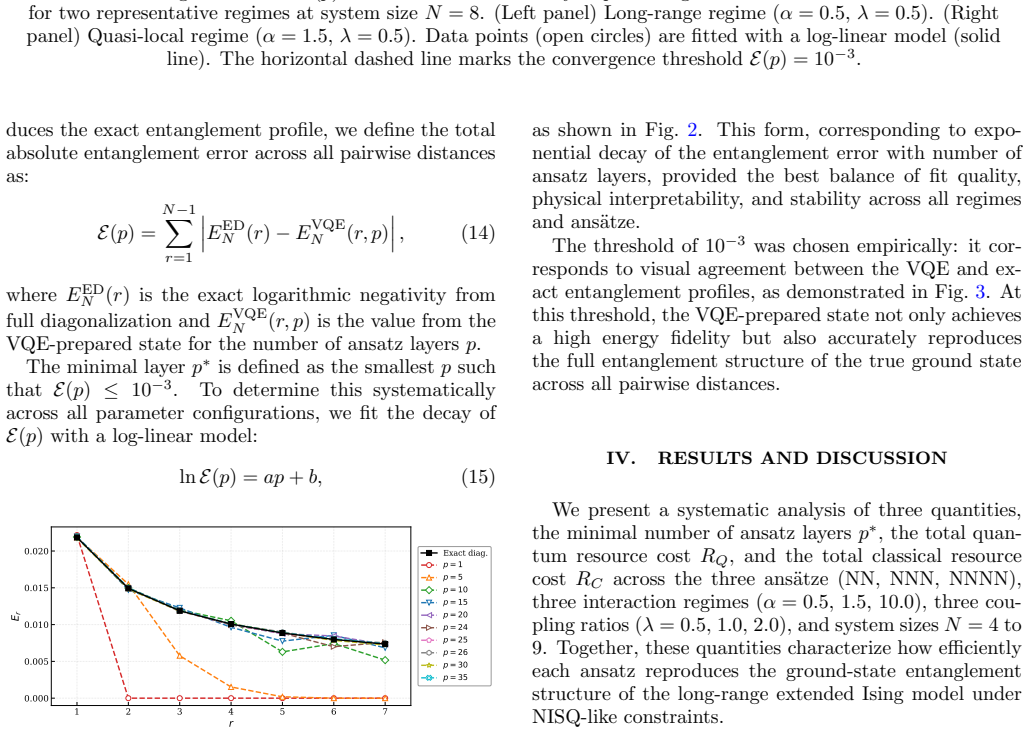
Together, these quantities characterize how efficiently each ansatz reproduces the ground-state entanglement structure of the long-range extended Ising model under NISQ-like constraints. A. Minimal Ansatz Layers The minimal number of layersp ∗ is defined as the smallest number of ansatz layers required to reduce the total entanglement errorE(p) below 10 −...
-
[2]
S. R. White, Phys. Rev. Lett.69, 2863 (1992)
1992
-
[3]
Schollw¨ ock, Annals of Physics326, 96 (2011), january 2011 Special Issue
U. Schollw¨ ock, Annals of Physics326, 96 (2011), january 2011 Special Issue
2011
-
[4]
Eisert, M
J. Eisert, M. Cramer, and M. B. Plenio, Rev. Mod. Phys. 82, 277 (2010)
2010
-
[5]
M. B. Hastings, Journal of Statistical Mechanics: Theory and Experiment2007, P08024–P08024 (2007)
2007
-
[6]
Calabrese and J
P. Calabrese and J. Cardy, Journal of Statistical Mechan- ics: Theory and Experiment2004, P06002 (2004)
2004
-
[7]
Koffel, M
T. Koffel, M. Lewenstein, and L. Tagliacozzo, Phys. Rev. Lett.109, 267203 (2012)
2012
-
[8]
Vodola, L
D. Vodola, L. Lepori, E. Ercolessi, A. V. Gorshkov, and 11 G. Pupillo, Phys. Rev. Lett.113, 156402 (2014)
2014
-
[9]
Vodola, L
D. Vodola, L. Lepori, E. Ercolessi, and G. Pupillo, New Journal of Physics18, 015001 (2015)
2015
-
[10]
Defenu, T
N. Defenu, T. Donner, T. Macr` ı, G. Pagano, S. Ruffo, and A. Trombettoni, Rev. Mod. Phys.95, 035002 (2023)
2023
-
[11]
Hauke and L
P. Hauke and L. Tagliacozzo, Phys. Rev. Lett.111, 207202 (2013)
2013
-
[12]
J. W. Britton, B. C. Sawyer, A. C. Keith, C.-C. J. Wang, J. K. Freericks, H. Uys, M. J. Biercuk, and J. J. Bollinger, Nature484, 489–492 (2012)
2012
-
[13]
Monroe, W
C. Monroe, W. C. Campbell, L.-M. Duan, Z.-X. Gong, A. V. Gorshkov, P. W. Hess, R. Islam, K. Kim, N. M. Linke, G. Pagano, P. Richerme, C. Senko, and N. Y. Yao, Rev. Mod. Phys.93, 025001 (2021)
2021
-
[14]
Keesling, A
A. Keesling, A. Omran, H. Levine, H. Bernien, H. Pich- ler, S. Choi, R. Samajdar, S. Schwartz, P. Silvi, S. Sachdev, P. Zoller, M. Endres, M. Greiner, V. Vuleti´ c, and M. D. Lukin, Nature568, 207–211 (2019)
2019
-
[15]
Preskill, Quantum2, 79 (2018)
J. Preskill, Quantum2, 79 (2018)
2018
-
[16]
Nature Communications5(1), 4213 (2014) https://doi.org/ 10.1038/ncomms5213
A. Peruzzo, J. McClean, P. Shadbolt, M.-H. Yung, X.-Q. Zhou, P. J. Love, A. Aspuru-Guzik, and J. L. O’Brien, Nature Communications5(2014), 10.1038/ncomms5213
-
[17]
J. R. McClean, J. Romero, R. Babbush, and A. Aspuru- Guzik, New Journal of Physics18, 023023 (2016)
2016
-
[18]
Tilly, H
J. Tilly, H. Chen, S. Cao, D. Picozzi, K. Setia, Y. Li, E. Grant, L. Wossnig, I. Rungger, G. H. Booth, and J. Tennyson, Physics Reports986, 1–128 (2022)
2022
-
[19]
Cerezo, A
M. Cerezo, A. Arrasmith, R. Babbush, S. C. Benjamin, S. Endo, K. Fujii, J. R. McClean, K. Mitarai, X. Yuan, L. Cincio, and P. J. Coles, Nature Reviews Physics3, 625–644 (2021)
2021
-
[20]
Boixo, S
S. Boixo, S. V. Isakov, V. N. Smelyanskiy, R. Babbush, N. Ding, Z. Jiang, M. J. Bremner, J. M. Martinis, and H. Neven, Nature Physics14, 595–600 (2018)
2018
-
[21]
Kottmann, Tim Menke, Wai-Keong Mok, Sukin Sim, Leong-Chuan Kwek, and Al´ an Aspuru-Guzik
K. Bharti, A. Cervera-Lierta, T. H. Kyaw, T. Haug, S. Alperin-Lea, A. Anand, M. Degroote, H. Heimonen, J. S. Kottmann, T. Menke, W.-K. Mok, S. Sim, L.-C. Kwek, and A. Aspuru-Guzik, Reviews of Modern Physics 94(2022), 10.1103/revmodphys.94.015004
-
[22]
Kokail, C
C. Kokail, C. Maier, R. van Bijnen, T. Brydges, M. K. Joshi, P. Jurcevic, C. A. Muschik, P. Silvi, R. Blatt, C. F. Roos, and P. Zoller, Nature569, 355–360 (2019)
2019
-
[23]
Kandala, A
A. Kandala, A. Mezzacapo, K. Temme, M. Takita, M. Brink, J. M. Chow, and J. M. Gambetta, Nature 549, 242–246 (2017)
2017
-
[24]
J. R. McClean, S. Boixo, V. N. Smelyanskiy, R. Bab- bush, and H. Neven, Nature Communications9(2018), 10.1038/s41467-018-07090-4
-
[25]
Wecker, M
D. Wecker, M. B. Hastings, and M. Troyer, Phys. Rev. A92, 042303 (2015)
2015
-
[26]
H. R. Grimsley, S. E. Economou, E. Barnes, and N. J. Mayhall, Nature Communications10(2019), 10.1038/s41467-019-10988-2
-
[27]
S. Sim, P. D. Johnson, and A. Aspuru-Guzik, Advanced Quantum Technologies2(2019), 10.1002/qute.201900070
-
[28]
Kim and Y
J. Kim and Y. Oz, Phys. Rev. A106, 052424 (2022)
2022
-
[29]
Q. Li, C. Mukhopadhyay, and A. Bayat, Phys. Rev. Res. 5, 043175 (2023)
2023
-
[30]
L. G. C. Lakkaraju, S. Ghosh, D. Sadhukhan, and A. Sen(De), Phys. Rev. A106, 052425 (2022)
2022
-
[31]
Vidal and R
G. Vidal and R. F. Werner, Phys. Rev. A65, 032314 (2002)
2002
-
[32]
M. B. Plenio, Phys. Rev. Lett.95, 090503 (2005)
2005
-
[33]
Coffman, J
V. Coffman, J. Kundu, and W. K. Wootters, Phys. Rev. A61, 052306 (2000)
2000
-
[34]
T. J. Osborne and F. Verstraete, Phys. Rev. Lett.96, 220503 (2006)
2006
-
[35]
E. Lieb, T. Schultz, and D. Mattis, Annals of Physics 16, 407 (1961)
1961
-
[36]
Peres, Phys
A. Peres, Phys. Rev. Lett.77, 1413 (1996)
1996
-
[37]
M. Kac, G. E. Uhlenbeck, and P. C. Hemmer, Journal of Mathematical Physics4, 216 (1963)
1963
-
[38]
R. H. Byrd, P. Lu, J. Nocedal, and C. Zhu, SIAM Journal on Scientific Computing16, 1190 (1995)
1995
-
[39]
Liuet al., Quantum7, 899 (2023)
J.-B. Liuet al., Quantum7, 899 (2023)
2023
-
[40]
Qiskit: An open-source frame- work for quantum computing,
G. Aleksandrowiczet al., “Qiskit: An open-source frame- work for quantum computing,” (2019)
2019
-
[41]
W. K. Wootters, Phys. Rev. Lett.80, 2245 (1998)
1998
-
[42]
Temme, S
K. Temme, S. Bravyi, and J. M. Gambetta, Phys. Rev. Lett.119, 180509 (2017)
2017
-
[43]
Z. Cai, R. Babbush, S. C. Benjamin, S. Endo, W. J. Huggins, Y. Li, J. R. McClean, and T. E. O’Brien, Rev. Mod. Phys.95, 045005 (2023)
2023
-
[44]
R. Puig, M. Drudis, S. Thanasilp, and Z. Holmes, PRX Quantum6, 010317 (2025)
2025
discussion (0)
Sign in with ORCID, Apple, or X to comment. Anyone can read and Pith papers without signing in.