Recognition: unknown
Three loop QCD corrections to electroweak radiative parameters
Pith reviewed 2026-05-10 04:03 UTC · model grok-4.3
The pith
Three-loop QCD corrections shift the predicted W boson mass in a way relevant to future precision collider measurements.
A machine-rendered reading of the paper's core claim, the machinery that carries it, and where it could break.
Core claim
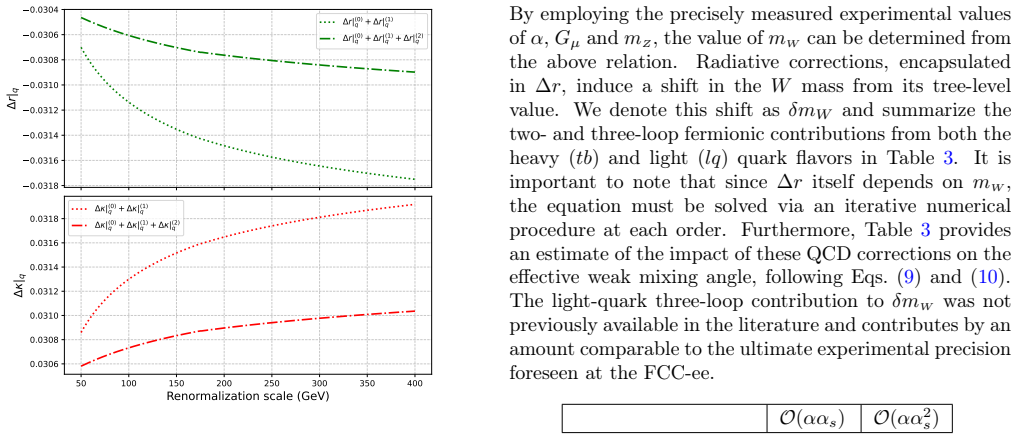
We reevaluate the vacuum polarization functions for electroweak gauge bosons at three loops in QCD, employing state-of-the-art perturbative techniques. We apply these results to determine the O(α α_s²) corrections to the electroweak radiative parameters Δρ, Δr and Δκ. We improve the accuracy of the calculation at this perturbative order, compared to the existing literature, and present some phenomenological implications of these results. We find a shift in the prediction of the W boson mass, significant in view of the FCC precision targets. We improve the prediction of the MS-bar electric charge at q²=m_Z² with the inclusion of these O(α α_s²) corrections.
What carries the argument
Three-loop QCD contributions to the vacuum polarization functions Π(q²) of the W and Z bosons, which enter the definitions of the radiative parameters Δρ, Δr, and Δκ.
If this is right
- A shift appears in the predicted value of the W boson mass that must be accounted for at the precision level targeted by the FCC.
- The MS-bar electric charge is predicted more precisely at the scale q² = m_Z².
- The parameters Δρ, Δr, and Δκ receive complete three-loop QCD corrections from the reevaluated vacuum polarizations.
- These updates affect the interpretation of electroweak precision data in searches for beyond-Standard-Model effects.
Where Pith is reading between the lines
- The shift in W mass could be compared against direct measurements to test consistency of the Standard Model at higher orders.
- Extending the same methods to four-loop order might become necessary once FCC data arrives.
- These corrections could be implemented in public codes for electroweak fits to allow broader use by the community.
Load-bearing premise
The reevaluation of the vacuum polarization functions at three loops using state-of-the-art perturbative techniques accurately captures all relevant QCD contributions without uncontrolled higher-order terms or numerical artifacts.
What would settle it
A fully independent recalculation of the three-loop vacuum polarization functions or of the resulting shift in the W boson mass using an alternative computational approach would verify or contradict the reported values.
Figures


read the original abstract
We reevaluate the vacuum polarization functions for electroweak gauge bosons at three loops in QCD, employing state-of-the-art perturbative techniques. We apply these results to determine the ${\mathcal{O}}(\alpha \alpha_s^2)$ corrections to the electroweak radiative parameters $\Delta\rho$, $\Delta r$ and $\Delta \kappa$. We improve the accuracy of the calculation at this perturbative order, compared to the existing literature, and present some phenomenological implications of these results. We find a shift in the prediction of the $W$ boson mass, significant in view of the FCC precision targets. We improve the prediction of the $\overline{\mathrm{MS}}$ electric charge at $q^2=m_Z^2$ with the inclusion of these ${\mathcal{O}}(\alpha \alpha_s^2)$ corrections.
Editorial analysis
A structured set of objections, weighed in public.
Referee Report
Summary. The manuscript reevaluates the vacuum polarization functions of the electroweak gauge bosons at three-loop order in QCD using state-of-the-art perturbative techniques. These results are used to compute the O(α α_s²) corrections to the electroweak radiative parameters Δρ, Δr and Δκ. The paper reports an improvement in accuracy relative to prior literature and presents phenomenological implications, including a shift in the predicted W-boson mass that is stated to be relevant for FCC precision targets and an improved value for the MS-bar electric charge at q² = m_Z².
Significance. If the central numerical results hold, the work supplies a higher-order QCD correction that reduces theoretical uncertainty in key electroweak precision observables. This is directly relevant to the interpretation of future high-precision measurements at the FCC-ee, where the quoted shift in m_W could affect sensitivity to new physics. The adoption of established three-loop methods (IBP reduction, MS-bar renormalization, top-mass effects) is a methodological strength that supports reproducibility of the perturbative evaluation.
minor comments (3)
- [Abstract] The abstract asserts an improvement in accuracy at this perturbative order but does not quantify the reduction in uncertainty relative to the previous literature; a brief numerical comparison in the introduction or results section would strengthen the claim.
- [Phenomenological implications] Phenomenological implications for the W-mass shift are discussed qualitatively; inclusion of a compact table (or explicit numerical values with error estimates) comparing the new and prior predictions for m_W and the MS-bar charge would improve clarity and allow direct assessment of the FCC relevance.
- [Calculation section] The manuscript refers to 'state-of-the-art perturbative techniques' without a short summary of the specific reduction and numerical integration methods employed; a one-paragraph outline in §2 or §3 would aid readers outside the immediate subfield.
Simulated Author's Rebuttal
We thank the referee for the positive assessment of our manuscript, the recognition of its methodological approach, and the recommendation for minor revision. The referee's summary correctly reflects the scope and phenomenological relevance of the three-loop QCD corrections to the electroweak parameters.
Circularity Check
No significant circularity; direct perturbative evaluation of new three-loop corrections
full rationale
The paper performs a standard reevaluation of vacuum polarization functions at three loops in QCD using established techniques (integration-by-parts reduction, MS-bar renormalization, top-mass effects) and applies the resulting O(α α_s²) terms to Δρ, Δr, Δκ and m_W predictions. No step reduces by construction to a fitted parameter, self-defined quantity, or load-bearing self-citation; the central results are new higher-order contributions computed from first principles and independent of the target observables. This matches the default expectation of a non-circular perturbative calculation.
Axiom & Free-Parameter Ledger
axioms (1)
- standard math Standard perturbative expansion of QCD and electroweak gauge theory to three loops
Reference graph
Works this paper leans on
- [1]
-
[2]
Future Circular Collider Feasibility Study Report: Vol- ume 1, Physics, Experiments, Detectors,
M. Benediktet al.(FCC), Eur. Phys. J. C85, 1468 (2025), arXiv:2505.00272 [hep-ex]
-
[3]
Freitaset al., (2019), arXiv:1906.05379 [hep-ph]
A. Freitaset al., (2019), arXiv:1906.05379 [hep-ph]
- [4]
- [5]
-
[6]
C. Duhr and B. Mistlberger, JHEP03, 116 (2022), arXiv:2111.10379 [hep-ph]
-
[7]
R. Bonciani, L. Buonocore, M. Grazzini, S. Kallweit, N. Rana, F. Tramontano, and A. Vicini, Phys. Rev. Lett.128, 012002 (2022), arXiv:2106.11953 [hep-ph]
-
[8]
F. Buccioni, F. Caola, H. A. Chawdhry, F. De- voto, M. Heller, A. von Manteuffel, K. Melnikov, R. Röntsch, and C. Signorile-Signorile, JHEP06, 022 (2022), arXiv:2203.11237 [hep-ph]
-
[9]
S. Dittmaier, A. Huss, and J. Schwarz, JHEP05, 170 (2024), arXiv:2401.15682 [hep-ph]
-
[10]
T. Armadillo, R. Bonciani, L. Buonocore, S. Devoto, M. Grazzini, S. Kallweit, N. Rana, and A. Vicini, JHEP07, 141 (2025), arXiv:2412.16095 [hep-ph]
-
[11]
T. Armadillo, S. Devoto, M. Dradi, and A. Vicini, (2025), arXiv:2511.20365 [hep-ph]
- [12]
- [13]
- [14]
-
[15]
Sirlin, Phys
A. Sirlin, Phys. Rev. D22, 971 (1980)
1980
-
[16]
A. Freitas, W. Hollik, W. Walter, and G. Weiglein, Phys.Lett.B495,338(2000),[Erratum: Phys.Lett.B 570, 265 (2003)], arXiv:hep-ph/0007091
-
[17]
M. Awramik and M. Czakon, Phys. Rev. Lett.89, 241801 (2002), arXiv:hep-ph/0208113
-
[18]
M. Awramik, M. Czakon, A. Onishchenko, and O. Veretin, Phys. Rev. D68, 053004 (2003), arXiv:hep-ph/0209084
-
[19]
A. Onishchenko and O. Veretin, Phys. Lett. B551, 111 (2003), arXiv:hep-ph/0209010 . 7
-
[20]
M. Awramik and M. Czakon, Phys. Lett. B568, 48 (2003), arXiv:hep-ph/0305248
-
[21]
M. Awramik, M. Czakon, A. Freitas, and G. Wei- glein, Phys. Rev. D69, 053006 (2004), arXiv:hep- ph/0311148
-
[22]
Djouadi, Nuovo Cim
A. Djouadi, Nuovo Cim. A100, 357 (1988)
1988
-
[23]
B. A. Kniehl, J. H. Kuhn, and R. G. Stuart, Phys. Lett. B214, 621 (1988)
1988
-
[24]
B. A. Kniehl, Nucl. Phys. B347, 86 (1990)
1990
-
[25]
B. A. Kniehl and A. Sirlin, Nucl. Phys. B371, 141 (1992)
1992
-
[26]
A. Djouadi and P. Gambino, Phys. Rev. D49, 3499 (1994), [Erratum: Phys.Rev.D 53, 4111 (1996)], arXiv:hep-ph/9309298
- [27]
- [28]
- [29]
- [30]
- [31]
-
[32]
Y. Schroder and M. Steinhauser, Phys. Lett. B622, 124 (2005), arXiv:hep-ph/0504055
- [33]
-
[34]
R. Boughezal and M. Czakon, Nucl. Phys. B755, 221 (2006), arXiv:hep-ph/0606232
-
[35]
L. Chen and A. Freitas, JHEP03, 215 (2021), arXiv:2012.08605 [hep-ph]
-
[36]
I. Dubovyk, A. Freitas, J. Gluza, and J. Usovitsch, (2026), arXiv:2603.06571 [hep-ph]
-
[37]
I. Dubovyk, A. Freitas, J. Gluza, T. Riemann, and J. Usovitsch, Phys. Lett. B783, 86 (2018), arXiv:1804.10236 [hep-ph]
-
[38]
Navaset al.(Particle Data Group), Phys
S. Navaset al.(Particle Data Group), Phys. Rev. D 110, 030001 (2024)
2024
-
[39]
de Blas,et al.doi:10.23731/CYRM-2025-008 [arXiv:2511.03883 [hep-ex]]
J. de Blaset al., (2025), 10.23731/CYRM-2025-008, arXiv:2511.03883 [hep-ex]
- [40]
-
[41]
E. Bagnaschi and A. Vicini, Phys. Rev. Lett.126, 041801 (2021), arXiv:1910.04726 [hep-ph]
-
[42]
L. Rottoli, P. Torrielli, and A. Vicini, Eur. Phys. J. C83, 948 (2023), arXiv:2301.04059 [hep-ph]
-
[43]
Amorosoet al.[LHC-TeV MW Working Group], Eur
S. Amorosoet al.(LHC-TeV MW Working Group), Eur. Phys. J. C84, 451 (2024), arXiv:2308.09417 [hep-ex]
-
[44]
Schaelet al.(ALEPH and DELPHI and L3 and OPAL and SLD), Phys
S. Schaelet al.(ALEPH, DELPHI, L3, OPAL, SLD, LEP Electroweak Working Group, SLD Electroweak Group, SLD Heavy Flavour Group), Phys. Rept.427, 257 (2006), arXiv:hep-ex/0509008
-
[45]
Abadaet al.(FCC), Eur
A. Abadaet al.(FCC), Eur. Phys. J. C79, 474 (2019)
2019
-
[46]
W. J. Marciano and A. Sirlin, Phys. Rev. D22, 2695 (1980), [Erratum: Phys.Rev.D 31, 213 (1985)]
1980
-
[47]
G. Degrassi and A. Vicini, Phys. Rev. D69, 073007 (2004), arXiv:hep-ph/0307122
-
[48]
S. Dittmaier, Phys. Rev. D103, 053006 (2021), arXiv:2101.05154 [hep-ph]
- [49]
-
[50]
G. Degrassi, P. Gambino, and P. P. Giardino, JHEP 05, 154 (2015), arXiv:1411.7040 [hep-ph]
-
[51]
Degrassi and A
G. Degrassi and A. Sirlin, Nucl. Phys. B352, 342 (1991)
1991
- [52]
-
[53]
G. Degrassi, P. Gambino, and A. Sirlin, Phys. Lett. B394, 188 (1997), arXiv:hep-ph/9611363
-
[54]
R. Bonciani, F. Buccioni, N. Rana, I. Triscari, and A. Vicini, Phys. Rev. D101, 031301 (2020), arXiv:1911.06200 [hep-ph]
-
[55]
R. Bonciani, F. Buccioni, N. Rana, and A. Vicini, Phys. Rev. Lett.125, 232004 (2020), arXiv:2007.06518 [hep-ph]
-
[56]
Nogueira, J
P. Nogueira, J. Comput. Phys.105, 279 (1993)
1993
-
[57]
M. Tentyukov and J. A. M. Vermaseren, Com- put. Phys. Commun.181, 1419 (2010), arXiv:hep- ph/0702279 . 8
-
[58]
F. V. Tkachov, Phys. Lett. B100, 65 (1981)
1981
-
[59]
K. G. Chetyrkin and F. V. Tkachov, Nucl. Phys. B 192, 159 (1981)
1981
-
[60]
Laporta,High-precision calculation of multiloop Feynman integrals by difference equations,Int
S. Laporta, Int. J. Mod. Phys. A15, 5087 (2000), arXiv:hep-ph/0102033
-
[61]
P. Maierhöfer, J. Usovitsch, and P. Uwer, Comput. Phys. Commun.230, 99 (2018), arXiv:1705.05610 [hep-ph]
-
[62]
J. Klappert, F. Lange, P. Maierhöfer, and J. Uso- vitsch, Comput. Phys. Commun.266, 108024 (2021), arXiv:2008.06494 [hep-ph]
- [63]
-
[64]
R. N. Lee, (2012), arXiv:1212.2685 [hep-ph]
work page Pith review arXiv 2012
- [65]
-
[66]
Ferguson and D
H. Ferguson and D. Bailey, (1992)
1992
- [67]
-
[68]
X. Liu and Y.-Q. Ma, Comput. Phys. Commun.283, 108565 (2023), arXiv:2201.11669 [hep-ph]
-
[69]
D. J. Broadhurst, Zeitschrift für Physik C Particles and Fields54, 599 (1992)
1992
-
[70]
Kalmykov, Nuclear Physics B718, 276–292 (2005)
M. Kalmykov, Nuclear Physics B718, 276–292 (2005)
2005
- [71]
-
[72]
Schröder and A
Y. Schröder and A. Vuorinen, Journal of High Energy Physics2005, 051–051 (2005)
2005
-
[73]
D. J. Broadhurst, N. Gray, and K. Schilcher, Z. Phys. C52, 111 (1991)
1991
-
[74]
K. Melnikov and T. van Ritbergen, Nucl. Phys. B 591, 515 (2000), arXiv:hep-ph/0005131
-
[75]
P. Marquard, L. Mihaila, J. H. Piclum, and M. Stein- hauser, Nucl. Phys. B773, 1 (2007), arXiv:hep- ph/0702185
-
[76]
J. Erler and R. Ferro-Hernandez, JHEP12, 131 (2023), arXiv:2308.05740 [hep-ph]
- [77]
-
[78]
Consoli, W
M. Consoli, W. Hollik, and F. Jegerlehner, Phys. Lett. B227, 167 (1989). 9
1989
discussion (0)
Sign in with ORCID, Apple, or X to comment. Anyone can read and Pith papers without signing in.