Recognition: unknown
AtomTwin.jl: a physics-native digital twin framework for neutral-atom quantum processors
Pith reviewed 2026-05-10 05:12 UTC · model grok-4.3
The pith
AtomTwin.jl models neutral-atom quantum processors natively from physical geometry and parameters without manual Hamiltonians.
A machine-rendered reading of the paper's core claim, the machinery that carries it, and where it could break.
Core claim
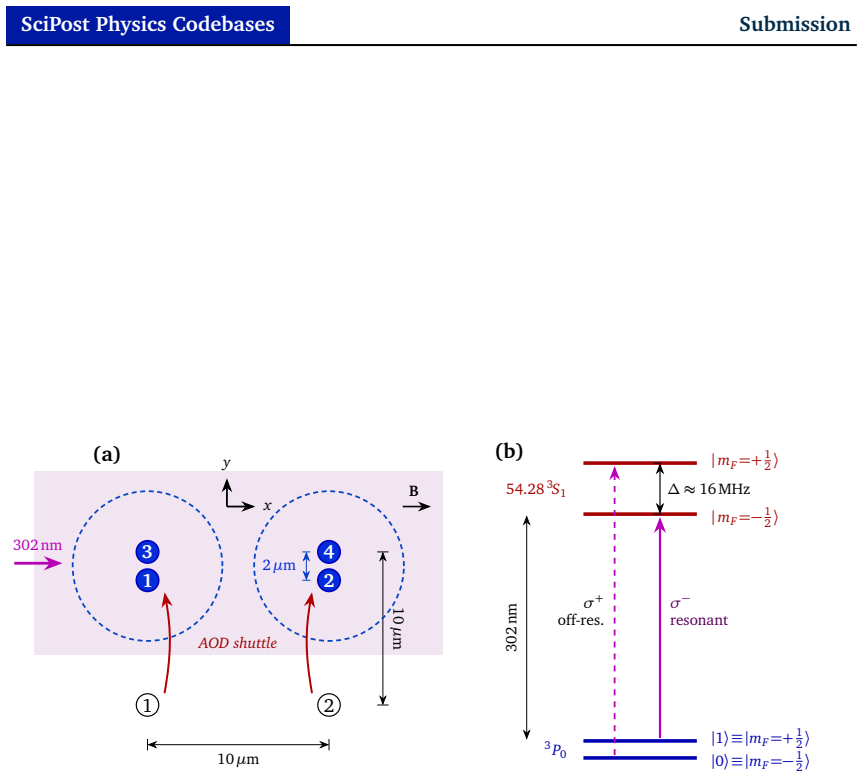
AtomTwin.jl is a physics-native digital twin framework that models atoms, optical tweezers, laser fields, atomic motion, interactions, and noise processes natively from physical geometry and parameters. It provides hardware-level instruction sequences, high-performance solvers for coupled quantum and classical dynamics, and a ready-to-use model for ytterbium-171 atoms in an extensible framework. This is demonstrated in an end-to-end application preparing a logical Bell state in the [[4,2,2]] error-detecting code with four ^{171}Yb atoms in moveable tweezers.
What carries the argument
The native modeling from physical geometry and parameters that generates the quantum and classical dynamics without requiring manual Hamiltonian definitions.
If this is right
- Quantum protocols can be developed using hardware-level instruction sequences for neutral-atom devices.
- High-performance simulation of coupled quantum and classical dynamics is enabled for the modeled systems.
- The framework supports demonstration of logical Bell state preparation in error-detecting codes with ytterbium atoms.
- Extensible design accommodates additional atomic species and hardware components.
- Performance is benchmarked against existing simulation toolboxes.
Where Pith is reading between the lines
- Such direct physical modeling could allow for more reliable virtual prototyping of quantum hardware configurations.
- Future extensions might link the digital twin to experimental feedback for adaptive protocol optimization.
- Analogous frameworks could be developed for other quantum hardware types to improve simulation fidelity.
- The demonstrated application suggests potential for scaling to larger error-corrected quantum computations in neutral atoms.
Load-bearing premise
That simulations constructed directly from physical geometry and parameters produce sufficiently accurate dynamics for useful digital-twin predictions without additional fitting or manual adjustments.
What would settle it
Comparing the simulated fidelity or state preparation success for the logical Bell state using four ytterbium atoms to the results of a corresponding physical experiment on actual hardware; a large discrepancy would indicate the modeling is not accurate enough.
Figures




read the original abstract
AtomTwin$.$jl is an open-source Julia package for developing and simulating quantum protocols, hardware configurations and building digital twins for neutral-atom quantum processors and related atomic quantum devices. AtomTwin operates between mathematical models and physical devices; modeling atoms, optical tweezers, laser fields, atomic motion, interactions, and noise processes natively from physical geometry and parameters, without requiring users to define Hamiltonians manually. The package provides hardware-level instruction sequences, high-performance solvers for coupled quantum and classical dynamics, and a ready-to-use model for ytterbium-171 atoms in an extensible framework designed to accommodate a greater variety of atomic species and hardware components in the future. This paper describes the software architecture, performance benchmarks against existing toolboxes, and a demonstrated end-to-end application: preparation of a logical Bell state in the $[[4,2,2]]$ error-detecting code with four $^{171}$Yb atoms in moveable tweezers.
Editorial analysis
A structured set of objections, weighed in public.
Referee Report
Summary. The paper introduces AtomTwin.jl, an open-source Julia package for simulating quantum protocols and building digital twins for neutral-atom quantum processors. It models atoms, optical tweezers, laser fields, atomic motion, interactions, and noise processes natively from physical geometry and parameters without requiring manual Hamiltonian definitions. The manuscript describes the software architecture, provides performance benchmarks against existing toolboxes, and demonstrates an end-to-end in-silico simulation of logical Bell state preparation in the [[4,2,2]] error-detecting code using four 171Yb atoms in movable tweezers.
Significance. If the native modeling approach proves accurate, the package could provide a valuable open-source resource for neutral-atom quantum hardware design and protocol development by enabling direct simulation from physical parameters and supporting coupled quantum-classical dynamics. The extensible framework for additional atomic species and the benchmarks are constructive contributions. However, the digital-twin utility depends on unvalidated predictive accuracy, which reduces the current significance for practical hardware applications.
major comments (1)
- End-to-end demonstration section: the logical Bell state preparation is presented as a pure simulation with no direct comparison of simulated fidelities, motional effects, or noise-induced errors to experimental data from 171Yb neutral-atom hardware. This is load-bearing for the central claim that native derivation from geometry and parameters yields dynamics accurate enough for useful digital-twin predictions without additional fitting.
minor comments (2)
- Abstract and introduction: the description of the 'ready-to-use model for ytterbium-171 atoms' lacks explicit specification of the atomic levels, transitions, or interaction parameters employed, which would aid reproducibility.
- Performance benchmarks section: additional details on the exact test cases, solver tolerances, and hardware configurations used in comparisons to other toolboxes would strengthen the evaluation.
Simulated Author's Rebuttal
We thank the referee for their constructive review of our manuscript on AtomTwin.jl. We address the single major comment below and describe the revisions we will make to better contextualize the scope of the work.
read point-by-point responses
-
Referee: End-to-end demonstration section: the logical Bell state preparation is presented as a pure simulation with no direct comparison of simulated fidelities, motional effects, or noise-induced errors to experimental data from 171Yb neutral-atom hardware. This is load-bearing for the central claim that native derivation from geometry and parameters yields dynamics accurate enough for useful digital-twin predictions without additional fitting.
Authors: We agree that the demonstration is a pure in-silico simulation and contains no direct comparison to experimental fidelities, motional effects, or noise-induced errors from 171Yb neutral-atom hardware. The manuscript presents AtomTwin.jl as a simulation framework that derives models natively from physical geometry and parameters; the logical Bell state example illustrates the end-to-end workflow and coupled quantum-classical dynamics, while separate benchmarks compare performance against existing toolboxes. The paper does not claim that these particular simulated results have been validated against experiment or that the framework yields accurate predictions without any fitting. To address the concern, we will add a dedicated paragraph in a new 'Limitations and Future Directions' subsection (or expand the conclusions) that explicitly states the current lack of experimental benchmarking for this protocol, notes that full digital-twin predictive utility requires such validation, and outlines how the framework is structured to support future comparisons once corresponding hardware data become available. This revision clarifies the contribution without altering the technical content of the demonstration. revision: partial
- We cannot supply a direct comparison of the simulated fidelities or motional effects to experimental data from 171Yb hardware in the revised manuscript, as no such corresponding experimental results for the specific [[4,2,2]] movable-tweezer implementation are available to the authors at this time.
Circularity Check
Software framework description contains no circular derivations or predictions
full rationale
The manuscript is a software description of the AtomTwin.jl package, detailing its architecture, solvers, and an in-silico demonstration of logical Bell state preparation. It claims native modeling from physical geometry and parameters but presents no mathematical derivations, first-principles predictions, or fitted parameters that reduce to inputs by construction. No self-citations, uniqueness theorems, or ansatzes are invoked in a load-bearing way. The central claim is an implementation choice for the toolbox, not a derived result equivalent to its inputs. This is self-contained software documentation with no qualifying circular steps.
Axiom & Free-Parameter Ledger
axioms (1)
- standard math Standard quantum mechanics and atomic physics for modeling atoms, interactions, and noise
Reference graph
Works this paper leans on
-
[1]
and Pupillo, Guido and Puri, Shruti and Thompson, Jeff D
Ma, Shuo and Liu, Genyue and Peng, Pai and Zhang, Bichen and Jandura, Sven and Claes, Jahan and Burgers, Alex P. and Pupillo, Guido and Puri, Shruti and Thompson, Jeff D. , title =. Nature , volume =. 2023 , doi =
2023
-
[2]
and Sherman, J
Hinkley, N. and Sherman, J. A. and Phillips, N. B. and Schioppo, M. and Lemke, N. D. and Beloy, K. and Pizzocaro, M. and Oates, C. W. and Ludlow, A. D. , title =. Science , volume =. 2013 , doi =
2013
-
[3]
and Johnson, T
Urban, E. and Johnson, T. A. and Henage, T. and Isenhower, L. and Yavuz, D. D. and Walker, T. G. and Saffman, M. , title =. Nature Physics , volume =. 2009 , doi =
2009
-
[4]
and Miroshnychenko, Y
Gaëtan, A. and Miroshnychenko, Y. and Wilk, T. and Chotia, A. and Viteau, M. and Comparat, D. and Pillet, P. and Browaeys, A. and Grangier, P. , title =. Nature Physics , volume =. 2009 , doi =
2009
-
[5]
1997 , url =
Gottesman, Daniel , title =. 1997 , url =
1997
-
[6]
Quantum , volume =
Jandura, Sven and Pupillo, Guido , title =. Quantum , volume =. 2022 , doi =
2022
-
[7]
Peper, M. and Wang, Y. and Reed, D. S. and Dinesan, V. and Pahl, E. and Saez-Mollejo, J. and Kaufman, A. M. and Covey, J. P. and Ye, J. , title =. arXiv:2406.01482 , year =
-
[8]
Calculation of
Weber, Sebastian and Tresp, Christoph and Menke, Henri and Urvoy, Alban and Firstenberg, Ofer and Büchler, Hans Peter and Hofferberth, Sebastian , journal =. Calculation of. 2017 , doi =
2017
-
[9]
2018 , doi =
Krämer, Sebastian and Plankensteiner, David and Ostermann, Laurin and Ritsch, Helmut , journal =. 2018 , doi =
2018
-
[10]
Quantum , volume =
Pulser: An open-source package for the design of pulse sequences in programmable neutral-atom arrays , author =. Quantum , volume =. 2022 , doi =
2022
-
[12]
Computer Physics Communications , volume =. 2022 , issn =. doi:10.1016/j.cpc.2021.108166 , url =
-
[13]
Computer Physics Communications , volume =. 2012 , issn =. doi:10.1016/j.cpc.2012.02.021 , url =
-
[14]
QuTiP 5: The Quantum Toolbox in Python
arXiv:2412.04705 , publisher =. 2024 , pubstate =. doi:10.48550/arXiv.2412.04705 , author =
work page internal anchor Pith review Pith/arXiv arXiv doi:10.48550/arxiv.2412.04705 2024
-
[15]
Computer Physics Communications , volume =. 2021 , issn =. doi:10.1016/j.cpc.2020.107814 , url =
-
[16]
Designing cloud servers for lower carbon,
Wang, Hanrui and Liu, Pengyu and Tan, Daniel Bochen and Liu, Yilian and Gu, Jiaqi and Pan, David Z. and Cong, Jason and Acar, Umut A. and Han, Song , title =. Proceedings of the 51st Annual International Symposium on Computer Architecture , pages =. 2025 , isbn =. doi:10.1109/ISCA59077.2024.00030 , abstract =
-
[17]
Proceedings of the 30th Asia and South Pacific Design Automation Conference , pages =
Tan, Daniel Bochen and Lin, Wan-Hsuan and Cong, Jason , title =. Proceedings of the 30th Asia and South Pacific Design Automation Conference , pages =. 2025 , isbn =
2025
-
[18]
Wille, Robert and Berent, Lucas and Forster, Tobias and Kunasaikaran, Jagatheesan and Mato, Kevin and Peham, Tom and Quetschlich, Nils and Rovara, Damian and Sander, Aaron and Schmid, Ludwig and Schoenberger, Daniel and Stade, Yannick and Burgholzer, Lukas , year = 2024, booktitle =. The. doi:10.1109/QSW62656.2024.00013 , eprint =
-
[19]
Mateo Weill and Andrea Bertoldi and Alexandre Dareau , year=. arXiv:2105.06447 , doi=
-
[20]
2024 , journal =
Fault-tolerant quantum computation with a neutral atom processor , author =. 2024 , journal =
2024
-
[21]
2024 , journal =
Fault-Tolerant Operation and Materials Science with Neutral Atom Logical Qubits , author =. 2024 , journal =
2024
-
[22]
2026 , journal =
Velocity-Enabled Quantum Computing with Neutral Atoms , author =. 2026 , journal =
2026
-
[23]
Nielsen , title =
Michael A. Nielsen , title =. Physics Letters A , volume =. 2002 , doi =
2002
-
[24]
Wave-function approach to dissipative processes in quantum optics , author =. Phys. Rev. Lett. , volume =. 1992 , month =
1992
-
[25]
Dudin, Y. O. and Li, L. and Bariani, F. and Kuzmich, A. , title =. Nature Physics , volume =. 2012 , doi =
2012
-
[26]
H\"ohn, Tim O. and Staub, Etienne and Brochier, Guillaume and Darkwah Oppong, Nelson and Aidelsburger, Monika , journal =. State-dependent potentials for the. 2023 , month =. doi:10.1103/PhysRevA.108.053325 , url =
discussion (0)
Sign in with ORCID, Apple, or X to comment. Anyone can read and Pith papers without signing in.