Recognition: unknown
The Apple Pear Basket Problem: A Combinatorial Exploration
Pith reviewed 2026-05-10 08:02 UTC · model grok-4.3
The pith
The maximum number of baskets is the largest divisor of N that does not exceed (1 + sqrt(1 + 8N))/2.
A machine-rendered reading of the paper's core claim, the machinery that carries it, and where it could break.
Core claim
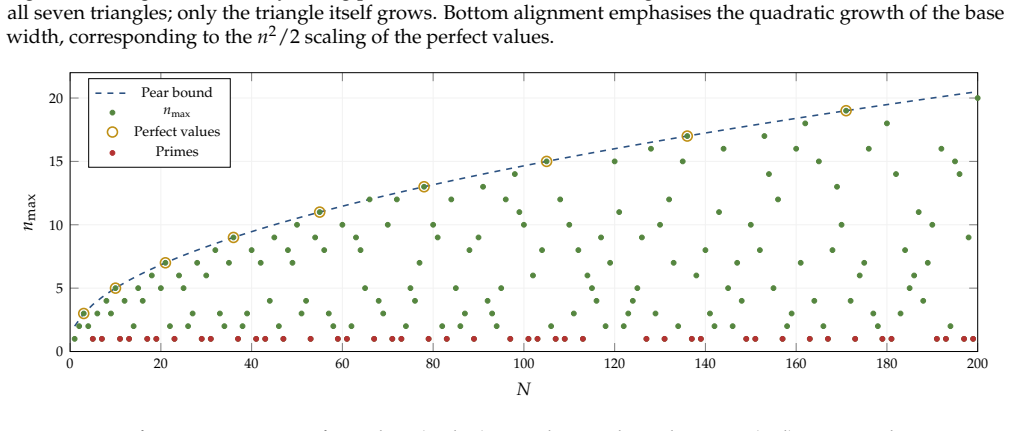
We prove that the maximum number of baskets is the largest divisor of N not exceeding (1 + sqrt(1+8N))/2. For the original puzzle with N = 60, this yields 10 baskets. The solution reveals a rich interplay between divisibility and combinatorics, leading to a natural classification of integers into perfect values, primes, and highly composite numbers according to their basket-packing efficiency. Computational results for N up to one million confirm the asymptotic growth rate of sqrt(2N), and a complete tabulation for N = 1 to 100 is included.
What carries the argument
The largest divisor of N that is at most the largest integer k satisfying k(k-1)/2 <= N. This enforces that the apples divide evenly among the baskets while the pears admit distinct non-negative integer counts whose minimal possible sum fits inside the total N.
If this is right
- The maximum basket count grows asymptotically like sqrt(2N) for large N.
- Positive integers receive a classification into perfect, prime, and highly composite types according to how efficiently they support basket packing.
- Explicit maximum values are supplied for every N from 1 to 100.
- Verification by direct computation holds through N equal to one million.
Where Pith is reading between the lines
- The same divisor-and-triangular-bound logic could be applied to variants in which the two fruit totals differ or in which basket capacities are capped.
- The efficiency classification may illuminate other divisor-constrained packing questions that arise in number theory or combinatorics.
- Checking the formula against still larger N could expose whether higher-order arithmetic constraints occasionally reduce the achievable count below the predicted divisor.
Load-bearing premise
Distinct non-negative integer pear counts summing exactly to N can always be chosen whenever their minimal possible sum is at most N and the apple count per basket is an integer.
What would settle it
An explicit distribution using strictly more baskets than the largest qualifying divisor for any chosen N, such as 11 baskets with N=60 while keeping equal apple shares and distinct pear counts.
Figures




read the original abstract
We investigate a combinatorial puzzle in which $N$ apples and $N$ pears are distributed among baskets subject to two constraints: every basket must contain the same number of apples, and every basket must contain a distinct number of pears. We prove that the maximum number of baskets is the largest divisor of $N$ not exceeding $(1 + \sqrt{1+8N})/2$. For the original puzzle with $N = 60$, this yields 10 baskets. The solution reveals a rich interplay between divisibility and combinatorics, leading to a natural classification of integers into perfect values, primes, and highly composite numbers according to their basket-packing efficiency. Computational results for $N$ up to one million confirm the asymptotic growth rate of $\sqrt{2N}$, and a complete tabulation for $N = 1$ to 100 is included.
Editorial analysis
A structured set of objections, weighed in public.
Referee Report
Summary. The paper claims to solve the Apple Pear Basket Problem by proving that the maximum number of baskets for distributing N apples and N pears—with equal apples per basket and distinct non-negative pear counts per basket—is the largest divisor of N not exceeding (1 + sqrt(1+8N))/2. For N=60 this yields 10 baskets. It includes an explicit construction achieving this bound, computational verification up to N=1e6 confirming the asymptotic sqrt(2N) growth, a complete tabulation for N=1 to 100, and a classification of integers into perfect values, primes, and highly composite numbers based on basket-packing efficiency.
Significance. If the central claim holds, the result cleanly links divisibility with the triangular-number lower bound on distinct non-negative integers, providing a parameter-free characterization and explicit construction that adds the excess pears to the largest count while preserving distinctness. The computational confirmation and small-N table are strengths for verifiability. The classification offers an interpretive extension, though its novelty depends on elaboration. The direct derivation without fitted parameters or circular definitions is a positive feature.
minor comments (3)
- Abstract: the classification of integers into 'perfect values, primes, and highly composite numbers' according to basket-packing efficiency is mentioned but lacks explicit definitions or criteria for these categories; this should be defined precisely in the main text to support the claim.
- Computational results: while verification up to N=1e6 is reported, the manuscript should describe the algorithm or method used to compute the largest qualifying divisor for each N to facilitate independent reproduction and error checking.
- Table for N=1 to 100: the reported values should be cross-checked against the formula for edge cases such as primes (where the maximum should be 1) and highly composite N to ensure consistency with the stated bound.
Simulated Author's Rebuttal
We thank the referee for their positive and accurate summary of our manuscript. The report correctly identifies the central theorem, the explicit construction, the computational verification up to N=1e6, the tabulation for small N, and the interpretive classification of integers by basket-packing efficiency. We are pleased that the direct link between divisibility and the triangular-number bound is recognized as a strength.
read point-by-point responses
-
Referee: The paper claims to solve the Apple Pear Basket Problem by proving that the maximum number of baskets for distributing N apples and N pears—with equal apples per basket and distinct non-negative pear counts per basket—is the largest divisor of N not exceeding (1 + sqrt(1+8N))/2. For N=60 this yields 10 baskets. It includes an explicit construction achieving this bound, computational verification up to N=1e6 confirming the asymptotic sqrt(2N) growth, a complete tabulation for N=1 to 100, and a classification of integers into perfect values, primes, and highly composite numbers based on basket-packing efficiency.
Authors: This is a faithful summary of the results presented in the abstract and Sections 2–5. The proof in Section 2 shows that no larger number of baskets is possible because the pear counts must be distinct non-negative integers summing to at most N (after accounting for the fixed apples), which is bounded by the triangular number T_k = k(k+1)/2. The largest divisor d of N with d ≤ (1 + sqrt(1+8N))/2 therefore maximizes k. The construction in Section 3 achieves this bound by distributing the apples equally and assigning pear counts 0,1,…,d−2 together with an adjusted final count that absorbs any excess while preserving distinctness. The computational checks and table are as described. revision: no
-
Referee: If the central claim holds, the result cleanly links divisibility with the triangular-number lower bound on distinct non-negative integers, providing a parameter-free characterization and explicit construction that adds the excess pears to the largest count while preserving distinctness. The computational confirmation and small-N table are strengths for verifiability. The classification offers an interpretive extension, though its novelty depends on elaboration.
Authors: We agree that the parameter-free characterization and the explicit construction (adding excess pears to the largest basket) are the core contributions. The classification in Section 6 arises naturally from comparing the achieved basket count to the triangular bound and to N itself; it is presented as an interpretive consequence rather than a primary claim. If the referee or editor believes further elaboration would strengthen the manuscript, we are happy to expand that section in a revision. revision: partial
Circularity Check
No significant circularity; direct combinatorial proof
full rationale
The paper derives the maximum basket count k as the largest divisor of N with k(k-1)/2 <= N by stating the two constraints (equal apples => k|N; distinct pears => minimal sum T_k) and exhibiting an explicit construction that distributes the excess pears to preserve distinctness. This is a standard necessary-and-sufficient argument with no fitted parameters, no self-citations, and no redefinition of inputs as outputs. The triangular bound is the closed-form solution to the inequality and is not smuggled in; the divisor selection is ordinary number theory. The result is self-contained against the stated assumptions.
Axiom & Free-Parameter Ledger
axioms (2)
- standard math The minimal sum of k distinct non-negative integers is 0 + 1 + ... + (k-1) = k(k-1)/2
- domain assumption The number of baskets must divide N because each basket receives the same positive integer number of apples
Reference graph
Works this paper leans on
-
[1]
G. H. Hardy and E. M. Wright,An Introduction to the Theory of Numbers, 6th ed., Oxford University Press, 2008. Chapters 16–18 cover the divisor func- tion d(n), its average order, and the distribution of divisors
2008
-
[2]
G. E. Andrews,The Theory of Partitions, Cambridge University Press, 1998. The minimum-sum lemma (Lemma 1) is a special case of results on partitions into distinct parts; see Chapter 1
1998
-
[3]
Highly composite numbers,
S. Ramanujan, “Highly composite numbers,”Pro- ceedings of the London Mathematical Society, vol. 14, pp. 347–409, 1915. The classification of integers by divisor richness in Section 4 echoes Ramanujan’s study of numbers with unusually many divisors
1915
-
[4]
T. M. Apostol,Introduction to Analytic Number The- ory, Springer, 1976. Chapters 3–4 provide a rigor- ous treatment of the prime counting function π(x) and the prime number theorem referenced in Sec- tion 4.2
1976
-
[5]
Sur la distribution des z ´eros de la fonction ζ(s) et ses cons´equences arithm´etiques,
J. Hadamard, “Sur la distribution des z ´eros de la fonction ζ(s) et ses cons´equences arithm´etiques,” Bulletin de la Soci´ et´ e Math´ ematique de France, vol. 24, pp. 199–220, 1896
-
[6]
Recherches analytiques sur la th´eorie des nombres premiers,
C.-J. de la Vall´ee Poussin, “Recherches analytiques sur la th´eorie des nombres premiers,”Annales de la Soci´ et´ e Scientifique de Bruxelles, vol. 20, pp. 183–256,
-
[7]
References [5] and [6] independently proved the prime number theorem,π(x)∼x/ lnx
-
[8]
J. H. Conway and R. K. Guy,The Book of Numbers, Copernicus (Springer), 1996. A survey of number- theoretic curiosities, including triangular numbers and related combinatorial puzzles
1996
-
[9]
Gardner,The Last Recreations: Hydras, Eggs, and Other Mathematical Mystifications, Copernicus (Springer), 1997
M. Gardner,The Last Recreations: Hydras, Eggs, and Other Mathematical Mystifications, Copernicus (Springer), 1997. A classic collection of recreational 4 0 1 2 3 4 5 6 7 8 24 Figure 6: The complete solution for N= 60: ten baskets, each containing 6 apples (red), with pears (green) distributed as {0, 1, 2, 3, 4, 5, 6, 7, 8, 24}. Every apple and pear is sho...
1997
-
[10]
Sequence A000217: Triangu- lar numbers,
OEIS Foundation, “Sequence A000217: Triangu- lar numbers,”The On-Line Encyclopedia of Integer Sequences, 2024. Available at https://oeis.org/ A000217
2024
-
[11]
Niven, H
I. Niven, H. S. Zuckerman, and H. L. Montgomery, An Introduction to the Theory of Numbers, 5th ed., Wi- ley, 1991. An alternative reference for the divisibil- ity and prime-theoretic results used in Theorem 2. 5 Table 1: Complete results forN=1 to 100 by Theorem 2. Left half:N=1 to 50. Right half:N=51 to 100. NBndn kEff Pear distributionNBndn kEff Pear di...
1991
discussion (0)
Sign in with ORCID, Apple, or X to comment. Anyone can read and Pith papers without signing in.