Recognition: unknown
Inflation from a Weyl-flat null origin
Pith reviewed 2026-05-10 05:41 UTC · model grok-4.3
The pith
Any single-field inflation where the slow-roll parameter approaches a constant between zero and one at late times shares the same Weyl-flat null past boundary.
A machine-rendered reading of the paper's core claim, the machinery that carries it, and where it could break.
Core claim
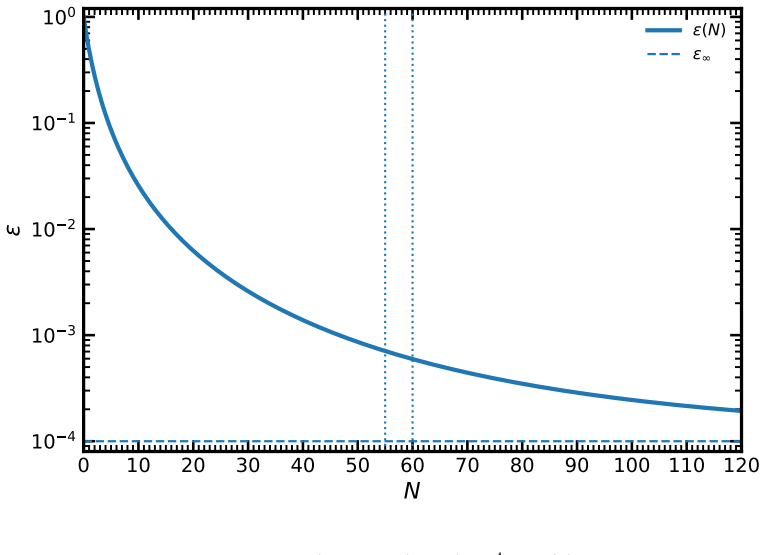
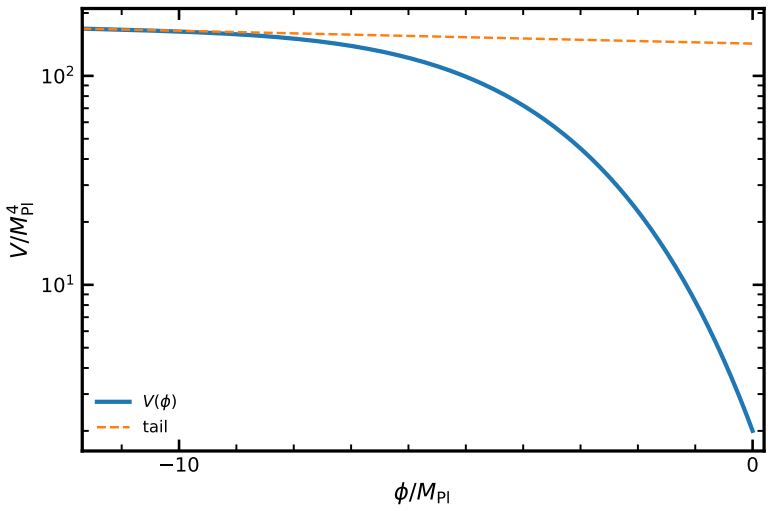
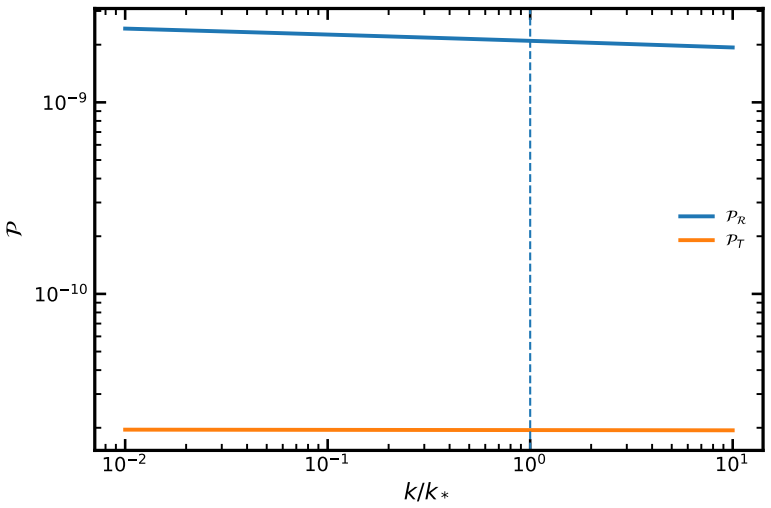
For any canonical single-field model with epsilon(N) approaching a constant epsilon_infinity in (0,1) as N to infinity, the background is asymptotically power-law, inherits the same Weyl-flat null past boundary, and reconstructs an exponential tail in field space. This origin is therefore an asymptotic universality class. A minimal deformation epsilon(N) equals epsilon_infinity plus (1 minus epsilon_infinity) times (N0 over N plus N0) to the power p, with p greater than 1, preserves the geometry, allows a smooth exit, and produces viable finite-N observables including n_s in the Planck range and r between 10 to the minus 3 and 10 to the minus 2.
What carries the argument
The minimal deformation of the first slow-roll parameter epsilon(N) = epsilon_infinity + (1 - epsilon_infinity) * (N0 / (N + N0))^p with p > 1, which keeps the asymptotic Weyl-flat null boundary while allowing a graceful exit.
If this is right
- The Weyl-flat null origin is compatible with all slow-roll models that settle to constant epsilon at late times rather than being limited to one exact solution.
- The deformed models produce a smooth exit and realistic reheating without spoiling the asymptotic boundary condition.
- Direct solution of mode equations in e-fold time yields n_s and r values inside current observational windows.
- The framework remains calculable and single-field while keeping the Penrose-compatible null origin intact.
Where Pith is reading between the lines
- If the universality holds, future tighter bounds on r could either support or rule out the entire class without needing to specify the exact early-time solution.
- The exponential tail in field space may connect to constructions in which the inflaton potential flattens at large field values.
- The same asymptotic logic could be applied to other early-universe scenarios that assume a null boundary, such as certain cyclic or ekpyrotic models.
Load-bearing premise
The specific form of the deformation of epsilon(N) preserves the Weyl-flat null geometry at early times while still permitting a smooth exit and matching observations.
What would settle it
A detection of tensor modes with r below 10 to the minus 3 combined with a scalar spectral index outside the narrow corridor predicted by the deformed epsilon(N) family, or a direct measurement showing that epsilon(N) does not approach a constant.
Figures



read the original abstract
We show that a Weyl-flat null origin of inflation need not be in tension with present observations. For canonical single-field inflation, any background with $\epsilon(N)\to \epsilon_\infty\in(0,1)$ as $N\to\infty$ is asymptotically power-law, inherits the same Weyl-flat null past boundary, and reconstructs an exponential tail in field space. This identifies the origin as an asymptotic universality class rather than a rigid exact solution. We study a minimal deformation, $\epsilon(N)=\epsilon_\infty+(1-\epsilon_\infty)\left(\frac{N_0}{N+N_0}\right)^p$ with $p>1$, which preserves the asymptotic geometry, yields a smooth exit, and produces realistic finite-$N$ phenomenology. Solving the scalar and tensor mode equations directly in e-fold time, we find a viable corridor with $n_s$ in the Planck-preferred range and $r\sim10^{-3}-10^{-2}$, including reheating-compatible benchmarks. The result is a calculable single-field framework in which a Penrose-compatible Weyl-flat inflationary origin survives as a realistic and testable possibility.
Editorial analysis
A structured set of objections, weighed in public.
Referee Report
Summary. The manuscript claims that for canonical single-field inflation, any background satisfying ε(N) → ε_∞ ∈ (0,1) as N → ∞ is asymptotically power-law, inherits a Weyl-flat null past boundary, and corresponds to an exponential tail in field space, thereby framing the Weyl-flat null origin as an asymptotic universality class rather than a specific solution. It introduces a minimal deformation ε(N) = ε_∞ + (1-ε_∞)(N0/(N+N0))^p with p > 1 that preserves the asymptotics while permitting a smooth exit, and by directly solving the scalar and tensor mode equations in e-fold time obtains a viable parameter corridor with ns in the Planck-preferred range and r ∼ 10^{-3}–10^{-2}, including reheating-compatible points.
Significance. If the central claims are substantiated, the work would identify a broad, observationally viable class of single-field models compatible with a Penrose-style Weyl-flat origin, shifting emphasis from exact solutions to controlled asymptotic behaviors. The direct numerical solution of the mode equations (rather than reliance on slow-roll approximations) and the inclusion of reheating benchmarks are constructive elements that strengthen the phenomenological side.
major comments (3)
- [Abstract and §2] Abstract and the derivation of the asymptotic background (likely §2): the assertion that 'any background with ε(N)→ε_∞∈(0,1)' is asymptotically power-law with H(N) ∼ C exp(−ε_∞ N) requires convergence of ∫^∞ [ε(s)−ε_∞] ds; this does not hold for arbitrary approaches (e.g., δϵ ∼ 1/ln N or the deformation with p ≤ 1). The integrability condition must be stated explicitly as part of the universality class, since it is necessary for the claimed inheritance of the identical Weyl-flat null boundary and exponential tail.
- [§4] Phenomenological results (likely §4): the reported viable corridor for ns and r is obtained by selecting the deformation parameters (ε_∞, N0, p) to match observations. The manuscript should provide a sensitivity scan or explicit demonstration that the corridor is robust rather than a post-hoc fit, and clarify the extent to which the framework yields genuine predictions versus parameter tuning.
- [§3] Mode-equation solution (likely §3): the central viability claim rests on direct numerical integration of the scalar and tensor modes. Without presented convergence tests, step-size error estimates, or side-by-side comparison against the standard slow-roll expressions for the same ε(N), the accuracy of the quoted ns and r values at finite N cannot be fully assessed.
minor comments (2)
- [Notation] Clarify the normalization of the e-fold coordinate N (e.g., whether N=0 corresponds to the onset of the deformation or to the end of inflation) and ensure consistent notation for the Hubble parameter and its derivatives throughout.
- [Abstract] The abstract states that the deformation 'preserves the asymptotic geometry'; a brief explicit check (e.g., showing that the Weyl tensor or null boundary condition remains unchanged at leading order) would strengthen this assertion.
Simulated Author's Rebuttal
We thank the referee for the insightful comments that help clarify and strengthen our presentation. We address each major comment point by point below.
read point-by-point responses
-
Referee: [Abstract and §2] Abstract and the derivation of the asymptotic background (likely §2): the assertion that 'any background with ε(N)→ε_∞∈(0,1)' is asymptotically power-law with H(N) ∼ C exp(−ε_∞ N) requires convergence of ∫^∞ [ε(s)−ε_∞] ds; this does not hold for arbitrary approaches (e.g., δϵ ∼ 1/ln N or the deformation with p ≤ 1). The integrability condition must be stated explicitly as part of the universality class, since it is necessary for the claimed inheritance of the identical Weyl-flat null boundary and exponential tail.
Authors: We agree with the referee that the integrability condition ∫^∞ [ε(s)−ε_∞] ds < ∞ is necessary to ensure the asymptotic power-law form H(N) ∼ C exp(−ε_∞ N) and the inheritance of the Weyl-flat null boundary. Our original statement referred to backgrounds satisfying this condition, which includes our proposed deformation for p > 1. We will revise the manuscript to explicitly include this integrability requirement in the definition of the universality class and clarify that approaches such as δϵ ∼ 1/ln N or p ≤ 1 fall outside it. This does not change the main results but improves the precision of the claim. revision: yes
-
Referee: [§4] Phenomenological results (likely §4): the reported viable corridor for ns and r is obtained by selecting the deformation parameters (ε_∞, N0, p) to match observations. The manuscript should provide a sensitivity scan or explicit demonstration that the corridor is robust rather than a post-hoc fit, and clarify the extent to which the framework yields genuine predictions versus parameter tuning.
Authors: The deformation parameters are chosen to satisfy the physical requirements of asymptotic behavior (p>1 for integrability), a smooth exit from inflation, and consistency with reheating dynamics. The viable corridor for ns and r arises naturally from exploring the allowed parameter space rather than being a post-hoc fit. To demonstrate robustness, we will include in the revision a sensitivity analysis showing the variation of ns and r with ε_∞, N0, and p within the physically allowed ranges. This will clarify that while there is parameter freedom (as in standard single-field inflation), the framework provides genuine predictions for the existence of a broad class of models compatible with both the Weyl-flat origin and current observations. revision: yes
-
Referee: [§3] Mode-equation solution (likely §3): the central viability claim rests on direct numerical integration of the scalar and tensor modes. Without presented convergence tests, step-size error estimates, or side-by-side comparison against the standard slow-roll expressions for the same ε(N), the accuracy of the quoted ns and r values at finite N cannot be fully assessed.
Authors: We recognize the need for rigorous validation of the numerical results. In the revised version, we will add convergence tests by varying the integration step size and the number of e-folds, provide estimates of numerical errors, and include direct comparisons between the numerically computed ns and r and the corresponding slow-roll approximations for the same ε(N) profiles. These additions will substantiate the accuracy of our quoted values. revision: yes
Circularity Check
No significant circularity in the derivation chain
full rationale
The paper derives the asymptotic power-law behavior directly from the definition ε(N) = −d ln H/dN together with the limit ε(N)→ε_∞, by integrating to obtain ln H(N) and showing that the resulting scale factor and field-space tail follow when the deviation integral converges. The minimal deformation is introduced explicitly with the p>1 condition chosen to enforce that convergence while permitting a smooth exit; the subsequent solution of the Mukhanov-Sasaki equations in e-fold time then produces ns and r as functions of the free parameters (ε_∞, N0, p). Scanning those parameters to locate a viable corridor is ordinary model exploration, not a reduction of the output to the input by construction. No load-bearing self-citation, imported uniqueness theorem, or ansatz smuggling appears in the chain; the central universality statement is obtained from the differential relation and boundary conditions without tautological redefinition.
Axiom & Free-Parameter Ledger
free parameters (3)
- ε_∞
- N0
- p
axioms (1)
- domain assumption Canonical single-field inflation with the given ε(N) form inherits the Weyl-flat null boundary from the asymptotic power-law behavior.
Reference graph
Works this paper leans on
-
[1]
the far past is asymptotic to power-law inflation with constantϵ∞
-
[2]
the reconstructed potential acquires an exponential tail,V (ϕ) =V0e−√2ϵ∞ϕ/MPl[1 +o(1)] asϕ→−∞
-
[3]
Proof.Integrating Eq
the background Weyl tensor vanishes identically, and the causal character of the past boundary is the same null boundary found in exact power-law inflation [16]. Proof.Integrating Eq. (8) gives lnH(N) = lnH ∞+ϵ∞N+o(1),(14) ϕ(N) =ϕ∞−MPl √2ϵ∞N+o(N),(15) where the integrability assumption ensures that the correction tolnH stays bounded at large N. Eliminatin...
-
[4]
A. H. Guth, Phys. Rev. D23, 347 (1981)
1981
-
[5]
A. D. Linde, Phys. Lett. B108, 389 (1982)
1982
-
[6]
Albrecht and P
A. Albrecht and P. J. Steinhardt, Phys. Rev. Lett.48, 1220 (1982)
1982
-
[7]
A. A. Starobinsky, Phys. Lett. B91, 99 (1980)
1980
-
[8]
V. F. Mukhanov and G. V. Chibisov, JETP Lett.33, 532 (1981)
1981
-
[9]
A. A. Starobinsky, Phys. Lett. B117, 175 (1982)
1982
-
[10]
J. M. Bardeen, P. J. Steinhardt, and M. S. Turner, Phys. Rev. D28, 679 (1983)
1983
-
[11]
Planck 2018 results. X. Constraints on inflation
Planck Collaboration, Astron. Astrophys.641, A10 (2020), arXiv:1807.06211 [astro-ph.CO]
work page internal anchor Pith review arXiv 2020
- [12]
- [13]
-
[14]
The Atacama Cosmology Telescope: DR6 Constraints on Extended Cosmological Models
E. Calabreseet al., JCAP11, 063, arXiv:2503.14454 [astro-ph.CO]
work page internal anchor Pith review arXiv
-
[15]
D. Wanget al., Primordial gravitational waves 2024 (2024), arXiv:2407.02714 [astro-ph.CO], arXiv:2407.02714 [astro-ph.CO]
-
[16]
Penrose, inGeneral Relativity: An Einstein Centenary Survey, edited by S
R. Penrose, inGeneral Relativity: An Einstein Centenary Survey, edited by S. W. Hawking and W. Israel (Cambridge University Press, Cambridge, 1979) pp. 581–638
1979
-
[17]
Hu, Universe7, 424 (2021), arXiv:2110.01104 [gr-qc]
B.-L. Hu, Universe7, 424 (2021), arXiv:2110.01104 [gr-qc]
- [18]
-
[19]
G. D’Amico and N. Kaloper, Phys. Rev. D106, 103503 (2022), arXiv:2208.01048 [gr-qc]
-
[20]
Lucchin and S
F. Lucchin and S. Matarrese, Phys. Rev. D32, 1316 (1985)
1985
- [21]
- [22]
- [23]
- [24]
- [25]
-
[26]
J. L. Cook, E. Dimastrogiovanni, D. A. Easson, and L. M. Krauss, JCAP04, 047, arXiv:1502.04673 [astro-ph.CO]
- [27]
-
[28]
Pirzada, Y. Gao, and Q. Yang, Parametric-resonance production of qcd axions (2026), arXiv:2602.06922 [hep-ph], arXiv:2602.06922 [hep-ph]
-
[29]
D. S. Salopek and J. R. Bond, Phys. Rev. D42, 3936 (1990)
1990
- [30]
- [31]
-
[32]
D. J. Schwarz, C. A. Terrero-Escalante, and A. A. Garcia, Phys. Lett. B517, 243 (2001), arXiv:astro-ph/0106020 [astro-ph]
work page Pith review arXiv 2001
-
[33]
Ratra, Phys
B. Ratra, Phys. Rev. D45, 1913 (1992)
1913
- [34]
- [35]
- [36]
-
[37]
V. F. Mukhanov, JETP Lett.41, 493 (1985)
1985
-
[38]
Sasaki, Prog
M. Sasaki, Prog. Theor. Phys.76, 1036 (1986)
1986
-
[39]
T. S. Bunch and P. C. W. Davies, Proc. Roy. Soc. Lond. A360, 117 (1978)
1978
-
[40]
E. D. Stewart and D. H. Lyth, Phys. Lett. B302, 171 (1993), arXiv:gr-qc/9302019 [gr-qc]
work page Pith review arXiv 1993
-
[41]
J. chan Hwang, J. Yoo, E. D. Stewart, and D. H. Gong, Astrophys. J.569, 710 (2002), arXiv:astro-ph/0109045 [astro-ph]
-
[42]
The exact numerical treatment of inflationary models
C. Ringeval, inInflationary Cosmology, Lecture Notes in Physics, Vol. 738 (Springer, 2008) pp. 243–273, arXiv:astro-ph/0703486 [astro-ph]
work page Pith review arXiv 2008
- [43]
- [44]
- [45]
-
[46]
Post-Inflationary Quenched Production of Axion SU(2) Dark Matter
I. Khan, Pirzada, and G. Mustafa, Post-inflationary quenched production of axion su(2) dark matter (2026), arXiv:2604.07044 [hep-ph], arXiv:2604.07044 [hep-ph]
work page internal anchor Pith review Pith/arXiv arXiv 2026
-
[47]
A. Muhammad, I. Khan, T. Li, S. Raza, M. Khan, and Pirzada, Lhc run-3, dark matter and supersymmetric spectra in the supersymmetric pati-salam model (2026), arXiv:2603.24152 [hep-ph], arXiv:2603.24152 [hep-ph]
-
[48]
N. Ijaz and M. U. Rehman, Phys. Lett. B861, 139229 (2025), arXiv:2402.13924 [astro-ph.CO]
- [49]
- [50]
discussion (0)
Sign in with ORCID, Apple, or X to comment. Anyone can read and Pith papers without signing in.