Recognition: unknown
The perturbative Ricci flow in gravity
Pith reviewed 2026-05-10 04:09 UTC · model grok-4.3
The pith
A perturbative Ricci flow in gravity defines a renormalization scheme for Newton's constant that exhibits a non-Gaussian fixed point.
A machine-rendered reading of the paper's core claim, the machinery that carries it, and where it could break.
Core claim
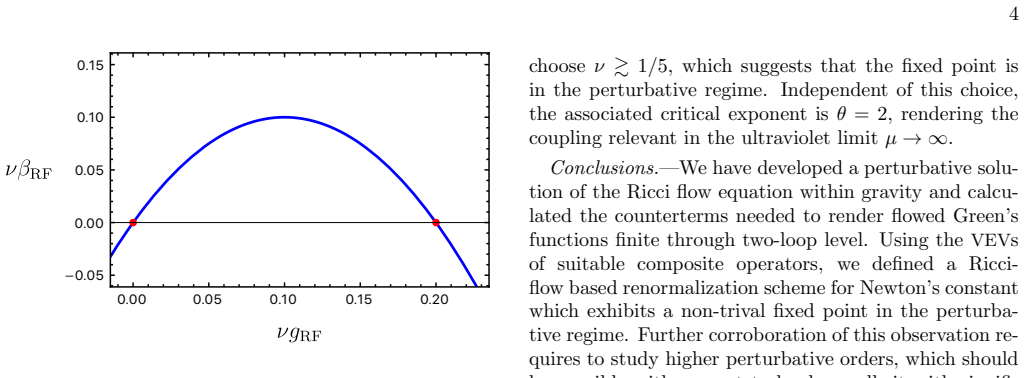
Following steps analogous to the gradient flow in QCD, we supplement the usual Feynman rules for perturbative gravity by flowed propagators and vertices as well as graviton flow lines which describe the evolution of gravity along the Ricci flow. By calculating vacuum expectation values of a number of independent operators at the two-loop level, we derive the required counterterms of the flowed action. Our results allow us to define a Ricci-flow based renormalization scheme for Newton's constant G_N. Studying its renormalization group behavior, we recover a non-Gaussian fixed point in accordance with well-known non-perturbative considerations.
What carries the argument
The flowed action supplemented with graviton flow lines and two-loop counterterms derived from operator vacuum expectation values, which implements the Ricci-flow renormalization scheme for Newton's constant.
If this is right
- The scheme supplies a perturbative definition of the renormalization-group trajectory for Newton's constant.
- It reproduces the non-Gaussian fixed point at two-loop order in agreement with non-perturbative results.
- The same construction can be applied to additional gravitational operators and couplings.
- It provides a controlled perturbative window onto aspects of quantum gravity previously accessible only non-perturbatively.
Where Pith is reading between the lines
- Higher-loop extensions of the same flowed diagrams could test whether the fixed point remains stable under further corrections.
- Inclusion of matter fields within the flowed framework would allow study of their influence on the fixed-point structure.
- The method may be compared with other perturbative approaches to the renormalization group in gravity to identify shared features.
Load-bearing premise
The direct analogy between QCD gradient flow and Ricci flow in gravity preserves the necessary perturbative structure so that two-loop counterterms suffice to define a consistent renormalization-group trajectory.
What would settle it
A three-loop computation of the flowed counterterms that produces inconsistent renormalization-group equations or eliminates the non-Gaussian fixed point.
Figures

read the original abstract
We develop a perturbative formulation of the Ricci flow in gravity. Following steps analogous to the gradient flow in QCD, we supplement the usual Feynman rules for perturbative gravity by flowed propagators and vertices as well as graviton flow lines which describe the evolution of gravity along the Ricci flow. By calculating vacuum expectation values of a number of independent operators at the two-loop level, we derive the required counterterms of the flowed action. Our results allow us to define a Ricci-flow based renormalization scheme for Newton's constant $G_N$. Studying its renormalization group behavior, we recover a non-Gau{\ss}ian fixed point in accordance with well-known non-perturbative considerations
Editorial analysis
A structured set of objections, weighed in public.
Referee Report
Summary. The manuscript develops a perturbative formulation of the Ricci flow in gravity by supplementing standard Feynman rules with flowed propagators, vertices, and graviton flow lines, following an analogy to QCD gradient flow. Two-loop vacuum expectation values of independent operators are computed to obtain counterterms of the flowed action. These results are used to define a Ricci-flow based renormalization scheme for Newton's constant G_N, whose renormalization-group flow is shown to recover a non-Gaussian fixed point consistent with non-perturbative expectations.
Significance. If the construction is free of higher-order obstructions, the work supplies a concrete perturbative handle on geometric flows in gravity and an explicit two-loop calculation that grounds a new renormalization scheme for G_N. Credit is due for performing the two-loop VEV computations and for making the flowed Feynman rules explicit.
major comments (2)
- [two-loop VEV calculations] § on two-loop counterterm extraction: the central claim that two-loop VEVs of independent operators suffice to define a consistent renormalization scheme for G_N lacks any discussion of possible obstructions at three loops or higher that could arise from the diffeomorphism invariance of the Einstein-Hilbert action or from the geometric constraints of the Ricci flow itself; without such an argument the extracted beta function for G_N cannot be guaranteed to define a reliable RG trajectory.
- [RG behavior of G_N] § on RG behavior of G_N: the non-Gaussian fixed point is recovered 'in accordance with well-known non-perturbative considerations'; this phrasing leaves open whether the scheme is independently predictive or whether the two-loop truncation and normalization have been chosen to reproduce an already-known result, undermining the claim that the fixed point emerges from the flowed theory.
minor comments (2)
- [Abstract] Abstract: 'Gaußian' should read 'Gaussian'.
- [Feynman rules] Notation: the definitions of the flowed graviton propagators and vertices should be collected in a single subsection with explicit Feynman rules for clarity.
Simulated Author's Rebuttal
We thank the referee for the careful reading of our manuscript and the constructive comments. We address each major point below and indicate the revisions that will be incorporated.
read point-by-point responses
-
Referee: [two-loop VEV calculations] § on two-loop counterterm extraction: the central claim that two-loop VEVs of independent operators suffice to define a consistent renormalization scheme for G_N lacks any discussion of possible obstructions at three loops or higher that could arise from the diffeomorphism invariance of the Einstein-Hilbert action or from the geometric constraints of the Ricci flow itself; without such an argument the extracted beta function for G_N cannot be guaranteed to define a reliable RG trajectory.
Authors: We agree that an explicit discussion of the perturbative order would improve clarity. Our construction is defined at two-loop order, where the vacuum expectation values determine the counterterms and yield a well-defined beta function for G_N within the Ricci-flow scheme. Diffeomorphism invariance is maintained order-by-order in the expansion, and no inconsistencies appear in the two-loop computation. Potential obstructions at three loops or higher would require separate higher-order calculations that lie beyond the present scope; we will add a short paragraph in the conclusions noting the two-loop limitation and the absence of obstructions at the computed order, while stating that higher-loop consistency remains an open question for future work. revision: partial
-
Referee: [RG behavior of G_N] § on RG behavior of G_N: the non-Gaussian fixed point is recovered 'in accordance with well-known non-perturbative considerations'; this phrasing leaves open whether the scheme is independently predictive or whether the two-loop truncation and normalization have been chosen to reproduce an already-known result, undermining the claim that the fixed point emerges from the flowed theory.
Authors: The beta function is obtained directly from the two-loop counterterms computed with the flowed propagators, vertices, and flow lines; the non-Gaussian fixed point is then located by solving the resulting renormalization-group equation. No free parameters are adjusted to enforce the fixed point, and the normalization is fixed by the perturbative matching conditions. The agreement with non-perturbative expectations is therefore a consistency check rather than an input. We will revise the abstract and the relevant discussion section to make this explicit, replacing the current phrasing with language that stresses the fixed point as an output of the two-loop calculation. revision: yes
Circularity Check
No significant circularity: perturbative counterterm calculation and RG analysis are independent of the recovered fixed point
full rationale
The derivation proceeds by supplementing Feynman rules with flowed propagators/vertices and graviton flow lines, computing explicit two-loop VEVs of independent operators to obtain counterterms, defining a renormalization scheme for G_N from those counterterms, and extracting the beta function whose flow exhibits a non-Gaussian fixed point. This fixed point is reported as matching external non-perturbative results, but the paper presents it as an outcome of the two-loop computation rather than an input or fitted parameter. No quoted step equates the final result to its own inputs by construction, no self-citation chain bears the central claim, and the perturbative structure is built from first-principles Feynman rules without smuggling ansatze or renaming known patterns. The scheme and beta function therefore retain independent content.
Axiom & Free-Parameter Ledger
axioms (2)
- standard math Standard perturbative expansion and Feynman rules for Einstein gravity
- domain assumption Analogy between QCD gradient flow and Ricci flow holds at the level of propagator and vertex modifications
invented entities (1)
-
Flowed graviton propagators and vertices
no independent evidence
Reference graph
Works this paper leans on
-
[1]
Navaset al.(Particle Data Group), Phys
S. Navaset al.(Particle Data Group), Phys. Rev. D110, 030001 (2024)
2024
-
[2]
F. J. Dyson, Phys. Rev.85, 631 (1952)
1952
-
[3]
M. H. Goroff and A. Sagnotti, Phys. Lett. B160, 81 (1985)
1985
-
[4]
M. H. Goroff and A. Sagnotti, Nucl. Phys. B266, 709 (1986)
1986
-
[5]
A. E. M. van de Ven, Nucl. Phys. B378, 309 (1992)
1992
-
[6]
Weinberg, in14th International School of Subnuclear Physics: Understanding the Fundamental Constitutents of Matter(1976)
S. Weinberg, in14th International School of Subnuclear Physics: Understanding the Fundamental Constitutents of Matter(1976)
1976
-
[7]
Parisi, inCargese Summer Institute: New Develop- ments in Quantum Field Theory and Statistical Mechan- ics(1977)
G. Parisi, inCargese Summer Institute: New Develop- ments in Quantum Field Theory and Statistical Mechan- ics(1977)
1977
-
[8]
Weinberg, Ultraviolet divergencies in quantum theo- 5 ries of gravitation, inGeneral Relativity: An Einstein Centenary Survey(1980) pp
S. Weinberg, Ultraviolet divergencies in quantum theo- 5 ries of gravitation, inGeneral Relativity: An Einstein Centenary Survey(1980) pp. 790–831
1980
-
[9]
Nonperturbative evolution equation for quantum gravity,
M. Reuter, Phys. Rev. D57, 971 (1998), arXiv:hep- th/9605030
-
[10]
J. Ambjørn, A. Goerlich, J. Jurkiewicz, and R. Loll, Phys. Rept.519, 127 (2012), arXiv:1203.3591 [hep-th]
-
[11]
Exact evolution equation for the effective potential,
C. Wetterich, Phys. Lett. B301, 90 (1993), arXiv:1710.05815 [hep-th]
-
[12]
Further evidence for asymptotic safety of quantum gravity,
K. Falls, D. F. Litim, K. Nikolakopoulos, and C. Rahmede, Phys. Rev. D93, 104022 (2016), arXiv:1410.4815 [hep-th]
-
[13]
Asymptotic safety of quantum gravity beyond Ricci scalars,
K. Falls, C. R. King, D. F. Litim, K. Nikolakopou- los, and C. Rahmede, Phys. Rev. D97, 086006 (2018), arXiv:1801.00162 [hep-th]
-
[14]
A. Eichhorn, P. Labus, J. M. Pawlowski, and M. Reichert, SciPost Phys.5, 031 (2018), arXiv:1804.00012 [hep-th]
-
[15]
A. Eichhorn, S. Lippoldt, J. M. Pawlowski, M. Re- ichert, and M. Schiffer, Phys. Lett. B792, 310 (2019), arXiv:1810.02828 [hep-th]
-
[16]
Y. Kluth and D. F. Litim, Phys. Rev. D108, 026005 (2023), arXiv:2008.09181 [hep-th]
-
[17]
A. Baldazzi, K. Falls, Y. Kluth, and B. Knorr, Phys. Rev. D113, 026005 (2026), arXiv:2312.03831 [hep-th]
-
[18]
Kluth,Fixed points of quantum gravity from dimen- sional regularization, Phys
Y. Kluth, Phys. Rev. D111, 106010 (2025), arXiv:2409.09252 [hep-th]
-
[19]
Cresswell-Hogg, Y
C. Cresswell-Hogg, Y. Kluth, and D. F. Litim (2026), in preparation
2026
-
[20]
Fixed points of higher derivative gravity,
A. Codello and R. Percacci, Phys. Rev. Lett.97, 221301 (2006), arXiv:hep-th/0607128
-
[21]
M. R. Niedermaier, Phys. Rev. Lett.103, 101303 (2009)
2009
-
[22]
Niedermaier, Nucl
M. Niedermaier, Nucl. Phys. B833, 226 (2010)
2010
-
[23]
R. Martini, A. Ugolotti, F. Del Porro, and O. Zanusso, Eur. Phys. J. C81, 916 (2021), arXiv:2103.12421 [hep- th]
- [24]
-
[25]
Absence of gravitational contributions to the running Yang-Mills coupling,
D. Ebert, J. Plefka, and A. Rodigast, Phys. Lett. B660, 579 (2008), arXiv:0710.1002 [hep-th]
- [26]
-
[27]
Kawai and M
H. Kawai and M. Ninomiya, Nucl. Phys. B336, 115 (1990)
1990
-
[28]
Jack and D
I. Jack and D. R. T. Jones, Nucl. Phys. B358, 695 (1991)
1991
- [29]
-
[30]
Kawai, Y
H. Kawai, Y. Kitazawa, and M. Ninomiya, Prog. Theor. Phys. Suppl.114, 149 (1993)
1993
- [31]
-
[32]
R. Martini, G. P. Vacca, and O. Zanusso, Perturba- tive Approaches to Nonperturbative Quantum Grav- ity, inHandbook of Quantum Gravity, edited by C. Bambi, L. Modesto, and I. Shapiro (2024) pp. 1–46, arXiv:2210.13910 [hep-th]
-
[33]
R. S. Hamilton, Journal of Differential Geometry17, 255 (1982)
1982
-
[34]
Finite extinction time for the solutions to the Ricci flow on certain three-manifolds
G. Perelman, preprint (2003), arXiv:math/0307245
work page Pith review arXiv 2003
-
[35]
The entropy formula for the Ricci flow and its geometric applications
G. Perelman, preprint (2006), arXiv:math/0211159
work page Pith review arXiv 2006
-
[36]
Ricci flow with surgery on three-manifolds
G. Perelman, preprint (2006), arXiv:math/0303109
work page Pith review arXiv 2006
-
[37]
Properties and uses of the Wilson flow in lattice QCD,
M. L¨ uscher, JHEP08, 071, [Erratum: JHEP 03, 092 (2014)], arXiv:1006.4518 [hep-lat]
- [38]
-
[39]
L¨ uscher, JHEP04, 123, arXiv:1302.5246 [hep-lat]
M. L¨ uscher, JHEP04, 123, arXiv:1302.5246 [hep-lat]
- [40]
-
[41]
A. Franciset al., Phys. Rev. Lett. (2025), to appear, arXiv:2509.02472 [hep-lat]
-
[42]
A. Francis, P. Fritzsch, R. Karur, J. Kim, G. Pederiva, D. A. Pefkou, A. Rago, A. Shindler, A. Walker-Loud, and S. Zafeiropoulos, preprint (2025), arXiv:2510.26738 [hep-lat]
- [43]
- [44]
-
[45]
T. Iritani, M. Kitazawa, H. Suzuki, and H. Takaura, PTEP2019, 023B02 (2019), arXiv:1812.06444 [hep-lat]
-
[46]
V.-M. Mandric, T. R. Morris, and D. Stulga, JHEP11, 149, arXiv:2308.07382 [hep-th]
- [47]
-
[48]
Nogueira, J
P. Nogueira, J. Comput. Phys.105, 279 (1993)
1993
-
[49]
R. Harlander, T. Seidensticker, and M. Steinhauser, Phys. Lett. B426, 125 (1998), arXiv:hep-ph/9712228
-
[50]
Nogueira, Comput
P. Nogueira, Comput. Phys. Commun.269, 108103 (2021)
2021
-
[51]
Gerlach, F
M. Gerlach, F. Herren, and M. Lang, Comput. Phys. Commun.282, 108544 (2023)
2023
-
[52]
J. Klappert, F. Lange, P. Maierh¨ ofer, and J. Uso- vitsch, Comput. Phys. Commun.266, 108024 (2021), arXiv:2008.06494 [hep-ph]
-
[53]
H. Makino and H. Suzuki, PTEP2014, 063B02 (2014), [Erratum: PTEP 2015, 079202 (2015)], arXiv:1403.4772 [hep-lat]
-
[54]
Ambjørn and J
J. Ambjørn and J. Jurkiewicz, Phys. Lett. B278, 42 (1992)
1992
-
[55]
M. E. Agishtein and A. A. Migdal, Mod. Phys. Lett. A 7, 1039 (1992)
1992
-
[56]
J. Ambjørn and R. Loll, Nucl. Phys. B536, 407 (1998), arXiv:hep-th/9805108
-
[57]
J. Ambjørn, J. Jurkiewicz, and R. Loll, Nucl. Phys. B 610, 347 (2001), arXiv:hep-th/0105267
-
[58]
R. Loll, Class. Quant. Grav.37, 013002 (2020), arXiv:1905.08669 [hep-th]
-
[59]
Suzuki, PTEP2013, 083B03 (2013), [Erratum: PTEP 2015, 079201 (2015)], arXiv:1304.0533 [hep-lat]
H. Suzuki, PTEP2013, 083B03 (2013), [Erratum: PTEP 2015, 079201 (2015)], arXiv:1304.0533 [hep-lat]
-
[60]
L¨ uscher, PoSLA TTICE2013, 016 (2014), arXiv:1308.5598 [hep-lat]
M. L¨ uscher, PoSLA TTICE2013, 016 (2014), arXiv:1308.5598 [hep-lat]
discussion (0)
Sign in with ORCID, Apple, or X to comment. Anyone can read and Pith papers without signing in.