Recognition: unknown
Floquet engineering of spin-spin interactions in a hybrid atomic system
Pith reviewed 2026-05-10 02:52 UTC · model grok-4.3
The pith
Periodic modulation of electron spin polarization direction renormalizes spin-exchange coupling in hybrid atomic systems according to a Bessel function.
A machine-rendered reading of the paper's core claim, the machinery that carries it, and where it could break.
Core claim
Periodic modulation of the direction of the electron spin polarization with respect to the nuclear polarization in an alkali-noble-gas comagnetometer leads to a Floquet-induced renormalization of the spin-exchange coupling, governed by a zeroth-order Bessel function. This enables continuous tuning and suppression of the effective interaction strength without altering the intrinsic properties of the system.
What carries the argument
Floquet-induced renormalization of the spin-exchange coupling governed by the zeroth-order Bessel function, resulting from parametric modulation of relative spin polarization directions.
If this is right
- The effective interaction strength can be tuned continuously by varying the modulation amplitude or frequency.
- Complete suppression of the spin-exchange interaction occurs at modulation parameters where the Bessel function equals zero.
- The control mechanism preserves the intrinsic atomic properties of the hybrid system.
- New opportunities arise for precision measurements and quantum memories using hybrid atomic systems.
Where Pith is reading between the lines
- This approach could extend to other multi-species quantum systems for engineering tailored interaction strengths.
- Dynamic switching of interactions on and off might enable new protocols in quantum simulation and information processing.
- Suppressing specific interactions could help isolate desired effects in precision metrology experiments.
Load-bearing premise
The modulation operates in a regime where the Floquet approximation holds without significant higher-order effects, heating, or decoherence, and the Fermi-contact interaction remains dominant.
What would settle it
Experimental observation that the measured effective coupling strength deviates from the predicted Bessel function dependence on modulation depth, or appearance of substantial heating or decoherence at the used modulation rates, would falsify the claim.
Figures



read the original abstract
We demonstrate dynamical control of the effective spin-spin interaction, dominated by Fermi-contact interaction, in a hybrid spin system via parametric modulation. We show that, in an alkali-noble-gas comagnetometer, periodic modulation of the direction of the electron spin polarization with respect to the nuclear polarization leads to a Floquet-induced renormalization of the spin-exchange coupling, governed by a zeroth-order Bessel function. This effect enables continuous tuning and suppression of the effective interaction strength without altering the intrinsic properties of the system. We develop a theoretical model that supports the experimental measurements. The results establish a general mechanism for controlling interaction strengths in hybrid atomic systems and provide new opportunities for precision measurements and quantum memories.
Editorial analysis
A structured set of objections, weighed in public.
Referee Report
Summary. The manuscript demonstrates dynamical control of the effective spin-spin interaction (dominated by Fermi-contact) in an alkali-noble-gas comagnetometer. Periodic modulation of the electron spin polarization direction relative to the nuclear polarization produces a Floquet-induced renormalization of the spin-exchange coupling governed by the zeroth-order Bessel function J_0(β). This enables continuous tuning and suppression of the interaction strength. A supporting theoretical model is presented alongside experimental measurements.
Significance. If the central claim holds, the work establishes a general, parameter-free mechanism (in the high-frequency limit) for engineering interaction strengths in hybrid atomic systems via Floquet modulation. This is valuable for precision metrology and quantum memory applications, as it avoids altering intrinsic system properties. The clean mapping to J_0(β) via standard Floquet theory is a strength when the regime is properly validated.
major comments (2)
- [Theoretical model] Theoretical model section: The derivation of J_eff = J * J_0(β) relies on the high-frequency Floquet limit (ω ≫ J and ≫ relaxation/Larmor rates) with negligible higher-order Magnus terms. No explicit bounds or measured values of ω/J are provided across the experimental range of modulation index β, leaving open the possibility that observed suppression includes non-Floquet contributions such as heating or resonant effects.
- [Experimental results] Experimental results and data analysis: The reported Bessel-function dependence of the spin-exchange rate must be accompanied by quantitative checks that decoherence and heating remain negligible over the full modulation range; without these, the data cannot unambiguously confirm pure Floquet renormalization as the sole mechanism.
minor comments (2)
- [Figures] Figure captions should explicitly state the fitted values of ω and the extracted J, along with the range of β explored.
- [Methods] A brief discussion of how the modulation is implemented (e.g., via magnetic field or optical pumping) would improve reproducibility.
Simulated Author's Rebuttal
We thank the referee for the thoughtful review and positive assessment of our work on Floquet engineering of spin-spin interactions. We address each major comment below with point-by-point responses and have revised the manuscript to incorporate additional details and checks where appropriate.
read point-by-point responses
-
Referee: Theoretical model section: The derivation of J_eff = J * J_0(β) relies on the high-frequency Floquet limit (ω ≫ J and ≫ relaxation/Larmor rates) with negligible higher-order Magnus terms. No explicit bounds or measured values of ω/J are provided across the experimental range of modulation index β, leaving open the possibility that observed suppression includes non-Floquet contributions such as heating or resonant effects.
Authors: We agree that explicit verification of the high-frequency limit is necessary to fully substantiate the Floquet approximation. In the revised manuscript, we have expanded the Theoretical model section to include the relevant experimental parameters: the modulation frequency is fixed at ω = 2π × 500 Hz, while the bare spin-exchange coupling J ranges from approximately 2π × 1 Hz to 2π × 5 Hz across the alkali densities used. This yields ω/J ratios between 100 and 500 for all values of the modulation index β explored. We further estimate that the next-order terms in the Magnus expansion contribute less than 1% to the effective coupling under these conditions. These additions confirm that the observed renormalization is governed by the zeroth-order Bessel function in the validated high-frequency regime. revision: yes
-
Referee: Experimental results and data analysis: The reported Bessel-function dependence of the spin-exchange rate must be accompanied by quantitative checks that decoherence and heating remain negligible over the full modulation range; without these, the data cannot unambiguously confirm pure Floquet renormalization as the sole mechanism.
Authors: We concur that quantitative validation is required to exclude alternative mechanisms. The revised manuscript now includes additional analysis and a supplementary figure in the Experimental results section. We report measurements of the transverse (T2) and longitudinal (T1) relaxation times as functions of β, which remain constant to within 5% across the full modulation range. Cell temperature was continuously monitored and varied by less than 0.1 K, indicating negligible heating. The spin-exchange rate data continue to fit J_0(β) with a reduced χ² of 1.05, and no resonant features or systematic deviations appear that would be expected from heating or other non-Floquet effects. These checks support that the suppression arises from Floquet renormalization. revision: yes
Circularity Check
No significant circularity in Floquet renormalization derivation
full rationale
The central claim applies standard Floquet theory (high-frequency limit, time-averaging or first-order Magnus expansion) to obtain J_eff = J * J_0(β) from periodic modulation of the electron spin direction relative to nuclear polarization. This is a direct, parameter-free consequence of the interaction Hamiltonian under the stated assumptions and does not reduce to a fitted input, self-definition, or self-citation chain. The paper develops a supporting theoretical model and reports experimental measurements, but the renormalization formula itself is externally verifiable from Floquet literature and independent of the present data or prior author results. No load-bearing self-citations, ansatz smuggling, or renaming of known results occur; the derivation remains self-contained.
Axiom & Free-Parameter Ledger
axioms (1)
- domain assumption The driven system remains in the regime where the zeroth-order Floquet approximation accurately describes the time-averaged effective coupling
Reference graph
Works this paper leans on
-
[1]
Longitudinal interaction, which produces static shifts of the electron and nuclear Larmor frequen- cies through the effective fieldsB n ∥ =λ ∥M nP n ∥ andB e ∥ =λ ∥M eP e ∥ corresponding to the longitudi- nal magnetizationsM nP n ∥ andM eP e ∥ enhanced by Fermi-contact interaction factorλ∥
-
[2]
Precision Physics, Fundamental Interactions, and Structure of Matter
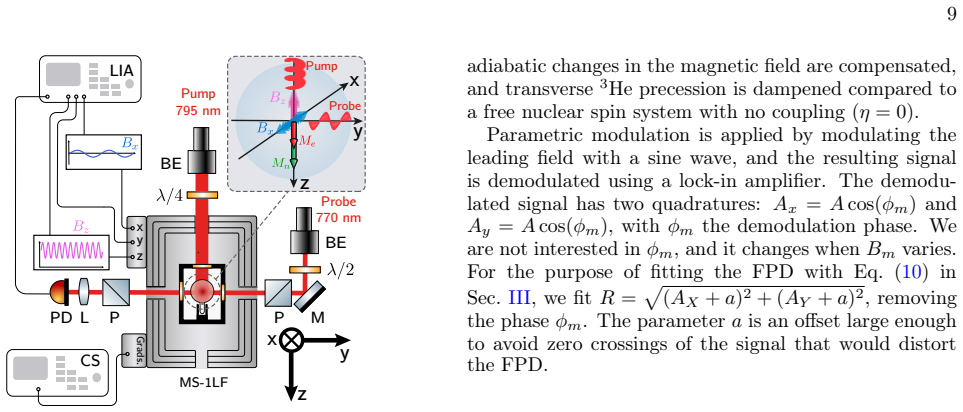
Transverse exchange interaction, which dynami- cally couples the transverse polarization compo- nents of the two ensembles with coupling factors ηen = γe q λ⊥M nP e ∥ , η ne =γ nλ⊥M eP n ∥ .(1) Hereγ e andγ n denoterespectivegyromagneticratiosand qis the slowing-down factor that accounts for the hyper- fine coupling between the electron and nuclear spins ...
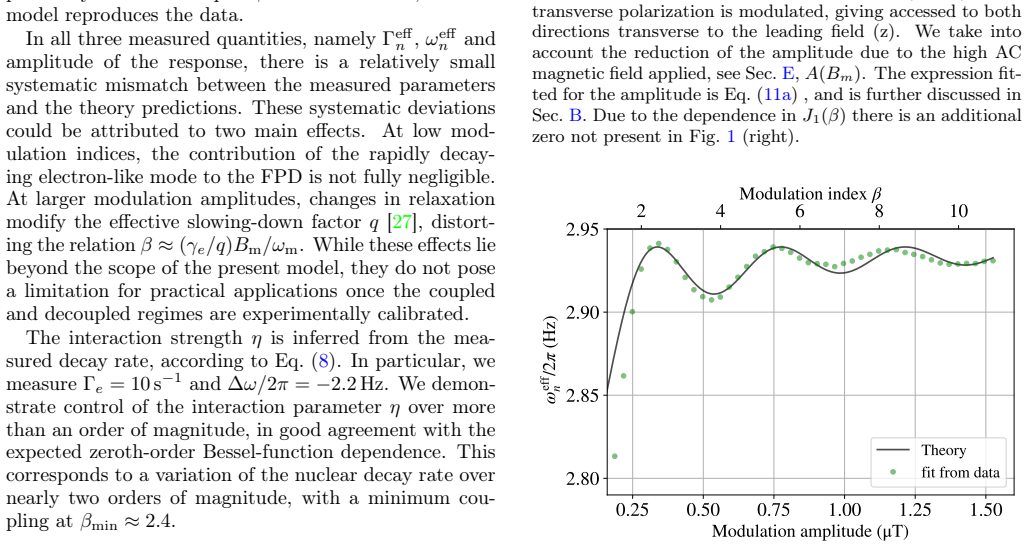
2020
-
[3]
W. Heil, H. Humblot, E. Otten, M. Schafer, R. Sarkau, and M. Leduc, Phys. Lett. A201, 337 (1995)
1995
-
[4]
Safronova, D
M. Safronova, D. Budker, D. DeMille, D. F. J. Kimball, A. Derevianko, and C. W. Clark, Rev. Mod. Phys.90, 025008 (2018)
2018
-
[5]
D. F. Jackson Kimball, D. Budker, T. E. Chupp, A. A. Geraci, S. Kolkowitz, J. T. Singh, and A. O. Sushkov, Phys. Rev. A108, 010101 (2023)
2023
-
[6]
L. Cong, W. Ji, P. Fadeev, F. Ficek, M. Jiang, V. V. Flambaum, H. Guan, D. F. Jackson Kimball, M. G. Ko- zlov, Y. V. Stadnik,et al., Rev. Mod. Phys.97, 025005 (2025)
2025
-
[7]
O. Katz, R. Shaham, E. Reches, A. V. Gorshkov, and O. Firstenberg, Phys. Rev. A105, 042606 (2022)
2022
-
[8]
O. Katz, E. Reches, R. Shaham, E. Poem, A. V. Gor- shkov, and O. Firstenberg, Phys. Rev. Research7, 043345 (2025)
2025
-
[9]
Vasilakis, J
G. Vasilakis, J. M. Brown, T. W. Kornack, and M. V. Romalis, Phys. Rev. Lett.103, 261801 (2009)
2009
-
[10]
Allmendinger, W
F. Allmendinger, W. Heil, S. Karpuk, W. Kilian, A. Scharth, U. Schmidt, A. Schnabel, Y. Sobolev, and K. Tullney, Phys. Rev. Lett.112, 110801 (2014)
2014
-
[11]
Kornack,A test of CPT and Lorentz symmetry us- ing a potassium-helium-3 co-magnetometer, Phd Thesis, Princeton University (2005)
T. Kornack,A test of CPT and Lorentz symmetry us- ing a potassium-helium-3 co-magnetometer, Phd Thesis, Princeton University (2005)
2005
-
[12]
Laboratory Constraints on the Neutron-Spin Coupling of feV-Scale Axions,
J. Lee, M. Lisanti, W. A. Terrano, and M. Romalis, “Laboratory Constraints on the Neutron-Spin Coupling of feV-scale Axions,” (2022), arXiv:2209.03289 [astro-ph, 7 physics:hep-ph, physics:physics]
-
[13]
Gavilan-Martin, G
D. Gavilan-Martin, G. Łukasiewicz, M. Padniuk, E. Klinger, M. Smolis, N. L. Figueroa, D. F. Jack- son Kimball, A. O. Sushkov, S. Pustelny, D. Budker, and A. Wickenbrock, Nat. Commun.16, 4953 (2025)
2025
-
[14]
Constraints on axion- like dark matter from a SERF comagnetometer,
I. M. Bloch, R. Shaham, Y. Hochberg, E. Kuflik, T. Volansky, and O. Katz, “NASDUCK SERF: New con- straints on axion-like dark matter from a SERF comagne- tometer,” (2022), arXiv:2209.13588 [hep-ex, physics:hep- ph, physics:physics, physics:quant-ph]
-
[15]
I. M. Bloch, Y. Hochberg, E. Kuflik, and T. Volansky, Journal of High Energy Physics2020, 167 (2020)
2020
-
[16]
Jiang, H
M. Jiang, H. Su, A. Garcon, X. Peng, and D. Budker, Nat. Phys.17, 1402 (2021)
2021
-
[17]
Zhang, Z.-L
S.-B. Zhang, Z.-L. Ba, D.-H. Ning, N.-F. Zhai, Z.-T. Lu, and D. Sheng, Phys. Rev. Lett.130, 201401 (2023)
2023
-
[18]
T. W. Kornack, R. K. Ghosh, and M. V. Romalis, Phys- ical Review Letters95, 230801 (2005)
2005
-
[19]
K. Wei, T. Zhao, X. Fang, Z. Xu, C. Liu, Q. Cao, A. Wickenbrock, Y. Hu, W. Ji, J. Fang, and D. Bud- ker, Physical Review Letters130, 063201 (2023)
2023
-
[20]
O. Katz, R. Shaham, and O. Firstenberg, Science Ad- vances7, eabe9164 (2021)
2021
-
[21]
O.Katz, R.Shaham, andO.Firstenberg,PRXQuantum 3, 010305 (2022)
2022
-
[22]
A. Barbosa, H. Terças, and E. Z. Cruzeiro, (2024), arXiv:2402.17752 [quant-ph]
-
[23]
Serafin, M
A. Serafin, M. Fadel, P. Treutlein, and A. Sinatra, Phys. Rev. Lett.127, 013601 (2021)
2021
-
[24]
T. G. Walker and W. Happer, Rev. Mod. Phys.69, 629 (1997)
1997
-
[25]
T. G. Walker, inJournal of Physics: Conference Series, Vol. 294 (2011) p. 012001
2011
-
[26]
Appelt, A
S. Appelt, A. B.-A. Baranga, C. J. Erickson, M. V. Ro- malis, A. R. Young, and W. Happer, Physical Review A 58, 1412 (1998)
1998
-
[27]
T. G. Walker, Phys. Rev. A40, 4959 (1989)
1989
-
[28]
Happer and A
W. Happer and A. C. Tam, Physical Review A16, 1877 (1977)
1977
-
[29]
I. M. Savukov and M. V. Romalis, Physical Review A 71, 023405 (2005)
2005
-
[30]
Shaham, O
R. Shaham, O. Katz, and O. Firstenberg, Nature Phys. 18, 506 (2022)
2022
-
[31]
H. Su, M. Jiang, and X. Peng, Sci. China Inf. Sci.65, 200501 (2022)
2022
-
[32]
Haroche, C
S. Haroche, C. Cohen-Tannoudji, C. Audoin, and J. P. Schermann, Phys. Rev. Lett.24, 861 (1970)
1970
-
[33]
Z. Li, R. T. Wakai, and T. G. Walker, Applied Physics Letters89, 134105 (2006)
2006
-
[34]
Jiang, W
L. Jiang, W. Quan, R. Li, W. Fan, F. Liu, J. Qin, S. Wan, and J. Fang, Applied Physics Letters112, 054103 (2018)
2018
-
[35]
P. Put, P. Wcisło, W. Gawlik, and S. Pustelny, Phys. Rev. A100, 043838 (2019)
2019
-
[36]
Jiang, H
M. Jiang, H. Su, Z. Wu, X. Peng, and D. Budker, Science Advances7, eabe0719 (2021)
2021
-
[37]
Jiang, Y
M. Jiang, Y. Qin, X. Wang, Y. Wang, H. Su, X. Peng, and D. Budker, Physical Review Letters128, 233201 (2022)
2022
-
[38]
Golub and S
R. Golub and S. K. Lamoreaux, Physics Reports237, 1 (1994)
1994
-
[39]
Tat, (2025), arXiv:2512.02443 [physics.atom-ph]
R. Tat, (2025), arXiv:2512.02443 [physics.atom-ph]
-
[40]
Happer and H
W. Happer and H. Tang, Physical Review Letters31, 273 (1973)
1973
-
[41]
Allred, R
J. Allred, R. Lyman, T. Kornack, and M. V. Romalis, Phys. Rev. Lett.89, 130801 (2002)
2002
-
[42]
T. W. Kornack and M. V. Romalis, Physical Review Let- ters89, 253002 (2002)
2002
-
[43]
Shaham, O
R. Shaham, O. Katz, and O. Firstenberg, Nat. Phys.18, 506 (2022)
2022
-
[44]
Happer, Y.-Y
W. Happer, Y.-Y. Jau, and T. Walker,Optically pumped atoms(John Wiley & Sons, 2010)
2010
-
[45]
Padniuk, E
M. Padniuk, E. Klinger, G. Łukasiewicz, D. Gavilan- Martin, T. Liu, S. Pustelny, D. F. Jackson Kimball, D. Budker, and A. Wickenbrock, Physical Review Re- search6, 013339 (2024)
2024
-
[46]
Klinger, T
E. Klinger, T. Liu, M. Padniuk, M. Engler, T. Kornack, S. Pustelny, D. F. Jackson Kimball, D. Budker, and A. Wickenbrock, Phys. Rev. Appl.19, 044092 (2023)
2023
-
[47]
Miri and A
M.-A. Miri and A. Alù, Science363, eaar7709 (2019)
2019
-
[48]
E. J. Bergholtz, J. C. Budich, and F. K. Kunst, Rev. Mod. Phys.93, 015005 (2021)
2021
-
[49]
L. M. Ellis, M. Jayaseelan, L. M. Rushton, J. D. Zipfel, P. Bevington, B. Steele, G. Quick, W. Chalupczak, and V. Guarrera, Quantum Science and Technology10, 045034 (2025)
2025
-
[50]
Phase Transition Control in Spin Ensemble by Spontaneous Symmetry Breaking,
K.Wei, W.Wang, S.Lin, Y.Wang, Z.Chai, J.Fang, and D. Budker, “Phase Transition Control in Spin Ensemble by Spontaneous Symmetry Breaking,” (2025)
2025
-
[51]
Kopciuch and A
M. Kopciuch and A. Miranowicz, Physical Review Re- search7, 033187 (2025)
2025
-
[52]
Wiersig, Photonics Research8, 1457 (2020)
J. Wiersig, Photonics Research8, 1457 (2020)
2020
-
[53]
H. Wang, K. Jacobs, D. Fahey, Y. Hu, D. R. Englund, and M. E. Trusheim, Nat. Phys.22, 577 (2026)
2026
-
[54]
Dembowski, B
C. Dembowski, B. Dietz, H.-D. Gräf, H. L. Harney, A. Heine, W. D. Heiss, and A. Richter, Physical Review E69, 056216 (2004)
2004
-
[55]
M. V. Romalis, Phys. Rev. Lett.105, 243001 (2010)
2010
-
[56]
Padniuk, M
M. Padniuk, M. Kopciuch, R. Cipolletti, A. Wicken- brock, D. Budker, and S. Pustelny, Sci. Rep.12, 324 (2022)
2022
-
[57]
Y. Zhao, X. Peng, T. Wu, and H. Guo, Phys. Rev. D 112, 012023 (2025). 8 Appendix A: Derivation of the Bessel renormalization of the transverse coupling Here we show how the interaction matrix introduced in Eq. (3) is transformed into the effective matrix of Eq. (4) under longitudinal field modulation. Starting from Eq. (3), we remove the explicit modu- la...
2025
discussion (0)
Sign in with ORCID, Apple, or X to comment. Anyone can read and Pith papers without signing in.