Recognition: unknown
Extracting Dark-Matter Mass from Angular Scanning
Pith reviewed 2026-05-10 03:45 UTC · model grok-4.3
The pith
Dark matter particle mass can be read from the curvature of event rates across detector angles in directional experiments.
A machine-rendered reading of the paper's core claim, the machinery that carries it, and where it could break.
Core claim
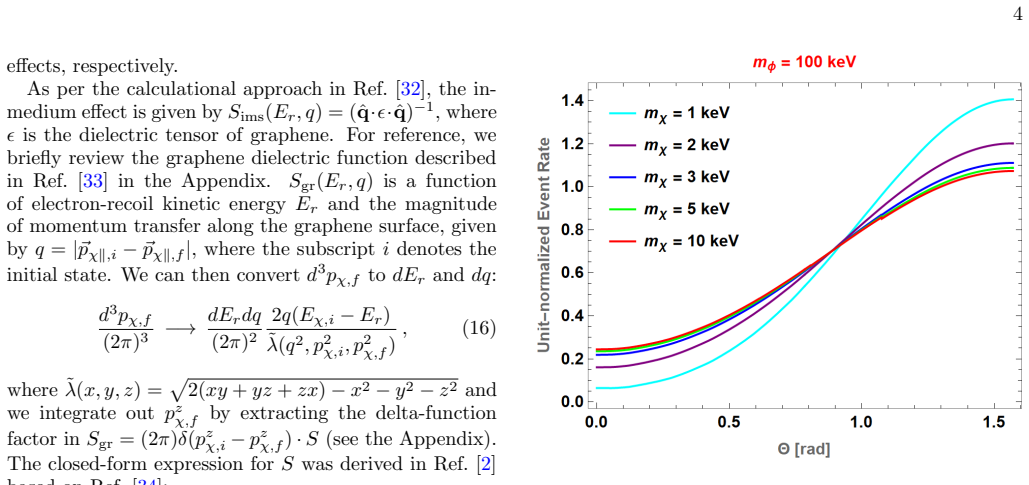
Due to the motion of the solar system and Earth relative to the Galactic Center, the dark-matter flux exhibits a directional preference. In two-dimensional direct detection experiments that allow directionality observables, dark-matter event rates depend non-trivially on the angle between the detection plane and the overall dark-matter flow, with the curvature of this angular spectrum encoding mass information.
What carries the argument
The angular spectrum of scattering events, whose curvature with respect to the angle between detector plane and dark-matter flow direction carries the mass dependence through kinematics.
If this is right
- The method applies to any effectively two-dimensional detector capable of directionality observables.
- Numerical validation confirms the angular curvature encodes mass for the graphene-Josephson-junction superlight dark matter detector.
- Mass extraction proceeds from the angular scan alone without requiring additional assumptions on the velocity distribution beyond the directional flow.
Where Pith is reading between the lines
- Combining angular curvature with energy spectra in the same detector could reduce degeneracies between mass and cross section.
- The approach may be tested in any future directional dark matter experiment once sufficient angular resolution and statistics are achieved.
- Similar angular scanning could be explored for other particles with anisotropic fluxes, such as solar neutrinos or cosmic rays.
Load-bearing premise
The dark matter flux has a well-defined directional preference from solar system motion, and the detector can accurately resolve and measure the angular dependence of events without significant smearing or background contamination.
What would settle it
A high-statistics directional detector measuring an angular spectrum whose curvature shows no dependence on the assumed dark matter mass, or whose shape deviates from the predicted kinematic relation, would falsify the claim.
Figures


read the original abstract
We propose a novel method to determine the mass scale of ambient dark matter, applicable to (at least effectively) two-dimensional direct detection experiments that allow for directionality observables. Due to the motion of the solar system and Earth relative to the Galactic Center and the Sun, the dark-matter flux exhibits a directional preference. We first demonstrate that dark-matter event rates depend non-trivially on the angle between the detection plane and the overall dark-matter flow, with the curvature of this angular spectrum encoding mass information. As proof of principle, we take the recently proposed Graphene-Josephson-Junction-based superlight dark-matter detector as a concrete example and validate these theoretical expectations through numerical analyses.
Editorial analysis
A structured set of objections, weighed in public.
Referee Report
Summary. The manuscript proposes a novel method to extract the dark-matter mass scale from the angular dependence of event rates in effectively two-dimensional directional detectors. It demonstrates that the DM flux's directional preference (due to solar-system motion) leads to a non-trivial angular spectrum whose curvature encodes m_DM, and validates the approach numerically for a Graphene-Josephson-Junction detector as a proof-of-principle example.
Significance. If the central claim holds after addressing robustness issues, the method would provide a new, directionality-based route to DM mass determination that is complementary to energy-spectrum analyses and potentially advantageous for superlight DM where recoil energies are low. The numerical validation for the concrete detector example is a positive step toward falsifiable predictions.
major comments (3)
- [Theoretical demonstration (prior to numerical analyses)] The derivation of the non-trivial angular dependence of the event rate and the explicit functional form linking its curvature (second derivative) to m_DM is not provided with sufficient detail; without an equation or section showing the projection of the boosted velocity distribution onto the 2D plane, it is impossible to verify that the curvature is mass-dependent rather than an artifact of approximations.
- [Numerical analyses / proof-of-principle section] The numerical validation for the Graphene-Josephson-Junction detector does not quantify degradation under finite angular resolution or DM velocity dispersion (~220 km/s galactic frame). Convolution with realistic smearing would flatten the curvature, directly impacting the claimed mass extraction; no such convolution or resolution scale is reported.
- [Numerical analyses / proof-of-principle section] Isotropic backgrounds are not addressed; they would add a constant term to the angular spectrum, reducing contrast and biasing the curvature measurement. No background model, subtraction procedure, or signal-to-background requirement is given, leaving the central claim vulnerable to this effect.
minor comments (2)
- The abstract states 'demonstration and numerical validation' but the manuscript lacks quantitative figures of merit such as extracted mass precision, error propagation from angular bins, or sensitivity curves.
- Notation for the angle between detection plane and DM flow, and for the curvature parameter, should be defined explicitly with a clear equation reference.
Simulated Author's Rebuttal
We thank the referee for their detailed and constructive feedback on our manuscript. We have addressed each of the major comments by expanding the theoretical derivations and enhancing the numerical analyses to include robustness checks. We believe these revisions strengthen the paper and clarify the method's applicability.
read point-by-point responses
-
Referee: [Theoretical demonstration (prior to numerical analyses)] The derivation of the non-trivial angular dependence of the event rate and the explicit functional form linking its curvature (second derivative) to m_DM is not provided with sufficient detail; without an equation or section showing the projection of the boosted velocity distribution onto the 2D plane, it is impossible to verify that the curvature is mass-dependent rather than an artifact of approximations.
Authors: We appreciate this observation. The original manuscript included a demonstration of the non-trivial angular dependence, but we concur that additional explicit equations would aid verification. In the revised version, we have added a dedicated paragraph in the theoretical section deriving the event rate from the projection of the boosted velocity distribution onto the 2D plane. The functional form shows that the curvature of the angular spectrum is indeed mass-dependent, arising from the kinematic threshold in the scattering cross-section and the velocity boost, rather than an approximation artifact. We provide the relevant equation for the second derivative explicitly. revision: yes
-
Referee: [Numerical analyses / proof-of-principle section] The numerical validation for the Graphene-Josephson-Junction detector does not quantify degradation under finite angular resolution or DM velocity dispersion (~220 km/s galactic frame). Convolution with realistic smearing would flatten the curvature, directly impacting the claimed mass extraction; no such convolution or resolution scale is reported.
Authors: The referee raises a valid point regarding the robustness of the numerical results. We have extended the numerical section to include convolutions with finite angular resolution (e.g., 5-15 degrees) and the galactic velocity dispersion of approximately 220 km/s. The updated analyses demonstrate that the curvature signature persists, albeit with some flattening, allowing for mass extraction with quantified uncertainties. New figures illustrate the degraded but still usable spectra, and we discuss the resolution requirements for practical implementation. revision: yes
-
Referee: [Numerical analyses / proof-of-principle section] Isotropic backgrounds are not addressed; they would add a constant term to the angular spectrum, reducing contrast and biasing the curvature measurement. No background model, subtraction procedure, or signal-to-background requirement is given, leaving the central claim vulnerable to this effect.
Authors: We acknowledge that isotropic backgrounds were not explicitly treated in the initial submission. In the revision, we have incorporated a discussion of this effect, noting that an isotropic background adds a constant offset to the angular spectrum. We propose a subtraction method using angular regions away from the peak or fitting the constant term simultaneously with the curvature. We provide estimates of the required signal-to-background ratio (greater than 0.5 for reliable extraction) and include this in the Graphene-Josephson-Junction example to show the method's resilience. revision: yes
Circularity Check
No circularity; derivation follows from standard DM wind kinematics
full rationale
The paper's central claim derives the non-trivial angular dependence of event rates and the mass-encoding curvature directly from the boosted dark-matter velocity distribution projected onto a 2D detector plane, using the well-known solar-system motion relative to the galactic frame. This is a first-principles kinematic calculation with no fitted parameters that are then renamed as predictions, no self-definitional loops, and no load-bearing self-citations or ansatzes imported from prior author work. The numerical validation for the Graphene-Josephson-Junction example is presented as an independent check of the analytic expectations rather than a fit that forces the result. The approach remains self-contained against external benchmarks of galactic DM halo models and directional detection kinematics.
Axiom & Free-Parameter Ledger
axioms (1)
- domain assumption Dark matter particles exhibit a directional flux preference due to the motion of the solar system and Earth relative to the Galactic Center
Reference graph
Works this paper leans on
-
[1]
Superconducting Detectors for Super Light Dark Matter
Y. Hochberg, Y. Zhao, and K. M. Zurek, Phys. Rev. Lett.116, 011301 (2016), arXiv:1504.07237 [hep-ph]
work page Pith review arXiv 2016
-
[2]
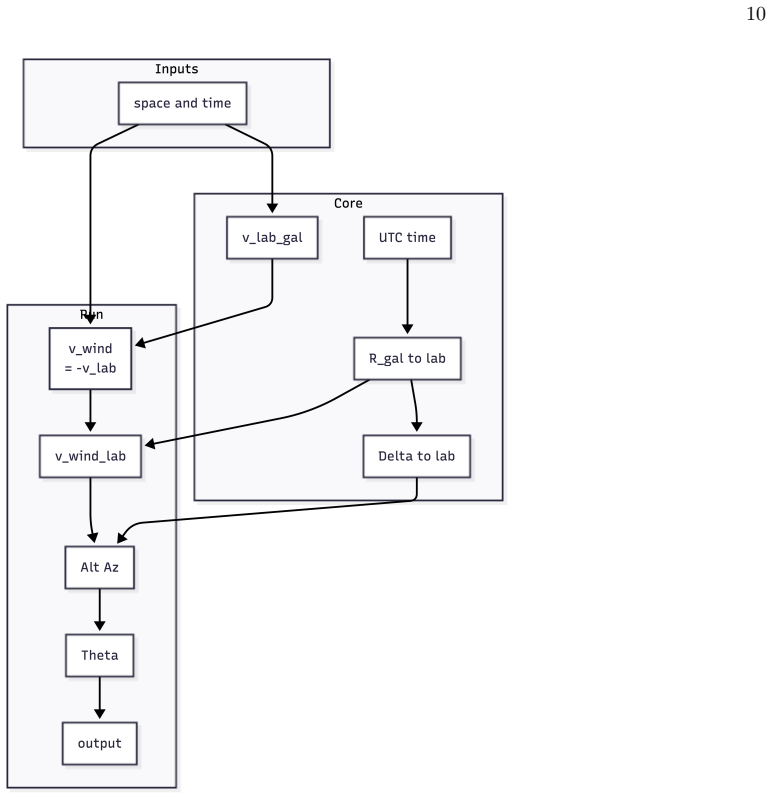
Y. Hochberg, M. Pyle, Y. Zhao, and K. M. Zurek, JHEP 10 FIG. 4. Flow chart ofDarkWind. 08, 057 (2016), arXiv:1512.04533 [hep-ph]
-
[3]
Y. Hochberg, Y. Kahn, M. Lisanti, C. G. Tully, and K. M. Zurek, Phys. Lett.B772, 239 (2017), arXiv:1606.08849 [hep-ph]
- [4]
-
[5]
Y. Hochberg, Y. Kahn, M. Lisanti, K. M. Zurek, A. G. Grushin, R. Ilan, S. M. Griffin, Z.-F. Liu, S. F. We- ber, and J. B. Neaton, Phys. Rev.D97, 015004 (2018), arXiv:1708.08929 [hep-ph]
-
[6]
Baracchiniet al.(PTOLEMY), (2018), arXiv:1808.01892 [physics.ins-det]
E. Baracchiniet al.(PTOLEMY), (2018), arXiv:1808.01892 [physics.ins-det]
-
[7]
Y. Hochberg, I. Charaev, S.-W. Nam, V. Verma, M. Colangelo, and K. K. Berggren, (2019), arXiv:1903.05101 [hep-ph]
-
[8]
C. Blanco, J. I. Collar, Y. Kahn, and B. Lillard, Phys. Rev. D101, 056001 (2020), arXiv:1912.02822 [hep-ph]
-
[9]
Detectability of Light Dark Matter with Superfluid Helium,
K. Schutz and K. M. Zurek, Phys. Rev. Lett.117, 121302 (2016), arXiv:1604.08206 [hep-ph]
- [10]
- [11]
- [12]
-
[13]
Detection of Light Dark Matter With Optical Phonons in Polar Materials,
S. Knapen, T. Lin, M. Pyle, and K. M. Zurek, Phys. Lett.B785, 386 (2018), arXiv:1712.06598 [hep-ph]
-
[14]
S. Griffin, S. Knapen, T. Lin, and K. M. Zurek, Phys. Rev.D98, 115034 (2018), arXiv:1807.10291 [hep-ph]
- [15]
- [16]
- [17]
- [18]
- [19]
- [20]
-
[21]
D. H. Andrews, W. F. Brucksch, W. T. Ziegler, and E. R. Blanchard, Review of Scientific Instruments13, 281 (1942)
1942
-
[22]
G. J. Dolan, T. G. Phillips, and D. P. Woody, Applied Physics Letters34, 347 (1979)
1979
-
[23]
G. N. Gol’tsman, O. Okunev, G. Chulkova, A. Lipatov, A. Semenov, K. Smirnov, B. Voronov, A. Dzardanov, C. Williams, and R. Sobolewski, Applied Physics Letters 79, 705 (2001)
2001
-
[24]
P. K. Day, H. G. LeDuc, B. A. Mazin, A. Vayonakis, and J. Zmuidzinas, Nature425, 817 (2003)
2003
- [25]
-
[26]
N. Agafonovaet al.(NEWSdm), Eur. Phys. J. C78, 578 (2018), arXiv:1705.00613 [astro-ph.CO]
- [27]
-
[28]
New Dark Matter Detectors using DNA or RNA for Nanometer Tracking
A. Drukier, K. Freese, A. Lopez, D. Spergel, C. Cantor, G. Church, and T. Sano, (2012), arXiv:1206.6809 [astro- ph.IM]
work page Pith review arXiv 2012
- [29]
-
[30]
M. C. Smithet al., Mon. Not. Roy. Astron. Soc.379, 755 (2007), arXiv:astro-ph/0611671
work page Pith review arXiv 2007
- [31]
- [32]
-
[33]
E. H. Hwang and S. Das Sarma, Phys. Rev. B75, 205418 (2007)
2007
- [34]
-
[35]
S. Kim, I. Jo, D. C. Dillen, D. A. Ferrer, B. Fallahazad, Z. Yao, S. K. Banerjee, and E. Tutuc, Phys. Rev. Lett. 108, 116404 (2012)
2012
-
[36]
J. Bovyet al., Astrophys. J.759, 131 (2012), arXiv:1209.0759 [astro-ph.GA]
-
[37]
R. Sch¨ onrich, J. Binney, and W. Dehnen, Mon. Not. Roy. Astron. Soc.403, 1829 (2010), arXiv:0912.3693 [astro- ph.GA]. [38]The Astronomical Almanac for the Year 2015(U.K. Hy- drographic Office, 2015)
-
[38]
Meeus,Astronomical Algorithms, 2nd ed
J. Meeus,Astronomical Algorithms, 2nd ed. (Willmann- Bell, Inc., 1998)
1998
-
[39]
F. Mayet, A. M. Green, J. B. R. Battat, J. Billard, N. Bo- zorgnia, G. B. Gelmini, P. Gondolo, B. J. Kavanagh, S. K. Lee, D. Loomba, J. Monroe, B. Morgan, C. A. J. O’Hare, A. H. G. Peter, N. S. Phan, and S. E. Vahsen, Physics Reports627, 1 (2016), arXiv:1602.03781 [astro- ph.CO]
-
[40]
McCabe, JCAP1402, 027 (2014), arXiv:1312.1355 [astro-ph.CO]
C. McCabe, JCAP1402, 027 (2014), arXiv:1312.1355 [astro-ph.CO]
-
[41]
European Space Agency,The Hipparcos and Tycho Cata- logues, ESA SP-1200 (ESA Publications Division, Noord- wijk, The Netherlands, 1997) vol. 1, Sect. 1.5: Transfor- mation of Astrometric Data and Associated Error Prop- agation
1997
-
[42]
N. Bozorgnia, G. B. Gelmini, and P. Gondolo, Phys. Rev. D84, 023516 (2011), arXiv:1101.2876 [astro-ph.CO]
discussion (0)
Sign in with ORCID, Apple, or X to comment. Anyone can read and Pith papers without signing in.