Recognition: unknown
Mass spectrum, magnetic moments and Regge trajectories of Ω_{ccb} and Ω_{cbb} baryons in the nonrelativistic quark--diquark model
Pith reviewed 2026-05-10 03:33 UTC · model grok-4.3
The pith
Nonrelativistic quark-diquark model predicts masses of 8 GeV for Ω_ccb and 11 GeV for Ω_cbb baryons
A machine-rendered reading of the paper's core claim, the machinery that carries it, and where it could break.
Core claim
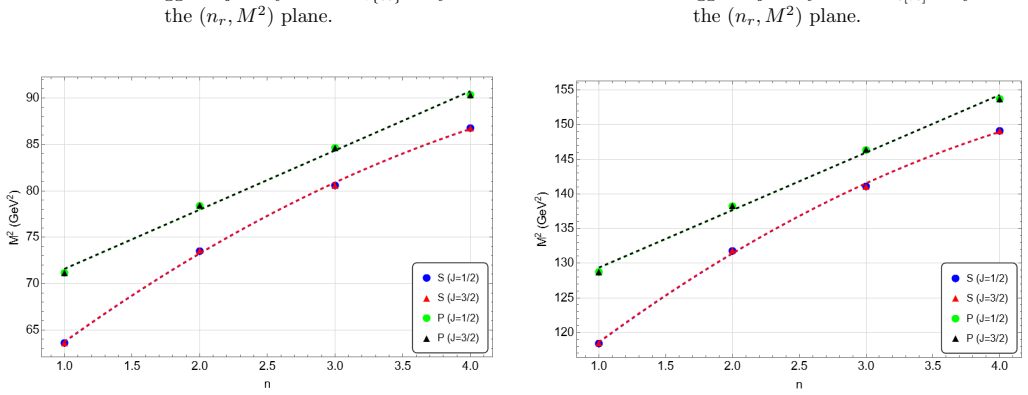
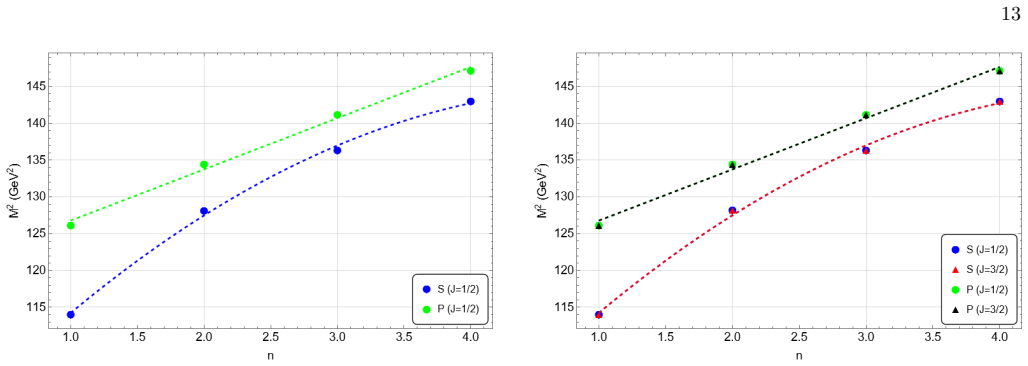
The nonrelativistic quark-diquark model with parameters fixed from the B_c meson spectrum yields ground-state masses of approximately 8.0 GeV for Ω_ccb and 11.0 GeV for Ω_cbb. All three possible diquark clusterings are examined for each baryon to indicate sensitivity to the decomposition. The computed magnetic moments of the spin-1/2 and spin-3/2 states are consistent with results from various other approaches. A radial Regge analysis in the (n_r, M^2) plane reveals approximately linear P-wave trajectories and mildly curved S-wave trajectories, with slope and intercept parameters that scale systematically with the heavy-quark content.
What carries the argument
The quark-diquark approximation that reduces the three-body baryon problem to an effective two-body system, using model parameters fitted to the B_c meson spectrum and considering all three possible diquark clusterings
If this is right
- Ground-state masses near 8.0 GeV for Ω_ccb and 11.0 GeV for Ω_cbb provide benchmarks for experimental searches.
- Magnetic moments for spin-1/2 and spin-3/2 states remain consistent across different theoretical methods.
- Regge trajectories in the (n_r, M^2) plane are linear for P-waves and mildly curved for S-waves.
- Slope and intercept parameters scale systematically with the heavy-quark content of the baryon.
- The framework supplies a consistent link between the heavy meson and baryon sectors.
Where Pith is reading between the lines
- High-precision mass measurements could test the sensitivity of results to different diquark clusterings.
- The pattern of Regge-parameter scaling with quark content could support similar predictions for other triply heavy systems.
- Confirmation of the masses at LHCb would support the transfer of meson-fitted parameters to baryons.
- Deviations from the predicted masses would indicate where the nonrelativistic approximation begins to break down.
Load-bearing premise
The quark-diquark approximation is valid for triply heavy baryons and the parameters fitted to the B_c meson spectrum transfer reliably to these baryon systems.
What would settle it
An experimental measurement of the Ω_ccb ground-state mass that differs substantially from 8.0 GeV would challenge the model's applicability to these systems.
Figures

read the original abstract
In this work, we investigate the mass spectra, magnetic moments, and Regge trajectories of the triply heavy baryons $\Omega_{ccb}$ and $\Omega_{cbb}$ within a nonrelativistic constituent quark model based on the quark--diquark approximation, which reduces the three-body problem to an effective two-body system. For each baryon, all three possible diquark clusterings are considered, providing a qualitative indication of the sensitivity of the results to the quark--diquark decomposition. The model parameters are fixed by a fit to the measured $B_c$ meson spectrum, thereby anchoring the baryon predictions to experimentally constrained inputs and establishing a consistent link between the heavy meson and baryon sectors. We obtain ground-state masses of approximately $8.0$~GeV for $\Omega_{ccb}$ and $11.0$~GeV for $\Omega_{cbb}$, with radial and orbital excitation patterns in good agreement with the results reported in the literature. The computed magnetic moments of the spin-$\tfrac{1}{2}$ and spin-$\tfrac{3}{2}$ states are consistent with the results of various approaches. A radial Regge analysis in the $(n_r, M^2)$ plane reveals approximately linear $P$-wave trajectories and mildly curved $S$-wave trajectories, with slope and intercept parameters that scale systematically with the heavy-quark content of the baryon. These results suggest that the nonrelativistic quark--diquark framework provides a reliable description of triply heavy baryons and serves as a useful reference for future experimental searches, particularly at LHCb.
Editorial analysis
A structured set of objections, weighed in public.
Referee Report
Summary. The paper investigates the mass spectra, magnetic moments, and Regge trajectories of the triply heavy baryons Ω_ccb and Ω_cbb in a nonrelativistic constituent quark model employing the quark-diquark approximation to reduce the three-body problem to an effective two-body system. Parameters are fixed via a fit to the B_c meson spectrum, all three possible diquark clusterings are examined for sensitivity, and predictions are made for ground-state masses (~8.0 GeV for Ω_ccb, ~11.0 GeV for Ω_cbb), excitations, magnetic moments, and approximately linear P-wave Regge trajectories whose slopes scale with heavy-quark content.
Significance. If the parameter transfer from the B_c fit holds, the work supplies concrete phenomenological benchmarks for undiscovered triply heavy baryons that could inform LHCb searches. The explicit consideration of multiple diquark clusterings and the systematic scaling of Regge slopes with quark content are positive features that link the heavy-meson and baryon sectors in a consistent framework.
major comments (2)
- [Abstract] Abstract: the assertion of a 'reliable description' of triply heavy baryons rests on transferring parameters fitted exclusively to the B_c meson spectrum; the manuscript provides no quantitative fit-quality metrics (χ², degrees of freedom) or uncertainty propagation to the baryon masses, leaving the numerical predictions (~8.0 GeV, ~11.0 GeV) without error estimates.
- [Section 3] Section 3 (numerical results): while the three diquark clusterings are varied, the color factor 1/2 for the antitriplet diquark is held fixed and no lattice-QCD anchor or variation of the reduced-mass treatment is shown; this makes the central mass values and the claim of consistency with literature sensitive to the untested transfer assumption.
minor comments (2)
- [Abstract] The abstract states 'good agreement with the results reported in the literature' without naming the specific references or quantifying the mass differences, which would help readers assess the level of consistency.
- [Section 4] Magnetic-moment tables would benefit from explicit comparison columns to other approaches (e.g., lattice or quark-model values) rather than only qualitative statements of consistency.
Simulated Author's Rebuttal
We thank the referee for the constructive comments on our manuscript. We address each major point below and indicate the revisions we will implement in the next version.
read point-by-point responses
-
Referee: [Abstract] Abstract: the assertion of a 'reliable description' of triply heavy baryons rests on transferring parameters fitted exclusively to the B_c meson spectrum; the manuscript provides no quantitative fit-quality metrics (χ², degrees of freedom) or uncertainty propagation to the baryon masses, leaving the numerical predictions (~8.0 GeV, ~11.0 GeV) without error estimates.
Authors: We acknowledge that the original manuscript omitted explicit χ²/dof values for the B_c fit and did not propagate parameter uncertainties to the baryon predictions. In the revised version we will report the χ² per degree of freedom for the fit to the B_c spectrum and include a short discussion of the fit procedure. For the baryon masses we will add a conservative uncertainty estimate obtained by varying the fitted parameters within the ranges that still reproduce the B_c data to within a few MeV; this will be presented as an indicative error band rather than a full statistical propagation. revision: partial
-
Referee: [Section 3] Section 3 (numerical results): while the three diquark clusterings are varied, the color factor 1/2 for the antitriplet diquark is held fixed and no lattice-QCD anchor or variation of the reduced-mass treatment is shown; this makes the central mass values and the claim of consistency with literature sensitive to the untested transfer assumption.
Authors: The color factor 1/2 follows directly from the SU(3)_c representation of the antitriplet diquark and is a standard, non-adjustable input in the quark-diquark model; altering it would change the underlying theoretical framework. We have already explored sensitivity by considering all three possible diquark clusterings for each baryon. Direct lattice-QCD results for Ω_ccb and Ω_cbb masses are not yet available in the literature for anchoring, so our comparisons are made to other phenomenological calculations. We will add an explicit statement in Section 3 justifying the fixed color factor and noting the current lack of lattice anchors as a limitation of the approach. revision: partial
Circularity Check
No significant circularity; meson fit transferred to distinct baryon systems without reduction by construction.
full rationale
The paper fixes model parameters via a fit to the measured B_c meson spectrum and then applies the same nonrelativistic quark-diquark framework to compute masses, magnetic moments, and Regge trajectories for the triply heavy baryons Ω_ccb and Ω_cbb. This constitutes a standard parameter transfer between related heavy-quark systems rather than any self-definitional loop, fitted input renamed as prediction, or load-bearing self-citation. The central numerical results (~8.0 GeV and ~11.0 GeV ground states) are genuine outputs of the effective two-body Schrödinger equation solved for the baryon reduced masses and potentials; they are not algebraically equivalent to the B_c fit data. No uniqueness theorems, ansatzes smuggled via prior self-work, or renaming of known patterns are invoked in a way that collapses the derivation. The approach is self-contained against external benchmarks once the meson fit is accepted as input.
Axiom & Free-Parameter Ledger
free parameters (1)
- model parameters
axioms (2)
- domain assumption nonrelativistic constituent quark model is applicable to triply heavy baryons
- domain assumption quark-diquark approximation reduces the three-body problem to an effective two-body system
Reference graph
Works this paper leans on
-
[1]
Silvestre-Brac, Few Body Syst.20, 1 (1996)
B. Silvestre-Brac, Few Body Syst.20, 1 (1996)
1996
-
[2]
J. Vijande, H. Garcilazo, A. Valcarce, and F. Fernandez, Phys. Rev. D70, 054022 (2004), arXiv:hep-ph/0408274
- [3]
- [4]
- [5]
-
[6]
W. Roberts and M. Pervin, Int. J. Mod. Phys. A23, 2817 (2008), arXiv:0711.2492 [nucl-th]
- [7]
- [8]
-
[9]
Shah and A
Z. Shah and A. K. Rai, Eur. Phys. J. A53, 195 (2017)
2017
-
[10]
X.-Z. Weng, X.-L. Chen, and W.-Z. Deng, Phys. Rev. D97, 054008 (2018), arXiv:1801.08644 [hep-ph]
- [11]
- [12]
- [13]
- [14]
-
[15]
E. Ortiz-Pacheco and R. Bijker, Phys. Rev. D108, 054014 (2023), arXiv:2307.04939 [hep-ph]
- [16]
-
[17]
H. Zhou, S.-Q. Luo, and X. Liu, Phys. Rev. D112, 074007 (2025), arXiv:2507.10243 [hep-ph]
- [18]
-
[19]
M. Padmanath, R. G. Edwards, N. Mathur, and M. Peardon, Phys. Rev. D90, 074504 (2014), arXiv:1307.7022 [hep-lat]
- [20]
- [21]
-
[22]
Burch, (2015), arXiv:1502.00675 [hep-lat]
T. Burch, (2015), arXiv:1502.00675 [hep-lat]
-
[23]
S. Meinel, Phys. Rev. D82, 114514 (2010), arXiv:1008.3154 [hep-lat]. 16
-
[24]
S. Meinel, Phys. Rev. D85, 114510 (2012), arXiv:1202.1312 [hep-lat]
-
[25]
C. Alexandrou, S. Bacchio, G. Christou, and J. Finkenrath, Phys. Rev. D108, 094510 (2023), arXiv:2309.04401 [hep-lat]
- [26]
- [27]
-
[28]
H. Bahtiyar, K. U. Can, G. Erkol, P. Gubler, M. Oka, and T. T. Takahashi, Phys. Rev. D102, 054513 (2020), arXiv:2004.08999 [hep-lat]
-
[29]
C. Alexandrou and C. Kallidonis, Phys. Rev. D96, 034511 (2017), arXiv:1704.02647 [hep-lat]
-
[30]
Y.-C. Chen and T.-W. Chiu (TWQCD), Phys. Lett. B767, 193 (2017), arXiv:1701.02581 [hep-lat]
- [31]
-
[32]
C. Alexandrou, V. Drach, K. Jansen, C. Kallidonis, and G. Koutsou, Phys. Rev. D90, 074501 (2014), arXiv:1406.4310 [hep-lat]
-
[33]
Y. Namekawaet al.(PACS-CS), Phys. Rev. D87, 094512 (2013), arXiv:1301.4743 [hep-lat]
-
[34]
S. Durr, G. Koutsou, and T. Lippert, Phys. Rev. D86, 114514 (2012), arXiv:1208.6270 [hep-lat]
work page Pith review arXiv 2012
-
[35]
C. Alexandrou, J. Carbonell, D. Christaras, V. Drach, M. Gravina, and M. Papinutto, Phys. Rev. D86, 114501 (2012), arXiv:1205.6856 [hep-lat]
- [36]
-
[37]
T.-W. Chiu and T.-H. Hsieh, Nucl. Phys. A755, 471 (2005), arXiv:hep-lat/0501021
-
[38]
N. Brambilla, A. Vairo, and T. Rosch, Phys. Rev. D72, 034021 (2005), arXiv:hep-ph/0506065
- [39]
-
[40]
J.-R. Zhang and M.-Q. Huang, Phys. Lett. B674, 28 (2009), arXiv:0902.3297 [hep-ph]
-
[41]
Z.-G. Wang, Commun. Theor. Phys.58, 723 (2012), arXiv:1112.2274 [hep-ph]
-
[42]
Wang, AAPPS Bull.31, 5 (2021), arXiv:2010.08939 [hep-ph]
Z.-G. Wang, AAPPS Bull.31, 5 (2021), arXiv:2010.08939 [hep-ph]
- [43]
- [44]
- [45]
- [46]
-
[47]
K. Serafin, M. G´ omez-Rocha, J. More, and S. D. G lazek, Eur. Phys. J. C78, 964 (2018), arXiv:1805.03436 [hep-ph]
- [48]
- [49]
-
[50]
M. G´ omez-Rocha, J. More, and K. Serafin, Few Body Syst.64, 44 (2023), arXiv:2305.06728 [hep-ph]
- [51]
- [52]
-
[53]
H.-Y. Cheng, Chin. J. Phys.78, 324 (2022), arXiv:2109.01216 [hep-ph]
-
[54]
S. Choet al.(ExHIC), Prog. Part. Nucl. Phys.95, 279 (2017), arXiv:1702.00486 [nucl-th]
- [55]
-
[56]
Anselmino, E
M. Anselmino, E. Predazzi, S. Ekelin, S. Fredriksson, and D. B. Lichtenberg, Rev. Mod. Phys.65, 1199 (1993)
1993
- [57]
-
[58]
Wilczek, inDeserfest: A Celebration of the Life and Works of Stanley Deser(2004) pp
F. Wilczek, inDeserfest: A Celebration of the Life and Works of Stanley Deser(2004) pp. 322–338, arXiv:hep-ph/0409168
-
[59]
A. Selem and F. Wilczek, inRingberg Workshop on New Trends in HERA Physics 2005(2006) pp. 337–356, arXiv:hep- ph/0602128
-
[60]
A. Valcarce, H. Garcilazo, and J. Vijande, Eur. Phys. J. A37, 217 (2008), arXiv:0807.2973 [hep-ph]
- [61]
-
[62]
Eichten, K
E. Eichten, K. Gottfried, T. Kinoshita, K. D. Lane, and T.-M. Yan, Phys. Rev. D21, 203 (1980)
1980
-
[63]
Lucha, F
W. Lucha, F. F. Schoberl, and D. Gromes, Phys. Rept.200, 127 (1991)
1991
-
[64]
W. Lucha and F. F. Schoberl, inInternational Summer School for Students on Development in Nuclear Theory and Particle Physics(1995) arXiv:hep-ph/9601263
work page internal anchor Pith review arXiv 1995
- [65]
-
[66]
Eiglsperger,Quarkonium Spectroscopy: Beyond One-Gluon Exchange, Master’s thesis, Munich, Tech
J. Eiglsperger,Quarkonium Spectroscopy: Beyond One-Gluon Exchange, Master’s thesis, Munich, Tech. U. (2007), arXiv:0707.1269 [hep-ph]
-
[67]
Godfrey and N
S. Godfrey and N. Isgur, Phys. Rev. D32, 189 (1985)
1985
-
[68]
Navaset al.(Particle Data Group), Phys
S. Navaset al.(Particle Data Group), Phys. Rev. D110, 030001 (2024)
2024
-
[69]
Gell-Mann, Phys
M. Gell-Mann, Phys. Lett.8, 214 (1964)
1964
-
[70]
M. A. B. Beg, B. W. Lee, and A. Pais, Phys. Rev. Lett.13, 514 (1964)
1964
-
[71]
De Rujula, H
A. De Rujula, H. Georgi, and S. L. Glashow, Phys. Rev. D12, 147 (1975)
1975
-
[72]
Regge, Nuovo Cim.14, 951 (1959)
T. Regge, Nuovo Cim.14, 951 (1959)
1959
-
[73]
Regge, Nuovo Cim.18, 947 (1960)
T. Regge, Nuovo Cim.18, 947 (1960)
1960
-
[74]
P. D. B. Collins, Phys. Rept.1, 103 (1971)
1971
-
[75]
P. D. B. Collins,An Introduction to Regge Theory and High Energy Physics(Cambridge University Press, 1977)
1977
-
[76]
G. F. Chew and S. C. Frautschi, Phys. Rev. Lett.7, 394 (1961)
1961
-
[77]
Klempt and B
E. Klempt and B. C. Metsch, Eur. Phys. J. A48, 127 (2012)
2012
- [78]
- [79]
- [80]
discussion (0)
Sign in with ORCID, Apple, or X to comment. Anyone can read and Pith papers without signing in.