Recognition: unknown
Thermal Phase Structure of the Attractive Fermi Hubbard Model with Imaginary Chemical Potential
Pith reviewed 2026-05-10 03:39 UTC · model grok-4.3
The pith
The BCS-BEC crossover in the one-dimensional attractive Fermi-Hubbard model is controlled by imaginary chemical potential, temperature via a thermal kernel, and a coupling deviation parameter, with a gapless window at unitarity.
A machine-rendered reading of the paper's core claim, the machinery that carries it, and where it could break.
Core claim
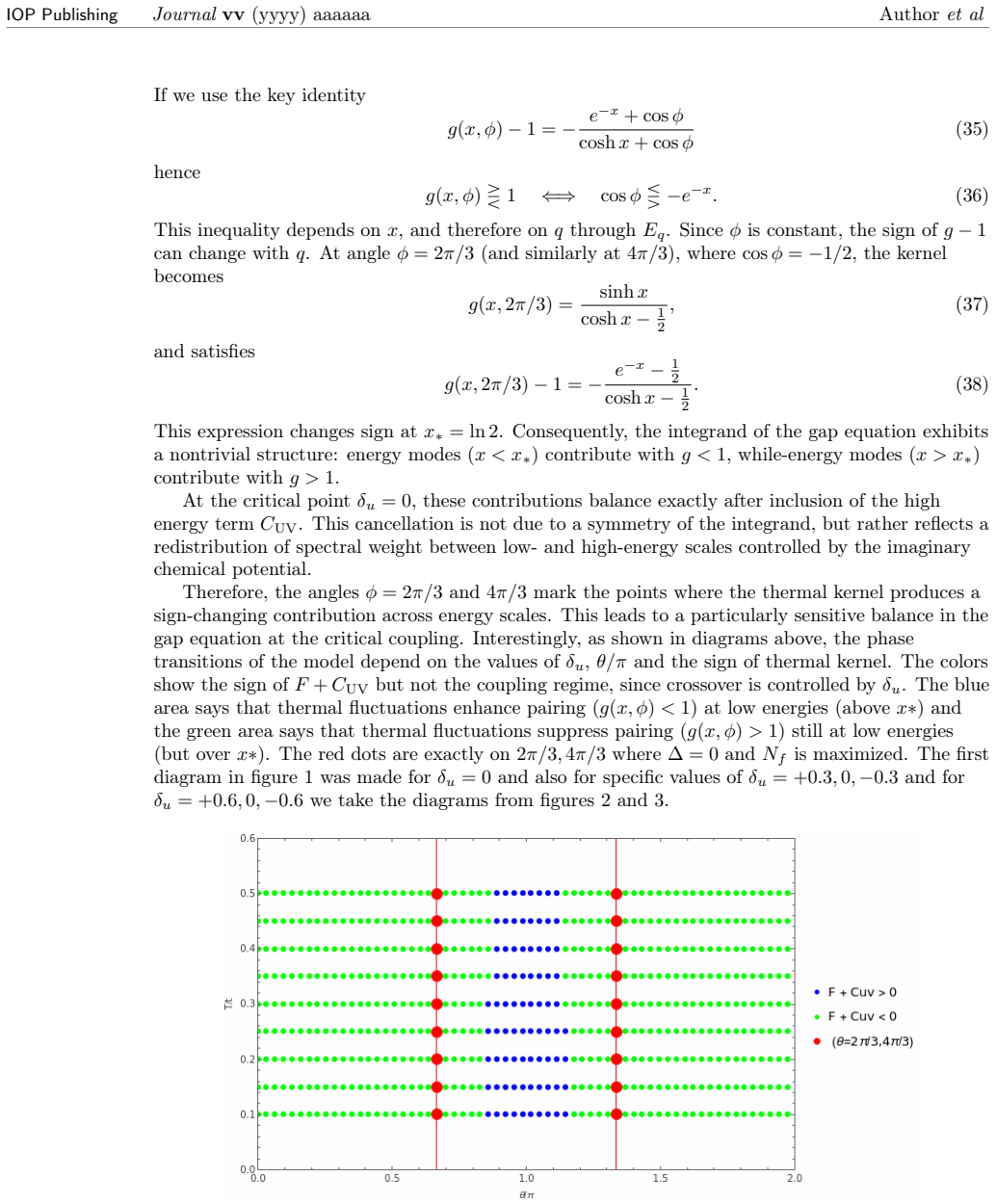
We show that the crossover is governed by three parameters. The imaginary chemical potential iθ, the temperature via a thermal kernel g(βE_k,βθ) and the parameter δ_u whose sign controls the weak and strong coupling regimes. At the unitarity point (U=U_c), we find a thermal window φ=βθ=2π/3,4π/3 where the gap vanishes while the fermion number N_f, which quantifies the balance between particle-like and hole-like excitations, has a local maximum/minimum. Inside this thermal window BCS and BEC physics await changes in the coupling to be selected as the dominant regime.
What carries the argument
The thermal kernel g(β E_k, β θ) that enters the mean-field expressions for the gap and fermion number, combined with the coupling deviation δ_u whose sign selects the regime.
If this is right
- At unitarity inside the thermal window the gap is suppressed, so that tiny changes in coupling strength select either BCS or BEC as the dominant pairing regime.
- The fermion number N_f reaches local extrema exactly where the gap closes, marking the point of balanced particle and hole excitations.
- The three-parameter control (iθ, thermal kernel, δ_u) maps the entire crossover, with the sign of δ_u switching between weak-coupling and strong-coupling behavior.
- Analytic continuation from the imaginary-chemical-potential results yields information on pairing correlations that applies to physical lattice many-body systems.
Where Pith is reading between the lines
- The identified thermal window suggests that thermodynamic observables such as specific heat or compressibility could exhibit distinct signatures at those parameter values.
- The same three-parameter structure might be used to organize crossover physics in related lattice models with different interaction ranges or additional flavors.
- Continuing the imaginary-potential results to real chemical potentials could provide quantitative predictions for cold-atom experiments on the 1D Hubbard chain.
Load-bearing premise
The mean-field approximation in the large-N limit accurately describes the thermal phase structure, and results at imaginary chemical potential can be analytically continued to physical regimes.
What would settle it
A direct evaluation of the gap equation and fermion number at βθ=2π/3 with U equal to the critical value U_c, checking whether the gap solution is exactly zero while N_f shows an extremum.
Figures


read the original abstract
We study the BCS--BEC crossover of the large $N$ attractive Fermi-Hubbard model on a one-dimensional lattice using the mean field approximation in the presence of an imaginary chemical potential. We show that the crossover is governed by three parameters. The imaginary chemical potential $i\theta$, the temperature via a thermal kernel $g(\beta E_k,\beta\theta)$ and the parameter $\delta_u$ whose sign controls the weak and strong coupling regimes. At the unitarity point ($U=U_c$), we find a thermal window $\phi=\beta\theta=2\pi/3,4\pi/3$ where the gap vanishes while the fermion number $N_f$, which quantifies the balance between particle-like and hole-like excitations, has a local maximum/minimum. Inside this thermal window BCS and BEC physics are await changes in the coupling to be selected as the dominant regime. We expect that our results will unveil a better understanding of pairing correlations in lattice many-body physics.
Editorial analysis
A structured set of objections, weighed in public.
Referee Report
Summary. The manuscript studies the BCS-BEC crossover of the large-N attractive Fermi-Hubbard model on a one-dimensional lattice using mean-field theory with imaginary chemical potential. It claims the crossover is governed by three parameters—the imaginary chemical potential iθ, temperature via the thermal kernel g(βE_k, βθ), and δ_u whose sign distinguishes weak and strong coupling regimes. At the unitarity point U=U_c, a thermal window φ=βθ=2π/3,4π/3 is reported where the gap vanishes while the fermion number N_f (quantifying particle-hole balance) exhibits a local maximum/minimum, purportedly allowing coupling changes to select BCS or BEC physics.
Significance. If the mean-field results hold and survive analytic continuation to real chemical potential, the identification of a thermal window at unitarity could offer a useful parameterization for understanding pairing correlations in lattice models. The large-N limit permits analytical progress on the thermal kernel, which is a methodological strength, but the 1D setting and mean-field approximation limit direct physical applicability without further validation.
major comments (3)
- [Abstract and main text] Abstract and main text: The self-consistency equations for the mean-field gap, the explicit definition of the thermal kernel g(βE_k, βθ), and any numerical checks are not supplied. This is load-bearing for the central claim of a thermal window at φ=2π/3,4π/3, as the reported vanishing of the gap and extrema in N_f cannot be verified or reproduced from the given information.
- [Results section on unitarity] Results section on unitarity: No demonstration is given of the analytic properties of the gap or free energy in the complex μ-plane, nor any check that the identified thermal window survives continuation from imaginary to real chemical potential. This directly weakens the link to the physical BCS-BEC crossover.
- [Parameter definitions] Parameter definitions: The parameter δ_u is introduced to control weak/strong coupling regimes and the thermal kernel g is defined in terms of model energies, but without an independent derivation or falsifiable test, the regime distinctions and unitarity window risk reducing to self-consistent or fitted choices rather than independent predictions.
minor comments (2)
- [Abstract] Abstract: The sentence 'BCS and BEC physics are await changes in the coupling' contains a grammatical error and should be rephrased for clarity.
- [Notation] Notation: The fermion number N_f is introduced as quantifying particle-hole balance but its precise definition and relation to the gap equation is not clarified in the provided text.
Simulated Author's Rebuttal
We appreciate the referee's thorough review of our manuscript on the thermal phase structure of the attractive Fermi-Hubbard model with imaginary chemical potential. The comments highlight important aspects for clarity and validation. We respond to each major comment below and indicate the revisions we will make.
read point-by-point responses
-
Referee: [Abstract and main text] Abstract and main text: The self-consistency equations for the mean-field gap, the explicit definition of the thermal kernel g(βE_k, βθ), and any numerical checks are not supplied. This is load-bearing for the central claim of a thermal window at φ=2π/3,4π/3, as the reported vanishing of the gap and extrema in N_f cannot be verified or reproduced from the given information.
Authors: We agree with the referee that the self-consistency equations, the definition of the thermal kernel, and numerical checks are essential for verifying the central claims. Although these are derived in the results section, they were not presented with sufficient explicitness. In the revised manuscript, we will add the explicit mean-field gap equation, the closed-form expression for g(βE_k, βθ) obtained from the large-N saddle point, and include numerical data or figures demonstrating the gap vanishing and the extrema in N_f at φ=2π/3 and 4π/3. This will allow full reproducibility. revision: yes
-
Referee: [Results section on unitarity] Results section on unitarity: No demonstration is given of the analytic properties of the gap or free energy in the complex μ-plane, nor any check that the identified thermal window survives continuation from imaginary to real chemical potential. This directly weakens the link to the physical BCS-BEC crossover.
Authors: We acknowledge that demonstrating the analytic continuation is crucial for physical relevance. The current work focuses on the imaginary chemical potential to access the thermal kernel analytically in the large-N limit. We will revise the results section to include a discussion of the analytic properties, noting that the gap equation is holomorphic in the relevant strip of the complex plane away from branch cuts, and argue that the thermal window at φ=2π/3,4π/3 should persist based on continuity arguments. A complete numerical analytic continuation will be mentioned as an important direction for future research. revision: partial
-
Referee: [Parameter definitions] Parameter definitions: The parameter δ_u is introduced to control weak/strong coupling regimes and the thermal kernel g is defined in terms of model energies, but without an independent derivation or falsifiable test, the regime distinctions and unitarity window risk reducing to self-consistent or fitted choices rather than independent predictions.
Authors: The parameter δ_u is not a fitted choice but is derived from the zero-temperature gap equation in the large-N limit, where U_c is the critical coupling at which the gap opens for given filling. Its sign determines whether the system is in the BCS-like (weak coupling, δ_u >0) or BEC-like (strong coupling, δ_u <0) regime through the behavior of the thermal kernel. We will add an appendix or subsection providing the independent derivation from the saddle-point equations and include a falsifiable prediction, such as the dependence of the unitarity point on the lattice filling factor, which can be checked in future numerical simulations beyond mean-field. revision: yes
Circularity Check
No significant circularity detected in derivation chain
full rationale
The paper introduces parameters iθ, the thermal kernel g(βE_k, βθ), and δ_u as governing the crossover, with explicit statements that δ_u's sign distinguishes coupling regimes and that the unitarity window is identified from mean-field gap equations at imaginary chemical potential. These are presented as derived from the large-N mean-field free energy and gap equation rather than tautological redefinitions. The thermal kernel is constructed from the model's quasiparticle energies E_k, which are themselves obtained from the self-consistent mean-field solution; this is standard model-building, not a reduction of predictions to inputs by construction. No load-bearing step reduces to a self-citation chain or fitted parameter renamed as prediction. The central results (vanishing gap at specific φ=2π/3,4π/3 and extrema in N_f) follow from solving the mean-field equations at those points and are not forced by prior definitions. The manuscript is self-contained against its stated approximations, yielding an honest non-finding of circularity.
Axiom & Free-Parameter Ledger
free parameters (2)
- δ_u
- U_c
axioms (2)
- domain assumption Mean-field theory is valid in the large-N limit for the 1D attractive Fermi-Hubbard model
- domain assumption Results at imaginary chemical potential iθ can be continued to physical regimes
Forward citations
Cited by 1 Pith paper
-
Bose-Fermi Mapping in Hubbard Models at Imaginary Chemical Potential and Phase-Induced Fermionization
Imaginary chemical potential induces a mapping that turns the BCS-BEC crossover of attractive fermions into a Bose-Fermi crossover for repulsive bosons via a simple phase shift in the thermal kernel.
Reference graph
Works this paper leans on
-
[1]
Wilhelm Zwerger, The BCS-BEC Crossover and the Unitary Fermi Gas,Springer(2012)
2012
-
[2]
Arti Garg, H. R. Krishnamurthy, and Mohit Randeria, BCS-BEC crossover atT= 0: A Dynamical Mean Field Theory Approach,Phys. Rev. B72(2005)
2005
-
[3]
Diener, Rajdeep Sensarma, and Mohit Randeria, Quantum fluctuations in the superfluid state of the BCS-BEC crossover,Phys
Roberto B. Diener, Rajdeep Sensarma, and Mohit Randeria, Quantum fluctuations in the superfluid state of the BCS-BEC crossover,Phys. Rev. A77(2008)
2008
-
[4]
Bauer, A.C
J. Bauer, A.C. Hewson, and N. Dupuis, Dynamical mean-field theory and numerical renormalization group study of superconductivity in the attractive Hubbard model,Phys. Rev. B79(2009)
2009
- [5]
-
[6]
Levin, BCS–BEC crossover: From high temperature superconductors to ultracold superfluids,Physics Reports412(2005)
Qijin Chen, Jelena Stajic, Shina Tan, K. Levin, BCS–BEC crossover: From high temperature superconductors to ultracold superfluids,Physics Reports412(2005)
2005
-
[7]
Levin, When superconductivity crosses over: From BCS to BEC,Reviews of Modern Physics96(2024) 14 IOP PublishingJournalvv(yyyy) aaaaaa Authoret al
Qijin Chen, Zhiqiang Wang, Rufus Boyack, Shuolong Yang, K. Levin, When superconductivity crosses over: From BCS to BEC,Reviews of Modern Physics96(2024) 14 IOP PublishingJournalvv(yyyy) aaaaaa Authoret al
2024
-
[8]
Arnaud Koetsier, D. B. M. Dickerscheid, and H. T. C. Stoof, BEC-BCS crossover in an optical lattice,Phys. Rev. A74(2006)
2006
-
[9]
Mark Alford, Anton Kapustin, and Frank Wilczek, Imaginary chemical potential and finite fermion density on the lattice,Phys. Rev. D59(1999)
1999
-
[10]
W. Liu, Z. Lin, Z. D. Wang, and Y. Chen, Generalized Haldane models on laser-coupling optical lattices,Sci. Rep.812898 (2018)
2018
-
[11]
H. Li, Q. Liang, Z. Dong, H. Wang, W. Yi, J. S. Pan, and B. Yan, Engineering topological chiral transport in a flat-band lattice of ultracold atoms,Light Sci. Appl.14326 (2025)
2025
-
[12]
Wei Wang, Zheng Zhang, Gui-Xin Tang, and Tao Wang, Floquet engineering tunable periodic gauge fields and simulating real topological phases in a cold-alkaline-earth-metal-atom optical lattice,Phys. Rev. A110(2024)
2024
-
[13]
Tanaka and F
K. Tanaka and F. Marsiglio, Even-odd and super-even effects in the attractive Hubbard model,Phys. Rev. B60(1999)
1999
-
[14]
Massimo D’Elia and Maria Paola Lombardo, Finite density QCD via an imaginary chemical potential,Phys. Rev. D67(2003)
2003
-
[15]
Dagotto, A
E. Dagotto, A. Moreo, R. L. Sugar, and D. Toussaint, Binding of holes in the Hubbard model, Phys. Rev. B41(1990)
1990
-
[16]
J. R. Schrieffer, X. Wen, and S. C. Zhang, Dynamic spin fluctuations and the bag mechanism of high-Tc superconductivity,Phys. Rev. B39(1989)
1989
-
[17]
Venketeswara Pai, Holstein-Hubbard model at half filling: A static auxiliary field study,Phys
Saurabh Pradhan and G. Venketeswara Pai, Holstein-Hubbard model at half filling: A static auxiliary field study,Phys. Rev. B92(2015)
2015
-
[18]
Taylor, A
E. Taylor, A. Griffin, N. Fukushima, and Y. Ohashi, Pairing fluctuations and the superfluid density through the BCS-BEC crossover,Phys. Rev. A74(2006)
2006
-
[19]
André Roberge and Nathan Weiss, Gauge theories with imaginary chemical potential and the phases of QCD,Nuclear Physics B275734 (1986)
1986
-
[20]
Haussmann, W
R. Haussmann, W. Rantner, S. Cerrito, and W. Zwerger, Thermodynamics of the BCS-BEC crossover,Phys. Rev. A75(2007)
2007
-
[21]
Filothodoros, Anastasios C
Evangelos G. Filothodoros, Anastasios C. Petkou, and Nicholas D. Vlachos, 3d fermion-boson map with imaginary chemical potential,Phys. Rev. D95(2017)
2017
-
[22]
Filothodoros, Anastasios C
Evangelos G. Filothodoros, Anastasios C. Petkou, and Nicholas D. Vlachos, The fermion–boson map for larged,Nuclear Physics B941(2019)
2019
-
[23]
Dupuis, Berezinskii-Kosterlitz-Thouless transition and BCS-Bose crossover in the two-dimensional attractive Hubbard model,Phys
N. Dupuis, Berezinskii-Kosterlitz-Thouless transition and BCS-Bose crossover in the two-dimensional attractive Hubbard model,Phys. Rev. B70(2004) 15
2004
discussion (0)
Sign in with ORCID, Apple, or X to comment. Anyone can read and Pith papers without signing in.