The High Explosives and Affected Targets (HEAT) Dataset
Pith reviewed 2026-05-10 04:57 UTC · model grok-4.3
The pith
This work introduces the HEAT dataset of two-dimensional simulations to train AI surrogate models for high-explosive-driven multi-material shock dynamics.
A machine-rendered reading of the paper's core claim, the machinery that carries it, and where it could break.
Core claim
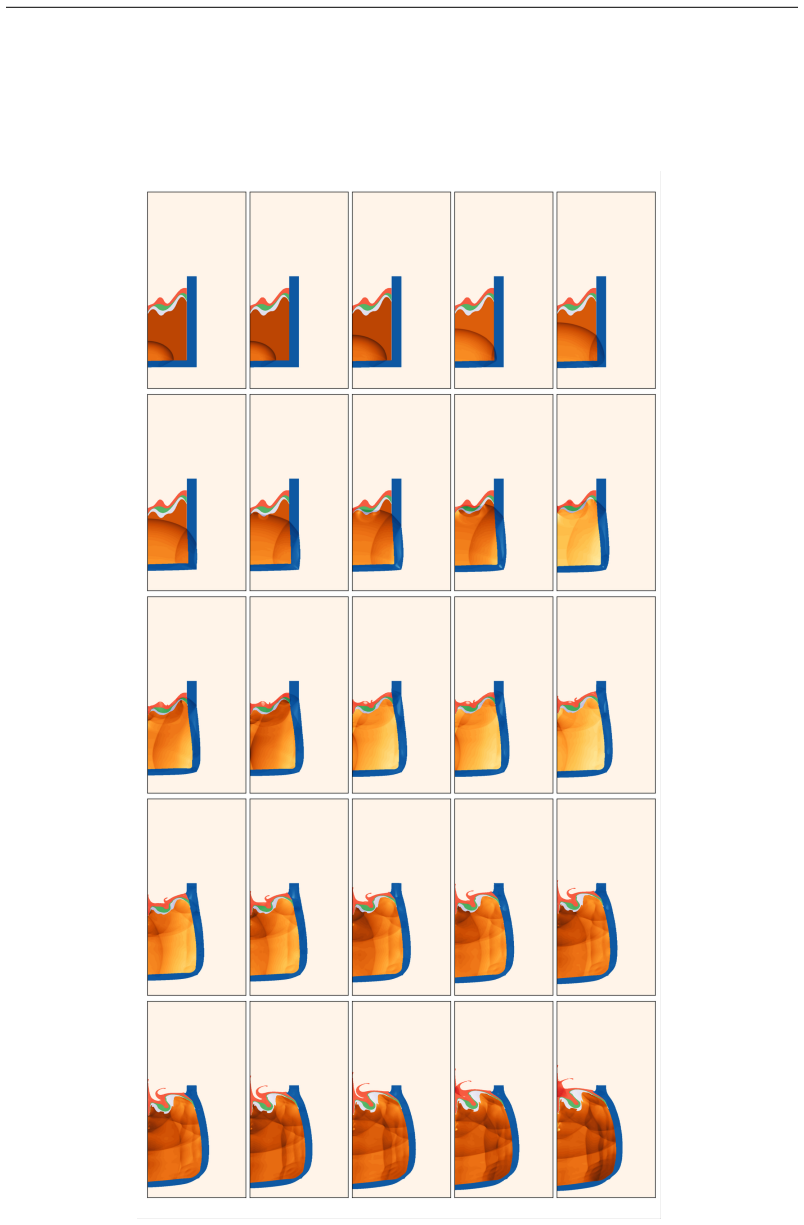
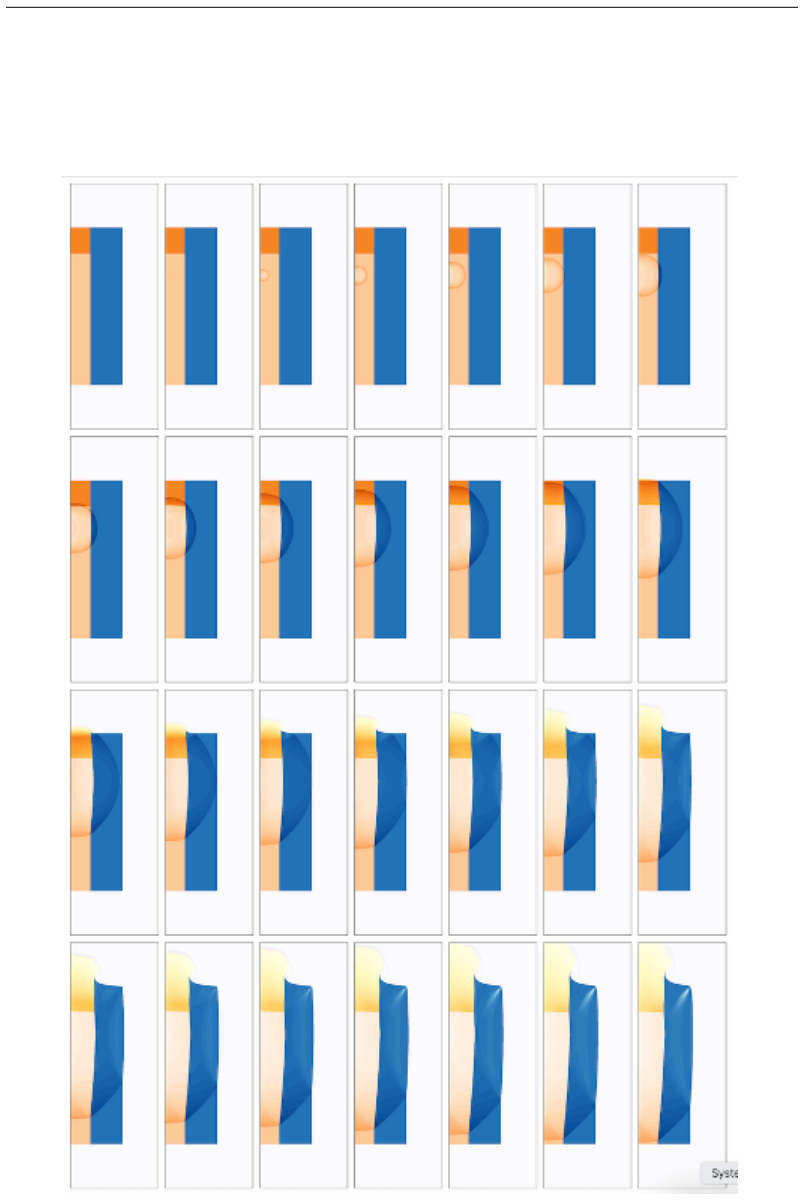
The HEAT dataset consists of two partitions: expanding shock-cylinder simulations spanning metals, polymers, water, gases, and detonating materials, and perturbed layered interface simulations with varied geometries using fixed materials like copper, aluminum, and high explosives. Each entry provides time series of pressure, density, temperature, position, velocity, and stress fields.
What carries the argument
The HEAT dataset, partitioned into CYL and PLI simulations generated with a multi-material Eulerian shock-propagation code.
If this is right
- AI models can be trained to predict shock dynamics without running expensive full-physics simulations.
- Models can learn material-specific behaviors across metals, polymers, and explosives from the provided time series data.
- The dataset enables validation of surrogate models on phenomena like momentum transfer and thermal effects.
- Researchers gain a public resource for developing generalizable AI approaches to multi-material interactions.
Where Pith is reading between the lines
- Such a dataset could support extensions to three-dimensional simulations if computational resources allow.
- Trained models might eventually guide experimental design in explosive testing by predicting outcomes quickly.
- Integration with real experimental data could improve model accuracy for practical applications.
Load-bearing premise
The underlying simulations accurately capture the essential physics of shock propagation, plasticity, and detonation.
What would settle it
A direct comparison showing that AI models trained on HEAT fail to match outcomes from independent full-physics simulations or physical experiments would indicate the dataset is insufficient.
Figures

read the original abstract
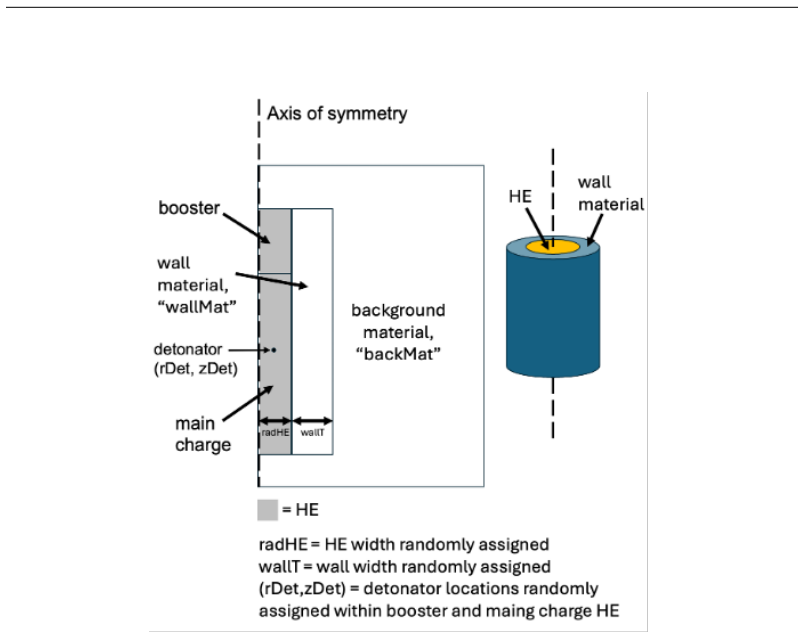
Artificial Intelligence (AI) surrogate models provide a computationally efficient alternative to full-physics simulations, but no public datasets currently exist for training and validating models of high-explosive-driven, multi-material shock dynamics. Simulating shock propagation is challenging due to the need for material-specific equations of state (EOS) and models of plasticity, phase change, damage, fluid instabilities, and multi-material interactions. Explosive-driven shocks further require reactive material models to capture detonation physics. To address this gap, we introduce the High-Explosives and Affected Targets (HEAT) dataset, a physics-rich collection of two-dimensional, cylindrically symmetric simulations generated using an Eulerian multi-material shock-propagation code developed at Los Alamos National Laboratory. HEAT consists of two partitions: expanding shock-cylinder (CYL) simulations and Perturbed Layered Interface (PLI) simulations. Each entry includes time series of thermodynamic fields (pressure, density, temperature), kinematic fields (position, velocity), and continuum quantities such as stress. The CYL partition spans a range of materials, including metals (aluminum, copper, depleted uranium, stainless steel, tantalum), a polymer, water, gases (air, nitrogen), and a detonating material. The PLI partition explores varied geometries with fixed materials: copper, aluminum, stainless steel, polymer, and high explosive. HEAT captures key phenomena such as shock propagation, momentum transfer, plastic deformation, and thermal effects, providing a benchmark dataset for AI/ML models of multi-material shock physics.
Editorial analysis
A structured set of objections, weighed in public.
Referee Report
Summary. The paper claims that no public datasets currently exist for training and validating AI surrogate models of high-explosive-driven multi-material shock dynamics. It introduces the HEAT dataset as a collection of two-dimensional cylindrically symmetric Eulerian simulations generated with a Los Alamos multi-material shock-propagation code. The dataset comprises two partitions (CYL: expanding shock-cylinder simulations across metals, polymers, water, gases, and detonating material; PLI: perturbed layered interface simulations with fixed materials) and supplies time series of thermodynamic fields (pressure, density, temperature), kinematic fields (position, velocity), and continuum quantities such as stress to capture phenomena including shock propagation, plastic deformation, and thermal effects.
Significance. If the simulations faithfully reproduce the relevant physics, HEAT would fill a genuine gap by supplying the first openly available, physics-rich benchmark dataset for developing generalizable machine-learning surrogates in multi-material high-explosive shock dynamics, thereby enabling more efficient exploration of complex multi-physics problems that are otherwise computationally prohibitive.
major comments (2)
- [Simulation methodology and dataset generation] The manuscript supplies only a high-level description of the Los Alamos Eulerian multi-material code and contains no quantitative validation of the simulation outputs. No comparisons are shown to experimental Hugoniot curves, shock arrival times, free-surface velocities, or standard analytic solutions for the materials employed (aluminum, copper, tantalum, depleted uranium, stainless steel, polymer, water, air, nitrogen, and high explosive). This validation is load-bearing for the central claim that the dataset is suitable for training generalizable AI surrogate models, because any systematic bias in the EOS, strength, or reactive models would be inherited by every training example.
- [Dataset partitions (CYL and PLI)] No information is provided on numerical convergence, grid-resolution studies, or uncertainty quantification for the supplied fields. Without such checks it is impossible to assess the data quality or to determine whether the captured phenomena (shock propagation, interface instabilities, plastic flow) are numerically converged for the intended ML use cases.
minor comments (2)
- [Abstract] The assertion in the abstract that 'no public datasets currently exist' would be strengthened by a short literature review or citations to any related (even if narrower) public simulation datasets in shock or explosive physics.
- All material models, equations of state, and constitutive relations should be explicitly referenced to standard sources or prior publications to support reproducibility and to allow users to judge the physical fidelity of the data.
Simulated Author's Rebuttal
Thank you for the opportunity to respond to the referee's report. We value the constructive criticism and have revised the manuscript to address the concerns raised. Below we provide point-by-point responses to the major comments.
read point-by-point responses
-
Referee: The manuscript supplies only a high-level description of the Los Alamos Eulerian multi-material code and contains no quantitative validation of the simulation outputs. No comparisons are shown to experimental Hugoniot curves, shock arrival times, free-surface velocities, or standard analytic solutions for the materials employed (aluminum, copper, tantalum, depleted uranium, stainless steel, polymer, water, air, nitrogen, and high explosive). This validation is load-bearing for the central claim that the dataset is suitable for training generalizable AI surrogate models, because any systematic bias in the EOS, strength, or reactive models would be inherited by every training example.
Authors: We agree that the original manuscript lacked explicit quantitative validation, which is important for substantiating the dataset's utility. The underlying Los Alamos multi-material code has been validated extensively in the literature against experiments, but we did not include direct comparisons in the initial submission. In the revised manuscript, we have added a dedicated Validation subsection in the Methods that presents comparisons of simulated Hugoniot curves and shock arrival times for key materials (aluminum, copper, tantalum) to experimental data, along with references to analytic solutions such as the Gurney model for cylinder expansion. These additions help confirm the absence of major systematic biases in the EOS and strength models. revision: yes
-
Referee: No information is provided on numerical convergence, grid-resolution studies, or uncertainty quantification for the supplied fields. Without such checks it is impossible to assess the data quality or to determine whether the captured phenomena (shock propagation, interface instabilities, plastic flow) are numerically converged for the intended ML use cases.
Authors: We concur that convergence information is necessary to evaluate data quality for ML applications. The revised manuscript now includes a Grid Resolution and Convergence subsection detailing the uniform grid spacing employed (e.g., 50 microns for CYL cases) and results from resolution-doubling studies on representative simulations, demonstrating convergence of shock front positions and interface velocities to within 2%. Uncertainty quantification was not performed during dataset generation owing to the substantial computational cost; we have added an explicit discussion of this limitation and its implications for surrogate model training. revision: partial
Circularity Check
Dataset release paper with no derivations or predictions
full rationale
This is a data-release paper that introduces the HEAT dataset of 2-D cylindrically symmetric Eulerian simulations. No mathematical derivations, first-principles results, fitted parameters, or predictions are claimed. The manuscript describes the simulation setup and output fields at a high level but performs no analysis that reduces to its own inputs by construction, self-citation chains, or ansatz smuggling. The central claim (providing a public benchmark for AI surrogates) is independent of any load-bearing self-referential steps and stands on the external validity of the underlying Los Alamos code, which is not derived within the paper.
Axiom & Free-Parameter Ledger
Reference graph
Works this paper leans on
-
[1]
Zhou, A. and Farimani, A. , title =. Computer Methods in Applied Mechanics and Engineering , volume =
-
[2]
Evans, L. C. , title =
-
[3]
Ohana, R. and McCabe, M. and Meyer, L. and Morel, R. and Agocs, F. and Beneitez, M. and Berger, M. and Burkhart, B. and Burns, K. and Dalziel, S. and Fielding, D. and Fortunato, D. and Goldberg, J. and Hirashima, K. and Jiang, Y.-F. and Ker , title =. Advances in Neural Information Processing Systems , volume =
-
[4]
Oberkampf, W. L. and Trucano, T. G. , title =. Progress in Aerospace Sciences , volume =
-
[5]
oceans11.lanl.gov , year =
-
[6]
Hickmann, Kyle and Callis, Skylar and Egozi, Gal and De, Soumi and Kaiser, Bryan and Pandit, Sourabh and Chakrabarti, Sharmistha and Armstrong, Derek and Henrick, Andrew and Schodt, David and Toivonen, Andrew and Stachelek, Jemma , title =. 2025 , howpublished =
work page 2025
- [7]
-
[8]
Miers, K. and Peterson, N. and Perry, W. L. and Lystrom, L. and Sweitzer, J. and DeFisher, S. , title =. International Journal of Impact Engineering , volume =
-
[9]
Subramanian, G. and Carver, R. and McDermott, D. and Coleman, A. and Morneau, R. and Jadrich, R. and Ticknor, C. , title =
- [10]
- [11]
discussion (0)
Sign in with ORCID, Apple, or X to comment. Anyone can read and Pith papers without signing in.