Recognition: unknown
Stripping Symmetry: Electrochemical Oxidation to a Superconducting Polar Metal in Au2Pb0.914P2
Pith reviewed 2026-05-10 02:51 UTC · model grok-4.3
The pith
Electrochemical removal of lead from a centrosymmetric crystal drives symmetry breaking to produce a polar superconductor.
A machine-rendered reading of the paper's core claim, the machinery that carries it, and where it could break.
Core claim
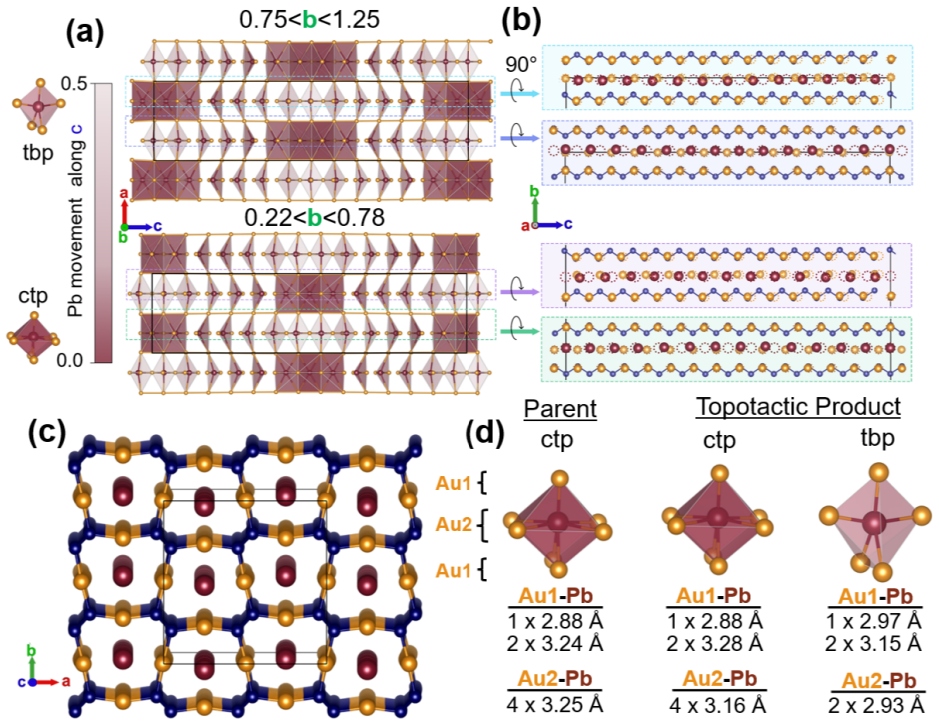
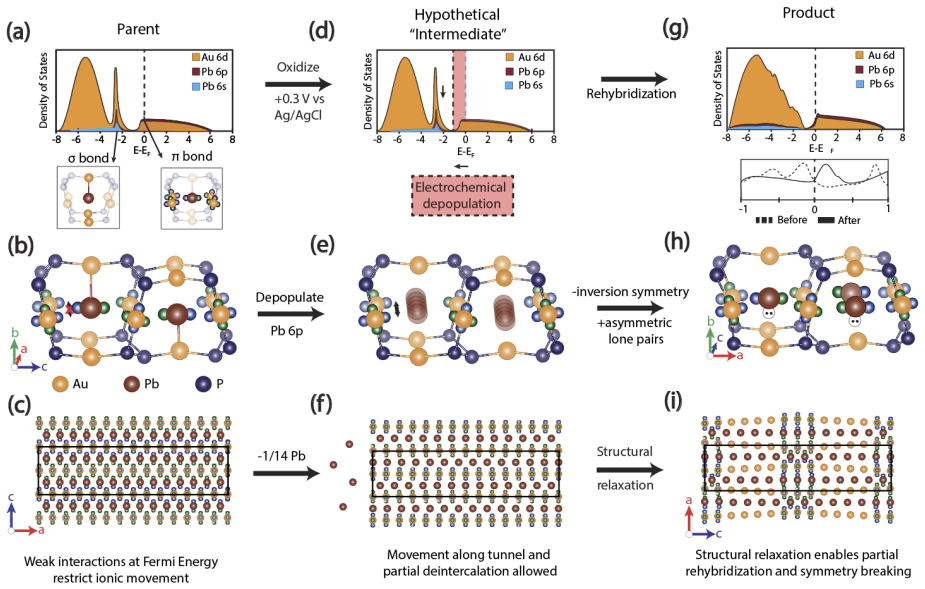
Electrochemical topotactic deintercalation of lead from centrosymmetric Au2PbP2 induces a cooperative electronic and geometric rearrangement mediated by a second-order Jahn-Teller effect and stereochemically active lone pairs. The product adopts the polar superspace group Ama2(01g)ss0, which is confirmed by synchrotron diffraction and nonlinear transport. Below Tc = 1.52 K the material is a type-II superconductor whose heat capacity and AC susceptibility follow power laws suggestive of a gap structure governed by the absence of inversion symmetry.
What carries the argument
topotactic electrochemical deintercalation of Pb atoms, which activates a second-order Jahn-Teller distortion that locks the lattice into the polar Ama2(01g)ss0 superspace group
If this is right
- The polar structure produces measurable nonlinear electronic transport.
- Heat capacity and AC susceptibility both follow power-law forms below Tc, consistent with nodes or unconventional pairing.
- Electrochemical oxidation supplies a rational route to other metastable noncentrosymmetric superconductors.
- The broken inversion symmetry is proposed to dictate the superconducting gap structure.
Where Pith is reading between the lines
- The same electrochemical stripping protocol could be applied to related layered intermetallics to generate additional polar phases.
- Power-law thermodynamics may signal mixed singlet-triplet pairing allowed only in noncentrosymmetric superconductors.
- Further low-temperature probes could test whether spin-momentum locking or magnetoelectric responses appear in this material.
Load-bearing premise
Partial lead removal must trigger a cooperative rearrangement that stabilizes the polar phase without introducing enough disorder to destroy long-range coherence or the observed superconductivity.
What would settle it
A synchrotron diffraction refinement that converges to a centrosymmetric space group, or a heat-capacity jump that decays exponentially rather than as a power law below Tc, would falsify the symmetry-breaking and gap-structure claims.
Figures



read the original abstract
Polar metals and noncentrosymmetric superconductors are exceptionally rare, yet their broken inversion symmetry can give rise to emergent electronic phenomena including mixed singlet-triplet superconducting pairing. As only a few such materials have been found among known compounds, accessing new examples requires synthetic strategies that go beyond conventional crystal growth. Here, we use electrochemical topotactic deintercalation to remove Pb from the centrosymmetric parent compound Au$_2$PbP$_2$, producing the polar metal Au$_2$Pb$_{0.914}$P$_2$. Unlike conventional chemical doping, this transformation actively drives structural symmetry-breaking: the partial removal of Pb triggers a cooperative electronic and geometric rearrangement, mediated by a second-order Jahn-Teller effect and stereochemically active lone pairs, that locks the product into a polar, noncentrosymmetric superspace group Ama2(01g)ss0. We solve the complete (3+1)D modulated structure by synchrotron single-crystal X-ray diffraction and confirm the polar assignment through nonlinear electronic transport. Below T$_c$ = 1.52 K, Au$_2$Pb$_{0.914}$P$_2$ becomes a type-II superconductor whose heat capacity and AC susceptibility both exhibit power-law behavior, suggestive of a gap structure governed by the broken inversion symmetry of the host lattice. This work establishes electrochemical oxidation as a rational route to metastable noncentrosymmetric superconductors through chemically directed symmetry-breaking.
Editorial analysis
A structured set of objections, weighed in public.
Referee Report
Summary. The manuscript reports the electrochemical topotactic deintercalation of Pb from centrosymmetric Au2PbP2 to yield the polar metal Au2Pb0.914P2. Synchrotron single-crystal XRD solves the (3+1)D modulated structure in the noncentrosymmetric superspace group Ama2(01g)ss0, with polarity independently confirmed by nonlinear transport. Below Tc = 1.52 K the compound is a type-II superconductor whose heat capacity and AC susceptibility both follow power-law temperature dependence, which the authors attribute to a gap structure influenced by the broken inversion symmetry.
Significance. If the noncentrosymmetric assignment is robust, the work demonstrates a chemically directed route to metastable polar metals via electrochemical oxidation, adding a new example to the small set of noncentrosymmetric superconductors. The combination of full modulated-structure solution, transport confirmation of polarity, and low-temperature thermodynamic data constitutes a coherent experimental package; the synthetic strategy itself may prove generalizable beyond this specific composition.
major comments (2)
- [Structure solution] Structure solution section: the assignment to the polar superspace group Ama2(01g)ss0 is presented without tabulated R-factors, goodness-of-fit values, or residual electron-density maps for a direct comparison against a centrosymmetric alternative (e.g., Amam). In the absence of a statistical test (Hamilton’s test or equivalent) showing that the modulation and polarity are required by the data rather than merely compatible, the robustness of the noncentrosymmetric claim remains open; this directly underpins the subsequent assertion that the superconducting gap structure is governed by broken inversion symmetry.
- [Superconducting properties] Superconducting properties section: the power-law fits to the low-T heat capacity and AC susceptibility are reported without the numerical exponents, their uncertainties, or a quantitative comparison to an exponential (BCS-like) form. Without these details it is difficult to judge how strongly the data exclude conventional s-wave behavior or impurity-dominated scenarios, weakening the link between the observed power-law dependence and the polar lattice symmetry.
minor comments (2)
- [Experimental methods] The abstract and main text use the formula Au2Pb0.914P2; a brief statement of how the Pb occupancy was refined (fixed vs. free parameter) and its uncertainty would aid reproducibility.
- [Figures] Figure captions for the XRD and transport data should explicitly state the temperature and field ranges used for each panel to improve clarity.
Simulated Author's Rebuttal
We thank the referee for their careful and constructive review of our manuscript. Their comments have helped us improve the rigor and clarity of the presentation. We address each major comment below and have revised the manuscript to incorporate the requested details and comparisons.
read point-by-point responses
-
Referee: [Structure solution] Structure solution section: the assignment to the polar superspace group Ama2(01g)ss0 is presented without tabulated R-factors, goodness-of-fit values, or residual electron-density maps for a direct comparison against a centrosymmetric alternative (e.g., Amam). In the absence of a statistical test (Hamilton’s test or equivalent) showing that the modulation and polarity are required by the data rather than merely compatible, the robustness of the noncentrosymmetric claim remains open; this directly underpins the subsequent assertion that the superconducting gap structure is governed by broken inversion symmetry.
Authors: We agree that a quantitative comparison to the centrosymmetric alternative is necessary to establish the robustness of the polar assignment. In the revised manuscript we have added a table of refinement statistics (R-factors, goodness-of-fit, and weighted residuals) for both the Ama2(01g)ss0 model and the Amam model, together with residual electron-density maps for each. The polar model yields a statistically superior fit. We have also performed Hamilton’s test on the two models; the result confirms that the improvement obtained with the polar superspace group is significant at the >99 % confidence level. These additions directly support the noncentrosymmetric claim and its relevance to the superconducting gap structure. revision: yes
-
Referee: [Superconducting properties] Superconducting properties section: the power-law fits to the low-T heat capacity and AC susceptibility are reported without the numerical exponents, their uncertainties, or a quantitative comparison to an exponential (BCS-like) form. Without these details it is difficult to judge how strongly the data exclude conventional s-wave behavior or impurity-dominated scenarios, weakening the link between the observed power-law dependence and the polar lattice symmetry.
Authors: We acknowledge that the original text lacked the quantitative details needed for a rigorous assessment. In the revised manuscript we now report the fitted power-law exponents together with their uncertainties for both the electronic heat capacity and the AC susceptibility. We have also added a direct, quantitative comparison (via reduced χ² and residual analysis) of the power-law model against an exponential BCS-like form. The power-law description provides a markedly better fit to the data. While these results are consistent with a gap structure influenced by broken inversion symmetry, we note that impurity scattering cannot be fully excluded without additional measurements such as penetration-depth studies. revision: yes
Circularity Check
No circularity: experimental structure solution and measurements are self-contained
full rationale
This is an experimental discovery paper whose central claims rest on direct synthesis, synchrotron single-crystal XRD data collection, standard superspace-group refinement to Ama2(01g)ss0, nonlinear transport confirmation of polarity, and low-temperature heat-capacity/AC-susceptibility measurements below Tc = 1.52 K. No mathematical derivations, predictions, or fitted parameters are presented that reduce by the paper's own equations to their inputs. The power-law behavior is reported as suggestive of gap structure influenced by broken inversion symmetry, but this is an interpretive inference from raw data rather than a self-referential construction. No load-bearing self-citations, uniqueness theorems, or ansatzes appear in the abstract or described workflow. The derivation chain is therefore independent of the target conclusions.
Axiom & Free-Parameter Ledger
free parameters (1)
- Pb site occupancy
axioms (2)
- domain assumption The structure is correctly described by the superspace group Ama2(01g)ss0
- domain assumption Power-law temperature dependence in heat capacity and AC susceptibility indicates a superconducting gap structure governed by broken inversion symmetry
Reference graph
Works this paper leans on
-
[1]
Wang,et al., Gigantic Magnetochiral Anisotropy in the Topological Semimetal ZrTe5.Phys
Y. Wang,et al., Gigantic Magnetochiral Anisotropy in the Topological Semimetal ZrTe5.Phys. Rev. Lett.128, 176602 (2022), doi:10.1103/PhysRevLett.128.176602,https://link.aps. org/doi/10.1103/PhysRevLett.128.176602
-
[2]
H. F. Legg,et al., Giant magnetochiral anisotropy from quantum-confined surface states of topological insulator nanowires.Nature Nanotechnology17(7), 696–700 (2022), doi:10.1038/ s41565-022-01124-1,https://doi.org/10.1038/s41565-022-01124-1
-
[3]
M. Su ´arez-Rodr´ıguez,et al., Nonlinear transport in non-centrosymmetric systems.Nature Materials24(7), 1005–1018 (2025), doi:10.1038/s41563-025-02261-3,https://doi.org/ 10.1038/s41563-025-02261-3
-
[4]
S. Bhowal, N. A. Spaldin, Polar Metals: Principles and Prospects.Annual Re- view of Materials Research53(Volume 53, 2023), 53–79 (2023), doi:https://doi.org/ 10.1146/annurev-matsci-080921-105501,https://www.annualreviews.org/content/ journals/10.1146/annurev-matsci-080921-105501
-
[5]
X.-G. Ye, P.-F. Zhu, W.-Z. Xu, T.-Y. Zhao, Z.-M. Liao, Nonlinear spin and orbital Edelstein effect in WTe 2.Phys. Rev. B110, L201407 (2024), doi:10.1103/PhysRevB.110.L201407, https://link.aps.org/doi/10.1103/PhysRevB.110.L201407
-
[6]
A. Johansson, Theory of spin and orbital Edelstein effects.Journal of Physics: Condensed Mat- ter36(42), 423002 (2024), doi:10.1088/1361-648X/ad5e2b,https://doi.org/10.1088/ 1361-648X/ad5e2b
-
[7]
D. Kumar,et al., Room-temperature nonlinear Hall effect and wireless radiofrequency rec- tification in Weyl semimetal TaIrTe 4.Nature Nanotechnology16(4), 421–425 (2021), doi: 10.1038/s41565-020-00839-3,https://doi.org/10.1038/s41565-020-00839-3
-
[8]
D. Kumar,et al., Quantum Rectification Based on Room Temperature Multidirectional Non- linearity in Bi 2Te3.Nano Letters24(40), 12545–12551 (2024), pMID: 39329367, doi: 10.1021/acs.nanolett.4c03517,https://doi.org/10.1021/acs.nanolett.4c03517. 21
-
[9]
M. Smidman, M. B. Salamon, H. Q. Yuan, D. F. Agterberg, Superconductivity and spin–orbit coupling in non-centrosymmetric materials: a review.Reports on Progress in Physics 80(3), 036501 (2017), doi:10.1088/1361-6633/80/3/036501,https://doi.org/10.1088/ 1361-6633/80/3/036501
-
[10]
S. Yip, Noncentrosymmetric Superconductors.Annual Review of Condensed Matter Physics5(Volume 5, 2014), 15–33 (2014), doi:https://doi.org/10.1146/ annurev-conmatphys-031113-133912,https://www.annualreviews.org/content/ journals/10.1146/annurev-conmatphys-031113-133912
-
[11]
Bauer,et al., Heavy Fermion Superconductivity and Magnetic Order in Noncentrosymmetric CePt3Si.Phys
E. Bauer,et al., Heavy Fermion Superconductivity and Magnetic Order in Noncentrosymmetric CePt3Si.Phys. Rev. Lett.92, 027003 (2004), doi:10.1103/PhysRevLett.92.027003,https: //link.aps.org/doi/10.1103/PhysRevLett.92.027003
-
[12]
B. Joshi, A. Thamizhavel, S. Ramakrishnan, Superconductivity in noncentrosymmetric BiPd. Phys. Rev. B84, 064518 (2011), doi:10.1103/PhysRevB.84.064518,https://link.aps. org/doi/10.1103/PhysRevB.84.064518
-
[13]
T. Shang,et al., Spin-triplet superconductivity in Weyl nodal-line semimetals.npj Quantum Materials7(1), 35 (2022), doi:10.1038/s41535-022-00442-w,https://doi.org/10.1038/ s41535-022-00442-w
-
[14]
M. Shrestha,et al., Superconductivity in non-centrosymmetric AuPb 3.Physica B: Condensed Matter728, 418384 (2026), doi:https://doi.org/10.1016/j.physb.2026.418384,https://www. sciencedirect.com/science/article/pii/S0921452626001420
-
[15]
H. Tran, H.-C. Dam, C. Kuenneth, V. Ngoc Tuoc, H. Kino, Superconductor Discov- ery in the Emerging Paradigm of Materials Informatics.Chemistry of Materials36(22), 10939–10966 (2024), doi:10.1021/acs.chemmater.4c01757,https://doi.org/10.1021/ acs.chemmater.4c01757
-
[16]
Z. Bai, M. Bhullar, A. Akinpelu, Y. Yao, Unveiling future superconductors through machine learning.Materials Today Physics43, 101384 (2024), doi:https://doi.org/ 22 10.1016/j.mtphys.2024.101384,https://www.sciencedirect.com/science/article/ pii/S2542529324000609
-
[17]
A. K. Cheetham, R. Seshadri, Artificial Intelligence Driving Materials Discovery? Perspec- tive on the Article: Scaling Deep Learning for Materials Discovery.Chemistry of Materi- als36(8), 3490–3495 (2024), doi:10.1021/acs.chemmater.4c00643,https://doi.org/10. 1021/acs.chemmater.4c00643
-
[18]
J. Leeman,et al., Challenges in High-Throughput Inorganic Materials Prediction and Au- tonomous Synthesis.PRX Energy3, 011002 (2024), doi:10.1103/PRXEnergy.3.011002, https://link.aps.org/doi/10.1103/PRXEnergy.3.011002
-
[19]
Zhang,et al., Identification of an Unreported Structure Type in GdNiSn4 and Its Implications for Materials Prediction (2026)
X. Zhang,et al., Identification of an Unreported Structure Type in GdNiSn4 and Its Implications for Materials Prediction (2026)
2026
-
[20]
Y. Guo,et al., Chemical Intercalation of Topological Insulator Grid Nanostructures for High-Performance Transparent Electrodes.Advanced Materials29(44), 1703424 (2017), doi: https://doi.org/10.1002/adma.201703424,https://advanced.onlinelibrary.wiley. com/doi/abs/10.1002/adma.201703424
-
[21]
X. Song,et al., Synthesis of an aqueous, air-stable, superconducting 1T-WS 2 monolayer ink.Science Advances9(12), eadd6167 (2023), doi:10.1126/sciadv.add6167,https://www. science.org/doi/abs/10.1126/sciadv.add6167
-
[22]
K. Takada,et al., Superconductivity in two-dimensional CoO 2 layers.Nature422(6927), 53–55 (2003), doi:10.1038/nature01450,https://doi.org/10.1038/nature01450
-
[23]
M. Rajapakse,et al., Intercalation as a versatile tool for fabrication, property tuning, and phase transitions in 2D materials.npj 2D Materials and Applications5(1), 30 (2021), doi: 10.1038/s41699-021-00211-6,https://doi.org/10.1038/s41699-021-00211-6
-
[24]
Y. Cui,et al., Ionic-Liquid-Gating Induced Protonation and Superconductivity in FeSe, FeSe 0.93S0.07, ZrNCl, 1T-TaS 2 and Bi 2Se3*.Chinese Physics Letters36(7), 077401 (2019), doi:10.1088/0256-307X/36/7/077401,https://dx.doi.org/10.1088/ 0256-307X/36/7/077401. 23
-
[25]
D. Li,et al., Superconductivity in an infinite-layer nickelate.Nature572(7771), 624–627 (2019), doi:10.1038/s41586-019-1496-5,https://doi.org/10.1038/ s41586-019-1496-5
-
[26]
Z. Meng,et al., Topotactic Transition: A Promising Opportunity for Creating New Ox- ides.Advanced Functional Materials33(46), 2305225 (2023), doi:https://doi.org/10.1002/ adfm.202305225,https://advanced.onlinelibrary.wiley.com/doi/abs/10.1002/ adfm.202305225
2023
-
[27]
F. Eder, C. Witteveen, E. Giannini, F. O. von Rohr, Structural Modulation and Enhanced Magnetic Ordering in Incommensurate K1–𝑥CrSe2 Crystals.Journal of the American Chemical Society147(6), 4896–4903 (2025), pMID: 39884289, doi:10.1021/jacs.4c13545,https: //doi.org/10.1021/jacs.4c13545
-
[28]
G. Villalpando,et al., Accessing bands with extended quantum metric in kagome Cs 2Ni3S4 through soft chemical processing.Science Advances10(38), eadl1103 (2024), doi:10.1126/ sciadv.adl1103,https://www.science.org/doi/abs/10.1126/sciadv.adl1103
-
[29]
S. Aharon,et al., Low-Temperature Topochemical Synthesis of Cu 2Pd3Se4 from Layered Rb2Pd3Se4 via Molten Salts Ion Exchange.Zeitschrift f ¨ur anorganische und allgemeine Chemie651(15), e202500098 (2025), doi:https://doi.org/10.1002/zaac.202500098,https: //onlinelibrary.wiley.com/doi/abs/10.1002/zaac.202500098
-
[30]
Xie,et al., Tuning Magnetism Through Stoichiometric Potassium Intercalation into VOCl
J. Xie,et al., Tuning Magnetism Through Stoichiometric Potassium Intercalation into VOCl. Journal of the American Chemical Society147(37), 33559–33570 (2025), pMID: 40907007, doi:10.1021/jacs.5c08177,https://doi.org/10.1021/jacs.5c08177
-
[31]
R. Wernert, R. D. Smyth, M. A. Hayward, Synthesis of the Double Infinite-Layer Ni(I) Phase La3Ni2O5F via Sequential Topochemical Reactions.Journal of the American Chemical Society 148(6), 6109–6115 (2026), pMID: 41638635, doi:10.1021/jacs.5c16740,https://doi.org/ 10.1021/jacs.5c16740
-
[32]
X. Mart ´ınez de Irujo Labalde,et al., Influence of Cation Substitution on Cycling Stability and Fe-Cation Migration in Li 3Fe3–𝑥M𝑥Te2O12 (M = Al, In) Cathode Materials.Inorganic 24 Chemistry63(2), 1395–1403 (2024), pMID: 38176021, doi:10.1021/acs.inorgchem.3c03929, https://doi.org/10.1021/acs.inorgchem.3c03929
-
[33]
Jeen,et al., Reversible redox reactions in an epitaxially stabilized SrCoO 𝑥 oxygen sponge
H. Jeen,et al., Reversible redox reactions in an epitaxially stabilized SrCoO 𝑥 oxygen sponge. Nature Materials12(11), 1057–1063 (2013), doi:10.1038/nmat3736,https://doi.org/ 10.1038/nmat3736
-
[35]
M. A. Wright, R. Seshadri, Linking battery electrode science with correlated and quantum materials.Phys. Rev. Mater.9, 110302 (2025), doi:10.1103/zwkw-zc5n,https://link. aps.org/doi/10.1103/zwkw-zc5n
-
[36]
Zheng,et al., Polar Ferromagnetic Metal by Intercalation of Metal–Amine Complexes
H. Zheng,et al., Polar Ferromagnetic Metal by Intercalation of Metal–Amine Complexes. Chemistry of Materials33(13), 4936–4947 (2021), doi:10.1021/acs.chemmater.1c00540, https://doi.org/10.1021/acs.chemmater.1c00540
-
[38]
G. M. Pang,et al., Evidence for nodal superconductivity in quasi-one-dimensional K 2Cr3As3. Phys. Rev. B91, 220502 (2015), doi:10.1103/PhysRevB.91.220502,https://link.aps. org/doi/10.1103/PhysRevB.91.220502
-
[39]
D. T. Adroja,et al., Superconducting ground state of quasi-one-dimensional K 2Cr3As3 inves- tigated using𝜇SR measurements.Phys. Rev. B92, 134505 (2015), doi:10.1103/PhysRevB.92. 134505,https://link.aps.org/doi/10.1103/PhysRevB.92.134505
-
[40]
M. Eschen, W. Jeitschko, Au 2PbP2, Au2TlP2, and Au 2HgP2: Ternary Gold Polyphosphides with Lead, Thallium, and Mercury in the Oxidation State Zero.Journal of Solid State Chem- 25 istry165(2), 238–246 (2002), doi:https://doi.org/10.1006/jssc.2001.9497,https://www. sciencedirect.com/science/article/pii/S0022459601994976
-
[41]
S. B. Lee,et al., Polymorphism within the Quasi-One-Dimensional Au 2MP2 (M = Tl, Pb, Pb/Bi, and Bi) Series.Chemistry of Materials36(17), 8217–8228 (2024), doi:10.1021/acs. chemmater.4c00784,https://doi.org/10.1021/acs.chemmater.4c00784
work page doi:10.1021/acs 2024
-
[42]
X.-D. Wen, T. J. Cahill, R. Hoffmann, Element Lines: Bonding in the Ternary Gold Polyphosphides, Au 2MP2 with M = Pb, Tl, or Hg.Journal of the American Chemi- cal Society131(6), 2199–2207 (2009), eprint: https://doi.org/10.1021/ja806884a, doi: 10.1021/ja806884a,https://doi.org/10.1021/ja806884a
-
[43]
L. A. Pressley,et al., Informing quantum materials discovery and synthesis using X- ray micro-computed tomography.npj Quantum Materials7(1), 121 (2022), doi:10.1038/ s41535-022-00527-6,https://doi.org/10.1038/s41535-022-00527-6
-
[44]
P. M. De Wolff, The Pseudo-Symmetry of Modulated Crystal Structures.Acta Crystallo- graphica Section A30(6), 777–785 (1974), doi:https://doi.org/10.1107/S0567739474010710, https://onlinelibrary.wiley.com/doi/abs/10.1107/S0567739474010710
-
[45]
S. V. Smaalen, Incommensurate crystal structures.Crystallography Reviews4(2), 79–202 (1995), doi:10.1080/08893119508039920,https://doi.org/10.1080/ 08893119508039920
-
[46]
D. Puggioni, J. M. Rondinelli, Designing a robustly metallic noncenstrosymmetric ruthenate oxide with large thermopower anisotropy.Nature Communications5(1), 3432 (2014), doi: 10.1038/ncomms4432,https://doi.org/10.1038/ncomms4432
-
[47]
I. Bersuker, On the origin of ferroelectricity in perovskite-type crystals.Physics Letters 20(6), 589–590 (1966), doi:https://doi.org/10.1016/0031-9163(66)91127-9,https://www. sciencedirect.com/science/article/pii/0031916366911279
-
[48]
I. B. Bersuker, Pseudo-Jahn–Teller Effect—A Two-State Paradigm in Formation, Deforma- tion, and Transformation of Molecular Systems and Solids.Chemical Reviews113(3), 26 1351–1390 (2013), pMID: 23301718, doi:10.1021/cr300279n,https://doi.org/10.1021/ cr300279n
-
[49]
S. Mallick,et al., The influence of the 6𝑠2 configuration of Bi3+ on the structures of𝐴 ′BiNb2O7 (𝐴′ = Rb, Na, Li) layered perovskite oxides.Dalton Trans.50, 15359–15369 (2021), doi: 10.1039/D1DT02974F,http://dx.doi.org/10.1039/D1DT02974F
-
[50]
M. Yan, H.-G. Xue, S.-P. Guo, Recent Achievements in Lone-Pair Cation-Based Infrared Second-Order Nonlinear Optical Materials.Crystal Growth & Design21(1), 698–720 (2021), doi:10.1021/acs.cgd.0c01407,https://doi.org/10.1021/acs.cgd.0c01407
-
[51]
A. Walsh, D. J. Payne, R. G. Egdell, G. W. Watson, Stereochemistry of post-transition metal oxides: revision of the classical lone pair model.Chem. Soc. Rev.40, 4455–4463 (2011), doi:10.1039/C1CS15098G,http://dx.doi.org/10.1039/C1CS15098G
-
[52]
D. H. Fabini,et al., Dynamic Stereochemical Activity of the Sn 2+ Lone Pair in Perovskite CsSnBr3.Journal of the American Chemical Society138(36), 11820–11832 (2016), pMID: 27583813, doi:10.1021/jacs.6b06287,https://doi.org/10.1021/jacs.6b06287
-
[53]
R. Li,et al., Perovskitizer Tuning Pb 2+ 6s2 Lone Pair Effects in Hybrid Perovskite Halide Enables Multiaxial Self-Powered X-Ray Detection.Advanced Functional Materials 34(42), 2404353 (2024), doi:https://doi.org/10.1002/adfm.202404353,https://advanced. onlinelibrary.wiley.com/doi/abs/10.1002/adfm.202404353
-
[54]
D. B. Straus, H. E. Mitchell Warden, R. J. Cava, s–p Mixing in Stereochemically Active Lone Pairs Drives the Formation of 1D Chains of Lead Bromide Square Pyramids.Inorganic Chem- istry60(17), 12676–12680 (2021), pMID: 34375087, doi:10.1021/acs.inorgchem.1c01277, https://doi.org/10.1021/acs.inorgchem.1c01277
-
[55]
M. I. Aroyo,et al., Bilbao Crystallographic Server: I. Databases and crystallographic computing programs.Zeitschrift f ¨ur Kristallographie - Crystalline Materials221(1), 15–27 (2006), doi: doi:10.1524/zkri.2006.221.1.15,https://doi.org/10.1524/zkri.2006.221.1.15
-
[56]
M. I. Aroyo, A. Kirov, C. Capillas, J. M. Perez-Mato, H. Wondratschek, Bilbao Crystal- lographic Server. II. Representations of crystallographic point groups and space groups. 27 Acta Crystallographica Section A62(2), 115–128 (2006), doi:10.1107/S0108767305040286, https://doi.org/10.1107/S0108767305040286
-
[57]
S. V. Gallego, J. Etxebarria, L. Elcoro, E. S. Tasci, J. M. Perez-Mato, Automatic calculation of symmetry-adapted tensors in magnetic and non-magnetic materials: a new tool of the Bilbao Crystallographic Server.Acta Crystallographica Section A75(3), 438–447 (2019), doi:10.1107/S2053273319001748,https://doi.org/10.1107/S2053273319001748
-
[58]
M. Sigrist, K. Ueda, Phenomenological theory of unconventional superconductivity.Rev. Mod. Phys.63, 239–311 (1991), doi:10.1103/RevModPhys.63.239,https://link.aps.org/doi/ 10.1103/RevModPhys.63.239
-
[59]
F. Gross,et al., Anomalous temperature dependence of the magnetic field penetration depth in superconducting UBe13.Zeitschrift f ¨ur Physik B Condensed Matter64(2), 175–188 (1986), doi:10.1007/BF01303700,https://doi.org/10.1007/BF01303700
-
[60]
Y. S. Hor,et al., Superconductivity in Cu𝑥Bi2Se3 and its Implications for Pairing in the Undoped Topological Insulator.Phys. Rev. Lett.104, 057001 (2010), doi:10.1103/PhysRevLett.104. 057001,https://link.aps.org/doi/10.1103/PhysRevLett.104.057001
-
[61]
M. Kriener, K. Segawa, Z. Ren, S. Sasaki, Y. Ando, Bulk Superconducting Phase with a Full Energy Gap in the Doped Topological Insulator Cu 𝑥Bi2Se3.Phys. Rev. Lett.106, 127004 (2011), doi:10.1103/PhysRevLett.106.127004,https://link.aps.org/doi/10. 1103/PhysRevLett.106.127004
-
[62]
Fr ¨ohlich,et al., Crystal structure and distortion of superconducting Cu 𝑥Bi2Se3.Phys
T. Fr ¨ohlich,et al., Crystal structure and distortion of superconducting Cu 𝑥Bi2Se3.Phys. Rev. Mater.4, 054802 (2020), doi:10.1103/PhysRevMaterials.4.054802,https://link.aps. org/doi/10.1103/PhysRevMaterials.4.054802
-
[63]
E. Morosan,et al., Superconductivity in Cu 𝑥TiSe2.Nature Physics2(8), 544–550 (2006), doi:10.1038/nphys360,https://doi.org/10.1038/nphys360
-
[64]
Kitou,et al., Effect of Cu intercalation and pressure on excitonic interaction in 1𝑇−TiSe 2
S. Kitou,et al., Effect of Cu intercalation and pressure on excitonic interaction in 1𝑇−TiSe 2. Phys. Rev. B99, 104109 (2019), doi:10.1103/PhysRevB.99.104109,https://link.aps. org/doi/10.1103/PhysRevB.99.104109. 28
-
[65]
A. Kogar,et al., Observation of a Charge Density Wave Incommensuration Near the Supercon- ducting Dome in Cu 𝑥TiSe2.Phys. Rev. Lett.118, 027002 (2017), doi:10.1103/PhysRevLett. 118.027002,https://link.aps.org/doi/10.1103/PhysRevLett.118.027002
-
[66]
S. L. Bud’ko, P. C. Canfield, E. Morosan, R. J. Cava, G. M. Schmiedeshoff, Thermal expansion and effect of pressure on superconductivity in Cu 𝑥TiSe2.Journal of Physics: Condensed Matter19(17), 176230 (2007), doi:10.1088/0953-8984/19/17/176230,https://doi.org/ 10.1088/0953-8984/19/17/176230
-
[67]
F. C. Chou,et al., Thermodynamic and transport measurements of superconducting Na0.3CoO2 ·yH 2O single crystals prepared by electrochemical deintercalation.Phys. Rev. Lett.92(15), 157004 (2004)
2004
-
[68]
V. Petˇr´ıˇcek, L. Palatinus, J. Pl´aˇsil, M. Duˇsek, Jana2020 – a new version of the crystallographic computing system Jana.Zeitschrift f ¨ur Kristallographie - Crystalline Materials238(7-8), 271–282 (2023), publisher: De Gruyter (O), doi:10.1515/zkri-2023-0005,https://www. degruyter.com/document/doi/10.1515/zkri-2023-0005/html
-
[69]
P. E. Bl ¨ochl, Projector augmented-wave method.Physical review B(50), 17953 (1994)
1994
-
[70]
G. Kresse, D. Joubert, From ultrasoft pseudopotentials to the projector augmented-wave method.Phys. Rev. B59, 1758–1775 (1999), doi:10.1103/PhysRevB.59.1758,https://link. aps.org/doi/10.1103/PhysRevB.59.1758
-
[71]
B. Zhu, S. R. Kavanagh, D. Scanlon, easyunfold: A Python package for unfolding electronic band structures.Journal of Open Source Software9(93), 5974 (2024), doi:10.21105/joss. 05974,https://doi.org/10.21105/joss.05974
-
[72]
P. J. Withers,et al., X-ray computed tomography.Nature Reviews Methods Primers1(1), 18 (2021), doi:10.1038/s43586-021-00015-4,https://doi.org/10.1038/ s43586-021-00015-4
-
[73]
K. R. Kamp, D. C. Fredrickson, A Tour of Soft Atomic Motions: Chemical Pressure Quadrupoles Across Transition Metal–Main Group 1:2 Structure Types.Chemistry of Ma- 29 terials34(22), 10011–10024 (2022), doi:10.1021/acs.chemmater.2c02410,https://doi. org/10.1021/acs.chemmater.2c02410
-
[74]
A. J. Bard, L. R. Faulkner, H. S. White,Electrochemical Methods: Fundamentals and Appli- cations(Wiley, Hoboken, NJ), chap. 2, pp. 61–120 (2022)
2022
-
[75]
J. Chen,et al., Evidence for two-gap superconductivity in the non-centrosymmetric compound LaNiC2.New Journal of Physics15(5), 053005 (2013), doi:10.1088/1367-2630/15/5/053005, https://doi.org/10.1088/1367-2630/15/5/053005
-
[76]
Y. Hirose,et al., Fermi Surface and Superconducting Properties of Non-centrosymmetric LaNiC2.Journal of the Physical Society of Japan81(11), 113703 (2012), doi:10.1143/JPSJ. 81.113703,https://doi.org/10.1143/JPSJ.81.113703
-
[77]
C. Buzea, T. Yamashita, Review of the superconducting properties of MgB 2.Superconductor Science and Technology14(11), R115 (2001), doi:10.1088/0953-2048/14/11/201,https: //doi.org/10.1088/0953-2048/14/11/201
-
[78]
A. Gurevich, Enhancement of the upper critical field by nonmagnetic impurities in dirty two-gap superconductors.Phys. Rev. B67, 184515 (2003), doi:10.1103/PhysRevB.67.184515, https://link.aps.org/doi/10.1103/PhysRevB.67.184515
-
[79]
E. M. Carnicom,et al., TaRh 2B2 and NbRh2B2: Superconductors with a chiral noncentrosym- metric crystal structure.Science Advances4(5), eaar7969 (2018), doi:10.1126/sciadv.aar7969, https://www.science.org/doi/abs/10.1126/sciadv.aar7969
-
[80]
H. Padamsee, J. E. Neighbor, C. A. Shiffman, Quasiparticle phenomenology for thermodynam- ics of strong-coupling superconductors.Journal of Low Temperature Physics12(3), 387–411 (1973), doi:10.1007/BF00654872,https://doi.org/10.1007/BF00654872
-
[81]
D. C. Johnston, Elaboration of the𝛼-model derived from the BCS theory of superconductivity. Superconductor Science and Technology26(11), 115011 (2013), doi:10.1088/0953-2048/26/ 11/115011,https://doi.org/10.1088/0953-2048/26/11/115011. 30
-
[82]
B. M¨ uhlschlegel, Die thermodynamischen Funktionen des Supraleiters.Zeitschrift f ¨ur Physik155(3), 313–327 (1959), doi:10.1007/BF01332932,https://doi.org/10.1007/ BF01332932
discussion (0)
Sign in with ORCID, Apple, or X to comment. Anyone can read and Pith papers without signing in.