Recognition: unknown
Subgraph Concept Networks: Concept Levels in Graph Classification
Pith reviewed 2026-05-10 04:39 UTC · model grok-4.3
The pith
The Subgraph Concept Network is the first GNN architecture to distill subgraph and graph-level concepts from node embeddings via soft clustering.
A machine-rendered reading of the paper's core claim, the machinery that carries it, and where it could break.
Core claim
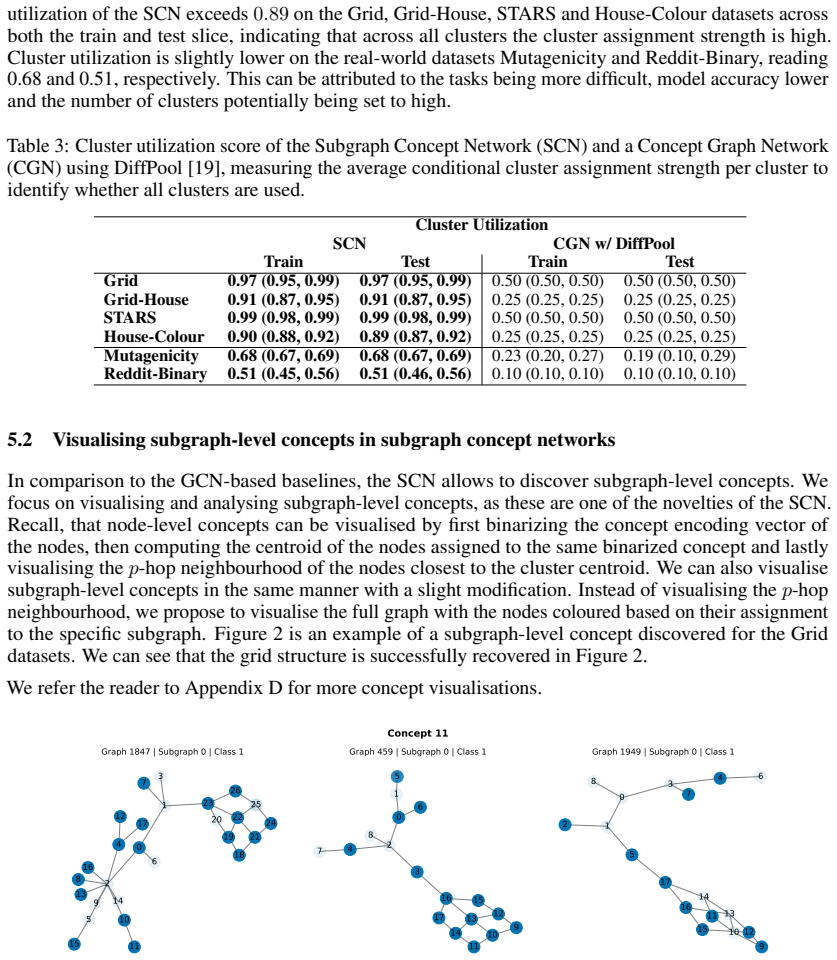
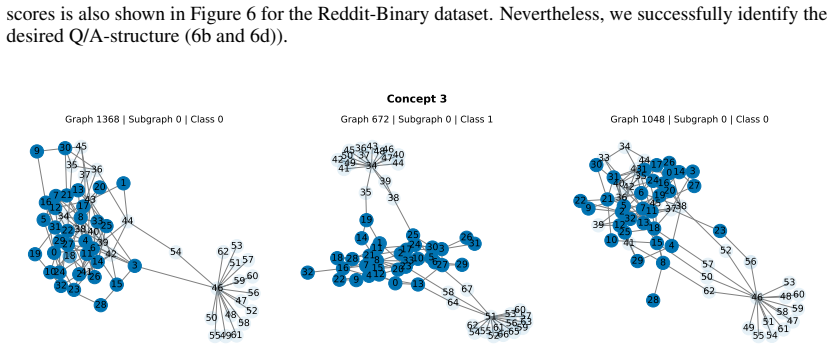
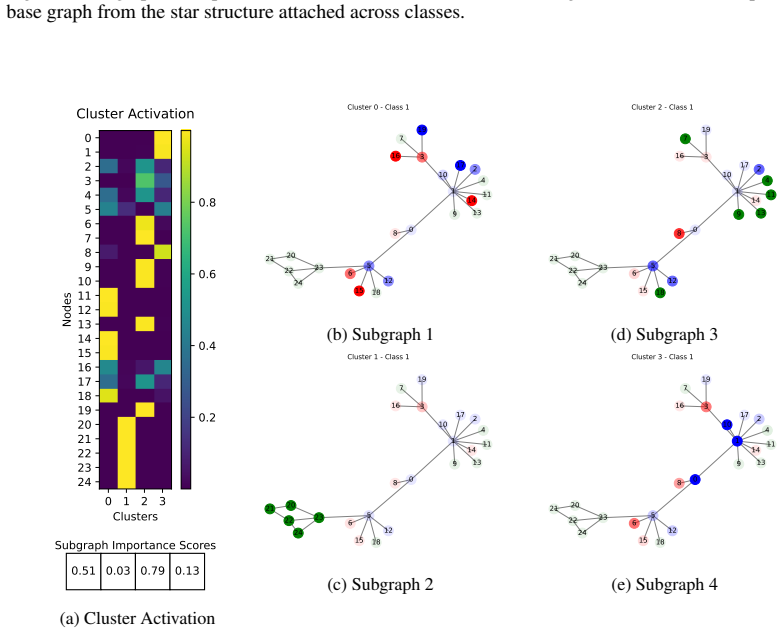
The Subgraph Concept Network is the first graph neural network architecture that distils subgraph and graph-level concepts. It achieves this by performing soft clustering on node concept embeddings to derive subgraph and graph-level concepts. Our results show that the Subgraph Concept Network allows to obtain competitive model accuracy, while discovering meaningful concepts at different levels of the network.
What carries the argument
Soft clustering performed on node concept embeddings to derive subgraph and graph-level concepts.
If this is right
- The model supplies explanations that incorporate the effects of pooling by surfacing subgraph and graph concepts.
- Standard graph classification accuracy remains competitive with existing GNNs.
- Concepts are discovered automatically at node, subgraph, and graph scales within a single network.
Where Pith is reading between the lines
- The multi-level clustering approach could be tested on molecular graphs to check whether discovered subgraphs align with known functional groups.
- If the concepts prove stable across similar graphs, they might support transfer of explanations between related classification tasks.
- Combining this architecture with attention layers could produce even more fine-grained hierarchical explanations.
Load-bearing premise
Soft clustering on node concept embeddings automatically yields clusters that represent genuine, human-interpretable concepts explaining the model's classification decisions.
What would settle it
On a synthetic graph dataset containing known planted substructures, the extracted higher-level concepts show no correspondence to those substructures and provide no measurable gain in explanation quality over node-only baselines.
Figures




read the original abstract
The reasoning process of Graph Neural Networks is complex and considered opaque, limiting trust in their predictions. To alleviate this issue, prior work has proposed concept-based explanations, extracted from clusters in the model's node embeddings. However, a limitation of concept-based explanations is that they only explain the node embedding space and are obscured by pooling in graph classification. To mitigate this issue and provide a deeper level of understanding, we propose the Subgraph Concept Network. The Subgraph Concept Network is the first graph neural network architecture that distils subgraph and graph-level concepts. It achieves this by performing soft clustering on node concept embeddings to derive subgraph and graph-level concepts. Our results show that the Subgraph Concept Network allows to obtain competitive model accuracy, while discovering meaningful concepts at different levels of the network.
Editorial analysis
A structured set of objections, weighed in public.
Referee Report
Summary. The paper introduces the Subgraph Concept Network (SCN), a new GNN architecture for graph classification that extends concept-based explanations beyond node embeddings. It performs soft clustering on node concept embeddings to derive subgraph-level and graph-level concepts, claiming this yields competitive classification accuracy while discovering meaningful multi-level concepts that address the opacity of standard GNNs and the pooling-induced limitations of prior node-only concept methods.
Significance. If the empirical claims hold with proper validation, the work could meaningfully advance interpretability research in graph ML by providing a principled way to extract higher-level concepts. However, the significance is limited by the absence of any reported quantitative results, baselines, ablation studies, or explicit metrics for concept meaningfulness, leaving open whether the clustering step produces decision-relevant or human-interpretable structures rather than arbitrary groupings.
major comments (2)
- [Abstract] Abstract: The central claim that soft clustering on node concept embeddings automatically produces subgraph and graph-level concepts that are both meaningful and explanatory is load-bearing but unsupported. Clustering operates on vector similarity alone and incorporates neither the input graph's edge structure nor the influence of those clusters on the final pooled prediction, so it is unclear why the resulting groups correspond to coherent subgraphs or alter model decisions as expected.
- [Abstract] Abstract: The assertions of 'competitive model accuracy' and 'discovering meaningful concepts' lack any supporting quantitative evidence, baselines, ablation studies, or evaluation protocol for interpretability. Without these, the empirical contribution cannot be assessed and the architecture's practical value over existing concept-based GNN explainers remains unverified.
minor comments (1)
- [Abstract] The abstract would be strengthened by briefly indicating the datasets, tasks, and specific metrics used to quantify both accuracy and concept meaningfulness.
Simulated Author's Rebuttal
We thank the referee for their constructive and detailed feedback on our manuscript. We address each major comment below, providing clarifications on the methodology and committing to revisions that strengthen the empirical support and explanations.
read point-by-point responses
-
Referee: [Abstract] Abstract: The central claim that soft clustering on node concept embeddings automatically produces subgraph and graph-level concepts that are both meaningful and explanatory is load-bearing but unsupported. Clustering operates on vector similarity alone and incorporates neither the input graph's edge structure nor the influence of those clusters on the final pooled prediction, so it is unclear why the resulting groups correspond to coherent subgraphs or alter model decisions as expected.
Authors: The node concept embeddings are outputs of a GNN whose layers perform message passing over the input graph edges, so the embeddings already encode structural neighborhood information. Soft clustering groups nodes whose embeddings are similar, which—because of the preceding GNN—corresponds to nodes that play analogous structural roles. Subgraph-level concepts are then obtained by associating each cluster with the subgraphs induced by its member nodes. We agree that the manuscript would benefit from an explicit statement of this dependence and from additional analysis showing how cluster assignments affect the final pooled prediction; we will add both in the revised version. revision: partial
-
Referee: [Abstract] Abstract: The assertions of 'competitive model accuracy' and 'discovering meaningful concepts' lack any supporting quantitative evidence, baselines, ablation studies, or evaluation protocol for interpretability. Without these, the empirical contribution cannot be assessed and the architecture's practical value over existing concept-based GNN explainers remains unverified.
Authors: The full manuscript reports accuracy results on standard graph-classification benchmarks (MUTAG, PROTEINS, NCI1, etc.) together with qualitative visualizations of the extracted multi-level concepts. To address the referee’s concern directly, we will expand the experimental section with (i) additional baselines including recent concept-based GNN explainers, (ii) ablation studies isolating the soft-clustering component, and (iii) a quantitative protocol for concept meaningfulness (e.g., fidelity and human-interpretability scores). These additions will be included in the revised manuscript. revision: yes
Circularity Check
No circularity: new architecture defined by construction and validated empirically
full rationale
The paper proposes the Subgraph Concept Network as a new GNN architecture whose core operation is explicitly defined as soft clustering on node concept embeddings to obtain subgraph- and graph-level concepts. This is a definitional step in the architecture rather than a derivation that reduces a claimed result to its own inputs by algebraic identity or fitted-parameter renaming. No equations are shown that equate the output concepts to the clustering inputs by construction, and the value is demonstrated through competitive accuracy and qualitative concept discovery on datasets. Prior concept-based methods are cited as motivation but do not form a self-citation chain that bears the central claim. The derivation chain is therefore self-contained.
Axiom & Free-Parameter Ledger
axioms (1)
- domain assumption Soft clustering on node concept embeddings produces meaningful subgraph and graph-level concepts that explain model decisions
invented entities (1)
-
Subgraph Concept Network
no independent evidence
Reference graph
Works this paper leans on
-
[1]
The graph neural network model.IEEE transactions on neural networks, 20(1):61–80, 2008
Franco Scarselli, Marco Gori, Ah Chung Tsoi, Markus Hagenbuchner, and Gabriele Monfardini. The graph neural network model.IEEE transactions on neural networks, 20(1):61–80, 2008
2008
-
[2]
Graph neural networks.Nature Reviews Methods Primers, 4(1):17, 2024
Gabriele Corso, Hannes Stark, Stefanie Jegelka, Tommi Jaakkola, and Regina Barzilay. Graph neural networks.Nature Reviews Methods Primers, 4(1):17, 2024
2024
-
[3]
A comprehensive survey on self-interpretable neural networks.Proceedings of the IEEE, 2025
Yang Ji, Ying Sun, Yuting Zhang, Zhigaoyuan Wang, Yuanxin Zhuang, Zheng Gong, Dazhong Shen, Chuan Qin, Hengshu Zhu, and Hui Xiong. A comprehensive survey on self-interpretable neural networks.Proceedings of the IEEE, 2025
2025
-
[4]
Mauparna Nandan, Soma Mitra, and Debashis De. Graphxai: a survey of graph neural networks (gnns) for explainable ai (xai).Neural Computing and Applications, 37(17):10949–11000, 2025. URLhttps://doi.org/10.1007/s00521-025-11054-3
-
[5]
Lucie Charlotte Magister, Dmitry Kazhdan, Vikash Singh, and Pietro Liò. Gcexplainer: Human-in- the-loop concept-based explanations for graph neural networks.arXiv preprint arXiv:2107.11889, 2021
-
[6]
Concept distillation in graph neural networks
Lucie Charlotte Magister, Pietro Barbiero, Dmitry Kazhdan, Federico Siciliano, Gabriele Ciravegna, Fabrizio Silvestri, Mateja Jamnik, and Pietro Liò. Concept distillation in graph neural networks. In World Conference on Explainable Artificial Intelligence, pages 233–255. Springer, 2023
2023
-
[7]
Global explain- ability of gnns via logic combination of learned concepts
Steve Azzolin, Antonio Longa, Pietro Barbiero, Pietro Liò, and Andrea Passerini. Global explain- ability of gnns via logic combination of learned concepts. InInternational Conference on Learning Representations. PMLR, 2023
2023
-
[8]
Protgnn: Towards self- explaining graph neural networks
Zaixi Zhang, Qi Liu, Hao Wang, Chengqiang Lu, and Cheekong Lee. Protgnn: Towards self- explaining graph neural networks. InProceedings of the AAAI Conference on Artificial Intelligence, volume 36, pages 9127–9135, 2022
2022
-
[9]
Interpretable prototype-based graph informa- tion bottleneck.Advances in Neural Information Processing Systems, 36:76737–76748, 2023
Sangwoo Seo, Sungwon Kim, and Chanyoung Park. Interpretable prototype-based graph informa- tion bottleneck.Advances in Neural Information Processing Systems, 36:76737–76748, 2023
2023
-
[10]
Prototype-based interpretable graph neural networks.IEEE Transactions on Artificial Intelligence, 5(4):1486–1495, 2024
Alessio Ragno, Biagio La Rosa, and Roberto Capobianco. Prototype-based interpretable graph neural networks.IEEE Transactions on Artificial Intelligence, 5(4):1486–1495, 2024
2024
-
[11]
This looks like that: deep learning for interpretable image recognition.Advances in neural information processing systems, 32, 2019
Chaofan Chen, Oscar Li, Daniel Tao, Alina Barnett, Cynthia Rudin, and Jonathan K Su. This looks like that: deep learning for interpretable image recognition.Advances in neural information processing systems, 32, 2019
2019
-
[12]
Interpretable image recognition by con- structing transparent embedding space
Jiaqi Wang, Huafeng Liu, Xinyue Wang, and Liping Jing. Interpretable image recognition by con- structing transparent embedding space. InProceedings of the IEEE/CVF international conference on computer vision, pages 895–904, 2021
2021
-
[13]
Unveiling global interactive patterns across graphs: Towards interpretable graph neural networks
Yuwen Wang, Shunyu Liu, Tongya Zheng, Kaixuan Chen, and Mingli Song. Unveiling global interactive patterns across graphs: Towards interpretable graph neural networks. InProceedings of the 30th ACM SIGKDD conference on knowledge discovery and data mining, pages 3277–3288, 2024
2024
-
[14]
Graph information bottleneck.Advances in Neural Information Processing Systems, 33:20437–20448, 2020
Tailin Wu, Hongyu Ren, Pan Li, and Jure Leskovec. Graph information bottleneck.Advances in Neural Information Processing Systems, 33:20437–20448, 2020
2020
-
[15]
Recognizing predictive substructures with subgraph information bottleneck.IEEE transactions on pattern analysis and machine intelligence, 46(3):1650–1663, 2021
Junchi Yu, Tingyang Xu, Yu Rong, Yatao Bian, Junzhou Huang, and Ran He. Recognizing predictive substructures with subgraph information bottleneck.IEEE transactions on pattern analysis and machine intelligence, 46(3):1650–1663, 2021
2021
-
[16]
Improving subgraph recognition with variational graph information bottleneck
Junchi Yu, Jie Cao, and Ran He. Improving subgraph recognition with variational graph information bottleneck. InProceedings of the IEEE/CVF conference on computer vision and pattern recognition, pages 19396–19405, 2022
2022
-
[17]
Pre-training graph neural networks on molecules by using subgraph-conditioned graph information bottleneck
O-Joun Lee et al. Pre-training graph neural networks on molecules by using subgraph-conditioned graph information bottleneck. InProceedings of the AAAI Conference on Artificial Intelligence, volume 39, pages 17204–17213, 2025. 10
2025
-
[18]
The information bottleneck method
Naftali Tishby, Fernando C Pereira, and William Bialek. The information bottleneck method.arXiv preprint physics/0004057, 2000
work page Pith review arXiv 2000
-
[19]
Hamilton, and Jure Leskovec
Rex Ying, Jiaxuan You, Christopher Morris, Xiang Ren, William L. Hamilton, and Jure Leskovec. Hierarchical graph representation learning with differentiable pooling. InProceedings of the 32nd International Conference on Neural Information Processing Systems, NIPS’18, page 4805–4815, Red Hook, NY , USA, 2018. Curran Associates Inc
2018
-
[20]
Structpool: Structured graph pooling via conditional random fields
Hao Yuan and Shuiwang Ji. Structpool: Structured graph pooling via conditional random fields. In International Conference on Learning Representations, 2020. URL https://openreview.net/ forum?id=BJxg_hVtwH
2020
-
[21]
From gnns to trees: Multi-granular interpretability for graph neural networks
Jie Yang, Yuwen Wang, Kaixuan Chen, Tongya Zheng, Yihe Zhou, Zhenbang Xiao, Ji Cao, Mingli Song, and Shunyu Liu. From gnns to trees: Multi-granular interpretability for graph neural networks. arXiv preprint arXiv:2505.00364, 2025
-
[22]
Jonas Jurss, Lucie Charlotte Magister, Pietro Barbiero, Pietro Liò, and Nikola Simidjievski. Everybody needs a little help: Explaining graphs via hierarchical concepts.arXiv preprint arXiv:2311.15112, 2023
-
[23]
Inter- pretable neural-symbolic concept reasoning
Pietro Barbiero, Gabriele Ciravegna, Francesco Giannini, Mateo Espinosa Zarlenga, Lucie Charlotte Magister, Alberto Tonda, Pietro Lió, Frederic Precioso, Mateja Jamnik, and Giuseppe Marra. Inter- pretable neural-symbolic concept reasoning. InProceedings of the 40th International Conference on Machine Learning, ICML’23. JMLR.org, 2023
2023
-
[24]
C. E. Shannon. A mathematical theory of communication.The Bell System Technical Journal, 27 (3):379–423, 1948. doi:10.1002/j.1538-7305.1948.tb01338.x
-
[25]
On Completeness-aware Concept-Based Explanations in Deep Neural Net- works
Chih-Kuan Yeh, Been Kim, Sercan Ö Arık, Chun-Liang Li, Tomas Pfister, and Pradeep Ravikumar. On Completeness-aware Concept-Based Explanations in Deep Neural Net- works. InAdvances in Neural Information Processing Systems 33 (NeurIPS 2020), vol- ume 33, pages 20554–20565, 2020. URL https://papers.nips.cc/paper/2020/hash/ ecb287ff763c169694f682af52c1f309-Ab...
2020
-
[26]
Wadsworth, 1984
L Breiman, JH Friedman, R Olshen, and CJ Stone.Classification and Regression Trees. Wadsworth, 1984
1984
-
[27]
Explaining the explainers in graph neural networks: a comparative study.ACM Computing Surveys, 57(5):1–37, 2025
Antonio Longa, Steve Azzolin, Gabriele Santin, Giulia Cencetti, Pietro Lio, Bruno Lepri, and Andrea Passerini. Explaining the explainers in graph neural networks: a comparative study.ACM Computing Surveys, 57(5):1–37, 2025
2025
-
[28]
Gnnexplainer: Generating explanations for graph neural networks.Advances in neural information processing systems, 32, 2019
Zhitao Ying, Dylan Bourgeois, Jiaxuan You, Marinka Zitnik, and Jure Leskovec. Gnnexplainer: Generating explanations for graph neural networks.Advances in neural information processing systems, 32, 2019
2019
-
[29]
Erdos and Alfréd Rényi
Paul L. Erdos and Alfréd Rényi. On the evolution of random graphs.Transactions of the Amer- ican Mathematical Society, 286:257–257, 1984. URL https://api.semanticscholar.org/ CorpusID:6829589
1984
-
[30]
Christopher Morris, Nils M Kriege, Franka Bause, Kristian Kersting, Petra Mutzel, and Marion Neumann. Tudataset: A collection of benchmark datasets for learning with graphs.arXiv preprint arXiv:2007.08663, 2020. 11 A Dataset statistics We summarise important dataset statistics in Table 4. Table 4: An overview of key markers of the datasets. Dataset Number...
-
[31]
This stands in tension with the utilisation loss term, which encourages not all nodes to be assigned to a single cluster
This indicates that potentially not all clusters are needed. This stands in tension with the utilisation loss term, which encourages not all nodes to be assigned to a single cluster. This lets us hypothesize that examining these values can be useful in deciding the parametrization needs of the model for a given dataset. Overall, we can say that all cluste...
discussion (0)
Sign in with ORCID, Apple, or X to comment. Anyone can read and Pith papers without signing in.