Understanding Quantum Instruments
Pith reviewed 2026-05-10 04:00 UTC · model grok-4.3
The pith
Errors on quantum instruments can be represented by separate superoperators for each measurement outcome.
A machine-rendered reading of the paper's core claim, the machinery that carries it, and where it could break.
Core claim
The quantum instrument formalism models mid-circuit measurements by producing a joint quantum-classical state, with the classical part being the measurement outcome. Errors in such instruments can still be captured by a d^2 × d^2 superoperator for each outcome, just as process or transfer matrices describe Markovian errors on unitary gates. However, because each outcome has its own error model, the usual interpretation of these matrices as describing a single channel must be adjusted to account for the conditional nature of the process.
What carries the argument
Per-outcome superoperator (process or transfer matrix) representation for errors in quantum instruments.
If this is right
- Standard quantum process tomography techniques can be applied separately to each measurement outcome to characterize the instrument errors.
- Error correction codes that rely on mid-circuit measurements can incorporate these superoperators to account for faulty measurements.
- Adaptive quantum algorithms can simulate their performance more accurately by including outcome-specific error channels.
- The overall system remains describable within the usual Markovian error framework without needing higher-order correlations.
Where Pith is reading between the lines
- Hardware calibration procedures could measure these per-outcome superoperators to improve device performance in dynamic circuits.
- This representation might help bridge quantum instrument models with classical control theory for feedback-based quantum computing.
- If extended, it could allow testing for deviations from Markovianity in measurement errors by checking if a single superoperator fits the data per outcome.
Load-bearing premise
Errors remain Markovian and factor independently per outcome without introducing additional classical-quantum correlations beyond those inherent in the instrument definition.
What would settle it
Observing that the mapping from input state to post-measurement state for a fixed outcome cannot be described by a linear superoperator, or finding residual correlations between the quantum state and classical outcome that require a more complex joint error model.
Figures

read the original abstract
The quantum instrument (QI) formalism is required to model mid-circuit measurements (MCMs) and the dependence of the post-measurement state on the measurement outcome. Correctly modeling QIs is essential for applications using MCMs, such as adaptive circuits and quantum error correction. Although QIs yield a joint quantum-classical state after measurement, errors in QIs can still be represented by a $d^2 \times d^2$ superoperator (e.g., process or transfer matrix) for each outcome, just as superoperators describe Markovian errors on unitary gates. However, because the joint quantum-classical system has a distinct error model for each outcome, this complicates the usual interpretation of process- or transfer-matrix error models. This Note offers practical guidance on understanding and interpreting QI error models.
Editorial analysis
A structured set of objections, weighed in public.
Referee Report
Summary. The manuscript offers practical guidance on understanding error models for quantum instruments (QIs) in the context of mid-circuit measurements. It asserts that errors in QIs can be represented by a d^2 × d^2 superoperator for each outcome, just as for Markovian errors on unitary gates, while acknowledging that the joint quantum-classical system leads to outcome-specific error models that complicate standard interpretations.
Significance. This work is significant for practical quantum computing applications involving adaptive circuits and quantum error correction, as it clarifies how to apply familiar superoperator formalisms to quantum instruments without requiring new mathematical structures. The note correctly points out the Markovian nature of per-outcome maps and the non-Markovian character of the overall process due to the classical register, providing a useful bridge between theory and implementation.
minor comments (2)
- [Abstract] The claim that the joint quantum-classical system complicates the usual interpretation of process- or transfer-matrix error models is stated in the abstract but would benefit from a concrete example or short derivation to illustrate the point for readers.
- Add a brief section or paragraph on how the per-outcome superoperator representation can be used in numerical simulations of noisy adaptive quantum circuits.
Simulated Author's Rebuttal
We thank the referee for their positive assessment of the manuscript, recognition of its significance for practical applications in adaptive circuits and quantum error correction, and recommendation for minor revision. No specific major comments were provided in the report.
Circularity Check
No significant circularity; purely interpretive guidance on standard formalism
full rationale
The paper is an interpretive note explaining how errors on quantum instruments admit per-outcome d²×d² superoperator representations, following immediately from the definition of a quantum instrument as a set of Kraus operators {K_m} whose action is the standard CPTP map per outcome. No derivations, predictions, fitted parameters, or first-principles results are claimed. No self-citations, ansatzes, or uniqueness theorems are invoked as load-bearing steps. The central statements reduce only to the pre-existing quantum instrument formalism and the vectorized superoperator representation of CP maps, both external to the note itself.
Axiom & Free-Parameter Ledger
Reference graph
Works this paper leans on
-
[1]
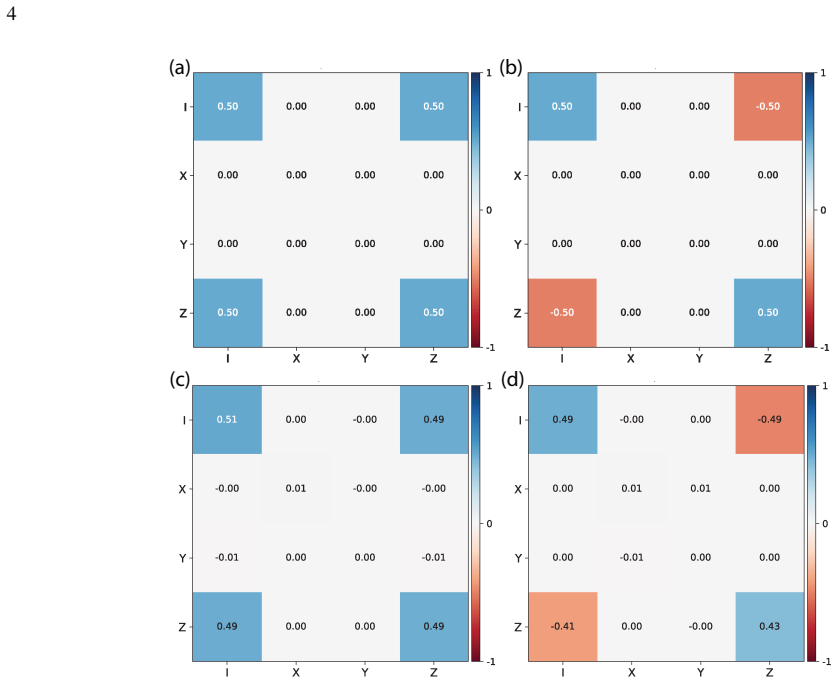
However, measure-and-prepare processes (which are rank-1 matrices; see the ideal PTMs in Fig
— that is, a process in which the output state|i⟩is en- tirely determined by the measurement outcomei. However, measure-and-prepare processes (which are rank-1 matrices; see the ideal PTMs in Fig. 2) cannot fully model MCMs (which can be higher rank matrices; see the experimental PTMs in Fig. 2), because in a generalized setting the post- measurement stat...
-
[2]
Hashim, L
A. Hashim, L. B. Nguyen, N. Goss, B. Marinelli, R. K. Naik, T. Chistolini, J. Hines, J. Marceaux, Y . Kim, P. Gokhale, T. Tomesh, S. Chen, L. Jiang, S. Ferracin, K. Rudinger, T. Proctor, K. C. Young, I. Siddiqi, and R. Blume-Kohout, PRX Quantum6, 030202 (2025)
2025
-
[3]
E. B. Davies and J. T. Lewis, Communications in Mathemati- cal Physics17, 239–260 (1970)
1970
-
[4]
Hatridge, S
M. Hatridge, S. Shankar, M. Mirrahimi, F. Schackert, K. Geerlings, T. Brecht, K. M. Sliwa, B. Abdo, L. Frunzio, S. M. Girvin, R. J. Schoelkopf, and M. H. Devoret, Science 339, 178–181 (2013)
2013
-
[5]
Dressel and A
J. Dressel and A. N. Jordan, Phys. Rev. A88, 022107 (2013)
2013
-
[6]
Ozawa, Journal of Mathematical Physics25, 79 (1984)
M. Ozawa, Journal of Mathematical Physics25, 79 (1984)
1984
-
[7]
Ji and E
K. Ji and E. Chitambar, PRX Quantum5, 010340 (2024)
2024
-
[8]
Mitra and M
A. Mitra and M. Farkas, Phys. Rev. A105, 052202 (2022)
2022
-
[9]
Mitra and M
A. Mitra and M. Farkas, Phys. Rev. A107, 032217 (2023)
2023
-
[10]
Chiribella, G
G. Chiribella, G. M. D’Ariano, and P. Perinotti, Phys. Rev. A 80, 022339 (2009)
2009
-
[11]
Introduction to Quantum Gate Set Tomography
D. Greenbaum, arXiv preprint arXiv:1509.02921 (2015)
work page Pith review arXiv 2015
-
[12]
C. J. Wood, J. D. Biamonte, and D. G. Cory, Quantum Infor- mation and Computation15, 759–811 (2015)
2015
-
[13]
Rudinger, G
K. Rudinger, G. J. Ribeill, L. C. Govia, M. Ware, E. Nielsen, K. Young, T. A. Ohki, R. Blume-Kohout, and T. Proctor, Phys. Rev. Appl.17, 014014 (2022)
2022
- [14]
-
[15]
Hashim, A
A. Hashim, A. Carignan-Dugas, L. Chen, C. Jünger, N. Fruit- wala, Y . Xu, G. Huang, J. J. Wallman, and I. Siddiqi, PRX Quantum6, 010307 (2025)
2025
-
[16]
D. McLaren, M. A. Graydon, and J. J. Wallman, arXiv preprint arXiv:2306.07418 (2023)
-
[17]
Hacohen-Gourgy, L
S. Hacohen-Gourgy, L. S. Martin, E. Flurin, V . V . Ramasesh, K. B. Whaley, and I. Siddiqi, Nature538, 491–494 (2016)
2016
-
[18]
Siddiqi, R
I. Siddiqi, R. Vijay, M. Metcalfe, E. Boaknin, L. Frunzio, R. J. Schoelkopf, and M. H. Devoret, Phys. Rev. B73, 054510 (2006)
2006
-
[19]
Y . Chen, M. Farahzad, S. Yoo, and T.-C. Wei, Phys. Rev. A 100, 052315 (2019)
2019
-
[20]
Horodecki, P
M. Horodecki, P. W. Shor, and M. B. Ruskai, Reviews in Mathematical Physics15, 629–641 (2003)
2003
-
[21]
V . B. Braginsky, Y . I. V orontsov, and K. S. Thorne, Science 209, 547–557 (1980)
1980
-
[22]
Lupa¸ scu, S
A. Lupa¸ scu, S. Saito, T. Picot, P. C. de Groot, C. J. P. M. Harmans, and J. E. Mooij, Nature Physics3, 119–123 (2007)
2007
-
[23]
V . B. Braginsky and F. Y . Khalili, Rev. Mod. Phys.68, 1 (1996)
1996
-
[24]
Stricker, D
R. Stricker, D. V odola, A. Erhard, L. Postler, M. Meth, M. Ringbauer, P. Schindler, R. Blatt, M. Müller, and T. Monz, PRX Quantum3, 030318 (2022)
2022
-
[25]
Hazra, W
S. Hazra, W. Dai, T. Connolly, P. D. Kurilovich, Z. Wang, L. Frunzio, and M. H. Devoret, Phys. Rev. Lett.134, 100601 (2025)
2025
-
[26]
Pereira, J
L. Pereira, J. J. García-Ripoll, and T. Ramos, Phys. Rev. Lett. 129, 010402 (2022)
2022
-
[27]
Pereira, J
L. Pereira, J. J. García-Ripoll, and T. Ramos, npj Quantum Information9, 22 (2023)
2023
- [28]
-
[29]
Govia, P
L. Govia, P. Jurcevic, C. Wood, N. Kanazawa, S. Merkel, and D. McKay, New Journal of Physics25, 123016 (2023)
2023
-
[30]
Zhang, S
Z. Zhang, S. Chen, Y . Liu, and L. Jiang, PRX Quantum6, 010310 (2025)
2025
-
[31]
Hines and T
J. Hines and T. Proctor, Phys. Rev. Lett.134, 020602 (2025)
2025
-
[32]
Hothem, J
D. Hothem, J. Hines, C. Baldwin, D. Gresh, R. Blume- Kohout, and T. Proctor, Nature Communications16, 5761 (2025)
2025
discussion (0)
Sign in with ORCID, Apple, or X to comment. Anyone can read and Pith papers without signing in.