Ultrafast Light-Induced Magnetoelectric Effect in van der Waals Magnetic Semiconductor Heterostructures
Pith reviewed 2026-05-10 02:22 UTC · model grok-4.3
The pith
Ultrafast light in a WS2/CrGeTe3 bilayer produces magnetic torque of opposite sign to an isolated magnetic film by driving photoexcited charge across the interface.
A machine-rendered reading of the paper's core claim, the machinery that carries it, and where it could break.
Core claim
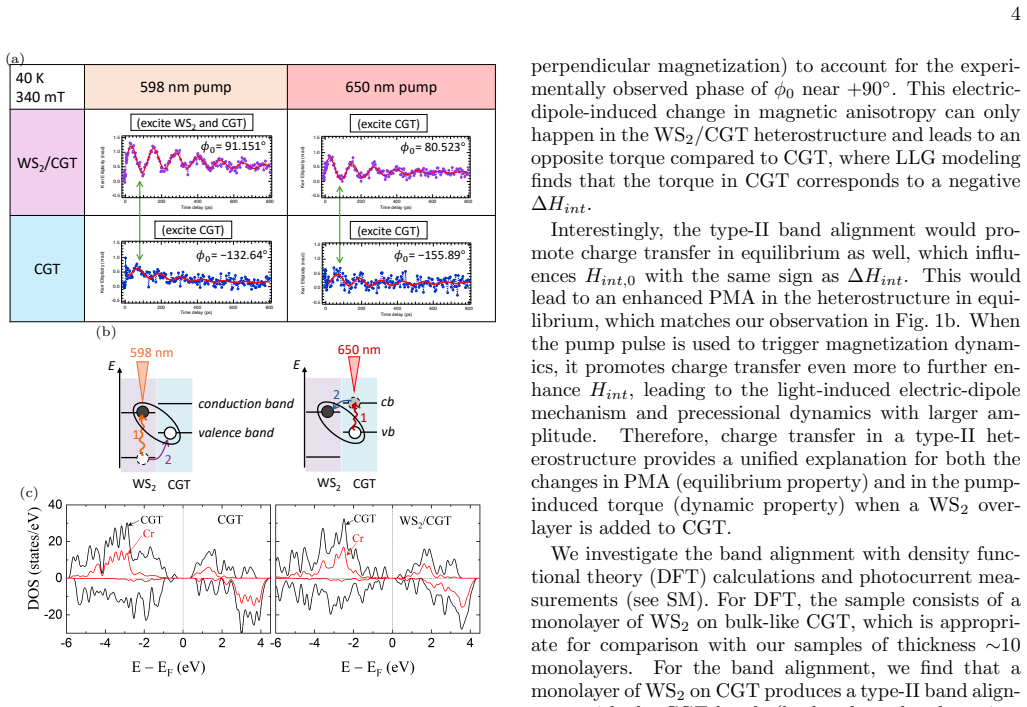
In the WS₂/CrGeTe₃ heterostructure, ultrafast optical excitation produces a magnetic torque of opposite sign to that observed in an isolated CrGeTe₃ film. Charge transfer of photoexcited carriers across the interface alters the perpendicular magnetic anisotropy of the magnetic layer and thereby generates the torque that drives precessional magnetization dynamics. Time-resolved magneto-optic Kerr effect experiments record the reversed precession, while density functional theory and Landau-Lifshitz-Gilbert simulations confirm that the interfacial charge movement is responsible. Optically generated spin currents flowing from WS₂ into CrGeTe₃ can additionally launch the same dynamics through net
What carries the argument
interfacial charge transfer of photoexcited carriers that modifies the perpendicular magnetic anisotropy of the CrGeTe₃ layer
If this is right
- Precessional magnetization dynamics can be started in van der Waals heterostructures by light-driven changes to magnetic anisotropy.
- Ultrafast magnetization control becomes possible in stacks that have type-II band alignments between the layers.
- Spin currents created by light in the semiconductor layer can also drive precession by delivering angular momentum to the magnet.
- The direction of the resulting torque can be set by selecting material combinations that produce the desired charge-transfer direction.
Where Pith is reading between the lines
- The same charge-transfer route might be used to reduce the role of heating in all-optical magnetic switching of two-dimensional magnets.
- Varying the thickness or doping of the semiconductor layer could provide a direct test of how much the torque depends on the amount of transferred charge.
- Device concepts in spintronics could incorporate this interface mechanism to achieve light-triggered operations at higher speeds than current electrical methods.
- Other pairs of two-dimensional semiconductors and magnets with similar band alignments are likely to show analogous torque reversal.
Load-bearing premise
The observed reversal in torque sign is produced by charge transfer that changes perpendicular magnetic anisotropy rather than by heating, photothermal expansion, or other non-interfacial processes.
What would settle it
The torque sign remains the same as in the isolated film when an insulating barrier is inserted at the interface to block charge transfer or when a material pair without type-II band alignment is used.
Figures



read the original abstract
Atomic-scale heterostructures of van der Waals (vdW) magnets and semiconductors provide a unique environment for exploring magnetic dynamics. In contrast to typical photothermal excitation of precessional magnetization dynamics by a pump laser pulse, we find that ultrafast optical excitation of a WS$_2$/CrGeTe$_3$ (CGT) bilayer produces an opposite sign of magnetic torque compared to an isolated CGT film. Experimental observations by time-resolved magneto-optic Kerr effect (TR-MOKE) and theoretical analysis by density functional theory (DFT) and Landau-Lifshitz-Gilbert (LLG) simulations support a mechanism in which charge transfer of photoexcited carriers across the interface alters the perpendicular magnetic anisotropy, which in turn generates a torque on the magnetic layer to trigger precessional magnetization dynamics. These results provide new avenues for ultrafast manipulation of magnetization in vdW heterostructures with type-II band alignments. Lastly, we show that optically-generated spin currents from WS$_2$ into CGT can also trigger precessional dynamics via angular momentum transfer.
Editorial analysis
A structured set of objections, weighed in public.
Referee Report
Summary. The manuscript reports that ultrafast optical excitation of a WS₂/CrGeTe₃ (CGT) van der Waals bilayer produces a magnetic torque of opposite sign relative to an isolated CGT film, as measured by time-resolved magneto-optic Kerr effect (TR-MOKE). The authors attribute this to photoexcited carrier charge transfer across the interface that modifies the perpendicular magnetic anisotropy (PMA) of the CGT layer, with supporting density functional theory (DFT) calculations and Landau-Lifshitz-Gilbert (LLG) simulations; they additionally note that spin currents from WS₂ can independently trigger precession via angular momentum transfer. The work positions this as a light-induced magnetoelectric effect distinct from conventional photothermal mechanisms in type-II band-aligned heterostructures.
Significance. If the mechanism attribution holds, the result opens routes for ultrafast, non-thermal control of magnetization in vdW magnetic semiconductor heterostructures. A clear strength is the direct experimental comparison of TR-MOKE dynamics in the bilayer versus the isolated CGT film, combined with DFT/LLG modeling to interpret the sign reversal; this provides a concrete platform for exploring interfacial charge-transfer effects on anisotropy.
major comments (1)
- [Abstract] Abstract and mechanism discussion: the central claim that the observed TR-MOKE torque sign reversal arises specifically from interfacial charge transfer altering PMA (rather than spin currents or photothermal effects) is load-bearing, yet the text acknowledges that 'optically-generated spin currents from WS₂ into CGT can also trigger precessional dynamics' without providing quantitative exclusion (e.g., fluence dependence, time-scale separation, or control structures) to isolate the charge-transfer channel from the alternatives explicitly mentioned.
minor comments (2)
- [Abstract] The abstract states that TR-MOKE data and DFT/LLG support the mechanism but provides no quantitative fits, error bars, or goodness-of-fit metrics, making it difficult to assess the robustness of the agreement between experiment and simulation.
- Notation for the magnetic torque and anisotropy terms should be defined consistently when first introduced to aid readability for readers outside the immediate subfield.
Simulated Author's Rebuttal
We thank the referee for their careful review and constructive feedback. We address the major comment below and have revised the manuscript to strengthen the mechanism discussion and better distinguish the charge-transfer channel.
read point-by-point responses
-
Referee: [Abstract] Abstract and mechanism discussion: the central claim that the observed TR-MOKE torque sign reversal arises specifically from interfacial charge transfer altering PMA (rather than spin currents or photothermal effects) is load-bearing, yet the text acknowledges that 'optically-generated spin currents from WS₂ into CGT can also trigger precessional dynamics' without providing quantitative exclusion (e.g., fluence dependence, time-scale separation, or control structures) to isolate the charge-transfer channel from the alternatives explicitly mentioned.
Authors: We appreciate the referee highlighting the need for clearer quantitative support. The primary evidence remains the direct experimental comparison: the magnetic torque reverses sign in the WS₂/CGT bilayer relative to the isolated CGT film under the same optical excitation. Photothermal heating of the CGT layer would produce the same torque sign in both cases, so the reversal excludes photothermal effects as the origin. For spin currents, the manuscript already notes their possible independent contribution via angular momentum transfer. However, the DFT calculations explicitly show that photoexcited charge transfer in the type-II alignment modifies the CGT PMA, generating an effective torque of opposite sign. The LLG simulations incorporating this anisotropy change reproduce the measured TR-MOKE precession amplitude, frequency, and sign. We have revised the abstract and mechanism section to emphasize that the sign reversal is the discriminator favoring the charge-transfer/PMA channel over spin currents alone, and we have added a paragraph discussing the relevant timescales (charge transfer <1 ps matching the observed onset). While we lack new fluence-dependent data or additional control samples in the current dataset, the existing comparison and modeling provide the strongest available separation; these textual clarifications are incorporated in the revision. revision: yes
Circularity Check
No significant circularity in the derivation chain
full rationale
The paper anchors its central claim in independent TR-MOKE measurements that directly observe opposite torque signs between the WS2/CGT bilayer and isolated CGT film. DFT calculations compute the interfacial charge-transfer effect on PMA from first principles without fitting to the target dynamics, and LLG simulations then use those parameters to interpret (not generate) the precessional response. No self-definitional loops, fitted inputs renamed as predictions, or load-bearing self-citations appear in the provided abstract or described workflow; the experimental data and first-principles inputs remain external to the final interpretation.
Axiom & Free-Parameter Ledger
axioms (2)
- standard math Landau-Lifshitz-Gilbert equation governs magnetization dynamics
- domain assumption Type-II band alignment enables charge transfer across the WS2/CGT interface
Reference graph
Works this paper leans on
-
[1]
Here,M S is the saturation magnetization andθ M is the angle betweenmand sample normal ( ˆz). To model the effect of the pump excitation, we treatH int(t) as consisting of a time-independent part Hint,0 and a pump-induced perpendicular anisotropy field ∆Hint that decays exponentially:H int(t) =H int,0+ ∆Hint e−t/τexcitation. Upon arrival of the pump pulse...
-
[2]
A. Kirilyuk, A. V. Kimel, and T. Rasing, Ultrafast opti- cal manipulation of magnetic order, Reviews of Modern Physics82, 2731 (2010)
work page 2010
-
[3]
M. Dabrowski, S. Guo, M. Strungaru, P. S. Keatley, 6 F. Withers, E. J. G. Santos, and R. J. Hicken, All-optical control of spin in a 2D van der Waals magnet, Nature Communications13, 5976 (2022)
work page 2022
- [4]
-
[5]
Y. J. Bae, J. Wang, A. Scheie, J. Xu, D. G. Chica, G. M. Diederich, J. Cenker, M. E. Ziebel, Y. Bai, H. Ren, C. R. Dean, M. Delor, X. Xu, X. Roy, A. D. Kent, and X. Zhu, Exciton-coupled coherent magnons in a 2D semiconduc- tor, Nature609, 282 (2022)
work page 2022
-
[6]
G. M. Diederich, J. Cenker, Y. Ren, J. Fonseca, D. G. Chica, Y. J. Bae, X. Zhu, X. Roy, T. Cao, D. Xiao, and X. Xu, Tunable interaction between excitons and hybridized magnons in a layered semiconductor, Nature Nanotechnology18, 23 (2023)
work page 2023
-
[7]
Y. Sun, F. Meng, C. Lee, A. Soll, H. Zhang, R. Ramesh, J. Yao, Z. Sofer, and J. Orenstein, Dipolar spin wave packet transport in a van der Waals antiferromagnet, Na- ture Physics20, 794 (2024)
work page 2024
-
[8]
F. M. Bartram, M. Li, L. Liu, Z. Xu, Y. Wang, M. Che, H. Li, Y. Wu, Y. Xu, J. Zhang, S. Yang, and L. Yang, Real-time observation of magnetization and magnon dy- namics in a two-dimensional topological antiferromagnet MnBi2Te4, Science Bulletin68, 2734 (2023)
work page 2023
-
[9]
E. Rongione, O. Gueckstock, M. Mattern, O. Gomonay, H. Meer, C. Schmitt, R. Ramos, T. Kikkawa, M. Miˇ cica, E. Saitoh, J. Sinova, H. Jaffr` es, J. Mangeney, S. T. B. Goennenwein, S. Gepr¨ ags, T. Kampfrath, M. Kl¨ aui, M. Bargheer, T. S. Seifert, S. Dhillon, and R. Lebrun, Emission of coherent THz magnons in an antiferromag- netic insulator triggered by u...
work page 2023
-
[10]
P. Li, N. Wu, S. Liu, Y. Cheng, P. Gong, J. Tong, J. Liu, W. He, F. Xiu, J. Zhao, S. Meng, and X. Wu, Above-Curie-temperature ultrafast terahertz emission and spin current generation in a 2D super- lattice (Fe3GeTe2/CrSb)3, National Science Review12, nwae447 (2025)
work page 2025
-
[11]
A. V. Kimel and M. Li, Writing magnetic memory with ultrashort light pulses, Nature Reviews Materials4, 189 (2019)
work page 2019
-
[12]
A. Barman, G. Gubbiotti, S. Ladak, A. O. Adey- eye, M. Krawczyk, J. Gr¨ afe, C. Adelmann, S. Coto- fana, A. Naeemi, V. I. Vasyuchka, B. Hillebrands, S. A. Nikitov, H. Yu, D. Grundler, A. V. Sadovnikov, A. A. Grachev, S. E. Sheshukova, J.-Y. Duquesne, M. Marangolo, G. Csaba, W. Porod, V. E. Demidov, S. Urazhdin, S. O. Demokritov, E. Albisetti, D. Petti, R....
work page 2021
-
[13]
E. Beaurepaire, J.-C. Merle, A. Daunois, and J.-Y. Bigot, Ultrafast spin dynamics in ferromagnetic nickel, Physical Review Letters76, 4250 (1996)
work page 1996
- [14]
-
[15]
C. Tang, L. Alahmed, M. Mahdi, Y. Xiong, J. Inman, N. J. McLaughlin, C. Zollitsch, T. H. Kim, C. R. Du, H. Kurebayashi, E. J. Santos, W. Zhang, P. Li, and W. Jin, Spin dynamics in van der Waals magnetic sys- tems, Physics Reports1032, 1 (2023)
work page 2023
- [16]
-
[17]
F. Hendriks, R. R. Rojas-Lopez, B. Koopmans, and M. H. D. Guimaraes, Electric control of optically-induced magnetization dynamics in a van der Waals ferromag- netic semiconductor, Nature Communications15, 1298 (2024)
work page 2024
-
[18]
A. V. Kimel, A. Kirilyuk, P. A. Usachev, R. V. Pisarev, A. M. Balbashov, and T. Rasing, Ultrafast non-thermal control of magnetization by instantaneous photomagnetic pulses, Nature435, 655 (2005)
work page 2005
-
[19]
G.-M. Choi, A. Schleife, and D. G. Cahill, Optical- helicity-driven magnetization dynamics in metallic fer- romagnets, Nature Communications8, 15085 (2017)
work page 2017
-
[20]
A. Chernikov, T. C. Berkelbach, H. M. Hill, A. Rigosi, Y. Li, O. B. Aslan, D. R. Reichman, M. S. Hybertsen, and T. F. Heinz, Exciton binding energy and nonhydro- genic Rydberg series in monolayer WS2, Physical Review Letters113, 076802 (2014)
work page 2014
-
[21]
K. F. Mak and J. Shan, Photonics and optoelectronics of 2D semiconductor transition metal dichalcogenides, Na- ture Photonics10, 216 (2016)
work page 2016
-
[22]
G. Aivazian, Z. Gong, A. M. Jones, R.-L. Chu, J. Yan, D. G. Mandrus, C. Zhang, D. Cobden, W. Yao, and X. Xu, Magnetic control of valley pseudospin in mono- layer WSe2, Nature Physics11, 148 (2015)
work page 2015
-
[23]
D. Zhong, K. L. Seyler, X. Linpeng, R. Cheng, N. Sivadas, B. Huang, E. Schmidgall, T. Taniguchi, K. Watanabe, M. A. McGuire, W. Yao, D. Xiao, K.- M. C. Fu, and X. Xu, Van der Waals engineering of fer- romagnetic semiconductor heterostructures for spin and valleytronics, Science Advances3, e1603113 (2017)
work page 2017
- [24]
-
[25]
K. L. Seyler, D. Zhong, B. Huang, X. Linpeng, N. P. Wilson, T. Taniguchi, K. Watanabe, W. Yao, D. Xiao, M. A. McGuire, K.-M. C. Fu, and X. Xu, Valley Ma- nipulation by Optically Tuning the Magnetic Proximity Effect in WSe 2/CrI3 Heterostructures, Nano Letters18, 3823 (2018)
work page 2018
-
[26]
T. P. Lyons, D. Gillard, A. Molina-S´ anchez, A. Misra, F. Withers, P. S. Keatley, A. Kozikov, T. Taniguchi, K. Watanabe, K. S. Novoselov,et al., Interplay between spin proximity effect and charge-dependent exciton dy- namics in MoSe 2/CrBr3 van der waals heterostructures, Nature communications11, 6021 (2020)
work page 2020
-
[27]
J. Choi, C. Lane, J.-X. Zhu, and S. A. Crooker, Asym- metric magnetic proximity interactions in MoSe 2/CrBr3 van der Waals heterostructures, Nature Materials22, 305 (2023)
work page 2023
-
[28]
B. Huang, G. Clark, E. Navarro-Moratalla, D. R. Klein, R. Cheng, K. L. Seyler, D. Zhong, E. Schmidgall, M. A. 7 McGuire, D. H. Cobden, W. Yao, D. Xiao, P. Jarillo- Herrero, and X. Xu, Layer-dependent ferromagnetism in a van der Waals crystal down to the monolayer limit, Nature546, 270 (2017)
work page 2017
-
[29]
C. Gong, L. Li, Z. Li, H. Ji, A. Stern, Y. Xia, T. Cao, W. Bao, C. Wang, Y. Wang, Z. Q. Qiu, R. J. Cava, S. G. Louie, J. Xia, and X. Zhang, Discovery of intrinsic fer- romagnetism in two-dimensional van der Waals crystals, Nature546, 265 (2017)
work page 2017
-
[30]
W. Zhuo, B. Lei, S. Wu, F. Yu, C. Zhu, J. Cui, Z. Sun, D. Ma, M. Shi, H. Wang, W. Wang, T. Wu, J. Ying, S. Wu, Z. Wang, and X. Chen, Manipulating Ferromag- netism in Few-Layered Cr 2Ge2Te6, Advanced Materials 33, 2008586 (2021)
work page 2021
-
[31]
Z. Tu, T. Zhou, T. Ersevim, H. S. Arachchige, A. T. Han- bicki, A. L. Friedman, D. Mandrus, M. Ouyang, I. ˇZuti´ c, and C. Gong, Spin–orbit coupling proximity effect in MoS2/Fe3GeTe2 heterostructures, Applied Physics Let- ters120, 043102 (2022)
work page 2022
- [32]
-
[33]
B. M. Goff, W. Zhou, A. J. Bishop, R. Bailey-Crandell, K. Robinson, R. K. Kawakami, and J. A. Gupta, Scan- ning tunneling microscopy study of epitaxial Fe 3GeTe2 monolayers on Bi2Te3, 2D Materials11, 025012 (2024)
work page 2024
-
[34]
T. M. J. Cham, D. G. Chica, X. Huang, K. Watan- abe, T. Taniguchi, X. Roy, Y. K. Luo, and D. C. Ralph, Spin-filter tunneling detection of antiferromagnetic res- onance with electrically tunable damping, Science389, 479 (2025)
work page 2025
-
[35]
M. Gibertini, M. Koperski, A. F. Morpurgo, and K. S. Novoselov, Magnetic 2D materials and heterostructures, Nature Nanotechnology14, 408 (2019)
work page 2019
-
[36]
T. Sun, C. Zhou, Z. Jiang, X. Li, K. Qiu, R. Xiao, C. Liu, Z. Ma, X. Luo, Y. Sun, and Z. Sheng, Ultra-long spin relaxation in two-dimensional ferromagnet Cr 2Ge2Te6 flake, 2D Materials8, 045040 (2021)
work page 2021
-
[37]
E. Sutcliffe, X. Sun, I. Verzhbitskiy, T. Griepe, U. Atxi- tia, G. Eda, E. J. G. Santos, and J. O. Johansson, Tran- sient magneto-optical spectrum of photoexcited electrons in the van der Waals ferromagnet Cr 2Ge2Te6, Physical Review B107, 174432 (2023)
work page 2023
-
[38]
M. Dabrowski, S. Haldar, S. Khan, P. S. Keatley, D. Sagkovits, Z. Xue, C. Freeman, I. Verzhbitskiy, T. Griepe, U. Atxitia, G. Eda, H. Kurebayashi, E. J. G. Santos, and R. J. Hicken, Ultrafast thermo-optical con- trol of spins in a 2D van der Waals semiconductor, Nature Communications16, 2797 (2025)
work page 2025
-
[39]
I. A. Verzhbitskiy, H. Kurebayashi, H. Cheng, J. Zhou, S. Khan, Y. P. Feng, and G. Eda, Controlling the mag- netic anisotropy in Cr 2Ge2Te6 by electrostatic gating, Nature Electronics3, 460 (2020)
work page 2020
-
[40]
See Supplemental Material for discussion of the het- erostructure fabrication, photoluminescence measure- ments, detailed temperature-dependent MOKE loops, TRKE measurement details and fitting formula, TRKE data at different temperatures, LLG equation mod- elling, DFT calculations, and photocurrent measure- ments, which includes Refs. [48–55]
- [41]
- [42]
-
[43]
M. Weisheit, S. F¨ ahler, A. Marty, Y. Souche, C. Poinsignon, and D. Givord, Electric Field-Induced Modification of Magnetism in Thin-Film Ferromagnets, Science315, 349 (2007)
work page 2007
-
[44]
C.-G. Duan, J. P. Velev, R. F. Sabirianov, Z. Zhu, J. Chu, S. S. Jaswal, and E. Y. Tsymbal, Surface Magnetoelectric Effect in Ferromagnetic Metal Films, Physical Review Letters101, 137201 (2008)
work page 2008
-
[45]
K. Nakamura, R. Shimabukuro, Y. Fujiwara, T. Akiyama, T. Ito, and A. J. Freeman, Giant Modification of the Magnetocrystalline Anisotropy in Transition-Metal Monolayers by an External Electric Field, Physical Review Letters102, 187201 (2009)
work page 2009
- [46]
-
[47]
J. Xie, Z. Zhang, H. Zhang, V. Nagarajan, W. Zhao, H.- L. Kim, C. Sanborn, R. Qi, S. Chen, S. Kahn, K. Watan- abe, T. Taniguchi, A. Zettl, M. F. Crommie, J. Analytis, and F. Wang, Low Resistance Contact to P-Type Mono- layer WSe2, Nano Letters24, 5937 (2024)
work page 2024
-
[48]
A. J. Sternbach, R. A. Vitalone, S. Shabani, J. Zhang, T. P. Darlington, S. L. Moore, S. H. Chae, E. Seewald, X. Xu, C. R. Dean, X. Zhu, A. Rubio, J. Hone, A. N. Pasupathy, P. J. Schuck, and D. N. Basov, Quenched Excitons in WSe 2/α-RuCl3 Heterostructures Revealed by Multimessenger Nanoscopy, Nano Letters23, 5070 (2023)
work page 2023
-
[49]
E. Hairer and G. Wanner,Solving Ordinary Differential Equations II, Springer Series in Computational Mathe- matics, Vol. 14 (Springer, Berlin, Heidelberg, 1996)
work page 1996
-
[50]
P. Virtanen, R. Gommers, T. E. Oliphant, M. Haber- land, T. Reddy, D. Cournapeau, E. Burovski, P. Pe- terson, W. Weckesser, J. Bright, S. J. van der Walt, M. Brett, J. Wilson, K. J. Millman, N. Mayorov, A. R. J. Nelson, E. Jones, R. Kern, E. Larson, C. J. Carey, I. Po- lat, Y. Feng, E. W. Moore, J. VanderPlas, D. Laxalde, J. Perktold, R. Cimrman, I. Henri...
work page 2020
-
[51]
T. F. Coleman and Y. Li, An Interior Trust Region Ap- proach for Nonlinear Minimization Subject to Bounds, SIAM Journal on Optimization6, 418 (1996)
work page 1996
-
[52]
J. Furthm¨ uller, J. Hafner, and G. Kresse, Dimer recon- struction and electronic surface states on clean and hy- drogenated diamond (100) surfaces, Phys. Rev. B53, 7334 (1996)
work page 1996
-
[53]
G. Kresse and J. Furthm¨ uller, Efficiency of ab-initio total energy calculations for metals and semiconductors using a plane-wave basis set, Comput. Mater. Sci.6, 15 (1996)
work page 1996
-
[54]
J. P. Perdew, K. Burke, and M. Ernzerhof, Generalized gradient approximation made simple, Phys. Rev. Lett. 77, 3865 (1996)
work page 1996
-
[55]
P. E. Bl¨ ochl, Projector augmented-wave method, Phys. 8 Rev. B50, 17953 (1994)
work page 1994
-
[56]
J. Heyd, G. E. Scuseria, and M. Ernzerhof, Hybrid func- tionals based on a screened coulomb potential, J. Chem. Phys.118, 8207 (2003)
work page 2003
discussion (0)
Sign in with ORCID, Apple, or X to comment. Anyone can read and Pith papers without signing in.