Pseudogap and Condensation in Cuprate Superconductors from NMR Shifts
Pith reviewed 2026-05-10 01:55 UTC · model grok-4.3
The pith
NMR shifts in cuprates separate into A and B components whose coupling sets the pseudogap temperature and guides spin-singlet condensation.
A machine-rendered reading of the paper's core claim, the machinery that carries it, and where it could break.
Core claim
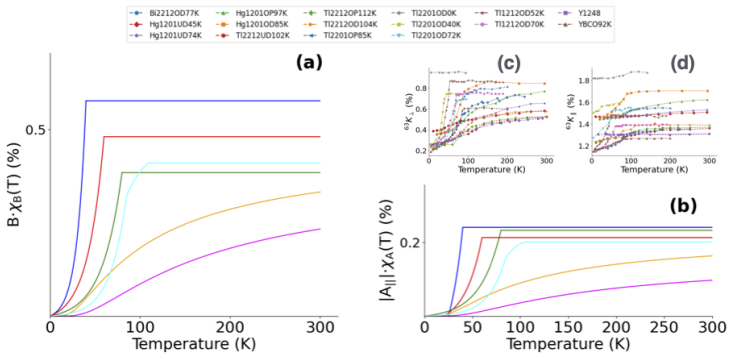
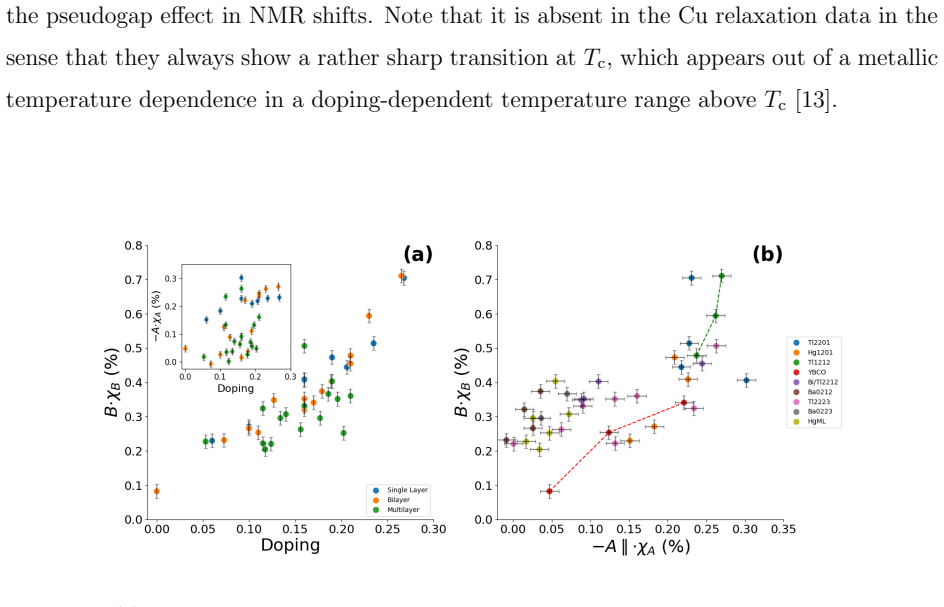
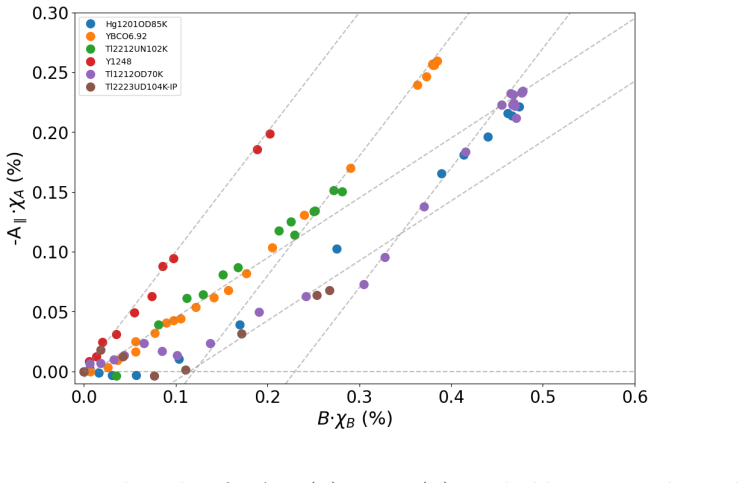
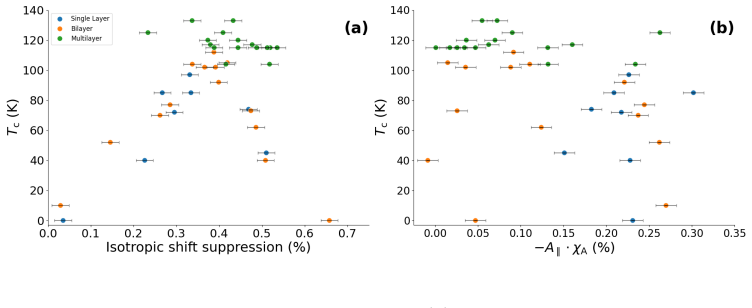
Based only on symmetry of the two Cu hyperfine couplings, an anisotropic A_alpha and isotropic B, the Cu shifts are disentangled, and two different shift components emerge. Upon doping the cuprates, metallic B-spins are created above the pseudogap temperature which is shared with metallic A-spins. Further doping decreases the pseudogap temperature and increases the B-spin, but less so the A-spin. The apparent linear rate of increase in density of states of the B-spin with doping increases nearly threefold above about x=0.20, where the pseudogap has disappeared and A and B turn into superconducting metals, i.e. they disappear rapidly at Tc. The pseudogap temperature is a measure of the A-B, A
What carries the argument
Disentanglement of Cu NMR shifts into anisotropic A_alpha and isotropic B hyperfine components that reveal independent doping behaviors and their coupling.
If this is right
- Pseudogap temperature falls with doping as B-spins increase faster than A-spins.
- Above x approximately 0.20 both A and B components become superconducting metals that vanish rapidly at Tc.
- Optimal Tc requires a special match between A and B and occurs in systems that retain a pseudogap.
- Highest Tc values are not carried by the shifts but appear in nuclear relaxation rates and charge sharing between planar Cu and O.
Where Pith is reading between the lines
- If A-B coupling sets the pseudogap scale, modest structural changes that alter this coupling could raise Tc at fixed doping.
- The three condensation rules might supply a minimal template for pairing in other doped Mott insulators.
- Combined shift and relaxation measurements could rank candidate cuprate compositions by predicted Tc before synthesis.
Load-bearing premise
The two Cu hyperfine couplings can be cleanly separated into a single anisotropic A_alpha and isotropic B form that remains valid for all cuprates and doping levels.
What would settle it
NMR shift data from one more cuprate compound that cannot be decomposed into consistent A and B components matching the reported doping trends or where pseudogap temperature fails to track the inferred A-B coupling strength.
Figures



read the original abstract
The electronic properties of the high-temperature superconducting cuprates are encoded in complex sets of NMR data, but without microscopic theory, reliable NMR phenomenologies are in demand. Early analyses of NMR could only focus on very few materials and discovered spin singlet pairing and the enigmatic pseudogap. However, a coherent phenomenology of shift and relaxation could not be established, as incoming data from other cuprates complicated the picture. Today, due to work of many groups worldwide, planar copper and oxygen NMR data are available for most cuprates. Here, based only on symmetry of the two Cu hyperfine couplings, an anisotropic $A_\alpha$ and isotropic $B$, the Cu shifts are disentangled, and two different shift components emerge. Upon doping the cuprates, metallic B-spins are created above the pseudogap temperature which is shared with metallic A-spins. Further doping decreases the pseudogap temperature and increases the B-spin, but less so the A-spin. The apparent linear rate of increase in density of states of the B-spin with doping increases nearly threefold above about $x=0.20$, where the pseudogap has disappeared and A and B turn into superconducting metals, i.e. they disappear rapidly at $T_\mathrm{c}$. The pseudogap temperature is a measure of the coupling between A and B, which suppresses the shifts but not nuclear relaxation. Spin singlet pairing involves A and B according to three simple rules for condensation which will be discussed. The optimal $T_\mathrm{c}$ demands a special match between A and B and involves systems with a pseudogap. However, the highest $T_\mathrm{c}$ of all cuprates is not encoded in the shift, but rather in nuclear relaxation and charge sharing between planar Cu and O. Relations to other probes are discussed.
Editorial analysis
A structured set of objections, weighed in public.
Referee Report
Summary. The paper claims to develop a coherent NMR phenomenology for cuprates by disentangling Cu shifts into two components (A-spins and B-spins) using symmetry of anisotropic A_α and isotropic B hyperfine couplings. It identifies the pseudogap temperature as a measure of A-B coupling suppressing shifts (but not relaxation), describes doping evolution of B-spin DOS with a change at x≈0.20, and proposes three rules for spin-singlet condensation where optimal Tc requires a special A-B match in pseudogap systems. Highest Tc relates to relaxation and Cu-O charge sharing.
Significance. This could be significant as it unifies data from many cuprates without microscopic theory, offering simple rules for condensation and explaining pseudogap as inter-component coupling. It gives credit to extensive experimental data. If the separation is robust, it provides a new framework for interpreting NMR in superconductors. However, its impact hinges on whether the hyperfine assumption holds.
major comments (1)
- [Shift disentanglement (based on symmetry arguments)] The disentanglement into independent A and B components assumes that the hyperfine form factors A_α (anisotropic) and B (isotropic) are doping-independent and the same for all cuprates. This is load-bearing for identifying metallic B-spins above T*, the suppression by coupling, and the condensation rules. If covalency or transferred hyperfine fields vary with doping (as suggested by changes at x≈0.20), the linear combination used to isolate components would mix A and B, making the claimed distinction an artifact rather than physical. No quantitative check against doping-dependent hyperfine literature is referenced.
minor comments (2)
- The abstract refers to 'three simple rules for condensation which will be discussed' without specifying their location or providing equations; this makes it difficult to evaluate their derivation from the shift data.
- Notation for A_α and B should be defined explicitly with reference to standard hyperfine Hamiltonian early in the text for clarity.
Simulated Author's Rebuttal
We thank the referee for the careful reading of our manuscript and the constructive feedback. We address the major comment below.
read point-by-point responses
-
Referee: The disentanglement into independent A and B components assumes that the hyperfine form factors A_α (anisotropic) and B (isotropic) are doping-independent and the same for all cuprates. This is load-bearing for identifying metallic B-spins above T*, the suppression by coupling, and the condensation rules. If covalency or transferred hyperfine fields vary with doping (as suggested by changes at x≈0.20), the linear combination used to isolate components would mix A and B, making the claimed distinction an artifact rather than physical. No quantitative check against doping-dependent hyperfine literature is referenced.
Authors: The separation into A and B components is grounded in the distinct symmetry properties of the hyperfine couplings (anisotropic on-site A_α versus isotropic transferred B), as originally established by Mila and Rice and validated across multiple cuprate families in the experimental literature. These symmetry-based distinctions remain robust even if modest doping variations in covalency exist, because the extracted components display consistent doping trends and cross-material patterns that would be disrupted by significant mixing. The feature at x≈0.20 reflects a change in the B-spin density of states rather than a hyperfine discontinuity. We nevertheless agree that an explicit discussion of possible doping dependence would strengthen the presentation. In revision we will add references to key studies on the doping evolution of Cu hyperfine constants (showing variations are small relative to the observed shift changes) together with a brief quantitative estimate of the impact any such variation would have on the linear combinations. This directly addresses the concern that the distinction could be an artifact. revision: partial
Circularity Check
No significant circularity; phenomenological analysis under explicit symmetry assumptions
full rationale
The paper starts from an explicit symmetry-based assumption that the two Cu hyperfine couplings can be written as a fixed anisotropic A_α plus isotropic B form factor pair, then uses this to linearly disentangle observed shifts into two components. All subsequent statements (doping evolution of B-spin density of states, T* as a measure of A-B coupling, three condensation rules, optimal-Tc matching condition) are direct interpretations or re-descriptions of the disentangled data sets. No equation or claim is shown to reduce by construction to a parameter fitted from the same shifts, no uniqueness theorem is imported from self-citation, and no ansatz is smuggled via prior work. The derivation chain therefore remains self-contained once the initial hyperfine-form assumption is granted; it does not loop back to its inputs.
Axiom & Free-Parameter Ledger
axioms (1)
- domain assumption Planar copper hyperfine couplings consist of an anisotropic A_alpha term and an isotropic B term whose symmetry allows clean separation of observed shifts.
invented entities (2)
-
A-spins
no independent evidence
-
B-spins
no independent evidence
Reference graph
Works this paper leans on
-
[1]
NMR. For example, planar O and Y show a superconducting metal for YBa 2Cu3O7 (just beyond optimal doping aty= 0.96). This means that aboveT c the shifts are temperature independent, and the relaxation is proportional to temperature, connected by the Korringa relation. A missing Hebel-Slichter peak just belowT c points to unconventional supercon- ductivity...
-
[2]
relate to the overall change in DOS and the pseudogap [28, 29] remains to be seen. As expected, the high-temperature B-spin draws the superconducting dome when plotted againstT c, as Fig. 5 shows. The variation in the A-component might be related to family dependent corrugation of the plane [30, 31]. The size of the pseudogap can be determined, from the c...
-
[3]
to other probes’ findings in greater detail. ACKNOWLEDGMENTS We acknowledge financial support from Leipzig University, in particular Roger Gl¨ aser, and stimulating discussions with Nabeel Aslam. Author contributions A.L. performed all data analysis. A.L. and J.H. contributed equally to preparing the manuscript. J.H. had the overall leadership. Competing ...
-
[4]
C. P. Slichter,Principles of Magnetic Resonance, third enlarged ed. (Springer, Berlin, 1990)
work page 1990
-
[5]
Korringa, Nuclear magnetic relaxation and resonnance line shift in metals, Physica16, 601 (1950)
J. Korringa, Nuclear magnetic relaxation and resonnance line shift in metals, Physica16, 601 (1950)
work page 1950
-
[6]
L. C. Hebel and C. P. Slichter, Nuclear Spin Relaxation in Normal and Superconducting Aluminum, Phys. Rev.113, 1504 (1959). 13
work page 1959
-
[7]
Yosida, Paramagnetic Susceptibility in Superconductors, Phys
K. Yosida, Paramagnetic Susceptibility in Superconductors, Phys. Rev.110, 769 (1958)
work page 1958
-
[8]
J. G. Bednorz and K. A. M¨ uller, Possible HighT c Superconductivity in the Ba-La-Cu-O System, Z. Phys. B Condens. Matter193, 189 (1986)
work page 1986
-
[9]
R. E. Walstedt, J. W W Warren, R. F. Bell, G. F. Brennert, G. P. Espinosa, R. J. Cava, L. F. Schneemeyer, and J. V. Waszczak, Anisotropic nuclear relaxation in YBa 2Cu3O7, Phys. Rev. B38, 9299 (1988)
work page 1988
-
[10]
M. Mali, D. Brinkmann, L. Pauli, J. Roos, H. Zimmermann, and J. Hulliger, Cu and Y NQR and NMR in the superconductor YBa2Cu3O7-[delta], Phys. Lett. A124, 112 (1987)
work page 1987
- [11]
-
[12]
C. P. Slichter, Magnetic Resonance Studies of High Temperature Superconductors, inHand- book of High-Temperature Superconductivity, edited by J. R. Schrieffer and J. S. Brooks (Springer, New York, 2007) pp. 215–256
work page 2007
- [13]
- [14]
-
[15]
D. Rybicki, J. Kohlrautz, J. Haase, M. Greven, X. Zhao, M. K. Chan, C. J. Dorow, and M. J. Veit, Electronic spin susceptibilities and superconductivity in HgBa 2CuO4+δ from nuclear magnetic resonance, Phys. Rev. B92, 081115(R) (2015)
work page 2015
-
[16]
Hidden Universal Metal in Cuprate Superconductors
A. Lee and J. Haase, Hidden universal metal in cuprate superconductors, arXiv: 2604.10133v1 (2026)
work page internal anchor Pith review Pith/arXiv arXiv 2026
- [17]
-
[18]
M. Avramovska, D. Pavi´ cevi´ c, and J. Haase, Properties of the Electronic Fluid of Supercon- ducting Cuprates from 63Cu NMR Shift and Relaxation, J. Supercond. Nov. Magn.32, 3761 (2019)
work page 2019
-
[19]
M. Avramovska, J. Nachtigal, S. Tsankov, and J. Haase, Planar Cu and O NMR and the Pseudogap of Cuprate Superconductors, Condens. Matter7, 21 (2022)
work page 2022
-
[20]
J. Nachtigal, M. Avramovska, A. Erb, D. Pavi´ cevi´ c, R. Guehne, and J. Haase, Temperature- 14 Independent Cuprate Pseudogap from Planar Oxygen NMR, Condens. Matter5, 66 (2020)
work page 2020
- [21]
-
[22]
R. E. Walstedt,The NMR Probe of High-T c Materials, 1st ed. (Springer, 2007)
work page 2007
-
[23]
F. Mila and T. M. Rice, Analysis of magnetic resonance experiments in YBa 2Cu3O7, Phys. C: Supercond.157, 561 (1989)
work page 1989
-
[24]
M. Takigawa, P. C. Hammel, R. H. Heffner, Z. Fisk, J. L. Smith, and R. B. Schwarz, Anisotropic Cu Knight shift and magnetic susceptibility in the normal state of YBa 2Cu3O7, Phys. Rev. B39, 300 (1989)
work page 1989
-
[25]
C. H. Pennington, D. J. Durand, C. P. Slichter, J. P. Rice, E. D. Bukowski, and D. M. Ginsberg, Static and dynamic Cu NMR tensors of YBa 2Cu3O7−δ, Phys. Rev. B39, 2902 (1989)
work page 1989
- [26]
-
[27]
E. Pavarini, I. Dasgupta, T. Saha-Dasgupta, O. Jepsen, and O. K. Andersen, Band-structure trend in hole-doped cuprates and correlation withT c,max, Phys. Rev. Lett.87, 047003 (2001)
work page 2001
-
[28]
M. Avramovska, J. Nachtigal, and J. Haase, Temperature independent pseudogap from 17O and 89Y NMR and the single component picture, J. Supercond. Nov. Magn.35, 1761 (2022)
work page 2022
-
[29]
C. Putzke, S. Benhabib, W. Tabis, J. Ayres, Z. Wang, L. Malone, S. Licciardello, J. Lu, T. Kondo, T. Takeuchi, N. E. Hussey, J. R. Cooper, and A. Carrington, Reduced Hall carrier density in the overdoped strange metal regime of cuprate superconductors, Nature Physics 17, 826 (2021)
work page 2021
-
[30]
J. Meng, G. Liu, W. Zhang, L. Zhao, H. Liu, X. Jia, D. Mu, S. Liu, X. Dong, J. Zhang, W. Lu, G. Wang, Y. Zhou, Y. Zhu, X. Wang, Z. Xu, C. Chen, and X. J. Zhou, Coexistence of Fermi arcs and Fermi pockets in a high-T c copper oxide superconductor, Nature462, 10.1038/nature08521 (2009)
-
[31]
T. J. Reber, N. C. Plumb, Z. Sun, Y. Cao, Q. Wang, K. McElroy, H. Iwasawa, M. Arita, J. S. Wen, Z. J. Xu, G. Gu, Y. Yoshida, H. Eisaki, Y. Aiura, and D. S. Dessau, The origin and non- quasiparticle nature of Fermi arcs in Bi2Sr2CaCu2O8+δ, Nature Physics8, 10.1038/nphys2352 (2012)
-
[32]
T. Kondo, Y. Hamaya, A. D. Palczewski, T. Takeuchi, J. S. Wen, Z. J. Xu, G. Gu, 15 J. Schmalian, and A. Kaminski, Disentangling Cooper-pair formation above the transition temperature from the pseudogap state in the cuprates, Nature Physics7, 10.1038/nphys1851 (2011)
-
[33]
O. Chmaissem, J. D. Jorgensen, S. Short, A. Knizhnik, Y. Eckstein, and H. Shaked, Scaling of transition temperature and CuO 2 plane buckling in a high-temperature superconductor, Nature397, 10.1038/16209 (1999)
-
[34]
P. Radaelli, J. Wagner, B. Hunter, M. Beno, G. Knapp, J. Jorgensen, and D. Hinks, Structure, doping and superconductivity in HgBa 2CaCu2O6+δ (Tc ≤128 K), Physica C: Superconduc- tivity216, 10.1016/0921-4534(93)90630-9 (1993)
-
[35]
J. W. Loram, K. A. Mirza, J. R. Cooper, and J. L. Tallon, Specific heat evidence on the normal state pseudogap, J. Phys. Chem. Solids59, 2091 (1998)
work page 2091
-
[36]
J. L. Tallon and J. G. Storey, Thermodynamics of the pseudogap in cuprates, Front. Phys. 10, 1030616 (2022)
work page 2022
- [37]
-
[38]
A. Bussmann-Holder and H. Keller, Multiband Superconductivity, Polarons, Jahn-Teller Polarons, Heterogeneity, and High-Temperature Superconductivity, Condensed Matter9, 10.3390/condmat9040056 (2024)
-
[39]
R. Khasanov, S. Str¨ assle, D. Di Castro, T. Masui, S. Miyasaka, S. Tajima, A. Bussmann- Holder, and H. Keller, Multiple Gap Symmetries for the Order Parameter of Cuprate Su- perconductors from Penetration Depth Measurements, Phys. Rev. Lett.99, 10.1103/Phys- RevLett.99.237601 (2007)
-
[40]
D. Rybicki, M. Jurkutat, S. Reichardt, C. Kapusta, and J. Haase, Perspective on the phase diagram of cuprate high-temperature superconductors, Nat. Commun.7, 11413 (2016)
work page 2016
-
[41]
N. Kowalski, S. S. Dash, P. S´ emon, D. S´ en´ echal, and A.-M. Tremblay, Oxygen hole con- tent, charge-transfer gap, covalency, and cuprate superconductivity, PNAS118, e2106476118 (2021)
work page 2021
-
[42]
B. Bacq-Labreuil, B. Lacasse, A.-M. S. Tremblay, D. S´ en´ echal, and K. Haule, Toward an Ab Initio Theory of High-Temperature Superconductors: A Study of Multilayer Cuprates, Phys. Rev. X15, 021071 (2025)
work page 2025
-
[43]
M. Jurkutat, M. Avramovska, G. V. M. Williams, D. Dernbach, D. Pavi´ cevi´ c, and J. Haase, 16 Phenomenology of 63Cu Nuclear Relaxation in Cuprate Superconductors, J. Supercond. Nov. Magn.155, 629 (2019)
work page 2019
-
[44]
J. M. Tranquada, B. J. Sternlieb, J. D. Axe, Y. Nakamura, and S. Uchida, Evidence for stripe correlations of spins and holes in copper oxide superconductors, Nature375, 561 (1995)
work page 1995
-
[45]
P. H¨ usser, H. U. Suter, E. P. Stoll, and P. F. Meier, First-principles calculations of hyperfine interactions in La 2CuO4, Phys. Rev. B61, 1567 (2000)
work page 2000
-
[46]
A. A. Gippius, E. V. Antipov, W. Hoffmann, K. L¨ uders, and G. Buntkowsky, Low-frequency spin dynamics as probed by 63Cu and 199Hg NMR in HgBa 2CuO4+δ superconductors with different oxygen content, Phys. Rev. B59, 654 (1999)
work page 1999
- [47]
-
[48]
K. Fujiwara, Y. Kitaoka, K. Ishida, K. Asayama, Y. Shimakawa, T. Manako, and Y. Kubo, NMR and NQR studies of superconductivity in heavily doped Tl 2Ba2CuO6+y with a single CuO2 plane, Physica C: Superconductivity184, 207 (1991)
work page 1991
-
[49]
K. Magishi, Y. Kitaoka, G. q. Zheng, K. Asayama, T. Kondo, Y. Shimakawa, T. Manako, and Y. Kubo, Magnetic excitation and superconductivity in overdoped TlSr 2CaCu2O7−δ: A 63Cu NMR study, Phys. Rev. B54, 10131 (1996)
work page 1996
-
[50]
M. Mali, I. Mangelschots, H. Zimmermann, and D. Brinkmann, Nuclear magnetic resonance of plane Cu in paramagnetic YBa 2Cu3O6, Physica C: Superconductivity175, 581 (1991)
work page 1991
-
[51]
M. Takigawa, A. P. Reyes, P. C. Hammel, J. D. Thompson, R. H. Heffner, Z. Fisk, and K. C. Ott, Cu and O NMR studies of the magnetic properties of YBa 2Cu3O6.63 (Tc=62K), Phys. Rev. B43, 247 (1991)
work page 1991
-
[52]
M. Takigawa, P. C. Hammel, R. H. Heffner, and Z. Fisk, Spin susceptibility in superconducting YBa2Cu3O7 from 63Cu Knight shift, Phys. Rev. B39, 7371 (1989)
work page 1989
-
[53]
R. Walstedt, W. Jr, R. Bell, and G. Espinosa, Anisotropic 63Cu nuclear relaxation in mag- netically oriented powdered samples of YBa 2Cu3O7., Phys. Rev. B40, 2572 (1989)
work page 1989
- [54]
-
[55]
H. Zimmermann, M. Mali, M. Bankay, and D. Brinkmann, Anisotropy of 63Cu Knight shift and spin-lattice relaxation in YBa 2Cu4O8, Physica C: Supercond.185-189, 1145 (1991)
work page 1991
-
[56]
A. P. Gerashchenko, Y. V. Piskunov, K. Mikhalev, A. Ananyev, K. Okuluva, S. Verkhovskii, 17 A. Yakubovskii, L. Shustov, and A. Trokiner, The 63Cu and 17O NMR studies of spin suscep- tibility in differently doped Tl 2Ba2CaCu2O8−δ compounds, Physica C328, 163 (1999)
work page 1999
-
[57]
S. Shimizu, S. Iwai, S.-i. Tabata, H. Mukuda, Y. Kitaoka, P. M. Shirage, H. Kito, and A. Iyo, Planar CuO2 hole density in high-T ccuprates determined by NMR Knight shift:Cu63 NMR on bilayered Ba2CaCu2O4(F,O)2 and three-layered Ba2Ca2Cu3O6(F,O)2, Phys. Rev. B83, 144523 (2011)
work page 2011
-
[58]
R. E. Walstedt, R. F. Bell, and D. B. Mitzi, Nuclear relaxation behavior of the superconducting cuprates: Bi 2Sr2CaCu2O8, Phys. Rev. B44, 7760 (1991)
work page 1991
-
[59]
Y. Piskunov, K. Mikhalev, Y. Zhdanov, A. Gerashenko, S. Verkhovskii, K. Okulova, E. Medvedev, A. Yakubovskii, L. Shustov, P. Bellot, and A. Trokiner, Influence of the doping level on the charge distribution among the inequivalent CuO 2 layers in Tl 2Ba2Ca2Cu3O10−δ - a NMR study, Physica C: Superconductivity300, 225 (1998)
work page 1998
-
[60]
Z. Han, R. Dupree, R. Liu, and P. Edwards, 63Cu NMR shift and relaxation behavior in Tl2Ba2Ca2Cu3O10−δ (Tc = 125 K), Physica C: Superconductivity226, 106 (1994)
work page 1994
- [61]
- [62]
-
[63]
K. Magishi, Y. Kitaoka, G.-q. Zheng, K. Asayama, K. Tokiwa, A. Iyo, and H. Ihara, Spin Correlation in High-T c Cuprate HgBa2Ca2Cu3O8+δ withT c = 133 K An Origin ofT c-Enhancement Evidenced by 63Cu-NMR Study, J. Phys. Soc. Japan64, 4561 (1995)
work page 1995
-
[64]
H. Kotegawa, Y. Tokunaga, Y. Araki, G.-q. Zheng, Y. Kitaoka, K. Tokiwa, K. Ito, T. Watan- abe, a. Iyo, Y. Tanaka, and H. Ihara, Coexistence of superconductivity and antiferromagnetism in multilayered high-Tc superconductor HgBa 2Ca4Cu5Oy: Cu-NMR study, Phys. Rev. B69, 014501 (2004). 18 Appendix A: Decomposition of the two spin components For the analysis,...
work page 2004
discussion (0)
Sign in with ORCID, Apple, or X to comment. Anyone can read and Pith papers without signing in.