Recognition: unknown
Progress on the soft anomalous dimension in QCD
Pith reviewed 2026-05-10 02:24 UTC · model grok-4.3
The pith
A lightcone expansion of Wilson line correlators determines the three-loop soft anomalous dimension for one massive coloured particle plus any number of massless ones in QCD.
A machine-rendered reading of the paper's core claim, the machinery that carries it, and where it could break.
Core claim
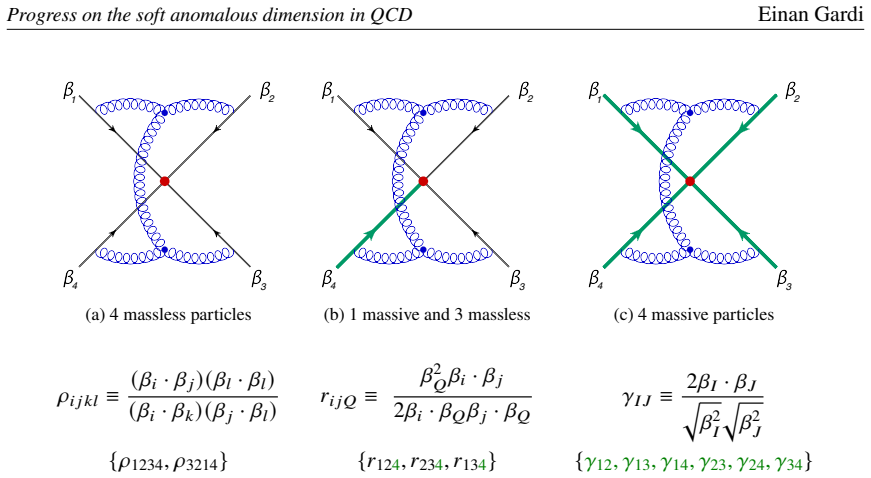
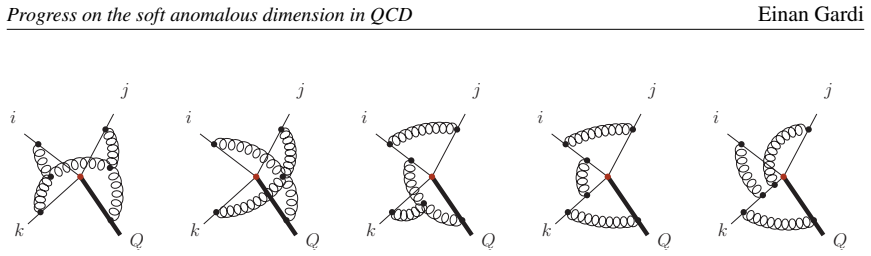
The three-loop soft anomalous dimension for amplitudes consisting of a single massive coloured particle with any number of massless ones has been determined by expanding correlators of semi-infinite Wilson lines along the lightcone and evaluating the resulting integrals with the Method of Regions; the same strategy opens the route to the corresponding quantity for two heavy particles and to higher loop orders.
What carries the argument
lightcone expansion of correlators of semi-infinite Wilson lines combined with the Method of Regions, which isolates the soft-gluon contributions that enter the anomalous dimension.
If this is right
- The same strategy extends directly to amplitudes involving two massive coloured particles at three loops.
- The method supplies a systematic route to four-loop and higher orders once the relevant integrals are evaluated.
- Knowledge of the soft anomalous dimension at this order completes the infrared subtraction terms needed for three-loop multileg cross sections.
- The explicit result reveals further cancellations that keep the soft anomalous dimension simpler than generic expectations.
Where Pith is reading between the lines
- Success with two massive particles would allow a complete three-loop infrared factorisation formula for all multileg QCD amplitudes.
- The lightcone technique may expose the underlying symmetry or cancellation mechanism responsible for the observed simplicity.
- The same expansion could be tested on known two-loop results to confirm that no soft contributions are omitted before tackling new cases.
- If the method scales, it would reduce reliance on diagram-by-diagram subtraction schemes in precision QCD phenomenology.
Load-bearing premise
The lightcone expansion combined with the Method of Regions captures all soft contributions to the anomalous dimension without missing or double-counting terms from other kinematic regions.
What would settle it
An independent three-loop calculation for any specific amplitude with one massive and two massless coloured particles that produces a numerically different result from the one obtained via the lightcone expansion would falsify the claim.
Figures

read the original abstract
We review the state-of-the-art knowledge of IR singularities in multileg QCD amplitudes, identifying the key reasons for the remarkable simplicity of the soft anomalous dimension. We then present a novel strategy to compute this quantity using a lightcone expansion of correlators of semi-infinite Wilson lines by the Method of Regions. Recently, this strategy allowed us to determine the three-loop soft anomalous dimension for amplitudes consisting of a single massive coloured particle with any number of massless ones. It opens the way to computing this quantity for amplitudes involving two heavy particles at three loops and potentially going to higher loop orders.
Editorial analysis
A structured set of objections, weighed in public.
Referee Report
Summary. The manuscript reviews the state-of-the-art understanding of infrared singularities in multileg QCD amplitudes, emphasizing the simplicity of the soft anomalous dimension. It introduces a novel computational strategy based on a lightcone expansion of correlators of semi-infinite Wilson lines combined with the Method of Regions. The authors report that this approach has enabled the determination of the three-loop soft anomalous dimension for amplitudes with one massive colored particle and an arbitrary number of massless colored particles, and discuss its potential extension to two massive legs and higher loop orders.
Significance. If the region decomposition is complete, the explicit three-loop result constitutes a valuable advance for precision QCD calculations, as the soft anomalous dimension enters resummation formulas and subtraction schemes. The systematic nature of the lightcone-plus-Regions method is a clear strength over purely diagrammatic or fitted approaches, and the paper correctly highlights its extensibility. No machine-checked proofs or fully parameter-free derivations are claimed, but the framework offers a reproducible path forward.
major comments (1)
- [three-loop application of the strategy] The central claim rests on the assertion that the lightcone expansion combined with the Method of Regions captures every soft contribution at three loops without omissions or double-counting from other kinematic regions. The manuscript must supply an explicit power-counting argument or exhaustive region list (with scaling assignments for all loop momenta) in the section presenting the three-loop computation to substantiate that no hard or collinear contamination enters the extracted soft anomalous dimension.
minor comments (1)
- [abstract] The abstract and introduction would benefit from a brief statement of the precise kinematic configuration (e.g., the number of legs and color representations) for which the three-loop result is given, to allow readers to assess applicability immediately.
Simulated Author's Rebuttal
We thank the referee for their careful reading of the manuscript and for the constructive suggestion regarding the three-loop region analysis. We address the major comment below and will revise the manuscript to incorporate the requested material.
read point-by-point responses
-
Referee: [three-loop application of the strategy] The central claim rests on the assertion that the lightcone expansion combined with the Method of Regions captures every soft contribution at three loops without omissions or double-counting from other kinematic regions. The manuscript must supply an explicit power-counting argument or exhaustive region list (with scaling assignments for all loop momenta) in the section presenting the three-loop computation to substantiate that no hard or collinear contamination enters the extracted soft anomalous dimension.
Authors: We agree that an explicit power-counting argument strengthens the presentation and removes any ambiguity about the completeness of the region decomposition. While the Method of Regions is applied systematically to the lightcone-expanded correlators, and the lightcone expansion itself suppresses hard and collinear modes by construction, the current manuscript does not tabulate the scalings for every three-loop momentum configuration. In the revised version we will add a dedicated subsection (in the three-loop computation section) that lists all relevant regions, assigns the appropriate lightcone scalings to each loop momentum, and demonstrates that only the soft region contributes to the infrared poles used to extract the anomalous dimension. This will include a brief justification that hard and collinear contributions either vanish or are orthogonal to the soft anomalous dimension at this order. revision: yes
Circularity Check
No circularity in the derivation of the three-loop soft anomalous dimension
full rationale
The paper reviews known results on IR singularities in multileg QCD amplitudes and introduces a novel computational strategy based on lightcone expansion of semi-infinite Wilson-line correlators combined with the Method of Regions. The three-loop soft anomalous dimension for one massive colored leg plus arbitrary massless legs is presented as a direct output of applying this strategy. No quoted step reduces the final expression to a fitted parameter, a self-definition, or a load-bearing self-citation chain; the central claim rests on the completeness of the region decomposition rather than tautological equivalence to inputs. The derivation chain is therefore self-contained.
Axiom & Free-Parameter Ledger
axioms (2)
- domain assumption Wilson-line correlators encode the soft-gluon contributions to QCD amplitudes
- domain assumption The Method of Regions can be applied to the lightcone expansion of these correlators to isolate soft contributions
Reference graph
Works this paper leans on
-
[1]
N. Agarwal, L. Magnea, C. Signorile-Signorile, and A. Tripathi,The infrared structure of perturbative gauge theories,Phys. Rept.994(2023) 1–120, [2112.07099]
- [2]
-
[3]
A. M. Polyakov,Gauge Fields as Rings of Glue,Nucl. Phys. B164(1980) 171–188
1980
-
[4]
G. P. Korchemsky and A. V. Radyushkin,Renormalization of the Wilson Loops Beyond the Leading Order,Nucl. Phys.B283(1987) 342–364. 16 Progress on the soft anomalous dimension in QCDEinan Gardi
1987
- [5]
-
[6]
A. Ferroglia, M. Neubert, B. D. Pecjak, and L. L. Yang,Two-loop divergences of scattering amplitudes with massive partons,Phys. Rev. Lett.103(2009) 201601, [0907.4791]
-
[7]
A. Ferroglia, M. Neubert, B. D. Pecjak, and L. L. Yang,Two-loop divergences of massive scattering amplitudes in non-abelian gauge theories,JHEP11(2009) 062, [0908.3676]
- [8]
- [9]
-
[10]
Ø. Almelid, C. Duhr, and E. Gardi,Three-loop corrections to the soft anomalous dimension in multileg scattering,Phys. Rev. Lett.117(2016), no. 17 172002, [1507.00047]
-
[11]
Almelid,Three-loop soft anomalous dimension of massless multi-leg scattering
Ø. Almelid,Three-loop soft anomalous dimension of massless multi-leg scattering. PhD thesis, University of Edinburgh, 2016
2016
- [12]
-
[13]
E. Gardi and Z. Zhu,Computing the soft anomalous dimension with massless particles using the method of regions,JHEP03(2026) 173, [2509.18017]
-
[14]
E. Gardi and Z. Zhu,Infrared singularities of multileg amplitudes with a massive particle at three loops,2510.27567
-
[15]
Ø. Almelid, C. Duhr, E. Gardi, A. McLeod, and C. D. White,Bootstrapping the QCD soft anomalous dimension,JHEP09(2017) 073, [1706.10162]
-
[16]
A. Vladimirov,Structure of rapidity divergences in multi-parton scattering soft factors, JHEP04(2018) 045, [1707.07606]
-
[17]
T. Becher and M. Neubert,Infrared singularities of scattering amplitudes and N3LL resummation for𝑛-jet processes,JHEP01(2020) 025, [1908.11379]
-
[18]
G. Falcioni, E. Gardi, N. Maher, C. Milloy, and L. Vernazza,Scattering amplitudes in the Regge limit and the soft anomalous dimension through four loops,JHEP03(2022) 053, [2111.10664]
- [19]
- [20]
- [21]
-
[22]
CambridgeMonographs on Particle Physics, Nuclear Physics and Cosmology
J.Collins,Libby-Stermananalysisandpower-counting,p.87–160. CambridgeMonographs on Particle Physics, Nuclear Physics and Cosmology. Cambridge University Press, 2011
2011
-
[23]
S. B. Libby and G. F. Sterman,Jet and Lepton Pair Production in High-Energy Lepton-Hadron and Hadron-Hadron Scattering,Phys. Rev. D18(1978) 3252
1978
-
[24]
Sen,Asymptotic Behavior of the Wide Angle On-Shell Quark Scattering Amplitudes in Nonabelian Gauge Theories,Phys
A. Sen,Asymptotic Behavior of the Wide Angle On-Shell Quark Scattering Amplitudes in Nonabelian Gauge Theories,Phys. Rev. D28(1983) 860
1983
-
[25]
Catani,The Singular behavior of QCD amplitudes at two loop order,Phys
S. Catani,The Singular behavior of QCD amplitudes at two loop order,Phys. Lett.B427 (1998) 161–171, [hep-ph/9802439]
-
[26]
N. Kidonakis, G. Oderda, and G. F. Sterman,Evolution of color exchange in QCD hard scattering,Nucl. Phys.B531(1998) 365–402, [hep-ph/9803241]
-
[27]
N. Kidonakis and G. F. Sterman,Resummation for QCD hard scattering,Nucl. Phys.B505 (1997) 321–348, [hep-ph/9705234]
- [28]
-
[29]
E. Gardi,On the quark distribution in an on-shell heavy quark and its all-order relations with the perturbative fragmentation function,JHEP02(2005) 053, [hep-ph/0501257]
-
[30]
L. J. Dixon, L. Magnea, and G. F. Sterman,Universal structure of subleading infrared poles in gauge theory amplitudes,JHEP08(2008) 022, [0805.3515]
work page Pith review arXiv 2008
-
[31]
Factorization constraints for soft anomalous dimensions in QCD scattering amplitudes
E. Gardi and L. Magnea,Factorization constraints for soft anomalous dimensions in QCD scattering amplitudes,JHEP03(2009) 079, [0901.1091]
work page Pith review arXiv 2009
-
[32]
E. Gardi and L. Magnea,Infrared singularities in QCD amplitudes,Nuovo Cim.C32N5-6 (2009) 137–157, [0908.3273]. [Frascati Phys. Ser.50(2010)]
-
[33]
Infrared singularities of scattering amplitudes in perturbative QCD
T. Becher and M. Neubert,Infrared singularities of scattering amplitudes in perturbative QCD,Phys. Rev. Lett.102(2009) 162001, [0901.0722]. [Erratum: Phys. Rev. Lett.111,no.19,199905(2013)]
work page Pith review arXiv 2009
-
[34]
On the Structure of Infrared Singularities of Gauge-Theory Amplitudes
T. Becher and M. Neubert,On the Structure of Infrared Singularities of Gauge-Theory Amplitudes,JHEP06(2009) 081, [0903.1126]. [Erratum: JHEP11,024(2013)]
work page Pith review arXiv 2009
-
[35]
Y. Ma,A Forest Formula to Subtract Infrared Singularities in Amplitudes for Wide-angle Scattering,JHEP05(2020) 012, [1910.11304]. 18 Progress on the soft anomalous dimension in QCDEinan Gardi
-
[36]
Hard-Soft-Collinear Factorization to All Orders
I. Feige and M. D. Schwartz,Hard-Soft-Collinear Factorization to All Orders,Phys. Rev. D 90(2014), no. 10 105020, [1403.6472]
work page Pith review arXiv 2014
-
[37]
Maher,Studying the soft anomalous dimension for massless multi-leg scattering at four loops
N. Maher,Studying the soft anomalous dimension for massless multi-leg scattering at four loops. PhD thesis, Edinburgh U., Edinburgh U., 2023
2023
-
[38]
G. Falcioni, E. Gardi, and C. Milloy,Relating amplitude and PDF factorisation through Wilson-line geometries,JHEP11(2019) 100, [1909.00697]
- [39]
-
[40]
G. P. Korchemsky and A. V. Radyushkin,Infrared asymptotics of perturbative QCD: renormalisation properties of the Wilson loops in higher orders of perturbation theory,Sov. J. Nucl. Phys.44(1986) 877. [Yad. Fiz.44,1351(1986)]
1986
-
[41]
G. P. Korchemsky,Sudakov Form-factor in QCD,Phys. Lett. B220(1989) 629–634
1989
-
[42]
G. P. Korchemsky,Asymptotics of the Altarelli-Parisi-Lipatov Evolution Kernels of Parton Distributions,Mod. Phys. Lett. A4(1989) 1257–1276
1989
- [43]
- [44]
- [45]
- [46]
- [47]
- [48]
-
[49]
Grozin,Four-loop cusp anomalous dimension in QED,JHEP06(2018) 073, [1805.05050]
A. Grozin,Four-loop cusp anomalous dimension in QED,JHEP06(2018) 073, [1805.05050]. [Addendum: JHEP 01, 134 (2019)]
- [50]
- [51]
- [52]
-
[53]
A. von Manteuffel and R. M. Schabinger,Quark and gluon form factors in four loop QCD: The𝑁 2 𝑓 and𝑁 𝑞𝛾 𝑁 𝑓 contributions,Phys. Rev. D99(2019), no. 9 094014, [1902.08208]
- [54]
-
[55]
A. von Manteuffel, E. Panzer, and R. M. Schabinger,Cusp and collinear anomalous dimensions in four-loop QCD from form factors,Phys. Rev. Lett.124(2020), no. 16 162001, [2002.04617]
-
[56]
B. Agarwal, A. von Manteuffel, E. Panzer, and R. M. Schabinger,Four-loop collinear anomalous dimensions in QCD and N=4 super Yang-Mills,Phys. Lett. B820(2021) 136503, [2102.09725]
- [57]
-
[58]
F. C. S. Brown,Polylogarithmes multiples uniformes en une variable,Compt. Rend. Math. 338(2004), no. 7 527–532
2004
- [59]
-
[60]
Frenkel and J
J. Frenkel and J. C. Taylor,Nonabelian Eikonal Exponentiation,Nucl. Phys. B246(1984) 231–245
1984
-
[61]
J. G. M. Gatheral,Exponentiation of Eikonal Cross-sections in Nonabelian Gauge Theories,Phys. Lett. B133(1983) 90–94
1983
-
[62]
G.F.Sterman,InfrareddivergencesinperturbativeQCD,AIPConf.Proc.74(1981)22–40
1981
- [63]
- [64]
-
[65]
E. Gardi and C. D. White,General properties of multiparton webs: Proofs from combinatorics,JHEP03(2011) 079, [1102.0756]
- [66]
- [67]
-
[68]
N. Agarwal, A. Danish, L. Magnea, S. Pal, and A. Tripathi,Multiparton webs beyond three loops,JHEP05(2020) 128, [2003.09714]
-
[69]
N. Agarwal, S. Pal, A. Srivastav, and A. Tripathi,Deciphering colour building blocks of massive multiparton amplitudes at 4-loops and beyond,JHEP02(2023) 258, [2212.06610]
- [70]
-
[71]
N. Agarwal, S. Pal, A. Srivastav, and A. Tripathi,CWebGen A tool to study colour structure of scattering amplitudes in IR limit,Comput. Phys. Commun.316(2025) 109765, [2411.07872]
-
[72]
R. A. Brandt, F. Neri, and M.-a. Sato,Renormalization of Loop Functions for All Loops, Phys. Rev. D24(1981) 879
1981
-
[73]
I. Y. Arefeva,Quantum Contour Field Equations,Phys. Lett. B93(1980) 347–353
1980
-
[74]
V. S. Dotsenko and S. N. Vergeles,Renormalizability of Phase Factors in the Nonabelian Gauge Theory,Nucl. Phys. B169(1980) 527–546
1980
-
[75]
G. P. Korchemsky and A. V. Radyushkin,Loop Space Formalism and Renormalization Group for the Infrared Asymptotics of QCD,Phys. Lett.B171(1986) 459–467
1986
-
[76]
Gardi and Z
E. Gardi and Z. Zhu,The three-loop soft anomalous dimension of multileg amplitudes with one heavy quark, in preparation (2026)
2026
- [77]
-
[78]
Asymptotic expansion of Feynman integrals near threshold
M. Beneke and V. A. Smirnov,Asymptotic expansion of Feynman integrals near threshold, Nucl. Phys. B522(1998) 321–344, [hep-ph/9711391]
work page Pith review arXiv 1998
-
[79]
V. A. Smirnov,Applied asymptotic expansions in momenta and masses,Springer Tracts Mod. Phys.177(2002) 1–262
2002
- [80]
discussion (0)
Sign in with ORCID, Apple, or X to comment. Anyone can read and Pith papers without signing in.