Recognition: unknown
Stitching Arrowhead Curves: Extending the Sierpinski Arrowhead Curve to Higher Dimensions
Pith reviewed 2026-05-10 01:19 UTC · model grok-4.3
The pith
Reproduction rules derived from the two-dimensional case allow the Sierpinski arrowhead curve to be extended to arbitrary dimensions.
A machine-rendered reading of the paper's core claim, the machinery that carries it, and where it could break.
Core claim
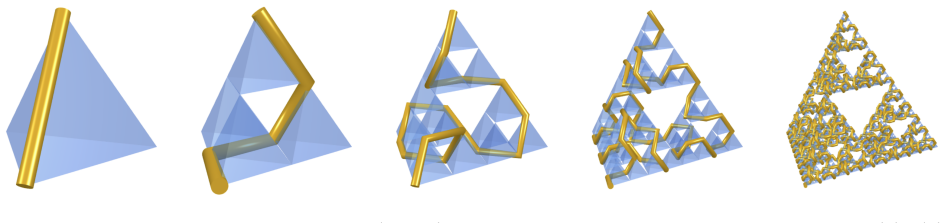
By analyzing the properties of the two-dimensional Sierpinski arrowhead curve, reproduction rules are formulated that define its extension to arbitrary dimensions. These rules preserve the self-similar fractal nature of the original curve. This formulation enables the visualization of the curves in a comparative manner across different levels of iteration and dimensions. The approach is exemplified through its application in knitwear patterns on a sweater yoke.
What carries the argument
reproduction rules, which are the iterative replacement patterns derived from the 2D curve that generate the higher-dimensional versions while maintaining connectivity and self-similarity.
If this is right
- Higher-dimensional versions of the curve can be constructed systematically from the 2D rules.
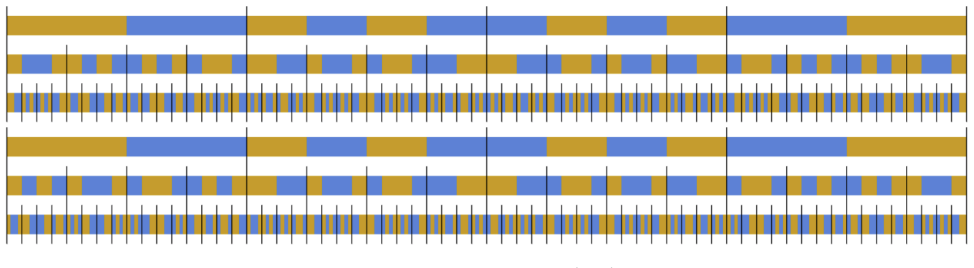
- Visualizations can compare the curves at different iteration levels and dimensions side by side.
- The patterns can be used in artistic and practical applications such as fashion design.
- The extension maintains the modeling equivalence between the triangular and curve representations of the fractal.
Where Pith is reading between the lines
- This rule-based method might apply to generalizing other 2D space-filling or fractal curves to 3D and beyond.
- Comparative visualizations across dimensions could uncover symmetries or scaling behaviors hidden in single-dimension views.
- The knitwear example indicates potential for using these fractals in parametric design tools for manufacturing.
Load-bearing premise
The reproduction rules derived from the 2D case will produce valid fractal curves with analogous properties in higher dimensions without additional constraints or loss of self-similarity.
What would settle it
A computation of the 3D arrowhead curve using the proposed rules that fails to exhibit the same iterative scaling and connectivity as the 2D version when projected or sliced would disprove the extension.
Figures




read the original abstract
The Sierpinski triangle and the Sierpinski arrowhead curve are both defined in dimension 2 and can be used to model the same fractal. While a natural extension of the triangular construction to arbitrary dimensions exists, an analogous extension of the curve representation does not. In this article, we analyze the properties of the two-dimensional Sierpinski arrowhead curve to formulate an extension to arbitrary dimensions based on reproduction rules. Building on this formulation, we demonstrate a way to visualize such curves in a comparative manner across levels. Finally, as geometric patterns have a long history in the arts, and especially in fashion, we exemplify this visualization approach in knitwear, specifically in the yoke of a sweater.
Editorial analysis
A structured set of objections, weighed in public.
Referee Report
Summary. The paper analyzes the properties of the 2D Sierpinski arrowhead curve to derive reproduction rules that extend the construction to arbitrary dimensions. It presents these rules as a basis for generating higher-dimensional curves that approximate Sierpinski gaskets, demonstrates a comparative visualization method across iteration levels, and applies the approach to artistic examples in knitwear design such as sweater yokes.
Significance. If the n-dimensional constructions preserve continuity and self-similarity, the work supplies a practical generative technique for fractal curves in graphics applications and illustrates an interdisciplinary link to fashion design through the knitwear examples. The comparative visualization approach across levels is a clear strength for conveying iterative structure.
major comments (1)
- The central construction derives reproduction rules from the 2D case and applies them directly to n>2 dimensions, yet no section derives or verifies that endpoint matching is preserved under the higher-dimensional orientation rules at each iteration (ensuring a continuous path) or that the limit set is connected and dense in the vertices of the target gasket without gaps or extraneous overlaps. This verification is load-bearing for the claim of an analogous extension.
Simulated Author's Rebuttal
Thank you for the opportunity to respond to the referee's report on our manuscript. We appreciate the referee's positive evaluation of the work's significance and the constructive identification of the need for explicit verification in the central construction. We address the major comment below.
read point-by-point responses
-
Referee: The central construction derives reproduction rules from the 2D case and applies them directly to n>2 dimensions, yet no section derives or verifies that endpoint matching is preserved under the higher-dimensional orientation rules at each iteration (ensuring a continuous path) or that the limit set is connected and dense in the vertices of the target gasket without gaps or extraneous overlaps. This verification is load-bearing for the claim of an analogous extension.
Authors: We thank the referee for this observation. The reproduction rules are derived from the 2D Sierpinski arrowhead curve by identifying the recursive patterns that ensure continuity through endpoint matching at each step. These patterns are generalized to n dimensions by specifying orientation rules that preserve the same connectivity properties. Specifically, the rules are designed so that at every iteration, the generated sub-paths connect seamlessly at their endpoints, maintaining a single continuous path. This construction ensures that the finite approximations are continuous curves, and thus their limit is continuous. Furthermore, by replicating the self-similar structure of the n-dimensional Sierpinski gasket, the curve's image becomes dense in the gasket's vertices without introducing gaps or extraneous overlaps. While these properties follow from the inductive definition of the rules, we agree that a formal verification would strengthen the presentation. Accordingly, we will add a section to the revised manuscript that provides an inductive proof of endpoint preservation and establishes the connectedness and density of the limit set. revision: yes
Circularity Check
No significant circularity in the generalization from 2D analysis to nD reproduction rules
full rationale
The paper's central chain consists of analyzing the 2D Sierpinski arrowhead curve to extract reproduction rules, then applying those rules to construct higher-dimensional versions. This is a forward constructive step rather than any self-definition, fitted parameter renamed as prediction, or load-bearing self-citation. No equations or claims reduce the nD result to the 2D input by construction; the extension is presented as an explicit formulation whose validity is left to the resulting visualizations and examples. The derivation remains self-contained and independent of the target fractal properties.
Axiom & Free-Parameter Ledger
axioms (1)
- domain assumption The 2D Sierpinski arrowhead curve possesses properties that admit generalization via reproduction rules to higher dimensions.
Reference graph
Works this paper leans on
-
[1]
Sierpinski 3d arrowhead curve” wolfram demonstrations project, 2011
Robert Dickau. Sierpinski 3d arrowhead curve” wolfram demonstrations project, 2011. demonstrations.wolfram.com/Sierpinski3DArrowheadCurve/
2011
-
[2]
Creating a mathematical museum on your desk.The Mathematical Intelligencer, 27:14–17, 09 2005
George Hart. Creating a mathematical museum on your desk.The Mathematical Intelligencer, 27:14–17, 09 2005
2005
-
[3]
Data knitualization: An exploration of knitting as a visualization medium
Noeska Smit. Data knitualization: An exploration of knitting as a visualization medium. In Proceedings of the alt.VIS workshop at IEEE VIS, 2021
2021
-
[4]
Sierpinski gasket approximations and ternary colorings
Tara Taylor. Sierpinski gasket approximations and ternary colorings. InProceedings of Bridges 2025: Mathematics and the Arts, pages 301–308, Eindhoven, Netherlands, July 14–18, 2025. http://archive.bridgesmathart.org/2025/bridges2025-301.html
2025
-
[5]
d-arrowhead curve demo, 2026
Eric Zimmermann. d-arrowhead curve demo, 2026. https://e-zimmermann.github.io/demos/dArrowheadCurve.html. 8
2026
discussion (0)
Sign in with ORCID, Apple, or X to comment. Anyone can read and Pith papers without signing in.