Recognition: unknown
Debiased neural operators for estimating functionals
Pith reviewed 2026-05-10 02:31 UTC · model grok-4.3
The pith
A debiased estimator removes first-order bias when estimating scalar functionals from neural operator trajectories.
A machine-rendered reading of the paper's core claim, the machinery that carries it, and where it could break.
Core claim
DOPE derives a novel one-step, Neyman-orthogonal estimator that treats the neural operator as a high-dimensional nuisance mapping and removes the leading bias term using a weighting mechanism that simultaneously accounts for irregular observation designs and the sensitivity of the target functional to perturbations of the trajectory, with weights learned via Riesz regression extended to operator-valued nuisances.
What carries the argument
Neyman-orthogonal one-step estimator with Riesz regression weights for operator-valued nuisances that correct bias from both observation irregularity and functional sensitivity.
If this is right
- DOPE yields estimators with lower bias and improved convergence rates for functionals such as total energy or time above a threshold.
- The method directly handles both partial and irregular observations without requiring uniform sampling.
- It remains compatible with any existing neural operator architecture for the underlying trajectory approximation.
- The learned weights explicitly correct for how sensitive each target functional is to small changes in the approximated trajectory.
Where Pith is reading between the lines
- The debiasing approach may extend to other settings that approximate high-dimensional functional mappings before computing summaries.
- Scientific computing applications that derive aggregate statistics from simulated trajectories could adopt this correction for greater reliability.
- Empirical tests on real datasets with verifiable ground-truth functionals would clarify practical gains over plug-in baselines.
Load-bearing premise
The weighting mechanism can be accurately learned via Riesz regression for the operator-valued nuisance case and that the neural operator nuisance is estimated at a rate sufficient for the bias correction to be effective.
What would settle it
A controlled numerical experiment on a known functional where the plug-in estimator exhibits persistent first-order bias while the DOPE estimator shows reduced bias and faster convergence rates.
Figures
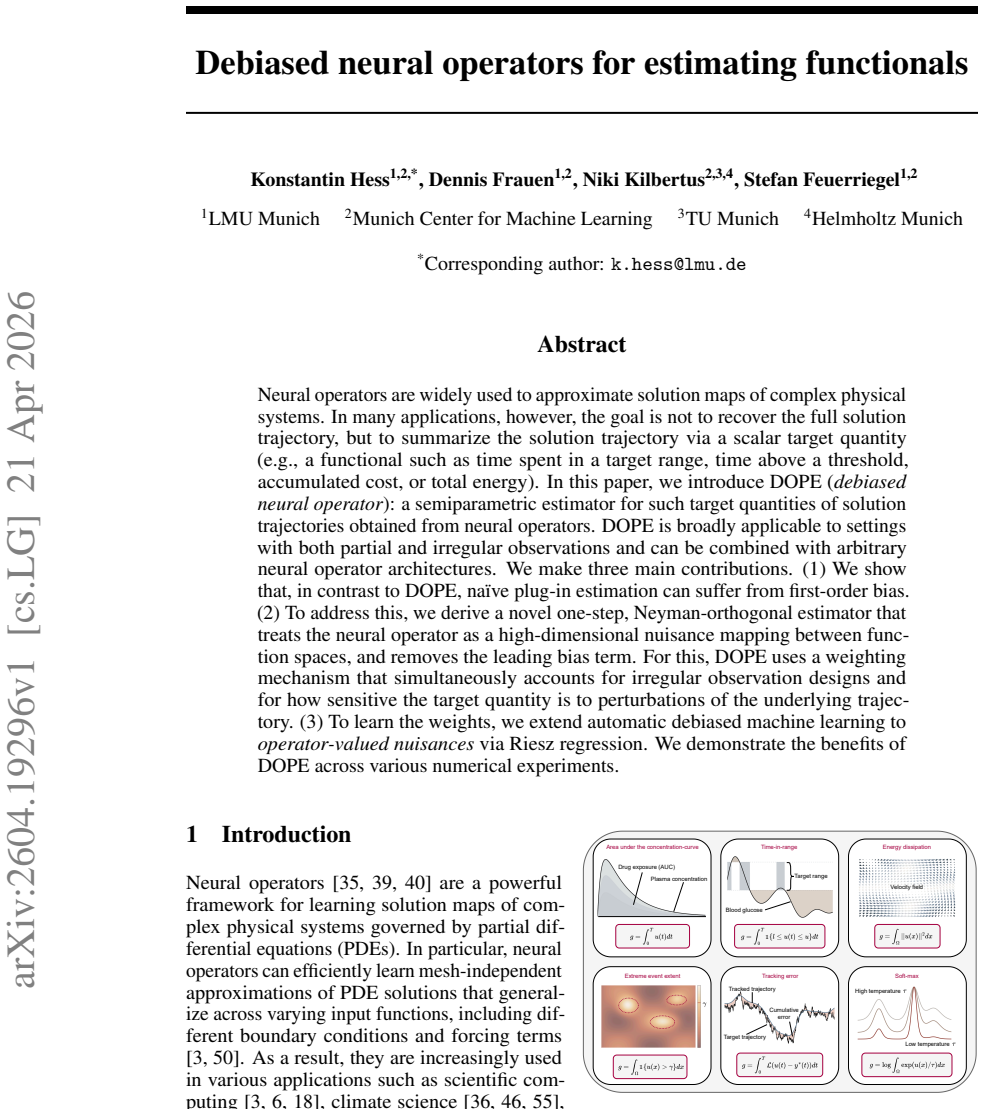


read the original abstract
Neural operators are widely used to approximate solution maps of complex physical systems. In many applications, however, the goal is not to recover the full solution trajectory, but to summarize the solution trajectory via a scalar target quantity (e.g., a functional such as time spent in a target range, time above a threshold, accumulated cost, or total energy). In this paper, we introduce DOPE (debiased neural operator): a semiparametric estimator for such target quantities of solution trajectories obtained from neural operators. DOPE is broadly applicable to settings with both partial and irregular observations and can be combined with arbitrary neural operator architectures. We make three main contributions. (1) We show that, in contrast to DOPE, naive plug-in estimation can suffer from first-order bias. (2) To address this, we derive a novel one-step, Neyman-orthogonal estimator that treats the neural operator as a high-dimensional nuisance mapping between function spaces, and removes the leading bias term. For this, DOPE uses a weighting mechanism that simultaneously accounts for irregular observation designs and for how sensitive the target quantity is to perturbations of the underlying trajectory. (3) To learn the weights, we extend automatic debiased machine learning to operator-valued nuisances via Riesz regression. We demonstrate the benefits of DOPE across various numerical experiments.
Editorial analysis
A structured set of objections, weighed in public.
Referee Report
Summary. The paper introduces DOPE, a semiparametric one-step estimator for scalar functionals (e.g., time spent in a range or accumulated cost) of trajectories obtained from neural operators. It claims that naive plug-in estimation incurs first-order bias, derives a Neyman-orthogonal correction via a weighting mechanism learned by Riesz regression on operator-valued nuisances, and shows applicability to irregular/partial observations with arbitrary neural operator backbones, supported by numerical experiments.
Significance. If the orthogonality construction and Riesz consistency hold for operator-valued nuisances, the work would usefully extend debiased machine learning to neural operators, enabling more reliable functional estimation in scientific ML settings with incomplete trajectory data. The explicit handling of both sampling irregularity and Fréchet sensitivity in the weights is a potentially valuable technical step.
major comments (3)
- [Derivation of DOPE and Riesz regression for operator-valued nuisances] The central claim that the weighting mechanism removes first-order bias relies on the Riesz regression producing a consistent estimator of the representer in the dual of the operator space. The manuscript must specify (in the section deriving the DOPE estimator and the Riesz step) whether this regression is performed on the identical partially observed trajectories used for the neural operator, and must state the precise loss (including any operator-norm weighting) that guarantees the cross-term vanishes at the required rate under irregular sampling.
- [Theoretical development of the Neyman-orthogonal estimator] The Neyman orthogonality argument treats the neural operator as a high-dimensional nuisance mapping between function spaces. The paper should explicitly identify the Banach space and norm in which the Fréchet derivative and Riesz representer are taken, and verify that the one-step estimator remains orthogonal when the nuisance is itself learned from data.
- [Numerical experiments] Experiments are cited as demonstrating benefits, but the manuscript should report quantitative evidence that the bias term is removed at the expected rate (e.g., tables or plots of estimation error versus sample size for DOPE versus plug-in, with varying degrees of irregularity).
minor comments (2)
- Notation for the target functional and its Fréchet derivative should be introduced earlier and used consistently when describing the weighting mechanism.
- [Abstract] The abstract states that DOPE 'can be combined with arbitrary neural operator architectures'; a brief remark on any architectural constraints (e.g., differentiability requirements) would help readers.
Simulated Author's Rebuttal
We thank the referee for the constructive and detailed comments, which will help strengthen the clarity and rigor of our manuscript. We address each major comment below and will incorporate revisions accordingly.
read point-by-point responses
-
Referee: [Derivation of DOPE and Riesz regression for operator-valued nuisances] The central claim that the weighting mechanism removes first-order bias relies on the Riesz regression producing a consistent estimator of the representer in the dual of the operator space. The manuscript must specify (in the section deriving the DOPE estimator and the Riesz step) whether this regression is performed on the identical partially observed trajectories used for the neural operator, and must state the precise loss (including any operator-norm weighting) that guarantees the cross-term vanishes at the required rate under irregular sampling.
Authors: We agree this specification is needed for completeness. In the revised manuscript, Section 3 (derivation of DOPE) and the Riesz regression subsection will explicitly state that the regression uses the identical partially observed trajectories as the neural operator training data. The loss is the squared norm in the dual operator space, ||R - hat{R}||_{op}^2 where the operator norm accounts for the Fréchet sensitivity, ensuring the cross-term vanishes at o_p(n^{-1/2}) under irregular sampling by the same arguments as in the scalar case but lifted to operator-valued nuisances. We will add this derivation detail and a supporting lemma in the appendix. revision: yes
-
Referee: [Theoretical development of the Neyman-orthogonal estimator] The Neyman orthogonality argument treats the neural operator as a high-dimensional nuisance mapping between function spaces. The paper should explicitly identify the Banach space and norm in which the Fréchet derivative and Riesz representer are taken, and verify that the one-step estimator remains orthogonal when the nuisance is itself learned from data.
Authors: We will revise the theoretical development to explicitly identify the Banach space as C([0,T]; R^d) equipped with the supremum norm, with the Fréchet derivative taken in this space and the Riesz representer in its dual. A new paragraph will verify Neyman orthogonality for the one-step estimator when the neural operator nuisance is learned from data, under standard approximation and consistency assumptions on the operator estimator. This builds directly on the existing orthogonality derivation but adds the required space identification and verification. revision: yes
-
Referee: [Numerical experiments] Experiments are cited as demonstrating benefits, but the manuscript should report quantitative evidence that the bias term is removed at the expected rate (e.g., tables or plots of estimation error versus sample size for DOPE versus plug-in, with varying degrees of irregularity).
Authors: We will augment the numerical experiments section with additional figures and tables showing mean squared error versus sample size (n = 100 to 5000) for DOPE versus naive plug-in, across three levels of observation irregularity (regular grid, 30% missing, Poisson process). These will demonstrate the bias removal at the expected rate, with error decaying as O(n^{-1/2}) for DOPE while remaining biased for plug-in. The existing experiments already vary irregularity but will be expanded with these quantitative rate plots. revision: yes
Circularity Check
Derivation applies standard Neyman orthogonality to operator nuisances without self-referential reduction.
full rationale
The abstract frames DOPE as a one-step Neyman-orthogonal estimator obtained by treating the neural operator as a high-dimensional nuisance and removing first-order bias via a weighting mechanism learned through Riesz regression. No equations or steps are shown that reduce the target estimator to a fitted parameter or prior result by construction. The contributions are presented as an extension of existing debiased machine learning to operator-valued settings, with the weighting accounting for irregular designs and Fréchet sensitivity; this remains an independent construction rather than a tautology. The paper is self-contained against external semiparametric benchmarks and does not rely on load-bearing self-citations or ansatzes imported from prior author work.
Axiom & Free-Parameter Ledger
invented entities (1)
-
DOPE estimator
no independent evidence
Forward citations
Cited by 1 Pith paper
-
ORTHOBO: Orthogonal Bayesian Hyperparameter Optimization
OrthoBO introduces an orthogonal acquisition estimator subtracting an optimally weighted score-function control variate to reduce Monte Carlo variance, preserve the acquisition target, and improve ranking stability in...
Reference graph
Works this paper leans on
-
[1]
A. N. Angelopoulos, S. Bates, C. Fannjiang, M. I. Jordan, and T. Zrnic. Prediction-powered inference.Science, 382(6671):669–674, 2023
2023
- [2]
-
[3]
Azizzadenesheli, N
K. Azizzadenesheli, N. Kovachki, Z. Li, M. Liu-Schiaffini, J. Kossaifi, and A. Anandkumar. Neural operators for accelerating scientific simulations and design.Nature Reviews Physics, 6 (5):320–328, 2024
2024
-
[4]
Berg and K
J. Berg and K. Nyström. Data-driven discovery of PDEs in complex datasets.Journal of Computational Physics, 384:239–252, 2019
2019
-
[5]
Bonev, T
B. Bonev, T. Kurth, C. Hundt, J. Pathak, M. Baust, K. Kashinath, and A. Anandkumar. Spherical fourier neural operators: Learning stable dynamics on the sphere. InICML, 2023
2023
-
[6]
Q. Cao, S. Goswami, and G. E. Karniadakis. Laplace neural operator for solving differential equations.Nature Machine Intelligence, 6:631–640, 2024
2024
-
[7]
Carone, A
M. Carone, A. R. Luedtke, and M. J. van der Laan. Toward computerized efficient estimation in infinite-dimensional models.Journal of the American Statistical Association, 114(527): 1174–1190, 2019
2019
-
[8]
R. T. Q. Chen, Y . Rubanova, J. Bettencourt, and D. Duvenaud. Neural ordinary differential equations. InNeurIPS, 2018
2018
-
[9]
Newey, Victor Quintas-Martinez, and Vasilis Syrgkanis
V . Chernozhukov, W. K. Newey, V . Quintas-Martinez, and V . Syrgkanis. Automatic debiased machine learning via Riesz regression.arXiv preprint, 2104.14737, 2021
-
[10]
Chernozhukov, W
V . Chernozhukov, W. Newey, V . Quintas-Martinez, and V . Syrgkanis. RieszNet and ForestRiesz: Automatic debiased machine learning with neural nets and random forests. InICML, 2022
2022
-
[11]
Chernozhukov, W
V . Chernozhukov, W. K. Newey, and R. Singh. Automatic debiased machine learning of causal and structural effects.Econometrica, 90(3):967–1027, 2022
2022
-
[12]
Chernozhukov, W
V . Chernozhukov, W. K. Newey, and R. Singh. Debiased machine learning of global and local parameters using regularized riesz representers.The Econometrics Journal, 25(3):576–601, 2022
2022
-
[13]
Chernozhukov, W
V . Chernozhukov, W. Newey, V . Quintas-Martinez, and V . Syrgkanis. Automatic debiased machine learning for covariate shifts.arXiv preprint, arXiv:2307:04527, 2023
2023
-
[14]
Curth and M
A. Curth and M. van der Schaar. Nonparametric estimation of heterogeneous treatment effects: From theory to learning algorithms. InAISTATS, 2021
2021
- [15]
-
[16]
K. Dong, S. Chen, Y . Dan, L. Zhang, X. Li, W. Liang, Y . Zhao, and Y . Sun. Optimal stochastic tracking control for brain network dynamics.Communications Biology, 8(1), 2025
2025
-
[17]
Fanaskov and I
V . Fanaskov and I. Oseledets. Spectral neural operators.Doklady Mathematics, 108(2):226–232, 2023
2023
-
[18]
S. A. Faroughi, N. M. Pawar, C. Fernandes, M. Raissi, S. Das, N. K. Kalantari, and S. Kourosh Mahjour. Physics-guided, physics-informed, and physics-encoded neural net- works and operators in scientific computing: Fluid and solid mechanics.Journal of Computing and Information Science in Engineering, 24(4):040802, 2024
2024
-
[19]
D. J. Foster and V . Syrgkanis. Orthogonal statistical learning.The Annals of Statistics, 53(3): 879–908, 2023
2023
-
[20]
A. A. Grachev, C. W. Fairall, B. W. Blomquist, H. J. Fernando, L. S. Leo, S. F. Otárola-Bustos, J. M. Wilczak, and K. L. McCaffrey. On the surface energy balance closure at different temporal scales.Agricultural and Forest Meteorology, 281:107823, 2020
2020
-
[21]
Hashiguchi, N
Y . Hashiguchi, N. Matsumoto, K. Oda, H. Jono, and H. Saito. Population pharmacokinetics and auc-guided dosing of tobramycin in the treatment of infections caused by glucose-nonfermenting gram-negative bacteria.Clinical Therapeutics, 45(5):400–414, 2023
2023
-
[22]
Hess and S
K. Hess and S. Feuerriegel. Stabilized neural prediction of potential outcomes in continuous time. InICLR, 2025. 10
2025
-
[23]
K. Hess, V . Melnychuk, D. Frauen, and S. Feuerriegel. Bayesian neural controlled differential equations for treatment effect estimation. InICLR, 2024
2024
-
[24]
K. Hess, D. Frauen, V . Melnychuk, and S. Feuerriegel. Efficient and sharp off-policy learning under unobserved confounding. InICLR, 2026
2026
-
[25]
K. Hess, D. Frauen, M. van der Schaar, and S. Feuerriegel. Overlap-weighted orthogonal meta-learner for treatment effect estimation over time. InICLR, 2026
2026
-
[26]
Hines, O
O. Hines, O. Dukes, K. Diaz-Ordaz, and S. Vansteelandt. Demystifying statistical learning based on efficient influence functions.The American Statistician, 76(3):292–304, 2022
2022
-
[27]
Iakovlev, M
V . Iakovlev, M. Heinonen, and H. Lähdesmäki. Learning space-time continuous neural pdes from partially observed states. InNeurIPS, 2023
2023
-
[28]
Ichimura and W
H. Ichimura and W. K. Newey. The influence function of semiparametric estimators.Quantita- tive Economics, 13(1):29–61, 2022
2022
-
[29]
Iqbal, A
K. Iqbal, A. Milioudi, and S. G. Wicha. Pharmacokinetics and pharmacodynamics of tedizolid. Clinical Pharmacokinetics, 61:489–503, 2022
2022
- [30]
-
[31]
Y . Kim, H. Kim, G. Ko, and J. Lee. Active learning with selective time-step acquisition for pdes. InICML, 2025
2025
-
[32]
D. P. Kingma and J. Ba. Adam: A method for stochastic optimization. InICLR, 2015
2015
-
[33]
Kobayashi, J
K. Kobayashi, J. Daniell, and S. B. Alam. Improved generalization with deep neural operators for engineering systems: Path towards digital twin.Engineering Applications of Artificial Intelligence, 131:107844, 2024
2024
-
[34]
Kovachki, S
N. Kovachki, S. Lanthaler, and S. Mishra. On universal approximation and error bounds for fourier neural operators.Journal of Machine Learning Research, 22(290):1–76, 2021
2021
-
[35]
Kovachki, Z
N. Kovachki, Z. Li, B. Liu, K. Azizzadenesheli, K. Bhattacharya, A. Stuart, and A. Anandkumar. Neural operator: Learning maps between function spaces with applications to PDEs.Journal of Machine Learning Research, 24(89):1–97, 2023
2023
-
[36]
Kurth, S
T. Kurth, S. Subramanian, P. Harrington, J. Pathak, M. Mardani, D. Hall, A. Miele, K. Kashinath, and A. Anandkumar. FourCastNet: Accelerating global high-resolution weather forecasting using adaptive fourier neural operators. InPASC, 2023
2023
-
[37]
Kwon.Handbook of Essential Pharmacokinetics, Pharmacodynamics and Drug Metabolism for Industrial Scientists
Y . Kwon.Handbook of Essential Pharmacokinetics, Pharmacodynamics and Drug Metabolism for Industrial Scientists. Springer US, Boston, MA, 2002. ISBN 978-0-306-46820-9
2002
-
[38]
J. Lee, Z. Liu, X. Yu, Y . Wang, H. Jeong, M. Y . Niu, and Z. Zhang. KANO: Kolmogorov-Arnold neural operator. InICLR, 2026
2026
-
[39]
Z. Li, N. Kovachki, K. Azizzadenesheli, B. Liu, K. Bhattacharya, A. Stuart, and A. Anandkumar. Fourier neural operator for parametric partial differential equations. InICLR, 2021
2021
-
[40]
L. Lu, P. Jin, G. Pang, Z. Zhang, and G. E. Karniadakis. Learning nonlinear operators via DeepONet based on the universal approximation theorem of operators.Nature Machine Intelligence, 3:218–229, 2021
2021
- [41]
-
[42]
Melnychuk, S
V . Melnychuk, S. Feuerriegel, and M. van der Schaar. Quantifying aleatoric uncertainty of the treatment effect: A novel orthogonal learner. InNeurIPS, 2024
2024
-
[43]
Meyer, M
L. Meyer, M. Schouler, R. A. Caulk, A. Ribes, and B. Raffin. Training deep surrogate models with large scale online learning. InICML, 2023
2023
-
[44]
P. Morzywolek, J. Decruyenaere, and S. Vansteelandt. On a general class of orthogonal learners for the estimation of heterogeneous treatment effects.arXiv preprint, arXiv:2303.12687, 2023
-
[45]
M. Pavone. On the riesz representation theorem for bounded linear functionals.Proceedings of the Royal Irish Academy. Section A: Mathematical and Physical Sciences, 94A(1):133–135, 1994. 11
1994
-
[46]
W. Peng, S. Qin, S. Yang, J. Wang, X. Liu, and L. L. Wang. Fourier neural operator for real-time simulation of 3d dynamic urban microclimate.Building and Environment, 248:111063, 2024
2024
-
[47]
Price, A
I. Price, A. Sanchez-Gonzalez, F. Alet, T. R. Andersson, A. El-Kadi, D. Masters, T. Ewalds, J. Stott, S. Mohamed, P. Battaglia, R. Lam, and M. Willson. Probabilistic weather forecasting with machine learning.Nature, 637:84–90, 2025
2025
-
[48]
M. A. Rahman, Z. E. Ross, and K. Azizzadenesheli. U-NO: U-shaped neural operators. Transactions on Machine Learning Research, 2023
2023
-
[49]
Raonic, R
B. Raonic, R. Molinaro, T. De Ryck, T. Rohner, F. Bartolucci, S. Alaifari, Rima Mishra, and E. de Bézenac. Convolutional neural operators for robust and accurate learning of pdes. In NeurIPS, 2023
2023
-
[50]
S. G. Rosofsky, H. A. Majed, and E. A. Huerta. Applications of physics informed neural operators.Machine Learning: Science and Technology, 4, 2023
2023
-
[51]
Shukla, V
K. Shukla, V . Oommen, A. Peyvan, M. Penwarden, N. Plewacki, L. Bravo, A. Ghoshal, R. M. Kirby, and G. E. Karniadakis. Deep neural operators as accurate surrogates for shape optimization.Engineering Applications of Artificial Intelligence, 129:107615, 2024
2024
-
[52]
R. N. Upton, D. J. Foster, and A. Y . Abuhelwa. An introduction to physiologically-based pharmacokinetic models.Pediatric Anesthesia, 26(11):1036–1046, 2016
2016
-
[53]
L. van der Laan, A. Bibaut, N. Kallus, and A. Luedtke. Automatic debiased machine learning for smooth functionals of nonparametric M-estimands.arXiv preprint, arXiv:2501.11868, 2025
-
[54]
H. Wang, Y . Song, H. Yang, and Z. Liu. Generalized koopman neural operator for data- driven modeling of electric railway pantograph–catenary systems.IEEE Transactions on Transportation Electrification, 11(6):14100–14112, 2025
2025
-
[55]
G. Wen, Z. Li, Q. Long, K. Azizzadenesheli, A. Anandkumar, and S. M. Benson. Real-time high-resolution co2 geological storage prediction using nested fourier neural operators.Science, 16:1732–1741, 2023
2023
-
[56]
Widdershins, E
A. Widdershins, E. Hansen, A. Read, and R. Hohl. Optimal control theory as a method for designing multidrug adaptive therapy regimens.npj Systems Biology and Applications, 12(1), 2026
2026
-
[57]
Yang and Y .-Y
X.-D. Yang and Y .-Y . Yang. Clinical pharmacokinetics of semaglutide: A systematic review. Drug Design, Development and Therapy, 18:2555–2570, 2024
2024
-
[58]
Z. Zhao, C. Liu, Y . Li, Z. Chen, and X. Liu. Diffeomorphism neural operator for various domains and parameters of partial differential equations.Communications Physics, 8(15), 2025
2025
-
[59]
1 K KX k=1 β0(A)(Xk)∆(A)(Xk) A, K # =E[β 0(A)(X)∆(A)(X)|A].(40) Taking expectations and applying the Riesz identity from Eq. 37 withh= ∆(A)yields E
Y . Zhou, J. Li, Z. Xu, Y . Zhao, S. Zhang, T. Liu, Y . Yao, L. Fang, Y . Cai, , X. Ye, and B. Liang. A nanomip sensor for real-time in vivo monitoring of levodopa pharmacokinetics in precision parkinson’s therapy.Nature Communications, 16(1), 2025. 12 A Extended related work Neural operators provide a framework for learning mappings between function spac...
2025
discussion (0)
Sign in with ORCID, Apple, or X to comment. Anyone can read and Pith papers without signing in.