Recognition: unknown
Calibrated electric-field imaging with Rydberg-state fluorescence and Autler-Townes splitting
Pith reviewed 2026-05-10 01:20 UTC · model grok-4.3
The pith
Rydberg atoms in warm vapor image millimeter-wave electric fields by turning on fluorescence only where the field is present and calibrating the strength from Autler-Townes splitting.
A machine-rendered reading of the paper's core claim, the machinery that carries it, and where it could break.
Core claim
A spatially resolved imaging technique that maps millimeter-wave electric-field amplitude by monitoring Rydberg-state fluorescence that appears only in the presence of the target field, with absolute calibration obtained by reconstructing the Autler-Townes splitting of the Rydberg resonance throughout the imaging volume using a steady-state Gorini-Kossakowski-Sudarshan-Lindblad master-equation analysis.
What carries the argument
Multi-photon ladder excitation to a Rydberg state whose specific decay channel is dark without the millimeter-wave field, combined with spatially resolved reconstruction of Autler-Townes splitting via steady-state GKSL master-equation fitting.
If this is right
- Standing-wave interference patterns inside a vapor cell can be visualized directly in the fluorescence image.
- Local field distributions can be engineered and verified by placing structured dielectric reflectors near the cell.
- The same platform can serve as a diagnostic for mmWave-optical interfaces without external calibration standards.
- The approach works across a wide dynamic range because the GKSL analysis handles partially resolved spectra.
Where Pith is reading between the lines
- The zero-background property could allow imaging of weak fields that would be lost in conventional absorption or fluorescence methods.
- Because the technique is self-calibrating, it may be extended to map fields in more complex environments such as near antennas or inside integrated mmWave devices.
- The reliance on a steady-state model suggests that time-resolved versions could be developed to capture pulsed or modulated mmWave fields.
Load-bearing premise
The chosen decay channel produces no fluorescence at all without the millimeter-wave field and the GKSL steady-state model returns accurate absolute field values over the entire dynamic range without unaccounted effects or corrections.
What would settle it
Observation of measurable fluorescence from the target decay channel in the complete absence of any millimeter-wave field, or systematic mismatch between the field amplitudes extracted from the model and the amplitudes expected from a known standing-wave interference pattern.
Figures


read the original abstract
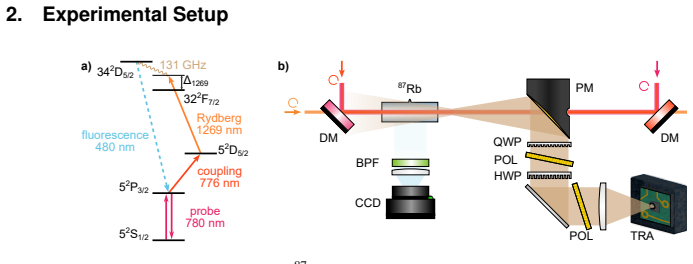
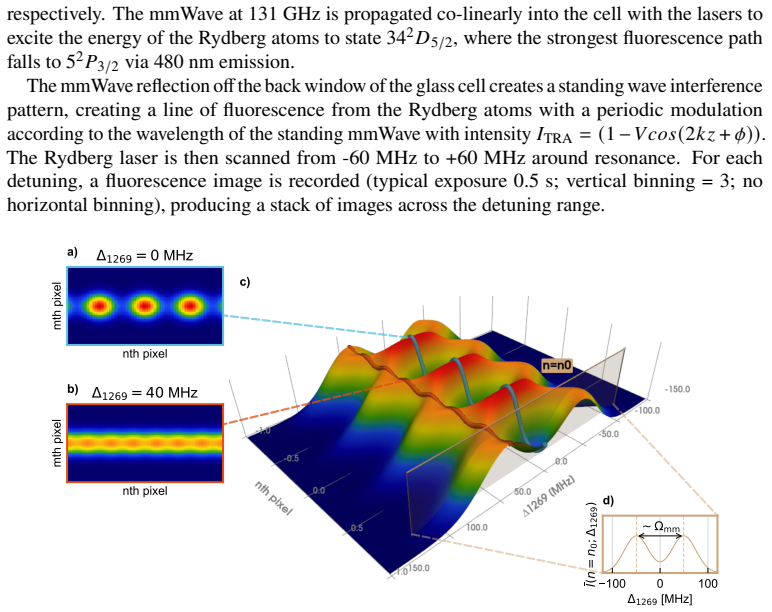
We demonstrate a spatially resolved method for imaging millimeter-wave (mmWave) electric fields using Rydberg-state fluorescence in a warm atomic vapor. By utilizing a multi-photon ladder excitation scheme, we leverage a specific decay channel that remains dark in the absence of the mmWave field, resulting in high-contrast imaging with effectively zero background. Absolute calibration of the local electric field is achieved by reconstructing the Autler-Townes splitting of the Rydberg resonance across the imaging volume. To ensure robust field extraction across a wide dynamic range--including regimes where spectral features are not fully resolved--we employ a steady-state analysis based on the Gorini-Kossakowski-Sudarshan-Lindblad (GKSL) master equation. We apply this technique to visualize standing-wave interference patterns within a vapor cell and demonstrate the ability to engineer local field distributions using structured dielectric reflectors. This approach provides a versatile and self-calibrating platform for the diagnostic imaging of high-frequency electromagnetic fields and the characterization of mmWave-optical interfaces.
Editorial analysis
A structured set of objections, weighed in public.
Referee Report
Summary. The paper demonstrates a spatially resolved method for imaging millimeter-wave electric fields using Rydberg-state fluorescence in a warm atomic vapor. A multi-photon ladder excitation scheme creates a decay channel that is dark without the mmWave field, yielding high-contrast imaging with near-zero background. Absolute calibration is achieved by reconstructing the Autler-Townes splitting of the Rydberg resonance across the imaging volume. A steady-state GKSL master-equation analysis extracts local field values over a wide dynamic range, including regimes where spectral features are unresolved. The technique is applied to visualize standing-wave interference patterns in a vapor cell and to engineer local field distributions with structured dielectric reflectors.
Significance. If validated, the approach supplies a self-calibrating, high-contrast platform for mmWave electric-field diagnostics that leverages established atomic-physics tools (observable Autler-Townes splitting and standard GKSL modeling) rather than fitted parameters. The demonstrations of standing-wave imaging and reflector-engineered fields illustrate practical utility for characterizing high-frequency electromagnetic environments and mmWave-optical interfaces.
minor comments (3)
- [Abstract and §3 (Experimental Setup)] The abstract states that the decay channel 'remains dark in the absence of the mmWave field,' but the manuscript should provide quantitative measurements of residual fluorescence (e.g., contrast ratio or background count rate) to substantiate the 'effectively zero background' claim.
- [§4 (Modeling and Field Extraction)] The GKSL steady-state analysis is invoked for field extraction when Autler-Townes features are unresolved; the paper should include a direct comparison of extracted fields against independent calibration (e.g., known applied fields or Fabry-Pérot measurements) across the full dynamic range to confirm absence of unmodeled effects.
- [Figures 3 and 4] Figure captions and text should explicitly state the spatial resolution achieved and any deconvolution or point-spread-function correction applied to the fluorescence images.
Simulated Author's Rebuttal
We thank the referee for the positive assessment of our manuscript, the clear summary of the work, and the recommendation for minor revision. No major comments are provided in the report.
Circularity Check
No significant circularity detected
full rationale
The paper's central derivation uses a multi-photon ladder scheme to create a dark decay channel whose fluorescence is modulated by mmWave-induced Autler-Townes splitting; absolute field values are recovered via standard GKSL steady-state solution of the optical Bloch equations. This chain depends on observable spectral features and a well-established master-equation framework rather than any fitted parameter being relabeled as a prediction, any self-citation serving as the sole justification, or any ansatz smuggled through prior work. The method is therefore self-contained against external atomic-physics benchmarks.
Axiom & Free-Parameter Ledger
axioms (1)
- domain assumption The Gorini-Kossakowski-Sudarshan-Lindblad (GKSL) master equation provides an accurate steady-state description of the multi-photon ladder scheme for field extraction.
Reference graph
Works this paper leans on
-
[1]
Observation of electromagnetically induced transparency,
K.-J. Boller, A. Imamoğlu, and S. E. Harris, “Observation of electromagnetically induced transparency,” Phys. Rev. Lett.66, 2593–2596 (1991)
1991
-
[2]
Quantum interference effects induced by interacting dark resonances,
M. D. Lukin, S. F. Yelin, M. Fleischhauer, and M. O. Scully, “Quantum interference effects induced by interacting dark resonances,” Phys. Rev. A60, 3225–3228 (1999)
1999
-
[3]
Electromagnetically induced transparency: Optics in coherent media,
M. Fleischhauer, A. Imamoglu, and J. P. Marangos, “Electromagnetically induced transparency: Optics in coherent media,” Rev. Mod. Phys.77, 633–673 (2005)
2005
-
[4]
Rydberg Atoms for Radio-Frequency Communications and Sensing: Atomic Receivers for Pulsed RF Field and Phase Detection,
D. A. Anderson, R. E. Sapiro, and G. Raithel, “Rydberg Atoms for Radio-Frequency Communications and Sensing: Atomic Receivers for Pulsed RF Field and Phase Detection,” IEEE Aerosp. Electron. Syst. Mag.35, 48–56 (2020)
2020
-
[5]
Rydberg Atom Electric Field Sensors for Communications and Sensing,
C. T. Fancher, D. R. Scherer, M. C. S. John, and B. L. S. Marlow, “Rydberg Atom Electric Field Sensors for Communications and Sensing,” IEEE Trans. on Quantum Eng.2, 3501313 (2021)
2021
-
[6]
Sensitivity of a Rydberg-atom receiver to frequency and amplitude modulation of microwaves,
S. Borówka, U. Pylypenko, M. Mazelanik, and M. Parniak, “Sensitivity of a Rydberg-atom receiver to frequency and amplitude modulation of microwaves,” Appl. Opt.61, 8806 (2022)
2022
-
[7]
Compact blackbody-radiation atomic sensor: Measuring temperature using optically excited atoms in vapor cells,
D. S. La Mantia, M. Lei, N. Prajapati,et al., “Compact blackbody-radiation atomic sensor: Measuring temperature using optically excited atoms in vapor cells,” Phys. Rev. Appl.23, 044037 (2025)
2025
-
[8]
Rydberg atom quantum technologies,
C. S. Adams, J. D. Pritchard, and J. P. Shaffer, “Rydberg atom quantum technologies,” J. Phys. B: At. Mol. Opt. Phys. 53, 012002 (2020)
2020
-
[9]
Probing bandwidth and sensitivity in rydberg atom sensing via optical homodyne and rf heterodyne detection,
D. Manchaiah, S. Oliver, S. Berweger,et al., “Probing bandwidth and sensitivity in rydberg atom sensing via optical homodyne and rf heterodyne detection,” Phys. Rev. A113, 013729 (2026)
2026
-
[10]
Quantum information with Rydberg atoms,
M. Saffman, T. G. Walker, and K. Mølmer, “Quantum information with Rydberg atoms,” Rev. Mod. Phys.82, 2313–2363 (2010)
2010
-
[11]
Coherent Optical Detection of Highly Excited Rydberg States Using Electromagnetically Induced Transparency,
A. K. Mohapatra, T. R. Jackson, and C. S. Adams, “Coherent Optical Detection of Highly Excited Rydberg States Using Electromagnetically Induced Transparency,” Phys. Rev. Lett.98, 113003 (2007)
2007
-
[12]
Subwavelength microwave electric-field imaging using Rydberg atoms inside atomic vapor cells,
H. Q. Fan, S. Kumar, R. Daschner,et al., “Subwavelength microwave electric-field imaging using Rydberg atoms inside atomic vapor cells,” Opt. Lett.39, 3030 (2014)
2014
-
[13]
Real-timenear-fieldterahertzimagingwithatomicopticalfluorescence,
C.G.Wade,N.Šibalić,N.R.DeMelo,et al.,“Real-timenear-fieldterahertzimagingwithatomicopticalfluorescence,” Nat. Photonics11, 40–43 (2017)
2017
-
[14]
Full-Field Terahertz Imaging at Kilohertz Frame Rates Using Atomic Vapor,
L. A. Downes, A. R. MacKellar, D. J. Whiting,et al., “Full-Field Terahertz Imaging at Kilohertz Frame Rates Using Atomic Vapor,” Phys. Rev. X10, 011027 (2020)
2020
-
[15]
Two-dimensional imaging of electromagnetic fields via light-sheet fluorescence imaging with Rydberg atoms,
N. Schlossberger, T. McDonald, K. Su,et al., “Two-dimensional imaging of electromagnetic fields via light-sheet fluorescence imaging with Rydberg atoms,” Opt. Lett.50, 7312–7315 (2025)
2025
-
[16]
Angle-of-arrivaldetectionofradio-frequencywaves via rydberg-atom fluorescence imaging of standing waves in a glass vapor cell,
N.Schlossberger,R.Talashila,N.Prajapati,andC.L.Holloway,“Angle-of-arrivaldetectionofradio-frequencywaves via rydberg-atom fluorescence imaging of standing waves in a glass vapor cell,” Phys. Rev. Appl.24, 024056 (2025)
2025
-
[17]
Investigation of fluorescence versus transmission readout for three-photon Rydberg excitation used in electrometry,
N. Prajapati, S. Berweger, A. P. Rotunno,et al., “Investigation of fluorescence versus transmission readout for three-photon Rydberg excitation used in electrometry,” AVS Quantum Sci.6, 034401 (2024)
2024
-
[18]
Millimeter wave imaging using Autler-Townes splitting induced fluorescence from Rydberg atoms in rubidium vapor,
G. Pati, D. Mechael, F. K. Fatemi, and R. Tripathi, “Millimeter wave imaging using Autler-Townes splitting induced fluorescence from Rydberg atoms in rubidium vapor,” Opt. Express34, 9723 (2026)
2026
-
[19]
Terahertz electrometry via infrared spectroscopy of atomic vapor,
S. Chen, D. J. Reed, A. R. MacKellar,et al., “Terahertz electrometry via infrared spectroscopy of atomic vapor,” Optica9, 485 (2022)
2022
-
[20]
Dual-cameras terahertz imaging with multi-kilohertz frame rates and high sensitivity via Rydberg-atom vapor,
X. Li, T. Li, J. Wan,et al., “Dual-cameras terahertz imaging with multi-kilohertz frame rates and high sensitivity via Rydberg-atom vapor,” J. Phys. D: Appl. Phys.58, 085109 (2024)
2024
-
[21]
ImagingofterahertzradiationusingaRydbergatomphotocathode,
A.Gürtler,A.S.Meijer,andW.J.vanderZande,“ImagingofterahertzradiationusingaRydbergatomphotocathode,” Appl. Phys. Lett.83, 222–224 (2003)
2003
-
[22]
Room temperature single-photon terahertz detection with thermal Rydberg atoms,
D. Li, Z. Bai, X. Zuo,et al., “Room temperature single-photon terahertz detection with thermal Rydberg atoms,” Appl. Phys. Rev.11, 041420 (2024)
2024
-
[23]
Optical analysis of 3D-printed terahertz waveplates from common thermoplastics,
G. F. Freitas, L. T. Roque, N. M. Kawahala, and F. G. G. Hernandez, “Optical analysis of 3D-printed terahertz waveplates from common thermoplastics,” Sci. Reports16, 2532 (2025)
2025
-
[24]
Replication data for: Calibrated electric-field imaging with Rydberg-state fluorescence and Autler-Townes splitting,
G. Ko, W. Krokosz, M. Mazelanik,et al., “Replication data for: Calibrated electric-field imaging with Rydberg-state fluorescence and Autler-Townes splitting,” (2026)
2026
discussion (0)
Sign in with ORCID, Apple, or X to comment. Anyone can read and Pith papers without signing in.