Recognition: unknown
Single-shot quantum neural networks with amplitude estimation
Pith reviewed 2026-05-10 02:35 UTC · model grok-4.3
The pith
Embedding a trained quantum neural network as an oracle in amplitude estimation yields output estimates with O(1/N) error from one circuit execution.
A machine-rendered reading of the paper's core claim, the machinery that carries it, and where it could break.
Core claim
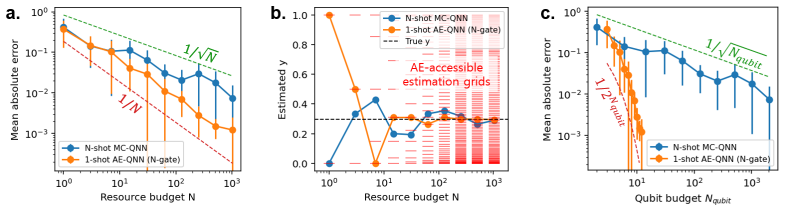
By embedding a trained QNN as a state-preparation oracle within amplitude estimation, the framework estimates outputs through coherent interference, achieving an O(1/N) sampling error even with a single shot, in contrast to the conventional O(1/sqrt(N)) Monte Carlo error.
What carries the argument
Amplitude estimation, with the trained quantum neural network serving as the state-preparation oracle that supplies the amplitude whose square is the desired output probability.
If this is right
- QNN inference on near-term devices requires far fewer circuit executions to reach a target accuracy.
- The sampling overhead that currently dominates quantum machine-learning workloads is reduced by a quadratic factor.
- Noise robustness remains sufficient for the method to be useful on present-day hardware.
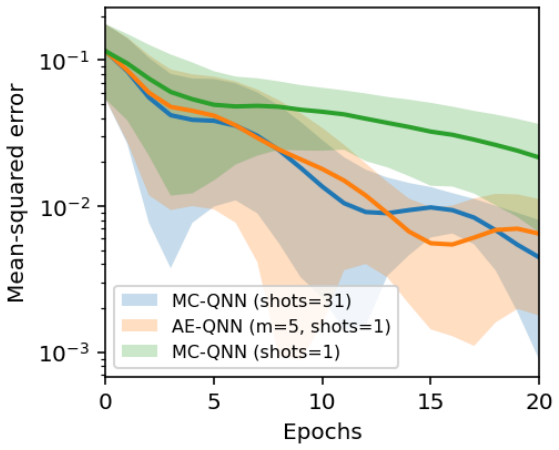
- Training loops for QNNs can be adapted to use the same amplitude-estimation readout without losing the efficiency gain.
Where Pith is reading between the lines
- The same oracle-embedding technique could be applied to other quantum models whose outputs are expectation values or probabilities.
- Hardware improvements that increase coherence time would directly widen the range of QNN sizes for which single-shot inference works.
- Classical post-processing of the amplitude-estimation results could be combined with classical machine-learning techniques for hybrid training.
Load-bearing premise
A trained quantum neural network can be turned into a state-preparation oracle for amplitude estimation without circuit depths that exceed available coherence times or that destroy the interference needed for the estimation.
What would settle it
An experiment on real quantum hardware that applies the single-shot QNN procedure and measures output error scaling no better than 1/sqrt(N) with increasing oracle calls would falsify the performance claim.
Figures


read the original abstract
Quantum neural networks (QNNs) suffer from a fundamental sampling bottleneck since quantum measurements are probabilistic, requiring many circuit executions to estimate outputs with sufficient accuracy. Conventional Monte-Carlo (MC) inference exhibits an $\mathcal{O}(1/\sqrt{N})$ sampling error, rendering QNN inference and training costly on near-term quantum hardware, especially where each shot requires expensive qubit generation. This work introduces a "single-shot" QNN framework by integrating quantum amplitude estimation (AE) into the readout stage. By embedding a trained QNN as a state-preparation oracle within AE, outputs are estimated through coherent interference rather than repeated sampling. We demonstrate that AE-based QNN inference achieves an $\mathcal{O}(1/N)$ error even with a single shot. We further analyze noise robustness and training feasibility, showing that AE can be a powerful primitive for overcoming the sampling overhead of QNNs. This highlights that when the model itself is quantum, quantum algorithms can enhance the computation efficiency.
Editorial analysis
A structured set of objections, weighed in public.
Referee Report
Summary. The manuscript introduces a single-shot QNN framework that integrates quantum amplitude estimation (AE) into the readout stage. By embedding a trained QNN as a state-preparation oracle within AE, it claims to achieve an O(1/N) estimation error with a single shot, in contrast to conventional Monte Carlo O(1/sqrt(N)) scaling. The work further analyzes noise robustness and training feasibility, positioning AE as a primitive to reduce sampling overhead when the model itself is quantum.
Significance. If the embedding preserves coherence across the required oracle calls and the noise analysis is quantitative, the approach could deliver a quadratic reduction in circuit executions for QNN inference and training on near-term hardware. This leverages quantum algorithms to improve quantum models and addresses a practical bottleneck; the noise-robustness and training sections are strengths if they include concrete bounds.
major comments (2)
- [AE-based readout and noise analysis] The central O(1/N) claim with a single shot rests on treating the trained QNN as a coherent, repeatable state-preparation oracle inside AE. AE requires O(1/ε) controlled applications of the oracle and its inverse to reach additive error ε = O(1/N); the manuscript provides no explicit bound on total circuit depth or resource count for the controlled-QNN blocks (see the AE integration description and noise-robustness analysis). Without this, coherence loss would collapse performance to Monte-Carlo scaling.
- [Abstract] The abstract asserts noise robustness and training feasibility, yet the provided text contains no derivation of the O(1/N) scaling, no error analysis, and no circuit diagram for the embedding step. This prevents independent verification of whether the QNN circuit depth permits the Grover iterate without prohibitive overhead.
minor comments (2)
- [Notation and claims] Clarify the precise meaning of N and the single-shot count in the O(1/N) scaling (number of final measurements versus total oracle queries).
- [Figures] Add a circuit diagram illustrating the controlled-QNN oracle inside the AE Grover operator.
Simulated Author's Rebuttal
We thank the referee for the constructive and positive review, which highlights both the promise of the approach and areas where the presentation can be strengthened. We address each major comment below and have revised the manuscript to incorporate explicit resource bounds, derivations, and diagrams as suggested.
read point-by-point responses
-
Referee: [AE-based readout and noise analysis] The central O(1/N) claim with a single shot rests on treating the trained QNN as a coherent, repeatable state-preparation oracle inside AE. AE requires O(1/ε) controlled applications of the oracle and its inverse to reach additive error ε = O(1/N); the manuscript provides no explicit bound on total circuit depth or resource count for the controlled-QNN blocks (see the AE integration description and noise-robustness analysis). Without this, coherence loss would collapse performance to Monte-Carlo scaling.
Authors: We agree that explicit quantitative bounds on total circuit depth are essential for assessing near-term feasibility. The manuscript describes the QNN as the state-preparation oracle within the AE framework and assumes coherent repetition of the oracle and its inverse, but it does not provide explicit resource counts (e.g., total depth scaling as O(D/ε) where D is the QNN depth). We have added a new subsection on resource estimation that derives the total depth and gate count in terms of the QNN circuit depth D and target precision ε, along with a discussion of coherence requirements and how noise in the controlled-QNN blocks affects the overall O(1/N) scaling. This revision directly addresses the concern that coherence loss could revert to Monte Carlo behavior. revision: yes
-
Referee: [Abstract] The abstract asserts noise robustness and training feasibility, yet the provided text contains no derivation of the O(1/N) scaling, no error analysis, and no circuit diagram for the embedding step. This prevents independent verification of whether the QNN circuit depth permits the Grover iterate without prohibitive overhead.
Authors: We acknowledge that the abstract is concise and that the manuscript would benefit from a more self-contained derivation of the O(1/N) scaling, explicit error analysis, and a circuit diagram for the QNN-AE embedding. While the main text outlines the integration, we have revised the manuscript to include: (i) a step-by-step derivation of the O(1/N) error in the AE readout section, (ii) quantitative error bounds tied to the noise-robustness analysis, and (iii) a new figure showing the circuit diagram with the controlled-QNN oracle and Grover iterate. The abstract has also been expanded slightly to reference these elements, enabling independent verification of resource overhead. revision: yes
Circularity Check
No circularity: O(1/N) scaling follows directly from standard amplitude estimation applied to a QNN oracle
full rationale
The paper's central claim embeds a trained QNN as a state-preparation oracle inside amplitude estimation and invokes the known O(1/N) additive error of AE (with the 'single-shot' qualifier referring to the final measurement after coherent iterations). No equation in the provided text defines the target scaling in terms of itself, fits a parameter to data and renames the fit as a prediction, or relies on a self-citation chain whose cited result is unverified. The argument is self-contained against the external benchmark of Brassard et al. amplitude estimation; any practical concerns about circuit depth or coherence are correctness issues, not circularity.
Axiom & Free-Parameter Ledger
axioms (1)
- standard math Quantum amplitude estimation provides O(1/N) error scaling when used as a black-box primitive
invented entities (1)
-
Single-shot QNN framework
no independent evidence
Reference graph
Works this paper leans on
-
[1]
P. W. Shor, Polynomial-time algorithms for prime factorization and discrete logarithms on a quantum computer, SIAM Review 41 (2) (1999) 303–332. arXiv:https://doi.org/10.1137/S0036144598347011, doi:10.1137/S0036144598347011. URLhttps://doi.org/10.1137/S0036144598347011
-
[2]
C. Godfrin, A. Ferhat, R. Ballou, S. Klyatskaya, M. Ruben, W. Werns- dorfer, F. Balestro, Operating quantum states in single magnetic molecules: Implementation of grover’s quantum algorithm, Phys. Rev. Lett. 119 (2017) 187702. doi:10.1103/PhysRevLett.119.187702. URLhttps://link.aps.org/doi/10.1103/PhysRevLett.119.187702
-
[3]
A. W. Harrow, A. Hassidim, S. Lloyd, Quantum algorithm for linear systems of equations, Phys. Rev. Lett. 103 (2009) 150502. doi:10.1103/PhysRevLett.103.150502. URLhttps://link.aps.org/doi/10.1103/PhysRevLett.103.150502
-
[4]
M. A. Schalkers, M. Möller, Efficient and fail-safe quantum algorithm for the transport equation, Journal of Computational Physics 502 (2024) 112816. doi:https://doi.org/10.1016/j.jcp.2024.112816. URLhttps://www.sciencedirect.com/science/article/pii/S0021999124000652
-
[5]
Biamonte, P
J. Biamonte, P. Wittek, N. Pancotti, P. Rebentrost, N. Wiebe, S. Lloyd, Quantum machine learning, Nature 549 (7671) (2017) 195–
2017
-
[6]
Quantum machine learning.Nature, 549(7671):195–202, Sep 2017
doi:10.1038/nature23474. URLhttps://doi.org/10.1038/nature23474 20
-
[7]
M. Cerezo, G. Verdon, H.-Y. Huang, L. Cincio, P. J. Coles, Challenges and opportunities in quantum machine learning, Nature Computational Science 2 (9) (2022) 567–576. doi:10.1038/s43588-022-00311-3. URLhttps://doi.org/10.1038/s43588-022-00311-3
-
[8]
Seo, Efficient quantum machine learning with inverse-probability al- gebraic corrections (2026)
J. Seo, Efficient quantum machine learning with inverse-probability al- gebraic corrections (2026). arXiv:2601.16665. URLhttps://arxiv.org/abs/2601.16665
-
[9]
Quantum Science and Technology4(4), 043001 (2019) https://doi.org/10.1088/2058-9565/ab4eb5
M. Benedetti, E. Lloyd, S. Sack, M. Fiorentini, Parameterized quantum circuits as machine learning models, Quantum Science and Technology 4 (4) (2019) 043001. doi:10.1088/2058-9565/ab4eb5. URLhttps://dx.doi.org/10.1088/2058-9565/ab4eb5
-
[10]
Quantum Machine Intelligence3(1), 9 (2021) https://doi.org/10.1007/s42484-021-00038-w
T. Hubregtsen, J. Pichlmeier, P. Stecher, K. Bertels, Evaluation of pa- rameterized quantum circuits: on the relation between classification ac- curacy, expressibility, and entangling capability, Quantum Machine In- telligence 3 (1) (2021) 9. doi:10.1007/s42484-021-00038-w. URLhttps://doi.org/10.1007/s42484-021-00038-w
-
[11]
J. Shi, W. Wang, X. Lou, S. Zhang, X. Li, Parameterized hamil- tonian learning with quantum circuit, IEEE Transactions on Pat- tern Analysis and Machine Intelligence 45 (5) (2023) 6086–6095. doi:10.1109/TPAMI.2022.3203157
-
[12]
J. Wen, Z. Huang, D. Cai, L. Qian, Enhancing the expressivity of quantum neural networks with residual connections, Communications Physics 7 (1) (2024) 220. doi:10.1038/s42005-024-01719-1. URLhttps://doi.org/10.1038/s42005-024-01719-1
-
[13]
doi:10.1038/s41598-024-81436-5
I.Panadero, Y.Ban, H.Espinós, R.Puebla, J.Casanova, E.Torrontegui, Regressions on quantum neural networks at maximal expressivity, Sci- entific Reports 14 (1) (2024) 31669. doi:10.1038/s41598-024-81436-5. URLhttps://doi.org/10.1038/s41598-024-81436-5
-
[14]
J. Seo, Quantum mixture-density network for multimodal prob- abilistic prediction, IEEE Access 13 (2025) 199317–199325. doi:10.1109/ACCESS.2025.3635294. 21
-
[15]
J. Seo, Multivariate unbounded quantum regression via log-ratio prob- abilities mitigating barren plateaus, IEEE Access 14 (2026) 4877–4885. doi:10.1109/ACCESS.2025.3647449
-
[16]
Y. Xiao, L. M. Yang, C. Shu, S. C. Chew, B. C. Khoo, Y. D. Cui, Y. Y. Liu, Physics-informed quantum neural network for solving forward and inverseproblemsofpartialdifferentialequations, PhysicsofFluids36(9) (2024) 097145. doi:10.1063/5.0226232. URLhttps://doi.org/10.1063/5.0226232
-
[17]
G. Panichi, S. Corli, E. Prati, Quantum physics-informed neural net- works for multivariable partial differential equations, Phys. Rev. Appl. 25 (2026) 014001. doi:10.1103/6nh4-yh2y. URLhttps://link.aps.org/doi/10.1103/6nh4-yh2y
-
[18]
Zhou, Z.-P
M.-G. Zhou, Z.-P. Liu, H.-L. Yin, C.-L. Li, T.-K. Xu, Z.-B. Chen, Quan- tum neural network for quantum neural computing, Research 6 (2023)
2023
-
[19]
URLhttps://spj.science.org/doi/abs/10.34133/research.0134
arXiv:https://spj.science.org/doi/pdf/10.34133/research.0134, doi:10.34133/research.0134. URLhttps://spj.science.org/doi/abs/10.34133/research.0134
-
[20]
Nature453, 1031– 1042 (2008) https://doi.org/10.1038/nature07128
J. Clarke, F. K. Wilhelm, Superconducting quantum bits, Nature 453 (7198) (2008) 1031–1042. doi:10.1038/nature07128. URLhttps://doi.org/10.1038/nature07128
-
[21]
J. M. Pino, J. M. Dreiling, C. Figgatt, J. P. Gaebler, S. A. Moses, M. S. Allman, C. H. Baldwin, M. Foss-Feig, D. Hayes, K. Mayer, C. Ryan-Anderson, B. Neyenhuis, Demonstration of the trapped-ion quantum ccd computer architecture, Nature 592 (7853) (2021) 209–213. doi:10.1038/s41586-021-03318-4. URLhttps://doi.org/10.1038/s41586-021-03318-4
-
[22]
R.; Khani, H.; Misztal, P.; Spray, R.; Ezekoye, O
K. Alexander, A. Benyamini, D. Black, D. Bonneau, S. Burgos, B. Bur- ridge, H. Cable, G. Campbell, G. Catalano, A. Ceballos, C.-M. Chang, S. S. Choudhury, C. J. Chung, F. Danesh, T. Dauer, M. Davis, E. Dud- ley, P. Er-Xuan, J. Fargas, A. Farsi, C. Fenrich, J. Frazer, M. Fukami, Y. Ganesan, G. Gibson, M. Gimeno-Segovia, S. Goeldi, P. Goley, R. Haislmaier, ...
-
[23]
K.Mitarai, M.Negoro, M.Kitagawa, K.Fujii, Quantumcircuitlearning, Phys. Rev. A 98 (2018) 032309. doi:10.1103/PhysRevA.98.032309. URLhttps://link.aps.org/doi/10.1103/PhysRevA.98.032309
-
[24]
Evaluating analytic gradients on quantum hardware,
M. Schuld, V. Bergholm, C. Gogolin, J. Izaac, N. Killoran, Evaluating analyticgradientsonquantumhardware, Phys.Rev.A99(2019)032331. doi:10.1103/PhysRevA.99.032331. URLhttps://link.aps.org/doi/10.1103/PhysRevA.99.032331
-
[25]
D. Grinko, J. Gacon, C. Zoufal, S. Woerner, Iterative quantum amplitude estimation, npj Quantum Information 7 (1) (2021) 52. doi:10.1038/s41534-021-00379-1. URLhttps://doi.org/10.1038/s41534-021-00379-1
-
[26]
U. Dorner, R. Demkowicz-Dobrzanski, B. J. Smith, J. S. Lun- deen, W. Wasilewski, K. Banaszek, I. A. Walmsley, Optimal quantum phase estimation, Phys. Rev. Lett. 102 (2009) 040403. doi:10.1103/PhysRevLett.102.040403. URLhttps://link.aps.org/doi/10.1103/PhysRevLett.102.040403
-
[27]
J. Etxezarreta Martinez, P. Fuentes, P. Crespo, J. Garcia-Frias, Time- varying quantum channel models for superconducting qubits, npj Quan- tum Information 7 (1) (2021) 115. doi:10.1038/s41534-021-00448-5. URLhttps://doi.org/10.1038/s41534-021-00448-5 23
-
[28]
A. Kubica, A. Haim, Y. Vaknin, H. Levine, F. Brandão, A. Retzker, Erasure qubits: Overcoming theT 1 limit in superconducting circuits, Phys. Rev. X 13 (2023) 041022. doi:10.1103/PhysRevX.13.041022. URLhttps://link.aps.org/doi/10.1103/PhysRevX.13.041022
-
[29]
S. Wang, P. Czarnik, A. Arrasmith, M. Cerezo, L. Cincio, P. J. Coles, Can Error Mitigation Improve Trainability of Noisy Variational Quan- tum Algorithms?, Quantum 8 (2024) 1287. doi:10.22331/q-2024-03-14- 1287. URLhttps://doi.org/10.22331/q-2024-03-14-1287
-
[30]
K. Dalton, C. K. Long, Y. S. Yordanov, C. G. Smith, C. H. W. Barnes, N. Mertig, D. R. M. Arvidsson-Shukur, Quantifying the effect of gate errors on variational quantum eigensolvers for quantum chemistry, npj Quantum Information 10 (1) (2024) 18. doi:10.1038/s41534-024-00808- x. URLhttps://doi.org/10.1038/s41534-024-00808-x
-
[31]
A. Uvarov, D. Rabinovich, O. Lakhmanskaya, K. Lakhmanskiy, J. Bi- amonte, S. Adhikary, Mitigating quantum gate errors for variational eigensolvers using hardware-inspired zero-noise extrapolation, Phys. Rev. A 110 (2024) 012404. doi:10.1103/PhysRevA.110.012404. URLhttps://link.aps.org/doi/10.1103/PhysRevA.110.012404
-
[32]
A. W. R. Smith, K. E. Khosla, C. N. Self, M. S. Kim, Qubit readout error mitigation with bit-flip av- eraging, Science Advances 7 (47) (2021) eabi8009. arXiv:https://www.science.org/doi/pdf/10.1126/sciadv.abi8009, doi:10.1126/sciadv.abi8009. URLhttps://www.science.org/doi/abs/10.1126/sciadv.abi8009
-
[33]
E. Peters, A. C. Y. Li, G. N. Perdue, Perturbative readout-error mitiga- tion for near-term quantum computers, Phys. Rev. A 107 (2023) 062426. doi:10.1103/PhysRevA.107.062426. URLhttps://link.aps.org/doi/10.1103/PhysRevA.107.062426
-
[34]
B. Cheng, X.-H. Deng, X. Gu, Y. He, G. Hu, P. Huang, J. Li, B.-C. Lin, D. Lu, Y. Lu, C. Qiu, H. Wang, T. Xin, S. Yu, M.-H. Yung, J. Zeng, S. Zhang, Y. Zhong, X. Peng, F. Nori, D. Yu, Noisy intermediate- scale quantum computers, Frontiers of Physics 18 (2) (2023) 21308. 24 doi:10.1007/s11467-022-1249-z. URLhttps://doi.org/10.1007/s11467-022-1249-z
-
[35]
M. A. Ijaz, M. Faryad, Noise analysis of grover and phase estimation algorithms implemented as quantum singular value transformations for a small number of noisy qubits, Scientific Reports 13 (1) (2023) 20144. doi:10.1038/s41598-023-47246-x. URLhttps://doi.org/10.1038/s41598-023-47246-x
-
[36]
T. Tanaka, Y. Suzuki, S. Uno, R. Raymond, T. Onodera, N. Ya- mamoto, Amplitude estimation via maximum likelihood on noisy quan- tum computer, Quantum Information Processing 20 (9) (2021) 293. doi:10.1007/s11128-021-03215-9. URLhttps://doi.org/10.1007/s11128-021-03215-9
-
[37]
Z. Cai, R. Babbush, S. C. Benjamin, S. Endo, W. J. Huggins, Y. Li, J. R. McClean, T. E. O’Brien, Quantum error mitigation, Rev. Mod. Phys. 95 (2023) 045005. doi:10.1103/RevModPhys.95.045005. URLhttps://link.aps.org/doi/10.1103/RevModPhys.95.045005
-
[38]
G. González-García, R. Trivedi, J. I. Cirac, Error propagation in nisq devices for solving classical optimization problems, PRX Quantum 3 (2022) 040326. doi:10.1103/PRXQuantum.3.040326. URLhttps://link.aps.org/doi/10.1103/PRXQuantum.3.040326 25
discussion (0)
Sign in with ORCID, Apple, or X to comment. Anyone can read and Pith papers without signing in.