Recognition: unknown
Drift Correction of Scan Images by Snapshot Referencing
Pith reviewed 2026-05-10 00:51 UTC · model grok-4.3
The pith
A fast high-signal snapshot image is used as a drift-free reference to calculate and remove continuous pixel-by-pixel drift vectors from slow analytical scans.
A machine-rendered reading of the paper's core claim, the machinery that carries it, and where it could break.
Core claim
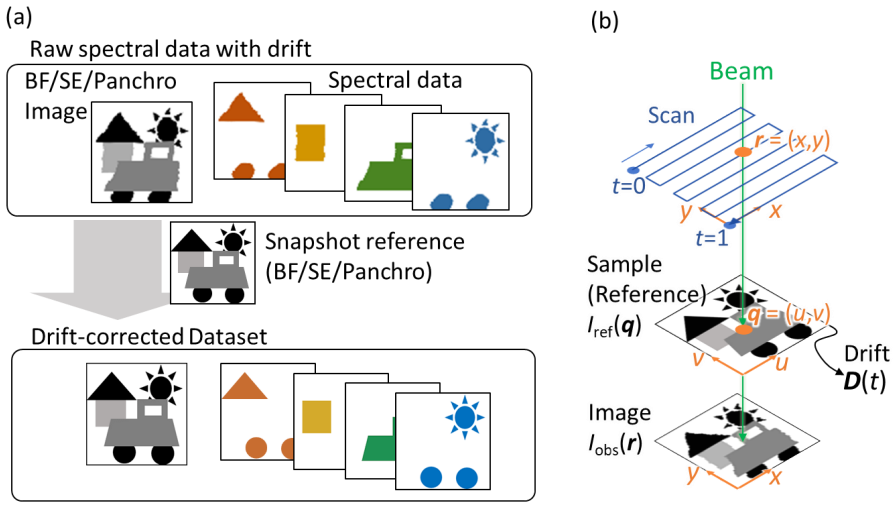
Snapshot-referencing (SSR) drift correction calculates a continuous drift vector for every pixel in a normalized time-field of the scan pattern by using a high-signal, fast-scan snapshot as a drift-free reference to guide the correction of simultaneously acquired analytical maps, demonstrated on experimental cathodoluminescence datasets.
What carries the argument
Snapshot-referencing (SSR) that derives a per-pixel drift vector from the time-field of the scan pattern by fitting the fast-scan snapshot reference with Bezier or piecewise-linear basis functions.
If this is right
- Spatial integrity is restored to hyperspectral data cubes in S(T)EM without specialized hardware.
- The method applies to any probe-based analytical technique that records a fast imaging signal alongside slow spectroscopic data.
- Both smooth thermal or mechanical drifts and high-frequency shifts such as charging can be modeled and removed.
- Quantitative analysis hindered by drift in long-duration spectral mapping becomes more reliable.
Where Pith is reading between the lines
- The same reference-based time-field approach could be tested on non-raster scan patterns if the timing information is recorded.
- SSR might be combined with existing hardware drift compensators to handle cases where the snapshot itself contains minor residual motion.
- The basis-function choice could be automated by comparing fit residuals across different scan speeds or sample types.
Load-bearing premise
The fast-scan snapshot is completely drift-free and the actual drift can be adequately represented by the chosen Bezier or piecewise-linear basis functions.
What would settle it
After applying the correction, residual spatial misalignment between the analytical maps and independently verified high-resolution structural features would show that the drift vector calculation failed.
Figures

read the original abstract
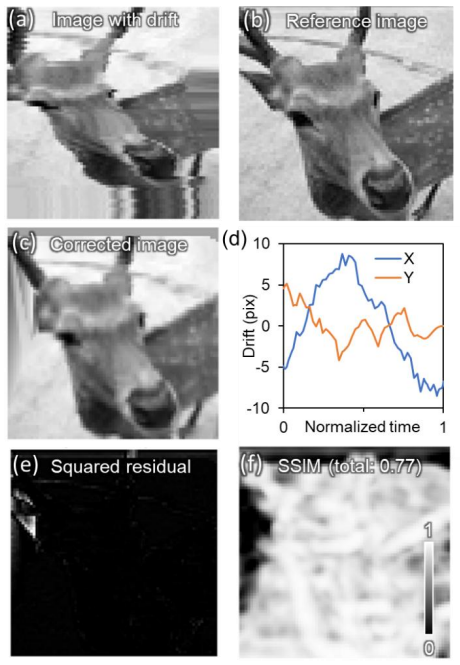
Reliable quantitative analysis in scanning (transmission) electron microscopy (S(T)EM) is often hindered by image drift during long-duration spectral mapping for elemental analysis or for various material functions. We here present snapshot-referencing (SSR) drift correction, a retrospective approach to eliminate spatial distortions based on the temporal nature of the scanning process; A continuous drift vector for every pixel is calculated for a normalized time-field of the scan pattern (e.g., serpentine or raster) utilizing a high-signal, fast-scan "snapshot" as a drift-free reference to guide the correction of simultaneously acquired analytical maps. To describe the drift, we employed Bezier basis functions to model smooth thermal or mechanical drifts and piece-wise linear basis for high-frequency "spiky" shifts such as those caused by charging. We demonstrate the efficacy of this approach on experimental cathodoluminescence (CL) datasets, showing that it effectively restores spatial integrity to hyperspectral data cubes without the need for specialized hardware. This flexible, software-based solution is broadly applicable to any probe-based analytical technique where a fast imaging signal can be recorded alongside slow spectroscopic data.
Editorial analysis
A structured set of objections, weighed in public.
Referee Report
Summary. The paper introduces a snapshot-referencing (SSR) drift-correction method for S(T)EM imaging. A continuous drift vector d(t) is computed for each pixel in a normalized time-field of the scan pattern (e.g., serpentine or raster) by using a simultaneously acquired high-signal fast-scan snapshot as a drift-free reference; the drift is parameterized with Bezier basis functions for smooth thermal/mechanical components and piecewise-linear basis functions for high-frequency spiky shifts (e.g., charging). The corrected drift field is then applied to restore spatial integrity in simultaneously acquired analytical maps such as cathodoluminescence hyperspectral cubes. The approach is presented as a retrospective, software-only solution applicable to any probe-based technique that can record a fast imaging signal alongside slow spectroscopic data.
Significance. If the central assumptions hold and the method is shown to deliver measurable improvement, SSR would provide a practical, hardware-free tool for mitigating drift in long-duration analytical scans, directly addressing a common limitation in quantitative S(T)EM. The dual-basis-function strategy for modeling both smooth and discontinuous drift trajectories is a reasonable engineering choice that could generalize beyond the demonstrated CL case.
major comments (3)
- [Abstract / demonstration on CL datasets] Abstract and demonstration section: the claim that SSR 'effectively restores spatial integrity' on experimental CL datasets is unsupported by any reported quantitative metrics (RMS error, pixel-shift histograms, comparison to uncorrected maps, or to existing drift-correction algorithms). Without such measures the efficacy statement remains unverified and is load-bearing for the paper's central contribution.
- [Method description] Method description: the procedure treats the fast-scan snapshot as having d(t) = 0 by construction, yet no bound, measurement, or residual-drift analysis is supplied for possible snapshot-internal motion (thermal, mechanical, or charging). If this assumption is violated even modestly, the recovered d(t) for the slow scan will be systematically biased.
- [Method description] Method description: no residual analysis or frequency-content check is presented to confirm that the chosen Bezier (smooth) and piecewise-linear (spiky) bases span the actual drift trajectory; unmodeled high-frequency content would produce uncorrected distortions that propagate directly into the corrected analytical maps.
minor comments (2)
- [Method description] The manuscript would benefit from explicit equations defining the normalized time-field, the drift-vector computation, and the fitting procedure for the basis functions; their absence hinders reproducibility.
- [Figure captions / experimental section] Figure captions and text should clarify whether the snapshot and slow-scan data are acquired truly simultaneously or sequentially, and how any temporal offset is handled.
Simulated Author's Rebuttal
We thank the referee for their constructive and detailed review. We address each major comment point by point below. Where the manuscript was missing supporting analysis or metrics, we have revised it to incorporate the requested elements while preserving the original scope and claims.
read point-by-point responses
-
Referee: Abstract / demonstration on CL datasets: the claim that SSR 'effectively restores spatial integrity' on experimental CL datasets is unsupported by any reported quantitative metrics (RMS error, pixel-shift histograms, comparison to uncorrected maps, or to existing drift-correction algorithms). Without such measures the efficacy statement remains unverified and is load-bearing for the paper's central contribution.
Authors: We agree that quantitative support is necessary. In the revised manuscript we have added a dedicated subsection in the Results section that reports RMS displacement errors before and after correction, histograms of residual pixel shifts extracted from the snapshot reference, side-by-side visual and quantitative comparison of uncorrected versus corrected hyperspectral maps, and a brief benchmark against a standard cross-correlation drift-correction routine. These additions directly substantiate the efficacy claim. revision: yes
-
Referee: Method description: the procedure treats the fast-scan snapshot as having d(t) = 0 by construction, yet no bound, measurement, or residual-drift analysis is supplied for possible snapshot-internal motion (thermal, mechanical, or charging). If this assumption is violated even modestly, the recovered d(t) for the slow scan will be systematically biased.
Authors: The assumption rests on the snapshot acquisition time being orders of magnitude shorter than the slow scan. We have added a new paragraph to the Methods section that supplies order-of-magnitude bounds on possible residual drift (thermal drift, stage creep, and charging) during the snapshot window, together with a brief discussion of the assumption as a limitation. We also note that averaging multiple rapid snapshots can further reduce any residual bias when needed. revision: yes
-
Referee: Method description: no residual analysis or frequency-content check is presented to confirm that the chosen Bezier (smooth) and piecewise-linear (spiky) bases span the actual drift trajectory; unmodeled high-frequency content would produce uncorrected distortions that propagate directly into the corrected analytical maps.
Authors: We have performed and now report a residual analysis that subtracts the fitted drift field from the raw snapshot-derived shifts, together with a frequency-spectrum comparison of the observed drift trajectory against the span of the dual basis set. These checks are included in the revised Methods section and show that residuals lie within the noise floor of the imaging signal, confirming that the chosen bases adequately capture the dominant drift components present in the data. revision: yes
Circularity Check
No circularity; direct computational procedure with independent assumptions
full rationale
The paper describes snapshot-referencing (SSR) drift correction as a retrospective software method: a continuous drift vector d(t) is computed for each pixel in the time-normalized scan pattern by using a simultaneously acquired high-signal fast-scan snapshot as a reference (treated as d(t)=0), with Bezier or piecewise-linear basis functions chosen to model the drift trajectory before correcting the analytical maps. No equations, derivations, or predictions are presented that reduce by construction to fitted inputs or self-referential definitions. The central construction is a direct algorithmic procedure without load-bearing self-citations, uniqueness theorems imported from prior author work, or ansatzes smuggled via citation. The method is self-contained against external benchmarks (experimental CL datasets) and the assumptions (snapshot drift-free, basis span sufficient) are stated as modeling choices rather than tautological outputs. This yields a normal non-finding of circularity.
Axiom & Free-Parameter Ledger
axioms (2)
- domain assumption The high-signal fast-scan snapshot is drift-free
- domain assumption Drift consists of smooth thermal/mechanical components plus high-frequency spiky shifts
Reference graph
Works this paper leans on
-
[1]
R. F. Egerton, Electron energy -loss spectroscopy in the TEM, Rep. Prog. Phys. 72, 016502 (2008)
2008
-
[2]
Kociak and L
M. Kociak and L. F. Zagonel, Cathodoluminescence in the scanning transmission electron microscope, Ultramicroscopy 176, 112 (2017)
2017
-
[3]
S. J. Pennycook, C. Li, M. Li, C. Tang, E. Okunishi, M. Varela, Y. -M. Kim, and J. H. Jang, Material structure, properties, and dynamics through scanning transmission electron microscopy, J. Anal. Sci. Technol. 9, 11 (2018)
2018
-
[4]
Saito and T
H. Saito and T. Sannomiya, A ngle-resolved cathodoluminescence microscopy on plasmonic crystals, Microscopy dfag002 (2026)
2026
-
[5]
D. A. Muller, E. J. Kirkland, M. G. Thomas, J. L. Grazul, L. Fitting, and M. Weyland, Room design for high-performance electron microscopy, Ultramicroscopy 106, 1033 (2006)
2006
-
[6]
Jones and P
L. Jones and P. D. Nellist, Identifying and Correcting Scan Noise and Drift in the Scanning Transmission Electron Microscope, Microsc. Microanal. 19, 1050 (2013)
2013
-
[7]
Sang and J
X. Sang and J. M. LeBeau, Revolving scanning transmission electron microscopy: Correcting sample drift distortion without prior knowledge, Ultramicroscopy 138, 28 (2014)
2014
-
[8]
Ophus, J
C. Ophus, J. Ciston, and C. T. Nelson, Correcting nonlinear drift distortion of scanning probe and scanning transmission electron microscopies from i mage pairs with orthogonal scan directions, Ultramicroscopy 162, 1 (2016)
2016
-
[9]
Z. Chen, M. Odstrcil, Y. Jiang, Y. Han, M. -H. Chiu, L.-J. Li, and D. A. Muller, Mixed -state electron ptychography enables sub -angstrom resolution imaging with picometer precisio n at low dose, Nat. Commun. 11, 2994 (2020). 19
2020
-
[10]
M.-C. Kang, J. Park, and C.-W. Yang, Registration-based method for correcting nonlinear drift and random jitter in STEM imaging and spectroscopic mapping, Micron 200, 103926 (2026)
2026
-
[11]
Cizmar, A
P. Cizmar, A. E. Vl adár, and M. T. Postek, Real -Time Scanning Charged -Particle Microscope Image Composition with Correction of Drift, Microsc. Microanal. 17, 302 (2011)
2011
-
[12]
Thollar, C
Z. Thollar, C. Wadell, T. Matsukata, N. Yamamoto, and T. Sannomiya, Three-Dimensional Multipole Rota tion in Spherical Silver Nanoparticles Observed by Cathodoluminescence, ACS Photonics 5, 2555 (2018). 1 Supplementary Material for: Drift Correction of Scan Images by Snapshot Referencing Zac Thollar1, Kanto Maeda1, Tetsuya Kubota1, Taka-aki Yano2, Qiwen T...
2018
discussion (0)
Sign in with ORCID, Apple, or X to comment. Anyone can read and Pith papers without signing in.