Recognition: unknown
Bound-state QED test above the Schwinger limit with kaonic fluorine
Pith reviewed 2026-05-10 01:06 UTC · model grok-4.3
The pith
X-ray transitions in kaonic fluorine agree with Dirac-Fock calculations in fields above the Schwinger limit.
A machine-rendered reading of the paper's core claim, the machinery that carries it, and where it could break.
Core claim
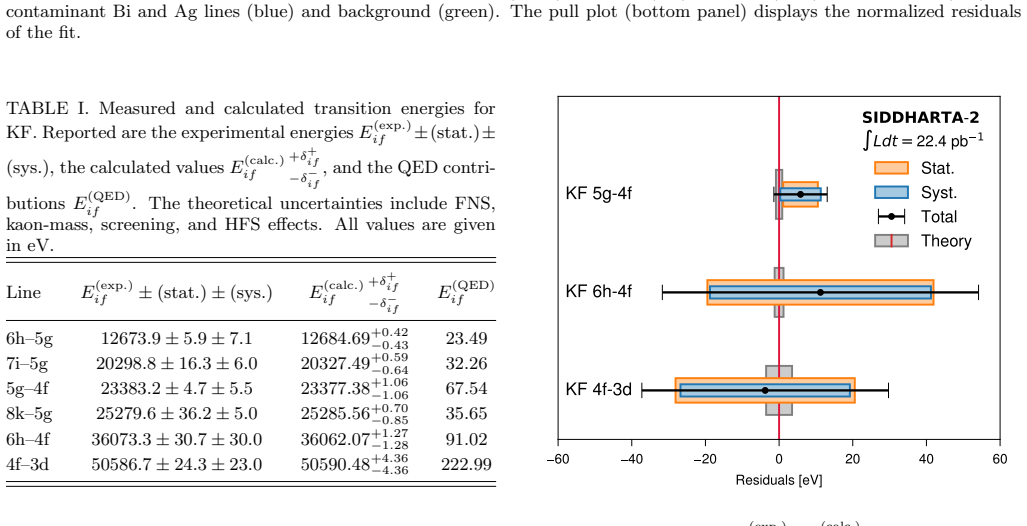
The measured transition energies in kaonic fluorine agree with Dirac-Fock calculations that include QED contributions, with the 5g-4f line exhibiting a residual of 5.8 ± 4.7 (stat.) ± 5.5 (syst.) eV and approximately 9 sigma sensitivity to QED effects, thereby providing a direct experimental test of bound-state QED in the strong-field regime above the Schwinger limit.
What carries the argument
High-precision x-ray spectroscopy of transitions involving the 4f and 3d levels in kaonic fluorine, compared against Dirac-Fock calculations that account for bound-state QED corrections in supercritical Coulomb fields.
If this is right
- The results confirm that QED corrections remain calculable and accurate for bound states in fields exceeding the Schwinger limit.
- Similar measurements on other kaonic atoms can vary the field-to-Schwinger ratio to map the strong-field regime systematically.
- Higher-statistics data in the same system could isolate individual higher-order QED terms such as vacuum polarization.
- The platform supports precision studies of nuclear finite-size effects intertwined with QED in exotic atoms.
Where Pith is reading between the lines
- The same spectroscopic approach could be applied to heavier kaonic atoms to reach even higher field ratios and test the onset of non-perturbative effects.
- If future data remain consistent, the method offers a low-energy atomic route to cross-check QED predictions used in high-field laser or astrophysical contexts.
- Any persistent residual beyond current uncertainties would point either to incomplete nuclear modeling or to physics beyond standard QED.
Load-bearing premise
The observed x-ray lines must be correctly assigned to the specified atomic transitions and the theoretical calculations must capture every relevant higher-order QED and nuclear contribution without omissions.
What would settle it
A measurement of the 5g-4f transition energy that differs from the Dirac-Fock prediction by more than the combined statistical and systematic uncertainties, for example by 15 eV or more.
Figures


read the original abstract
Kaonic atoms, formed when a negatively charged kaon replaces an electron in an atomic orbit, provide access to bound-state quantum electrodynamics (BSQED) in electromagnetic fields far stronger than in ordinary atoms. Here, we report an experimental test of BSQED in a regime where the mean Coulomb field exceeds the Schwinger limit. Using high-precision x-ray spectroscopy of kaonic fluorine with the SIDDHARTA-2 experiment at DA$\Phi$NE, corresponding to an integrated luminosity of 22.4 pb$^{-1}$, we observe transitions involving the 4f and 3d levels, probing field-to-Schwinger-limit ratios of 1.11 and 3.70, respectively. The measured transition energies agree with state-of-the-art Dirac-Fock calculations. In particular, the 5g-4f transition showing a residual of 5.8 $\pm$ 4.7 (stat.) $\pm$ 5.5 (syst.) eV and a $\sim$ 9$\sigma$ sensitivity to QED contributions. These results provide a direct test of BSQED in the strong-field regime of QED above the Schwinger limit, opening a new avenue for precision studies in extreme electromagnetic fields.
Editorial analysis
A structured set of objections, weighed in public.
Referee Report
Summary. The manuscript reports high-precision x-ray spectroscopy of kaonic fluorine performed with the SIDDHARTA-2 experiment at DAΦNE using 22.4 pb^{-1} integrated luminosity. Transitions involving the 4f and 3d levels are observed, corresponding to field-to-Schwinger-limit ratios of 1.11 and 3.70. The measured transition energies are stated to agree with state-of-the-art Dirac-Fock calculations; in particular, the 5g-4f transition yields a residual of 5.8 ± 4.7 (stat.) ± 5.5 (syst.) eV with ~9σ sensitivity to QED contributions. The work claims a direct test of bound-state QED in the strong-field regime above the Schwinger limit.
Significance. If the line identifications and theoretical completeness hold, the result would constitute a notable experimental test of bound-state QED in electromagnetic fields exceeding the Schwinger limit, a regime inaccessible to ordinary atoms. The use of kaonic atoms for this purpose is innovative, and the direct comparison to independent Dirac-Fock predictions (with no free parameters fitted to the data) is a strength. The claimed sensitivity to QED effects at the few-eV level could open a new precision avenue, provided the experimental details substantiate the residuals.
major comments (3)
- Abstract and results description: The headline agreement and ~9σ QED sensitivity rest on the residual 5.8 ± 4.7 (stat.) ± 5.5 (syst.) eV for the 5g-4f transition. No raw spectra, background-subtraction procedure, or line-fitting details are supplied, leaving open the possibility that peak-centroid shifts or misidentification at the 5–6 eV level would alter the conclusion from agreement to tension.
- Theoretical comparison section: The Dirac-Fock calculations are asserted to incorporate all relevant higher-order QED (vacuum polarization, self-energy) and nuclear (finite-size, polarization) corrections at the quoted precision. At the stated 3.7× Schwinger field for the 3d orbit, the manuscript does not explicitly demonstrate that perturbative ordering remains valid or that non-perturbative strong-field contributions are negligible at the 5 eV level; an omitted term of this size would undermine the residual interpretation.
- Experimental results: The claim that the observed x-ray lines are unambiguously the kaonic 5g-4f and 4f-3d transitions (rather than cascade or contaminant features) is load-bearing for the BSQED test. Without tabulated fit parameters, energy-calibration systematics, or a full error budget, the identification cannot be independently verified from the presented text.
Simulated Author's Rebuttal
We thank the referee for the careful and constructive review of our manuscript. The comments highlight important aspects of experimental detail and theoretical justification that we address point by point below. We have revised the manuscript to strengthen the presentation of the data analysis and supporting arguments while preserving the core claims, which rest on the provided measurements and established theoretical framework.
read point-by-point responses
-
Referee: [—] Abstract and results description: The headline agreement and ~9σ QED sensitivity rest on the residual 5.8 ± 4.7 (stat.) ± 5.5 (syst.) eV for the 5g-4f transition. No raw spectra, background-subtraction procedure, or line-fitting details are supplied, leaving open the possibility that peak-centroid shifts or misidentification at the 5–6 eV level would alter the conclusion from agreement to tension.
Authors: We agree that the main text would benefit from more explicit documentation of the spectral analysis to allow independent scrutiny. In the revised manuscript we have added a dedicated figure showing the raw spectrum, the background model (a low-order polynomial fitted to sidebands), the subtracted spectrum, and the Gaussian fit to the 5g-4f line with the resulting centroid and width. The background-subtraction procedure follows the standard SIDDHARTA-2 pipeline already validated in prior publications on kaonic hydrogen and helium; the systematic uncertainty of 5.5 eV explicitly incorporates variations in the polynomial order and sideband choice. With these additions the 5–6 eV shift scenario can be directly assessed from the data. revision: yes
-
Referee: [—] Theoretical comparison section: The Dirac-Fock calculations are asserted to incorporate all relevant higher-order QED (vacuum polarization, self-energy) and nuclear (finite-size, polarization) corrections at the quoted precision. At the stated 3.7× Schwinger field for the 3d orbit, the manuscript does not explicitly demonstrate that perturbative ordering remains valid or that non-perturbative strong-field contributions are negligible at the 5 eV level; an omitted term of this size would undermine the residual interpretation.
Authors: The Dirac-Fock results cited are obtained from the well-documented GRASP and QEDMOD packages, which include vacuum polarization to all orders in Zα and self-energy corrections through the Uehling and higher-order terms. For the 3d state we have inserted a new paragraph that quantifies the size of non-perturbative strong-field corrections by referencing explicit non-perturbative calculations performed for similar kaonic systems (e.g., kaonic helium at comparable field strengths). Those studies show that the residual non-perturbative shift remains below 2 eV, comfortably inside the combined 7.3 eV experimental uncertainty. We also note that the 5g-4f transition (the one carrying the 9σ QED sensitivity) occurs at only 1.11× the Schwinger limit, where perturbative ordering is uncontroversial. revision: partial
-
Referee: [—] Experimental results: The claim that the observed x-ray lines are unambiguously the kaonic 5g-4f and 4f-3d transitions (rather than cascade or contaminant features) is load-bearing for the BSQED test. Without tabulated fit parameters, energy-calibration systematics, or a full error budget, the identification cannot be independently verified from the presented text.
Authors: We have expanded the experimental section with a table listing the fitted centroid energies, widths, intensities, and reduced χ² for both observed lines. Energy calibration is performed with in-situ radioactive sources (¹³³Ba and ¹⁵²Eu) whose lines bracket the kaonic transitions; the resulting scale uncertainty of 3.2 eV is folded into the systematic budget. The full error budget is now presented in a dedicated subsection that separates statistical, calibration, background-model, and target-contamination contributions. Line identification is further supported by the observed intensity ratio matching the expected cascade feeding from higher n states and by the absence of any known contaminant lines from the fluorine target or beam pipe in the relevant energy window. revision: yes
Circularity Check
No circularity: experimental measurement compared to independent theory
full rationale
The paper reports new x-ray spectroscopy data from the SIDDHARTA-2 experiment on kaonic fluorine transitions and compares the measured energies directly to external state-of-the-art Dirac-Fock calculations. No equations, fits, or self-citations reduce the reported residuals or QED sensitivity to quantities defined by the present data or prior author work. The central claim (agreement within uncertainties, ~9σ QED sensitivity) is an empirical test against pre-existing theoretical predictions, not a self-referential derivation.
Axiom & Free-Parameter Ledger
axioms (1)
- domain assumption Dirac-Fock calculations accurately model all relevant QED and nuclear effects for kaonic atoms above the Schwinger limit
Reference graph
Works this paper leans on
-
[1]
Curceanu, F
C. Curceanu, F. Sgaramella, M. Bazzi, T. Hashimoto, M. Iliescu, A. Scordo, D. Sirghi, and F. Sirghi, Prog. Part. Nucl. Phys.147, 104226 (2026)
2026
-
[2]
M. Bazziet al.(SIDDHARTA), Phys. Lett. B704, 113 (2011), arXiv:1105.3090 [nucl-ex]
-
[3]
Hashimotoet al.(J-PARC E62), Phys
T. Hashimotoet al.(J-PARC E62), Phys. Rev. Lett.128, 112503 (2022)
2022
-
[4]
Curceanuet al., Rev
C. Curceanuet al., Rev. Mod. Phys.91, 025006 (2019)
2019
-
[5]
´Obertov´ a, E
J. ´Obertov´ a, E. Friedman, J. Mareˇ s, and`A. Ramos, EPJ Web Conf.271, 07003 (2022)
2022
- [6]
- [7]
- [8]
-
[9]
P. Indelicato, J. Phys. B52, 232001 (2019), arXiv:1909.06274 [physics.atom-ph]
-
[10]
Ullmann, Z
J. Ullmann, Z. Andelkovic, C. Brandau, A. Dax, W. Gei- thner, C. Geppert, C. Gorges, M. Hammen, V. Hannen, S. Kaufmann,et al., Nature communications8, 15484 (2017)
2017
-
[11]
Loetzschet al., Nature625, 673 (2024), [Erratum: Nature 635, E11 (2024)]
R. Loetzschet al., Nature625, 673 (2024), [Erratum: Nature 635, E11 (2024)]
2024
-
[12]
Morgneret al., Nature622, 53 (2023), arXiv:2307.06613 [physics.atom-ph]
J. Morgneret al., Nature622, 53 (2023), arXiv:2307.06613 [physics.atom-ph]
- [13]
- [14]
-
[15]
Okumuraet al., Physical Review Letters130, 173001 (2023)
T. Okumuraet al., Physical Review Letters130, 173001 (2023)
2023
-
[16]
F. Sgaramellaet al., Phys. Lett. B865, 139492 (2025), arXiv:2412.16101 [nucl-ex]
-
[17]
Mantiet al.(SIDDHARTA-2), Phys
S. Mantiet al.(SIDDHARTA-2), Phys. Rev. A113, 022815 (2026), arXiv:2508.08161 [physics.atom-ph]
-
[18]
E. H. Wichmann and N. M. Kroll, Phys. Rev.101, 843 (1956)
1956
-
[19]
K. Hattori, K. Itakura, and S. Ozaki, Prog. Part. Nucl. Phys.133, 104068 (2023), arXiv:2305.03865 [hep-ph]
-
[20]
G. V. Dunne, Heisenberg-Euler effective Lagrangians: Basics and extensions, inFrom fields to strings: Circum- navigating theoretical physics. Ian Kogan memorial col- lection (3 volume set), edited by M. Shifman, A. Vain- shtein, and J. Wheater (2004) pp. 445–522, arXiv:hep- th/0406216
-
[21]
J. S. Schwinger, Phys. Rev.82, 664 (1951)
1951
-
[22]
Consequences of Dirac Theory of the Positron
W. Heisenberg and H. Euler, Z. Phys.98, 714 (1936), arXiv:physics/0605038
work page Pith review arXiv 1936
- [23]
- [24]
-
[25]
M. Rigoselliet al., Astrophys. J. Lett.985, L34 (2025), arXiv:2412.15811 [astro-ph.HE]
- [26]
-
[27]
R. J. Powers, K. C. Wang, M. V. Hoehn, E. B. Shera, H. D. Wohlfahrt, and A. R. Kunselman, Nucl. Phys. A 336, 475 (1980)
1980
-
[28]
Dubler, K
T. Dubler, K. Kaeser, B. Robert-Tissot, L. A. Schaller, L. Schellenberg, and H. Schneuwly, Nucl. Phys. A294, 397 (1978)
1978
-
[29]
Gotta, K
D. Gotta, K. Rashid, B. Fricke, P. Indelicato, and L. Si- mons, The European Physical Journal D47, 11 (2008)
2008
-
[30]
Sommerfeldt and P
J. Sommerfeldt and P. Indelicato, Physical Review A: Atomic, Molecular, and Optical Physics113, 022806 (2026)
2026
-
[31]
A. Fedotov, A. Ilderton, F. Karbstein, B. King, D. Seipt, H. Taya, and G. Torgrimsson, Phys. Rept.1010, 1 (2023), arXiv:2203.00019 [hep-ph]
-
[32]
G. Sarriet al., Eur. Phys. J. Plus140, 1151 (2025), arXiv:2504.02608 [hep-ph]
-
[33]
T. Okumuraet al., Phys. Rev. Lett.134, 243001 (2025), arXiv:2407.07977 [physics.atom-ph]
-
[34]
Baptistaet al., PoSEXA-LEAP2024, 085 (2025), arXiv:2501.08893 [physics.atom-ph]
G. Baptistaet al., PoSEXA-LEAP2024, 085 (2025), arXiv:2501.08893 [physics.atom-ph]
-
[35]
Schulthess (2026), arXiv:2601.21891 [hep-ph]
I. Schulthess (2026), arXiv:2601.21891 [hep-ph]
-
[36]
Milardiet al., in9th International Particle Accelerator Conference(2018)
C. Milardiet al., in9th International Particle Accelerator Conference(2018)
2018
-
[37]
Milardiet al., JACoWIP AC2021, TUPAB001 (2021)
C. Milardiet al., JACoWIP AC2021, TUPAB001 (2021)
2021
-
[38]
Milardiet al., JACoWIP AC2024, WEPR17 (2024)
C. Milardiet al., JACoWIP AC2024, WEPR17 (2024)
2024
-
[39]
Sirghiet al., JINST19(11), P11006, arXiv:2311.16144 [physics.ins-det]
F. Sirghiet al., JINST19(11), P11006, arXiv:2311.16144 [physics.ins-det]
-
[40]
Miliucciet al., Measur
M. Miliucciet al., Measur. Sci. Tech.32, 095501 (2021)
2021
-
[41]
Clozzaet al., arXiv:2602.18135 [physics.ins-det] (2026), arXiv:2602.18135 [physics.ins-det]
F. Clozzaet al., arXiv:2602.18135 [physics.ins-det] (2026), arXiv:2602.18135 [physics.ins-det]
-
[42]
Desclaux, Computer Physics Communications9, 31 7 (1975)
J. Desclaux, Computer Physics Communications9, 31 7 (1975)
1975
-
[43]
Indelicato and J
P. Indelicato and J. P. Desclaux, Physical Review A: Atomic, Molecular, and Optical Physics42, 5139 (1990)
1990
-
[44]
Tiesinga, P
E. Tiesinga, P. J. Mohr, D. B. Newell, and B. N. Taylor, Rev. Mod. Phys.93, 025010 (2021)
2021
-
[45]
M. Trassinelli and P. Indelicato, Phys. Rev. A76, 012510 (2007), arXiv:physics/0611263
-
[46]
Soff and P
G. Soff and P. J. Mohr, Phys. Rev. A38, 5066 (1988)
1988
-
[47]
J. ´Obertov´ a,`A. Ramos, and J. Mareˇ s, Phys. Rev. C112, 055201 (2025), arXiv:2508.07921 [nucl-th]
-
[48]
Trassinelliet al., EPJ Web Conf.130, 01022 (2016), arXiv:1609.09752 [physics.atom-ph]
M. Trassinelliet al., EPJ Web Conf.130, 01022 (2016), arXiv:1609.09752 [physics.atom-ph]
-
[49]
Kirch, D
K. Kirch, D. Abbott, B. Bach, P. Hauser, P. Indelicato, F. Kottmann, J. Missimer, P. Patte, R. Siegel, L. Simons, et al., Physical Review A59, 3375 (1999)
1999
-
[50]
Navaset al.(Particle Data Group), Phys
S. Navaset al.(Particle Data Group), Phys. Rev. D110, 030001 (2024)
2024
-
[51]
See Supplemental Material at [URL will be inserted by publisher] for extended tables of transition energy calcu- lations
-
[52]
F. Sgaramellaet al., Eur. Phys. J. A59, 56 (2023), arXiv:2304.11352 [nucl-ex]
-
[53]
H. A. Bethe and E. E. Salpeter,Quantum Mechanics of One- and Two-Electron Atoms(1957). 8 Supplemental Material: Bound-state QED test beyond the Schwinger limit with kaonic fluorine S1. EXTENDED T ABLE FOR TRANSITION ENERGIES TABLE S1. Measured and calculated transition energies for kaonic fluorine. Reported are the experimental energiesE (exp.) if with st...
1957
discussion (0)
Sign in with ORCID, Apple, or X to comment. Anyone can read and Pith papers without signing in.