Recognition: unknown
Scientific tools and Innovation: Big Science Facilities Yield More Novel and Interdisciplinary Knowledge
Pith reviewed 2026-05-10 01:12 UTC · model grok-4.3
The pith
Big Science Facilities produce publications with higher recombinant novelty and interdisciplinary integration than matched controls by the same authors.
A machine-rendered reading of the paper's core claim, the machinery that carries it, and where it could break.
Core claim
Publications supported by Big Science Facilities exhibit higher recombinant novelty and interdisciplinary integration compared to matched controls. This improvement is most pronounced in non-physical sciences domains traditionally peripheral to the facilities' core focus, indicating a powerful intra-facility knowledge spillover effect.
What carries the argument
Comparison of BSF-supported publications to last-author-matched control publications, using metrics for recombinant novelty and interdisciplinarity to quantify the spillover.
Load-bearing premise
That matching publications solely on the last author sufficiently controls for differences in researcher quality, career stage, field norms, and other confounders that could independently drive measured novelty and interdisciplinarity.
What would settle it
Finding no significant difference in novelty or interdisciplinarity after additionally matching on institution, funding source, or using author fixed effects across multiple time periods.
Figures


read the original abstract
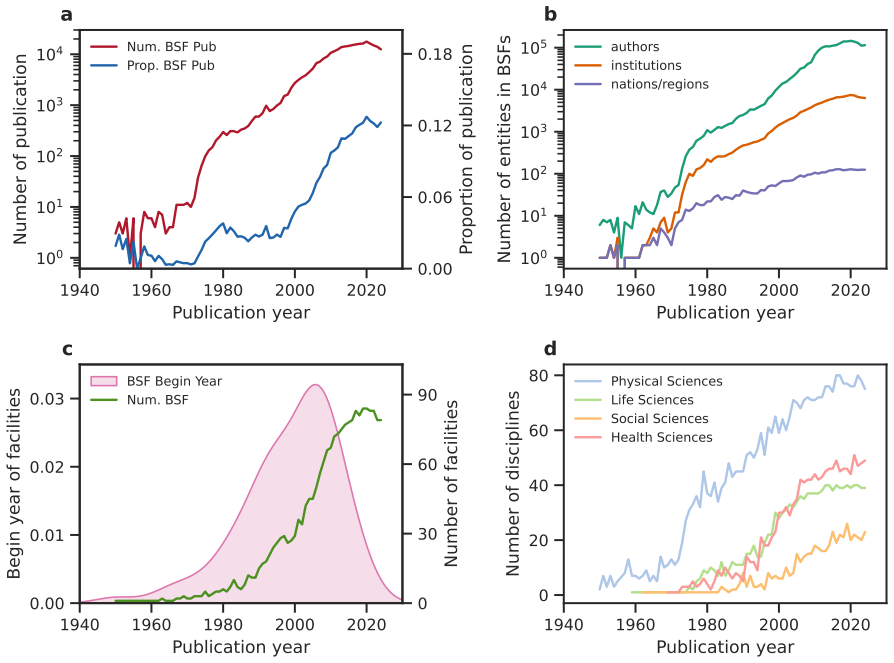
Scientific tools dictate the boundaries of human knowledge, serving as the foundation for perceptions and explorations. In the era of Big Science, science are increasingly dependent on advanced analytical technologies and experimental platforms. Over the past decades, national and supranational entities have invested massive financial resources, collaborative networks, and collective intelligence to construct Big Science Facilities (BSFs) aimed at generating cutting edge knowledge. However, empirical evaluations of these machines actual performance in driving scientific innovation remain scarce. To address this gap, we collected 310,086 publications from 88 global BSFs and constructed a matched control dataset of approximately 3 million publications sharing the same last authors. Our analysis reveals that the utilization of BSFs has expanded significantly since 1950s. Crucially, publications supported by these facilities exhibit higher recombinant novelty and interdisciplinary integration. Furthermore, this improvement is most pronounced in non physical sciences domains traditionally peripheral to BSFs core focus indicating the emergence of a powerful intra facility knowledge spillover effect. By enriching the Facilitymetrics framework, our findings provide empirical evidence that BSFs act as vital engines for scientific discovery, offering policymakers essential metrics to justify infrastructural investments, while prompting the science of science community to reassess the profound impact of scientific tools on knowledge production
Editorial analysis
A structured set of objections, weighed in public.
Referee Report
Summary. The paper collects 310,086 publications acknowledging 88 global Big Science Facilities (BSFs) and constructs a matched control set of ~3 million papers sharing the same last author. It reports that BSF-supported papers display higher recombinant novelty and interdisciplinary integration than controls, with the largest gains in non-physical science domains traditionally peripheral to BSFs, which the authors interpret as evidence of intra-facility knowledge spillovers. The study also documents the secular expansion of BSF use since the 1950s and situates the results within an expanded Facilitymetrics framework.
Significance. If the matched comparison survives additional controls for team size, year, and selection, the findings would supply rare large-scale evidence that major research infrastructure generates measurable novelty and cross-domain integration, especially outside core physical-science fields. Such results could strengthen the empirical basis for Facilitymetrics and inform policy justification for continued public investment in BSFs.
major comments (3)
- [Methods (dataset construction and matching)] Methods section on dataset construction: the control group is formed solely by matching on the last author. This leaves unmatched differences in publication year, number of co-authors, team size, cited-field diversity at baseline, and grant resources—factors that are definitionally higher in BSF papers and that mechanically elevate recombinant-novelty and interdisciplinarity scores. No propensity weighting, author-year fixed effects, or balance tables are described, rendering the central claim that BSF use causes higher novelty vulnerable to confounding.
- [Results (novelty and interdisciplinarity analysis)] Results section reporting novelty and interdisciplinarity differences: the manuscript supplies no explicit operationalization of the recombinant-novelty metric (e.g., exact keyword- or citation-combination formula), the interdisciplinarity index, the statistical tests employed, or any robustness checks (e.g., alternative matching specifications or subsample analyses). Without these details the reported effect sizes and the claim of stronger effects in non-physical domains cannot be evaluated.
- [Discussion (spillover interpretation)] Discussion section interpreting the spillover effect: the inference that larger gains in non-physical domains reflect “intra-facility knowledge spillover” presupposes that the last-author match has already removed selection on project ambition and cross-field collaboration. The design does not test this; ambitious spillover projects may simply be more likely to acknowledge BSF resources, producing the observed pattern without any causal facility effect.
minor comments (2)
- [Abstract] Abstract: grammatical issues include “science are increasingly dependent” (should be “sciences are”) and “machines actual performance” (should be “machines’ actual performance” or rephrased for clarity).
- [Introduction / Literature review] The manuscript does not cite or engage with prior quantitative work on facility impacts (e.g., studies using grant acknowledgments or facility-user registries), which would help situate the novelty of the last-author matching approach.
Simulated Author's Rebuttal
We thank the referee for their thoughtful and constructive comments on our manuscript. We address each of the major comments in turn below, and we indicate the revisions we plan to make to strengthen the paper.
read point-by-point responses
-
Referee: Methods section on dataset construction: the control group is formed solely by matching on the last author. This leaves unmatched differences in publication year, number of co-authors, team size, cited-field diversity at baseline, and grant resources—factors that are definitionally higher in BSF papers and that mechanically elevate recombinant-novelty and interdisciplinarity scores. No propensity weighting, author-year fixed effects, or balance tables are described, rendering the central claim that BSF use causes higher novelty vulnerable to confounding.
Authors: Matching on the last author provides a strong control for author-specific heterogeneity, including research interests, productivity, and collaboration tendencies, which are key to selection into BSF use. However, we recognize that differences in publication year, team size, and other factors may remain. In the revised manuscript, we will include balance tables to document covariate differences, incorporate year fixed effects and author-year interactions where feasible, and explore propensity score matching or weighting using available metadata such as field and year. We will also clarify in the text that our estimates represent associations conditional on the last author rather than fully causal effects. revision: partial
-
Referee: Results section reporting novelty and interdisciplinarity differences: the manuscript supplies no explicit operationalization of the recombinant-novelty metric (e.g., exact keyword- or citation-combination formula), the interdisciplinarity index, the statistical tests employed, or any robustness checks (e.g., alternative matching specifications or subsample analyses). Without these details the reported effect sizes and the claim of stronger effects in non-physical domains cannot be evaluated.
Authors: We regret that the detailed operationalizations were not sufficiently prominent in the main text. The recombinant novelty metric follows the established approach of identifying atypical combinations of cited references or keywords (as in Uzzi et al. 2013), and the interdisciplinarity index is the Rao-Stirling diversity measure based on field classifications. Statistical tests are t-tests and regression models with standard errors clustered at the author level. We will expand the Methods section with the precise formulas, data sources for classifications, and add a dedicated robustness section including alternative specifications (e.g., matching also on year and journal), subsample analyses by scientific domain, and sensitivity checks. These elements will allow readers to fully evaluate the results. revision: yes
-
Referee: Discussion section interpreting the spillover effect: the inference that larger gains in non-physical domains reflect “intra-facility knowledge spillover” presupposes that the last-author match has already removed selection on project ambition and cross-field collaboration. The design does not test this; ambitious spillover projects may simply be more likely to acknowledge BSF resources, producing the observed pattern without any causal facility effect.
Authors: The referee correctly notes that our interpretation of knowledge spillovers is based on the observed pattern of larger effects in non-traditional domains, but the matching does not directly test for selection on project ambition. We will revise the Discussion to present the spillover interpretation as one plausible mechanism supported by the data, while explicitly acknowledging alternative explanations such as differential selection of ambitious cross-disciplinary projects into BSF acknowledgment. We will avoid strong causal language and suggest avenues for future causal identification, such as instrumental variable approaches or natural experiments around facility access. revision: partial
Circularity Check
Empirical last-author matching yields no circularity
full rationale
The paper performs a direct empirical comparison: it assembles 310k BSF-supported publications, builds a ~3M control set by matching on last author only, and reports higher recombinant novelty and interdisciplinarity scores in the BSF set. These scores are computed from external publication metadata (keywords, citations) rather than from any internal fitted parameters, self-referential definitions, or equations that would make the outcome equivalent to the input by construction. No derivation chain, uniqueness theorem, or ansatz is invoked that reduces the claimed spillover effect to a tautology; the result remains an observable data difference subject to external falsification.
Axiom & Free-Parameter Ledger
axioms (2)
- domain assumption Last-author matching on publication records adequately balances researcher-level and field-level confounders
- domain assumption Recombinant novelty and interdisciplinarity metrics are reliable indicators of scientific innovation
Reference graph
Works this paper leans on
-
[1]
1963 , publisher=
Little science, big science , author=. 1963 , publisher=
1963
-
[2]
Science, Politics and Organization in Europe and the United States: Palgrave Macmillan , year=
Big science transformed , author=. Science, Politics and Organization in Europe and the United States: Palgrave Macmillan , year=
-
[3]
The new big science , author=. Physics Today , volume=. 2016 , publisher=. doi:10.1063/PT.3.3167 , url=
-
[4]
Journal of Physics: Conference Series , volume=
Megascience facilities in global research infrastructure , author=. Journal of Physics: Conference Series , volume=. 2020 , organization=. doi:10.1088/1742-6596/1685/1/012014 , url=
-
[5]
Synching Europe's big science facilities , author=. Nature , volume=. 2010 , publisher=. doi:10.1038/464659a , url=
-
[6]
Nature , volume=
‘Big science’spurs collaborative trend , author=. Nature , volume=. 2010 , doi=
2010
-
[7]
Scientific American , volume=
Little big science , author=. Scientific American , volume=. 2001 , publisher=
2001
-
[8]
Nature , volume=
The collider that cried ‘Higgs’ , author=. Nature , volume=. 2011 , doi=
2011
-
[9]
Gravitational wave detection wins physics Nobel. , author=. Nature , volume=. 2017 , publisher=. doi:10.1038/nature.2017.22737 , url=
-
[10]
Humanities and Social Sciences Communications , year=
Zhang, Mingze and Wang, Lili and Zhang, Lingling and Li, Zexia , title=. Humanities and Social Sciences Communications , year=. doi:10.1057/s41599-026-06992-9 , url=
-
[11]
Co-authorship networks and research impact in large research facilities: Benchmarking internal reports and bibliometric databases , author=. Scientometrics , volume=. 2019 , publisher=. doi:10.1007/s11192-018-2967-4 , url=
-
[12]
Research collaboration in Large Scale Research Infrastructures: Collaboration types and policy implications , author=. Research Policy , volume=. 2019 , publisher=. doi:10.1016/j.respol.2019.01.011 , url=
-
[13]
Nature , volume=
HYPERAUTHORSHIP AND WHAT IT MEANS FOR ‘BIG TEAM’SCIENCE , author=. Nature , volume=. 2023 , doi=
2023
-
[14]
World’s brightest X-rays: China first in Asia to build next-generation synchrotron , author=. Nature , volume=. 2024 , publisher=. doi:10.1038/d41586-024-01346-4 , url=
-
[15]
Public support of science: A contingent valuation study of citizens' attitudes about CERN with and without information about implicit taxes , author=. Research Policy , volume=. 2023 , publisher=. doi:10.1016/j.respol.2022.104627 , url=
-
[16]
Journal of the Association for Information Science and Technology , volume=
Global reach, regional strength: Spatial patterns of a big science facility , author=. Journal of the Association for Information Science and Technology , volume=. 2023 , publisher=. doi:10.1002/asi.24811 , url=
-
[17]
History and tecHnology , volume=
The reinvention of the SLAC national accelerator laboratory, 1992--2012 , author=. History and tecHnology , volume=. 2017 , publisher=. doi:10.1080/07341512.2018.1449711 , url=
-
[18]
Effect of high energy physics large collaborations on higher education institutions citations and rankings , author=. Scientometrics , volume=. 2016 , publisher=. doi:10.1007/s11192-016-2048-5 , url=
-
[19]
Qualifying the performance evaluation of Big Science beyond productivity, impact and costs , author=. Scientometrics , volume=. 2015 , publisher=. doi:10.1007/s11192-015-1577-7 , url=
-
[20]
Review of Policy Research , volume=
How Large-Scale Research Facilities Connect to Global Research , author=. Review of Policy Research , volume=. 2013 , publisher=. doi:10.1111/ropr.12027 , url=
-
[21]
Social Science Quarterly , volume=
Waypoints for evaluating big science , author=. Social Science Quarterly , volume=. 2017 , publisher=. doi:10.1111/ssqu.12467 , url=
-
[22]
Quantitative Science Studies , volume=
Generic instruments in a synchrotron radiation facility , author=. Quantitative Science Studies , volume=. 2022 , publisher=. doi:10.1162/qss_a_00190 , url=
-
[23]
Library & Information Science Research , volume=
Author-team diversity and the impact of scientific publications: Evidence from physics research at a national science lab , author=. Library & Information Science Research , volume=. 2012 , publisher=. doi:10.1016/j.lisr.2012.03.001 , url=
-
[24]
Use and productivity of contemporary, multidisciplinary Big Science , author=. Research Evaluation , volume=. 2016 , publisher=. doi:10.1093/reseval/rvw019 , url=
-
[25]
How expensive is Big Science? Consequences of using simple publication counts in performance assessment of large scientific facilities , author=. Scientometrics , volume=. 2014 , publisher=. doi:10.1007/s11192-014-1249-z , url=
-
[26]
Industry and Higher Education , volume=
Collaborative technological innovation in an academic, user-oriented big science facility , author=. Industry and Higher Education , volume=. 2017 , publisher=. doi:10.1177/0950422217729284 , url=
-
[27]
Introducing ‘facilitymetrics’: a first review and analysis of commonly used measures of scientific leadership among synchrotron radiation facilities worldwide , author=. Scientometrics , volume=. 2013 , publisher=. doi:10.1007/s11192-012-0945-9 , url=
-
[28]
Nature Reviews Physics , volume=
Visualizing big science projects , author=. Nature Reviews Physics , volume=. 2021 , publisher=. doi:10.1038/s42254-021-00374-7 , url=
-
[29]
The structure and dynamics of instrument collaboration networks , author=. Scientometrics , volume=. 2023 , publisher=. doi:10.1007/s11192-023-04658-w , url=
-
[30]
The impact of team compositions on disruptive and novel research in large-scale research infrastructures , author=. Scientometrics , volume=. 2025 , publisher=. doi:10.1007/s11192-025-05319-w , url=
-
[31]
Proceedings of the National Academy of Sciences , volume=
Team science for science communication , author=. Proceedings of the National Academy of Sciences , volume=. 2014 , publisher=. doi:10.1073/pnas.1320021111 , url=
-
[32]
2025 , doi=
A Novel Type Collaboration: Global Big Science Facilities Co-utilization , author=. 2025 , doi=
2025
-
[33]
2025 , doi=
Scientific Travelers Associated with Less Disruption but Better Scientific Novelty , author=. 2025 , doi=
2025
-
[34]
Bulletin of Chinese Academy of Sciences (Chinese Version) , volume=
Facilities’ scientists affect scientific impacts of large-scale research infrastructures’ outputs , author=. Bulletin of Chinese Academy of Sciences (Chinese Version) , volume=. 2024 , publisher=. doi:10.3724/j.issn.1000-3045.20240226001 , url=
-
[35]
OpenAlex: A fully-open index of scholarly works, authors, venues, institutions, and concepts , author=. arXiv preprint arXiv:2205.01833 , year=. doi:10.48550/arXiv.2205.01833 , url=
-
[36]
Quantitative Science Studies , volume=
Author mentions in science news reveal widespread disparities across name-inferred ethnicities , author=. Quantitative Science Studies , volume=. 2024 , publisher=. doi:10.1162/qss_a_00297 , url=
-
[37]
Humanities and Social Sciences Communications , volume=
Repeat collaboration and scientific innovation: evidence from dynamic ego networks of Nobel laureates , author=. Humanities and Social Sciences Communications , volume=. 2025 , publisher=. doi:10.1057/s41599-025-05887-5 , url=
-
[38]
Proceedings of the National Academy of Sciences , volume=
Gender-diverse teams produce more novel and higher-impact scientific ideas , author=. Proceedings of the National Academy of Sciences , volume=. 2022 , publisher=. doi:10.1073/pnas.2200841119 , url=
-
[39]
The geography of novel and atypical research , author=. Research Policy , volume=. 2026 , publisher=. doi:10.1016/j.respol.2025.105345 , url=
-
[40]
International research collaboration: Novelty, conventionality, and atypicality in knowledge recombination , author=. Research policy , volume=. 2019 , publisher=. doi:10.1016/j.respol.2019.01.002 , url=
-
[41]
Proceedings of the National Academy of Sciences , volume=
The distinctive innovation patterns and network embeddedness of scientific prizewinners , author=. Proceedings of the National Academy of Sciences , volume=. 2025 , publisher=. doi:10.1073/pnas.2424143122 , url=
-
[42]
Atypical combinations and scientific impact , author=. Science , volume=. 2013 , publisher=. doi:10.1126/science.1240474 , url=
-
[43]
arXiv preprint arXiv:2506.15959 , year=
Can Recombination Displace Dominant Scientific Ideas , author=. arXiv preprint arXiv:2506.15959 , year=. doi:10.48550/arXiv.2506.15959 , url=
-
[44]
Information Processing & Management , volume=
Unraveling topic switching and innovation in science , author=. Information Processing & Management , volume=. 2025 , publisher=. doi:10.1016/j.ipm.2025.104171 , url=
-
[45]
Journal of Information Science , pages=
Understanding the relationship between interdisciplinary knowledge and disruption in science , author=. Journal of Information Science , pages=. 2025 , publisher=. doi:10.1177/01655515251330614 , url=
-
[46]
Interdisciplinarity and impact: Distinct effects of variety, balance, and disparity , author=. PloS one , volume=. 2015 , publisher=. doi:10.1371/journal.pone.0127298 , url=
-
[47]
Journal of informetrics , volume=
Interdisciplinarity as diversity in citation patterns among journals: Rao-Stirling diversity, relative variety, and the Gini coefficient , author=. Journal of informetrics , volume=. 2019 , publisher=. doi:10.1016/j.joi.2018.12.006 , url=
-
[48]
Technological Forecasting and Social Change , volume=
Interdisciplinary research and technological change , author=. Technological Forecasting and Social Change , volume=. 2026 , publisher=. doi:10.1016/j.techfore.2026.124537 , url=
-
[49]
Information Processing & Management , volume=
The interaction of inter-organizational diversity and team size, and the scientific impact of papers , author=. Information Processing & Management , volume=. 2024 , publisher=. doi:10.1016/j.ipm.2024.103851 , url=
-
[50]
Journal of the Association for Information Science and Technology , volume=
Team power dynamics and team impact: New perspectives on scientific collaboration using career age as a proxy for team power , author=. Journal of the Association for Information Science and Technology , volume=. 2022 , publisher=. doi:10.1002/asi.24653 , url=
-
[51]
Journal of the Association for Information Science and Technology , volume=
The woman researcher's tale: A review of bibliometric methods and results for studying gender in science , author=. Journal of the Association for Information Science and Technology , volume=. 2025 , publisher=. doi:10.1002/asi.25012 , url=
-
[52]
Journal of the Association for Information Science and Technology , volume=
Why are coauthored academic articles more cited: Higher quality or larger audience? , author=. Journal of the Association for Information Science and Technology , volume=. 2023 , publisher=. doi:10.1002/asi.24755 , url=
-
[53]
Remote collaboration fuses fewer breakthrough ideas , author=. Nature , volume=. 2023 , publisher=. doi:10.1038/s41586-023-06767-1 , url=
-
[54]
Journal of informetrics , volume=
Further divided gender gaps in research productivity and collaboration during the COVID-19 pandemic: Evidence from coronavirus-related literature , author=. Journal of informetrics , volume=. 2022 , publisher=. doi:10.1016/j.joi.2022.101295 , url=
-
[56]
How journal rankings can suppress interdisciplinary research: A comparison between innovation studies and business & management , author=. Research policy , volume=. 2012 , publisher=. doi:10.1038/s41467-025-60590-y , url=
-
[57]
The sectoral configuration of technological innovation systems: Patterns of knowledge development and diffusion in the lithium-ion battery technology in Japan , author=. Research policy , volume=. 2017 , publisher=. doi:10.1016/j.respol.2017.01.009 , url=
-
[58]
Review of Economics and Statistics , pages=
Beyond citations: Measuring novel scientific ideas and their impact in publication text , author=. Review of Economics and Statistics , pages=. 2025 , publisher=. doi:10.1162/rest_a_01561 , url=
-
[59]
Institutional ecology,translations' and boundary objects: Amateurs and professionals in Berkeley's Museum of Vertebrate Zoology, 1907-39 , author=. Social studies of science , volume=. 1989 , publisher=. doi:10.1177/030631289019003001 , url=
-
[60]
doi:10.5281/zenodo.10949671 , url =
Van Eck, Nees Jan , title =. doi:10.5281/zenodo.10949671 , url =
-
[61]
Journal of the Association for Informati on Science and Technology
Bias against scientific novelty: A prepublication perspective , author=. Journal of the Association for Information Science and Technology , volume=. 2023 , publisher=. doi:10.1002/asi.24725 , url=
-
[62]
Nature Computational Science , volume=
Gender and racial diversity socialization in science , author=. Nature Computational Science , volume=. 2025 , publisher=. doi:10.1038/s43588-025-00795-9 , url=
-
[63]
Proceedings of the National Academy of Sciences , volume=
Flat teams drive scientific innovation , author=. Proceedings of the National Academy of Sciences , volume=. 2022 , publisher=. doi:10.1073/pnas.2200927119 , url=
-
[64]
Journal of the association for information science and technology , volume=
Diversity of references as an indicator of the interdisciplinarity of journals: Taking similarity between subject fields into account , author=. Journal of the association for information science and technology , volume=. 2016 , publisher=. doi:10.1002/asi.23487 , url=
-
[65]
Issues in Interdisciplinary Studies , year=
A theory of interdisciplinary studies , author=. Issues in Interdisciplinary Studies , year=
-
[66]
SciSciNet: A large-scale open data lake for the science of science research , author=. Scientific Data , volume=. 2023 , publisher=. doi:10.1038/s41597-023-02198-9 , url=
-
[67]
American Economic Review , volume=
Are ideas getting harder to find? , author=. American Economic Review , volume=. 2020 , publisher=. doi:10.1257/aer.20180338 , url=
-
[68]
Proceedings of the National Academy of Sciences , volume=
Slowed canonical progress in large fields of science , author=. Proceedings of the National Academy of Sciences , volume=. 2021 , publisher=. doi:10.1073/pnas.2021636118 , url=
-
[69]
The burden of knowledge and the “death of the renaissance man”: Is innovation getting harder? , author=. The Review of Economic Studies , volume=. 2009 , publisher=. doi:10.1111/j.1467-937X.2008.00531.x , url=
-
[70]
Journal of Knowledge Management , volume=
Knowledge spillover driven by institutions: evidence from the big science project in China , author=. Journal of Knowledge Management , volume=. 2021 , publisher=. doi:10.1108/JKM-11-2019-0675 , url=
-
[71]
Technological Forecasting and Social Change , volume=
Scientific effects of large research infrastructures in China , author=. Technological Forecasting and Social Change , volume=. 2016 , publisher=. doi:10.1016/j.techfore.2016.07.029 , url=
-
[72]
Managing innovation ecosystems around big science organizations , author=. Technovation , volume=. 2022 , publisher=. doi:10.1016/j.technovation.2022.102523 , url=
-
[73]
Journal of the Association for Information Science and Technology , volume=
Understanding discrepancies in the coverage of OpenAlex: The case of China , author=. Journal of the Association for Information Science and Technology , volume=. 2025 , publisher=. doi:10.1002/asi.70013 , url=
-
[74]
Missing institutions in OpenAlex: Possible reasons, implications, and solutions , author=. Scientometrics , volume=. 2024 , publisher=. doi:10.1007/s11192-023-04923-y , url=
-
[75]
Reference coverage analysis of OpenAlex compared to Web of Science and Scopus , author=. Scientometrics , volume=. 2025 , publisher=. doi:10.1007/s11192-025-05293-3 , url=
-
[76]
Cambridge journal of Economics , volume=
Schumpeterian patterns of innovation , author=. Cambridge journal of Economics , volume=. 1995 , publisher=
1995
-
[77]
Journal of Informetrics , volume=
Impact of gender composition of academic teams on disruptive output , author=. Journal of Informetrics , volume=. 2024 , publisher=. doi:10.1016/j.joi.2024.101520 , url=
-
[78]
Journal of the Association for Information Science and Technology , volume=
Quantifying the dynamics of research teams' academic diversity , author=. Journal of the Association for Information Science and Technology , volume=. 2025 , publisher=. doi:10.1002/asi.70023 , url=
-
[79]
The Economics of Caste and of the Rat Race and Other Woeful Tales
AI-assisted writing is growing fastest among non-english-speaking and less established scientists , author=. arXiv preprint arXiv:2511.15872 , year=. doi:10.48550/arXiv.2511.15872 , url=
-
[80]
Information Processing & Management , volume=
The impact of heterogeneous shared leadership in scientific teams , author=. Information Processing & Management , volume=. 2024 , publisher=. doi:10.1016/j.ipm.2023.103542 , url=
-
[81]
Humanities and Social Sciences Communications , volume=
Beamtimes and knowledge production times: how big-science research infrastructures shape nations’ domestic and international science production , author=. Humanities and Social Sciences Communications , volume=. 2024 , publisher=. doi:10.1057/s41599-024-03993-4 , url=
discussion (0)
Sign in with ORCID, Apple, or X to comment. Anyone can read and Pith papers without signing in.