Recognition: unknown
An Update on the Isospin-Breaking Effects in the Pion Decay Constant with Staggered Quarks
Pith reviewed 2026-05-10 01:16 UTC · model grok-4.3
The pith
Lattice calculations with staggered quarks are isolating isospin-breaking corrections to the pion decay constant.
A machine-rendered reading of the paper's core claim, the machinery that carries it, and where it could break.
Core claim
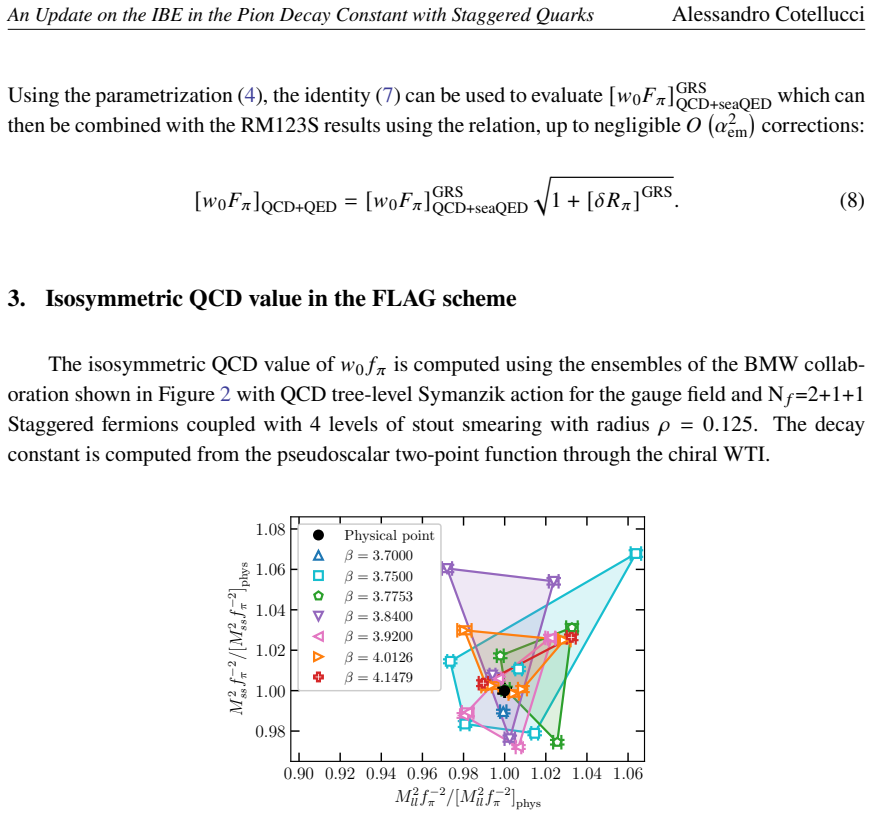
The authors present an update on the computation of isospin-breaking effects in the pion decay constant using Nf=2+1+1 staggered quarks at near-physical pion mass with QED_L. They provide the current isosymmetric value and its use in determining the gradient-flow scale w0, display preliminary valence-valence contributions to the axial-pseudoscalar correlator across several volumes and lattice spacings, and outline the remaining steps needed to complete the calculation.
What carries the argument
The valence-valence contribution to the axial-pseudoscalar correlator evaluated on staggered-quark lattices that include QED_L.
If this is right
- A completed calculation would supply a controlled lattice value for the electromagnetic shift in the pion decay constant.
- The updated w0 scale would tighten the overall calibration of the lattice ensembles.
- Control over volume and spacing dependence in the correlator would reduce systematic errors in the final isospin-breaking correction.
- The framework would be ready to incorporate sea-quark isospin breaking in subsequent work.
Where Pith is reading between the lines
- The same valence-valence technique could be applied to other leptonic decay constants to obtain consistent electromagnetic corrections.
- Once available, the result would allow a more precise extraction of CKM matrix elements from pion and kaon decays.
- Comparison with analytic predictions at this stage could already test whether the dominant effects are being captured before full sea-quark inclusion.
Load-bearing premise
The staggered action with QED_L and near-physical masses captures the dominant isospin-breaking contributions to the correlator without large uncontrolled discretization or finite-volume artifacts.
What would settle it
If the continuum-extrapolated valence-valence contribution fails to match the size and sign predicted by chiral perturbation theory for the electromagnetic correction to f_pi, the current approach would require substantial revision.
Figures



read the original abstract
We present an update on the ongoing computation of the isospin-breaking effects in the Pion Decay Constant from the BMW Collaboration. The calculation is carried out with N$_f$=2+1+1 staggered quarks with a near-physical pion mass and QED$_{\text{L}}$. We give an update on the isosymmetric value and the current determination used to compute the gradient-flow scale $w_{0}$, then we present some preliminary results of the valence-valence contribution to the axial-pseudoscalar correlator for different volumes and lattice spacings. We also discuss the next steps and plans.
Editorial analysis
A structured set of objections, weighed in public.
Referee Report
Summary. The manuscript is an update from the BMW Collaboration on their ongoing lattice QCD computation of isospin-breaking effects in the pion decay constant. It employs N_f=2+1+1 staggered quarks at near-physical pion mass with QED_L, reports an update to the isosymmetric value and the gradient-flow scale w_0, presents preliminary valence-valence contributions to the axial-pseudoscalar correlator across a few volumes and lattice spacings, and outlines next steps.
Significance. If completed with controlled extrapolations and uncertainties, the calculation would provide a valuable lattice determination of isospin-breaking corrections to f_π, relevant for precision tests of the Standard Model and CKM phenomenology. The staggered+QED_L setup is a standard choice for such studies, and the preliminary correlator data at multiple spacings and volumes represent incremental progress toward controlling discretization and finite-volume effects.
minor comments (3)
- Abstract: the preliminary results for the valence-valence axial-pseudoscalar correlator are described without any error bars, fit details, or numerical values, which limits the reader's ability to assess the current precision or trends with volume and spacing.
- The update on the isosymmetric w_0 determination (mentioned after the abstract) should explicitly state the fitting procedure or reference the prior isosymmetric work from which parameters are inherited, to clarify any potential circularity in the scale setting.
- The discussion of next steps would benefit from a brief outline of the planned chiral/continuum extrapolations and how the full isospin-breaking correction (including sea-quark contributions) will be assembled from the valence-valence piece shown.
Simulated Author's Rebuttal
We thank the referee for the positive evaluation of our manuscript and the recommendation for minor revision. The work is indeed a preliminary update on our ongoing N_f=2+1+1 staggered calculation with QED_L of isospin-breaking corrections to f_π, including updates to the isosymmetric value, w_0 scale setting, and sample valence-valence correlator data.
Circularity Check
No significant circularity detected
full rationale
The paper is a status update on an ongoing lattice QCD computation using staggered quarks with QED_L. It reports an update to the isosymmetric w0 scale (from prior BMW work) and preliminary valence-valence axial-pseudoscalar correlator results at a few volumes and spacings, without any final extrapolated value, derivation, or prediction of isospin-breaking corrections. No equation or claim reduces by construction to a fitted input, self-definition, or self-citation chain; the work remains computational and preliminary with no load-bearing circular steps.
Axiom & Free-Parameter Ledger
Reference graph
Works this paper leans on
-
[1]
Aoki, Y. and others. FLAG Review 2024. 2024. arXiv:2411.04268
work page internal anchor Pith review arXiv 2024
-
[2]
Di Carlo, M. and Giusti, D. and Lubicz, V. and Martinelli, G. and Sachrajda, C. T. and Sanfilippo, F. and Simula, S. and Tantalo, N. Light-meson leptonic decay rates in lattice QCD+QED. Phys. Rev. D. 2019. doi:10.1103/PhysRevD.100.034514. arXiv:1904.08731
-
[3]
Giusti, D. and Lubicz, V. and Martinelli, G. and Sachrajda, C. T. and Sanfilippo, F. and Simula, S. and Tantalo, N. and Tarantino, C. First lattice calculation of the QED corrections to leptonic decay rates. Phys. Rev. Lett. 2018. doi:10.1103/PhysRevLett.120.072001. arXiv:1711.06537
-
[4]
Di Carlo, M. and Hansen, M. T. and Portelli, A. and Hermansson-Truedsson, N. Relativistic, model-independent determination of electromagnetic finite-size effects beyond the pointlike approximation. Phys. Rev. D. 2022. doi:10.1103/PhysRevD.105.074509. arXiv:2109.05002
-
[5]
Lattice Calculation of Light Meson Radiative Leptonic Decays
Christ, Norman H. and Feng, Xu and Izubuchi, Taku and Jin, Luchang and Sachrajda, Christopher T. and Tuo, Xin-Yu. Lattice Calculation of Light Meson Radiative Leptonic Decays. 2025. arXiv:2510.26993
work page internal anchor Pith review Pith/arXiv arXiv 2025
-
[6]
Boyle, Peter and others. Isospin-breaking corrections to light-meson leptonic decays from lattice simulations at physical quark masses. JHEP. 2023. doi:10.1007/JHEP02(2023)242. arXiv:2211.12865
-
[7]
Lubicz, V. and Martinelli, G. and Sachrajda, C. T. and Sanfilippo, F. and Simula, S. and Tantalo, N. Finite-Volume QED Corrections to Decay Amplitudes in Lattice QCD. Phys. Rev. D. 2017. doi:10.1103/PhysRevD.95.034504. arXiv:1611.08497
-
[8]
Hybrid calculation of hadronic vacuum polarization in muon g-2 to 0.48\%
Boccaletti, A. and others. High precision calculation of the hadronic vacuum polarisation contribution to the muon anomaly. 2024. arXiv:2407.10913
work page internal anchor Pith review Pith/arXiv arXiv 2024
-
[9]
Properties and uses of the Wilson flow in lattice QCD
L. Properties and uses of the Wilson flow in lattice QCD. JHEP. 2010. doi:10.1007/JHEP08(2010)071. arXiv:1006.4518
-
[10]
Ramos, A. and Sint, S. Symanzik improvement of the gradient flow in lattice gauge theories. Eur. Phys. J. C. 2016. doi:10.1140/epjc/s10052-015-3831-9. arXiv:1508.05552
-
[11]
Aoki, Y. and others. FLAG Review 2021. Eur. Phys. J. C. 2022. doi:10.1140/epjc/s10052-022-10536-1. arXiv:2111.09849
-
[12]
Borsanyi, Sz. and others. Leading hadronic contribution to the muon magnetic moment from lattice QCD. Nature. 2021. doi:10.1038/s41586-021-03418-1. arXiv:2002.12347
-
[13]
Stokes, Finn M. and others. BMW/DMZ calculation of the hadronic vacuum polarisation for the muon magnetic moment. 2026. arXiv:2603.03835
-
[14]
Workman, R. L. and others. Review of Particle Physics. PTEP. 2022. doi:10.1093/ptep/ptac097
-
[15]
Giusti, D. and Lubicz, V. and Tarantino, C. and Martinelli, G. and Sanfilippo, F. and Simula, S. and Tantalo, N. Leading isospin-breaking corrections to pion, kaon and charmed-meson masses with Twisted-Mass fermions. Phys. Rev. D. 2017. doi:10.1103/PhysRevD.95.114504. arXiv:1704.06561
discussion (0)
Sign in with ORCID, Apple, or X to comment. Anyone can read and Pith papers without signing in.