Recognition: unknown
Next-to-leading order QCD and relativistic corrections to Z to J/psi+Upsilon(nS)
Pith reviewed 2026-05-10 02:32 UTC · model grok-4.3
The pith
NLO QCD and relativistic corrections substantially reduce the widths of Z to J/ψ plus Υ(nS) decays.
A machine-rendered reading of the paper's core claim, the machinery that carries it, and where it could break.
Core claim
Both the relativistic and QCD corrections are found to be large and negative. Compared to the leading-order results, the decay widths are significantly reduced by the higher-order corrections. Therefore, it is essential to take these corrections into account for a reliable estimation. For a high-luminosity electron positron collider running around the Z-pole, sizable event rates could be produced from these rare decay channels due to the Z-boson resonance effect.
What carries the argument
Nonrelativistic QCD factorization for mixed heavy-quarkonium production in Z decay, extended to NLO in the strong coupling and O(v^2) relativistic corrections.
If this is right
- Leading-order estimates significantly overestimate the decay rates.
- Sizable event rates remain possible at Z-pole colliders thanks to resonance enhancement.
- Reliable theoretical estimates for these channels must include both relativistic and QCD corrections.
Where Pith is reading between the lines
- The large negative corrections may indicate similar higher-order effects are important in other rare Z decays involving heavy quarkonia.
- These results could help constrain NRQCD matrix elements when compared to future data.
Load-bearing premise
The NRQCD factorization theorem remains valid and factorizable at next-to-leading order for this mixed-flavor process, together with the specific choices of quark masses, wave-function values at the origin, and renormalization scale.
What would settle it
A precise measurement of the Z to J/ψ + Υ branching fraction at a high-luminosity Z-pole collider that matches the leading-order prediction rather than the NLO-corrected one would show the corrections are not as large as calculated.
Figures
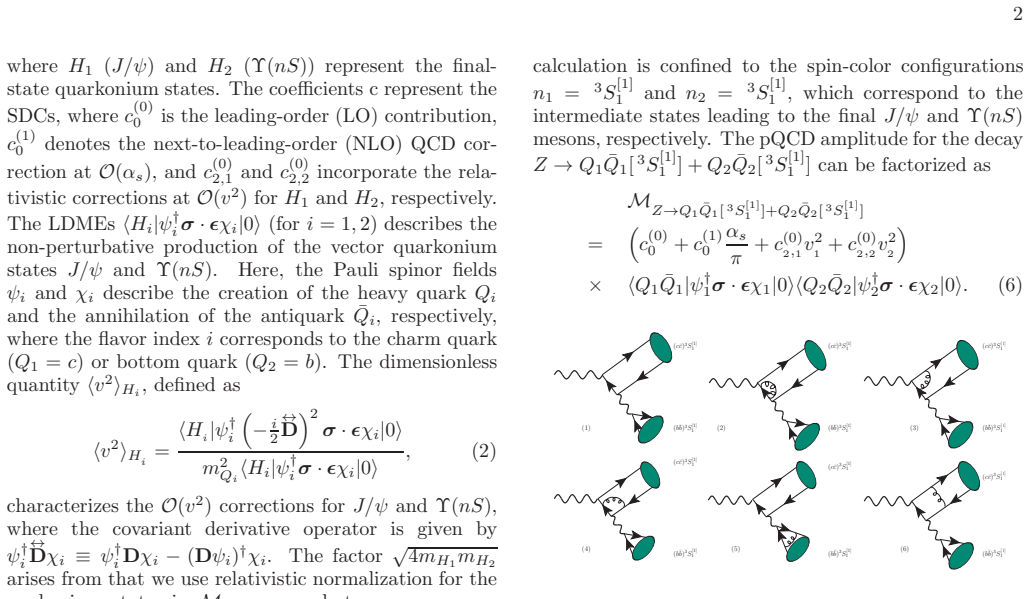

read the original abstract
In this paper, we calculate the decay widths and branching fractions for the decays $Z \to J/\psi+\Upsilon(nS)$ ($n=1,2,3$) at future super $Z$ factory and at the CEPC/FCC-ee, including both the relativistic and QCD corrections within the framework of nonrelativistic QCD. Both the relativistic and QCD corrections are found to be large and negative. Compared to the leading-order results, the decay widths are significantly reduced by the higher-order corrections. Therefore, it is essential to take these corrections into account for a reliable estimation. For a high-luminosity electron positron collider running around the $Z$-pole, sizable event rates could be produced from these rare decay channels due to the $Z$-boson resonance effect.
Editorial analysis
A structured set of objections, weighed in public.
Referee Report
Summary. The manuscript computes the decay widths and branching fractions for Z → J/ψ + Υ(nS) (n=1,2,3) at next-to-leading order in QCD together with relativistic corrections in the NRQCD framework. The central claim is that both classes of corrections are large and negative, substantially reducing the leading-order widths, and that their inclusion is mandatory for reliable predictions at future Z-pole colliders such as CEPC/FCC-ee.
Significance. If the NLO results are robust, the work supplies phenomenologically relevant higher-order corrections for a mixed-flavor quarkonium process that has not been treated at this accuracy before. Updated branching-fraction estimates could inform experimental strategies at high-luminosity e⁺e⁻ machines operating on the Z resonance.
major comments (3)
- [Abstract and §4 (Numerical results)] The abstract asserts that 'both the relativistic and QCD corrections are found to be large and negative' and that 'the decay widths are significantly reduced,' yet supplies no numerical values, percentage reductions, or scale-variation bands. The full results section must contain explicit tables or figures with central values, uncertainties, and μ_R dependence to substantiate the quantitative claim.
- [§3 (NLO QCD corrections)] For the mixed-flavor process, the NLO calculation must demonstrate explicit cancellation of infrared poles between virtual and real diagrams. Soft-gluon exchanges between the cc̄ and bb̄ pairs can generate non-factorizable contributions that are not absorbed into the color-singlet LDMEs; without this cancellation shown, the applicability of NRQCD factorization at O(α_s) remains unverified and undermines the central claim.
- [§4 (Numerical results) and Table 1] The quoted size of the corrections is sensitive to the input parameters (m_c, m_b, |R(0)|² for each state, and renormalization scale μ). No systematic variation or error envelope is mentioned; the paper should present results for at least two or three choices of each parameter to establish that the 'large negative' character is not an artifact of a particular input set.
minor comments (2)
- [§2 (Theoretical framework)] The notation for the long-distance matrix elements of the mixed-flavor final state should be defined more explicitly to distinguish them from single-quarkonium LDMEs used in the literature.
- [Introduction] A brief comparison table with existing leading-order results from other groups would help readers gauge the improvement.
Simulated Author's Rebuttal
We thank the referee for the careful and constructive review of our manuscript. We have addressed each major comment below and will incorporate revisions to improve the presentation and robustness of the results.
read point-by-point responses
-
Referee: [Abstract and §4 (Numerical results)] The abstract asserts that 'both the relativistic and QCD corrections are found to be large and negative' and that 'the decay widths are significantly reduced,' yet supplies no numerical values, percentage reductions, or scale-variation bands. The full results section must contain explicit tables or figures with central values, uncertainties, and μ_R dependence to substantiate the quantitative claim.
Authors: We agree that the abstract would be strengthened by including quantitative statements. In the revised version we will update the abstract to quote approximate percentage reductions (e.g., 'reduced by 40–60%') and will add an explicit summary table in §4 that lists, for each n=1,2,3, the LO width, the NLO QCD correction, the relativistic correction, the combined result, and the scale-variation band obtained by varying μ_R between m_Z/2 and 2m_Z. This table will also display the central values with uncertainties to make the claims fully transparent. revision: yes
-
Referee: [§3 (NLO QCD corrections)] For the mixed-flavor process, the NLO calculation must demonstrate explicit cancellation of infrared poles between virtual and real diagrams. Soft-gluon exchanges between the cc̄ and bb̄ pairs can generate non-factorizable contributions that are not absorbed into the color-singlet LDMEs; without this cancellation shown, the applicability of NRQCD factorization at O(α_s) remains unverified and undermines the central claim.
Authors: We have verified that the infrared poles cancel between the virtual and real-emission contributions in our analytic calculation. The soft-gluon exchanges between the two quarkonium systems are absorbed into the color-singlet LDMEs at this order, consistent with NRQCD factorization. To address the concern directly, we will add a short subsection (or appendix) in the revised §3 that displays the explicit 1/ε pole terms from the virtual diagrams and the corresponding real-emission integrals, demonstrating their cancellation. revision: yes
-
Referee: [§4 (Numerical results) and Table 1] The quoted size of the corrections is sensitive to the input parameters (m_c, m_b, |R(0)|² for each state, and renormalization scale μ). No systematic variation or error envelope is mentioned; the paper should present results for at least two or three choices of each parameter to establish that the 'large negative' character is not an artifact of a particular input set.
Authors: We acknowledge that a systematic parameter study is necessary. In the revised manuscript we will extend Table 1 to include results obtained with two additional sets of input parameters: (i) m_c and m_b varied by ±0.1 GeV around the central values, and (ii) |R(0)|² taken from alternative potential-model determinations. We will also show the μ_R dependence explicitly for three choices (m_Z/2, m_Z, 2m_Z) and quote the resulting envelope. This will confirm that the large negative corrections persist across the reasonable range of inputs. revision: yes
Circularity Check
No circularity: explicit NLO computation of corrections
full rationale
The paper executes a standard perturbative expansion in NRQCD, computing short-distance coefficients for Z → J/ψ + Υ(nS) at NLO in α_s together with O(v^2) relativistic corrections. The quoted reduction in decay widths is obtained directly from the evaluated diagrams and phase-space integrals rather than from any redefinition of fitted parameters, self-citation of an unverified uniqueness theorem, or ansatz smuggled through prior work. LDME inputs are taken from external phenomenology and the factorization assumption is stated as a premise, not derived inside the calculation; therefore the final numerical results do not reduce to the inputs by construction.
Axiom & Free-Parameter Ledger
free parameters (5)
- charm-quark mass
- bottom-quark mass
- renormalization scale μ
- J/ψ wave function at origin
- Υ(nS) wave function at origin
axioms (2)
- domain assumption NRQCD factorization theorem applies to Z → J/ψ + Υ(nS) at NLO in α_s and v²
- domain assumption Perturbative expansion in α_s and relative velocity v is convergent for this process
Reference graph
Works this paper leans on
-
[1]
The normalization fac- tors Ni = 2 √ 6NcEi arise from the LO LDMEs, and the squared LO LDMEs: |⟨(Qi ¯Qi)3S1|ψ † i σ ·ǫχi|0⟩|2 = 6Nc(2Ei)2
and ( 15), the SDCs at different orders can be expressed as: c(0) 0 = ( M(0) N1N2 ) ⏐ ⏐ ⏐ q1=q2=0 (16a) c(1) 0 = ( M(1) N1N2 ) ⏐ ⏐ ⏐ q1=q2=0 (16b) c(0) 2, 1 = m2 Q1 2! Iαβ 1 3 ∂ 2M(0) ∂qα 1∂qβ 1 N1N2 ⏐ ⏐ ⏐ q1=q2=0 (16c) c(0) 2, 2 = m2 Q2 2! Iαβ 2 3 ∂ 2M(0) ∂qα 2∂qβ 2 N1N2 ⏐ ⏐ ⏐ q1=q2=0 , (16d) where the superscript “( i)” of M(i) indicates the order (in αs...
-
[2]
6 GeV, respectively, and µ R is evolved from 2mc to mZ
4 GeV and mb = 4. 6 GeV, respectively, and µ R is evolved from 2mc to mZ. Γ denotes the total decay width, including contributions from LO, O(α s), and O(v2). widths of Z → J/ψ + Υ( nS) decays. The LO decay widths are fixed for each Υ( nS) state, with central val- ues of 0. 284 eV, 0. 150 eV, and 0. 118 eV for Υ(1 S), Υ(2S), and Υ(3 S), respectively. The O...
-
[3]
Therefore, higher-order corrections should be considered to obtain more reliable decay widths
The curves show that the decay widths depend strongly on the scale of αs. Therefore, higher-order corrections should be considered to obtain more reliable decay widths. B. Uncertainty analysis In this subsection, we present a detailed estimation of the theoretical uncertainties for the decay widths of Z → J/ψ + Υ( nS) (n = 1, 2, 3). The primary sources of...
-
[4]
The individual uncertainties from these sources are listed as follows: ΓZ→ J/ψ +Υ(1 S) = 35
and ( 24). The individual uncertainties from these sources are listed as follows: ΓZ→ J/ψ +Υ(1 S) = 35 . 77+14. 84+7. 50+5. 89+34. 30 − 35. 77− 6. 31− 4. 95− 34. 39 10− 3 eV, (25a) ΓZ→ J/ψ +Υ(2 S) = 14 . 52+7. 85+2. 40+2. 88+18. 15 − 14. 52− 2. 35− 2. 02− 14. 52 10− 3 eV, (25b) ΓZ→ J/ψ +Υ(3 S) = 9 . 14+6. 18+1. 70+4. 69+14. 31 − 9. 14− 1. 37− 2. 76− 9. 14...
-
[5]
33+15. 46 − 14. 33 × 10− 12, Br(Z → J/ψ + Υ(2S)) = 5. 82+8. 03 − 5. 82 × 10− 12, Br(Z → J/ψ + Υ(3 S)) = 3 . 66+6. 38 − 3. 66 × 10− 12, re- spectively. In recent years, several high-luminosity e+e− colliders have been proposed, such as the International Linear Collider (ILC) [ 37], Circular Electron Positron Collider (CEPC) [ 38], FCC-ee [ 39], and Super Z...
-
[6]
H. Dong, P. Sun, B. Yan and C. P. Yuan, Probing the Zb¯b anomalous couplings via exclusive Z boson decay, Phys. Lett. B 829, 137076 (2022)
2022
-
[7]
Bergstrom and R
L. Bergstrom and R. W. Robinett, ON THE RARE DE- CAYS Z → V V AND Z → V P, Phys. Rev. D 41 (1990)
1990
-
[8]
G. T. Bodwin, E. Braaten and G. P. Lepage, Rigorous QCD analysis of inclusive annihilation and production of heavy quarkonium, Phys. Rev. D 51, 1125 (1995)
1995
-
[9]
G. T. Bodwin, D. K. Sinclair and S. Kim, Quarkonium decay matrix elements from quenched lattice QCD, Phys. Rev. Lett. 77 (1996)
1996
-
[10]
G. P. Lepage, L. Magnea, C. Nakhleh, U. Magnea and K. Hornbostel, Improved nonrelativistic QCD for heavy quark physics, Phys. Rev. D 46 (1992)
1992
-
[11]
A. P. Chen, Y. Q. Ma and H. Zhang, A Short Theoretical Review of Charmonium Production, Adv. High Energy Phys. 2022, 7475923 (2022)
2022
-
[12]
Xu, Y.-J
G.-Z. Xu, Y.-J. Li, K.-Y. Liu, and Y.-J. Zhang, Relativis - tic correction to color-octet J/ψ production at hadron colliders, Phys. Rev. D 86 (2012), 094017
2012
-
[13]
Z. G. He and B. A. Kniehl, Relativistic corrections to prompt J/ψ photo- and hadroproduction, Phys. Rev. D 90 (2014), 014045
2014
-
[14]
Y. J. Zhang, Y. j. Gao and K. T. Chao, Next-to-leading order QCD correction to e+e− → J/ψ + ηc at √ s = 10.6-GeV, Phys. Rev. Lett. 96 (2006), 092001
2006
-
[15]
Gong and J
B. Gong and J. X. Wang, QCD corrections to J/ψ plus ηc production in e+e− annihilation at √ s = 10.6-GeV, Phys. Rev. D 77 (2008), 054028
2008
-
[16]
Y. J. Zhang, Y. Q. Ma and K. T. Chao, Factorization and NLO QCD correction in e+e− → J/ψ (ψ (2S)) +χ c0 at B Factories, Phys. Rev. D 78 (2008), 054006
2008
-
[17]
Brambilla, S
N. Brambilla, S. Eidelman, B. K. Heltsley, R. Vogt, G. T. Bodwin, E. Eichten, A. D. Frawley, A. B. Meyer, R. E. Mitchell and V. Papadimitriou, et al. Heavy Quarkonium: Progress, Puzzles, and Opportunities, Eur. Phys. J. C 71, 1534 (2011)
2011
-
[18]
H. R. Dong, F. Feng and Y. Jia, O(α s) corrections to J/ψ +χ cJ production at B factories, JHEP 10 (2011), 141, [erratum: JHEP 02 (2013), 089]
2011
-
[19]
Z. Sun, X. G. Wu, Y. Ma and S. J. Brodsky, Exclusive production of J/ψ +ηc at theB factories Belle and Babar using the principle of maximum conformality, Phys. Rev. D 98 (2018) no.9, 094001
2018
-
[20]
Sun, Next-to-leading-order study of J/ψ angular dis- tributions in e+e− → J/ψ +ηc,χ cJ at √ s ≈ 10
Z. Sun, Next-to-leading-order study of J/ψ angular dis- tributions in e+e− → J/ψ +ηc,χ cJ at √ s ≈ 10. 6GeV, JHEP 09 (2021), 073
2021
-
[21]
A. M. Sirunyan et al. [CMS], Search for Higgs and Z bo- son decays to J/ψ or Y pairs in the four-muon final state in proton-proton collisions at √ s=13TeV, Phys. Lett. B 797, 134811 (2019)
2019
-
[22]
Tumasyan et al
A. Tumasyan et al. [CMS], Search for Higgs boson decays into Z and J/ ψ and for Higgs and Z boson decays into J/ψ or Y pairs in pp collisions at √ s=13 TeV, Phys. Lett. B 842, 137534 (2023)
2023
-
[23]
A. K. Likhoded and A. V. Luchinsky, Double Charmonia Production in Exclusive Z Boson Decays, Mod. Phys. Lett. A 33 (2018) no.14, 1850078
2018
-
[24]
D. N. Gao and X. Gong, Note on rare Z-boson decays to double heavy quarkonia, Chin. Phys. C 47, 043106 (2023)
2023
-
[25]
C. Li, Z. Sun and G. Y. Zhang, Analysis of double-J/ ψ production in Z decay at next-to-leading-order QCD ac- curacy, JHEP 10, 120 (2023)
2023
- [26]
-
[27]
C. Li, Y. Z. Jiang and Z. Sun, Studies of Z boson decay into double Υ mesons at the NLO QCD accuracy, Phys. Rev. D 110 (2024) no.5, 054018
2024
-
[28]
G. Y. Wang, X. G. Wu, X. C. Zheng, J. Yan and J. W. Zhang, Improved analysis of double J/ψ produc- tion in Z-boson decay, Eur. Phys. J. C 84 (2024) no.5, 544
2024
-
[29]
Gremm and A
M. Gremm and A. Kapustin, Annihilation of S wave quarkonia and the measurement of alpha-s, Phys. Lett. B 407 (1997), 323-330
1997
-
[30]
G. T. Bodwin and A. Petrelli, Order- v4 corrections to S- wave quarkonium decay, Phys. Rev. D 66 (2002), 094011
2002
-
[31]
G. T. Bodwin, X. Garcia Tormo, and J. Lee, Factoriza- tion in exclusive quarkonium production, Phys. Rev. D 81 (2010), 114014
2010
-
[32]
S. A. Larin, The Renormalization of the axial anomaly in dimensional regularization, Phys. Lett. B 303, 113-118 (1993)
1993
-
[33]
Hahn, Generating Feynman diagrams and amplitudes with FeynArts 3, Comput
T. Hahn, Generating Feynman diagrams and amplitudes with FeynArts 3, Comput. Phys. Commun 140, 418 7 (2001)
2001
-
[34]
Mertig, M
R. Mertig, M. Bohm and A. Denner, Feyn Calc - Computer-algebraic calculation of Feynman amplitudes, Comput. Phys. Commun 64, 345 (1991)
1991
-
[35]
Shtabovenko, R
V. Shtabovenko, R. Mertig and F. Orellana, New Devel- opments in FeynCalc 9.0, Comput. Phys. Commun 207, 432 (2016)
2016
-
[36]
Feng, $Apart: A Generalized Mathematica Apart Function, Comput
F. Feng, $Apart: A Generalized Mathematica Apart Function, Comput. Phys. Commun 183, 2158 (2012)
2012
-
[37]
Smirnov, Algorithm FIRE - Feynman Integral RE- duction, J
A.V. Smirnov, Algorithm FIRE - Feynman Integral RE- duction, J. High Energy Phys. 0810, 107 (2008)
2008
-
[38]
Hahn and M
T. Hahn and M. Perez-Victoria, Automatized one loop calculations in four-dimensions and D-dimensions, Com- put. Phys. Commun 118, 153 (1999)
1999
-
[39]
G. T. Bodwin, H. S. Chung, D. Kang, J. Lee and C. Yu, Improved determination of color-singlet nonrelativistic QCD matrix elements for S-wave charmonium, Phys. Rev. D 77, 094017 (2008)
2008
-
[40]
H. S. Chung, J. Lee and C. Yu, NRQCD matrix ele- ments for S-wave bottomonia and Γ[ ηb(nS) → γγ ] with relativistic corrections, Phys. Lett. B 697 (2011), 48-51
2011
-
[41]
Navas et al
S. Navas et al. [Particle Data Group], Review of particle physics, Phys. Rev. D 110 (2024) no.3, 030001
2024
-
[42]
H. Baer et al. [ILC], The International Linear Col- lider Technical Design Report - Volume 2: Physics, arXiv:1306.6352 [hep-ph]
-
[43]
J. B. Guimar˜ aes da Costa et al. [CEPC Study Group], CEPC Conceptual Design Report: Volume 2 - Physics & Detector, arXiv:1811.10545 [hep-ex]
-
[44]
Abada et al
A. Abada et al. [FCC], FCC-ee: The Lepton Collider: Future Circular Collider Conceptual Design Report Vol- ume 2, Eur. Phys. J. ST 228, 261-623 (2019)
2019
-
[45]
J. P. Ma and Z. X. Zhang (The super Z-factory group), Preface, Sci. China: Phys., Mech. Astron. 53, 1947 (2010)
1947
discussion (0)
Sign in with ORCID, Apple, or X to comment. Anyone can read and Pith papers without signing in.