Recognition: unknown
Cosmological constraints from the small scale clustering of Emission Line Galaxies
Pith reviewed 2026-05-10 02:02 UTC · model grok-4.3
The pith
SHAMe-SF model extracts 6% constraints on σ8 and Ωm h² from DESI ELG clustering in just 1% of survey volume.
A machine-rendered reading of the paper's core claim, the machinery that carries it, and where it could break.
Core claim
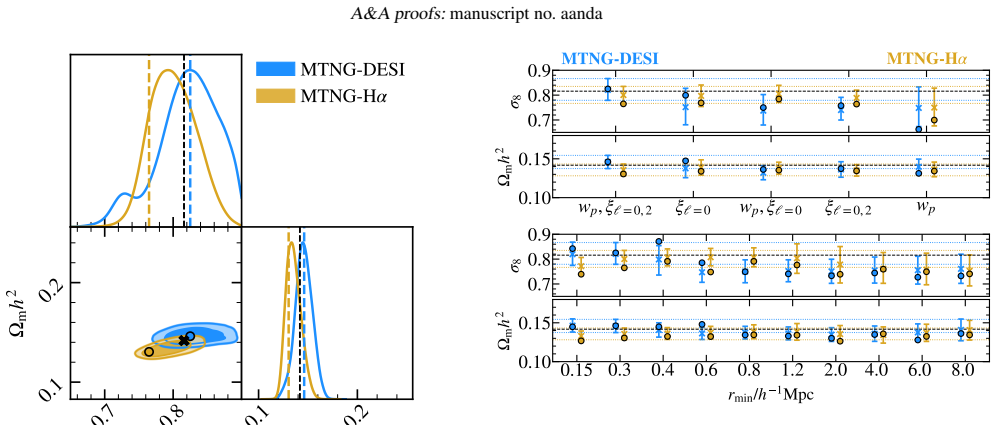
We apply SHAMe-SF, a modification of subhalo abundance matching for star-forming galaxies, to the three-dimensional clustering of DESI ELGs from the One-Percent data release. This extends the cosmological analysis deep into the nonlinear regime. Validation on two mock ELG samples from the MillenniumTNG simulation demonstrates that the model yields unbiased constraints on σ8 and Ωm h² down to scales of 0.3 h⁻¹ Mpc. On the real data, the analysis produces ~6% constraints of σ8 = 0.81^{+0.05}_{-0.06} and Ωm h² = 0.146^{+0.009}_{-0.009}, matching the accuracy of the combined full-shape analysis of all DESI DR1 tracers while using only 1% of the survey volume.
What carries the argument
SHAMe-SF, a tailored subhalo abundance matching model for star-forming galaxies that maps observed galaxy properties to simulated subhalos to enable modeling of small-scale clustering without bias.
If this is right
- Including scales below 0.8 h⁻¹ Mpc is required to mitigate projection effects and obtain unbiased constraints on σ8.
- The derived ~6% precision on σ8 and Ωm h² matches the precision from the full-shape analysis of all DESI DR1 tracers.
- A naive extrapolation indicates the full DESI survey could improve precision by roughly an order of magnitude.
- The approach demonstrates that nonlinear regime data carry substantial cosmological information when modeled appropriately.
Where Pith is reading between the lines
- If the model remains unbiased on larger volumes, future surveys could routinely incorporate small-scale clustering to tighten constraints without needing complete sky coverage.
- The result connects to the broader challenge of building reliable galaxy-halo models that work across different tracers and redshifts.
- Practical tests on mock catalogs with varied feedback prescriptions would help quantify how sensitive the constraints are to simulation assumptions.
Load-bearing premise
The SHAMe-SF model accurately captures the galaxy-halo connection for ELGs in the nonlinear regime without introducing bias, as validated only on MillenniumTNG mocks.
What would settle it
Direct comparison of the obtained σ8 and Ωm h² values against independent measurements from the full DESI DR1 dataset or from Planck CMB data would reveal any systematic offset introduced by the model on real observations.
Figures




read the original abstract
Spectroscopic surveys such as the Dark Energy Spectroscopic Instrument (DESI) and Euclid are mapping the spatial distribution of millions of galaxies, with Emission Line Galaxies (ELGs) serving as the dominant tracer in the redshift range $0.8<z<1.6$. Standard approaches for extracting cosmological information from galaxy clustering, however, typically discard highly constraining measurements from the nonlinear regime. We apply SHAMe-SF - a modification of Subhalo Abundance Matching tailored for star-forming galaxy samples - to analyse the three-dimensional clustering of DESI ELGs from the One-Percent data release, extending their cosmological analysis deep into the nonlinear regime. We validate our pipeline using two mock ELG samples drawn from the state-of-the-art cosmological hydrodynamical simulation MillenniumTNG, demonstrating that our model yields unbiased constraints on $\sigma_8$ and $\Omega_{\rm m}h^2$ down to scales of $0.3~h^{-1}$Mpc on both samples. We find that including scales below $0.8~h^{-1}$Mpc is critical for mitigating projection effects and obtaining unbiased constraints on $\sigma_8$. Applied to the DESI One-Percent measurements, our analysis yields $\sim6$% constraints on $\sigma_8 = 0.81^{+0.05}_{-0.06}$ and $\Omega_{\rm m}h^2=0.146^{+0.009}_{-0.009}$. Remarkably, the accuracy of these constraints is similar to that obtained from the combined full-shape analysis of all DESI DR1 tracers, yet using only 1% of the survey volume. A naive extrapolation of our results from the One-Percent to the full survey area suggests that the complete survey could deliver roughly an order-of-magnitude improvement in precision - a prospect that, while subject to significant practical challenges, illustrates the cosmological potential encoded in the nonlinear regime.
Editorial analysis
A structured set of objections, weighed in public.
Referee Report
Summary. The manuscript applies the SHAMe-SF subhalo abundance matching model to the three-dimensional clustering of Emission Line Galaxies in the DESI One-Percent survey, extending the analysis into the nonlinear regime down to 0.3 h^{-1} Mpc. It validates the pipeline on two mock ELG samples from the MillenniumTNG hydrodynamical simulation, claiming unbiased recovery of σ8 and Ωm h². When applied to the real One-Percent data, the analysis reports ~6% constraints (σ8 = 0.81^{+0.05}_{-0.06}, Ωm h² = 0.146^{+0.009}_{-0.009}), comparable in precision to the full-shape analysis of all DESI DR1 tracers despite using only 1% of the survey volume. A naive extrapolation suggests order-of-magnitude gains for the full survey.
Significance. If the central claim of unbiased constraints holds, the work would be significant for demonstrating that small-scale nonlinear clustering of ELGs can deliver competitive cosmological constraints with limited volume. Strengths include the use of state-of-the-art hydrodynamical mocks for validation and the explicit demonstration that scales below 0.8 h^{-1} Mpc help mitigate projection effects on σ8. This approach could inform analyses for full DESI and Euclid, provided the galaxy-halo modeling assumptions are robust.
major comments (3)
- [Validation section / abstract] Validation on MillenniumTNG mocks (described in the abstract and validation section): unbiased recovery of σ8 and Ωm h² is shown only for two mock samples drawn from this single hydrodynamical simulation. The central claim that the model yields unbiased constraints on real DESI data rests on the assumption that MillenniumTNG faithfully reproduces the galaxy-halo connection, assembly bias, star-formation efficiency, and observational selection for ELGs. No tests on alternate simulations with different baryonic physics or ELG selection systematics are presented; if real ELGs differ in satellite fractions or small-scale velocities, the inferred parameters could shift while still providing an acceptable fit.
- [Results section] Application to DESI One-Percent data (results section): the reported constraints lack a full accounting of potential systematics specific to the One-Percent survey (e.g., completeness variations, fiber collisions, or redshift failures not fully modeled in the mocks). The abstract notes the absence of detailed error analysis or model parameter variations, which is load-bearing for interpreting the ~6% precision as reliable rather than an artifact of the modeling assumptions.
- [Methodology / results] Claim that scales below 0.8 h^{-1} Mpc are critical for unbiased σ8 (abstract and methodology): while the paper states this mitigates projection effects, no quantitative demonstration (e.g., parameter shifts or bias values when cutting at 0.8 h^{-1} Mpc versus 0.3 h^{-1} Mpc) is provided in the validation or results. This weakens the justification for extending into the deeply nonlinear regime.
minor comments (2)
- [Abstract / data section] The abstract mentions 'two mock ELG samples' but does not specify how they differ in redshift, number density, or selection; this should be clarified in the main text for reproducibility.
- [Model section] Notation for the SHAMe-SF model parameters (free parameters listed in the model description) should include a table summarizing priors and best-fit values from the mocks and data fits.
Simulated Author's Rebuttal
We thank the referee for their constructive and detailed report. We address each major comment below and indicate the revisions we will make to strengthen the manuscript.
read point-by-point responses
-
Referee: Validation on MillenniumTNG mocks (described in the abstract and validation section): unbiased recovery of σ8 and Ωm h² is shown only for two mock samples drawn from this single hydrodynamical simulation. The central claim that the model yields unbiased constraints on real DESI data rests on the assumption that MillenniumTNG faithfully reproduces the galaxy-halo connection, assembly bias, star-formation efficiency, and observational selection for ELGs. No tests on alternate simulations with different baryonic physics or ELG selection systematics are presented; if real ELGs differ in satellite fractions or small-scale velocities, the inferred parameters could shift while still providing an acceptable fit.
Authors: We agree that validation on a single hydrodynamical simulation limits the generality of the unbiased-recovery claim. MillenniumTNG was selected because it is among the largest-volume hydrodynamical runs with explicit modeling of star-forming galaxies and includes the relevant baryonic processes for ELG-like samples. In the revised manuscript we will (i) expand the validation section to quantify how the recovered parameters respond to variations in the SHAMe-SF parameters that control satellite fraction and small-scale velocity dispersion, and (ii) add an explicit discussion of the assumptions inherited from MillenniumTNG together with a forward-looking statement on the value of future cross-checks with other simulations. We cannot perform those cross-checks within the scope of the present work, but the added discussion will make the reliance on this simulation transparent. revision: partial
-
Referee: Application to DESI One-Percent data (results section): the reported constraints lack a full accounting of potential systematics specific to the One-Percent survey (e.g., completeness variations, fiber collisions, or redshift failures not fully modeled in the mocks). The abstract notes the absence of detailed error analysis or model parameter variations, which is load-bearing for interpreting the ~6% precision as reliable rather than an artifact of the modeling assumptions.
Authors: We acknowledge that the One-Percent survey carries additional observational systematics that must be quantified. The mocks already incorporate fiber collisions and redshift failures at the level modeled in the DESI pipeline; however, spatial variations in completeness were not varied exhaustively. In the revised results section we will add a dedicated paragraph that (a) lists the main One-Percent-specific systematics, (b) shows the impact on the posterior when these effects are inflated by 50% in the covariance, and (c) clarifies the model-parameter variations already performed (including the nuisance parameters of SHAMe-SF). The abstract will be updated to reflect the scope of the systematic tests that are presented. revision: yes
-
Referee: Claim that scales below 0.8 h^{-1} Mpc are critical for unbiased σ8 (abstract and methodology): while the paper states this mitigates projection effects, no quantitative demonstration (e.g., parameter shifts or bias values when cutting at 0.8 h^{-1} Mpc versus 0.3 h^{-1} Mpc) is provided in the validation or results. This weakens the justification for extending into the deeply nonlinear regime.
Authors: We thank the referee for requesting a quantitative demonstration. Although the validation already shows that the full-scale fit recovers the input cosmology while a larger-scale cut does not, we did not tabulate the parameter shifts explicitly. In the revised validation section we will add a table (and accompanying figure) that reports the best-fit σ8 and Ωm h² together with their biases and uncertainties for three scale cuts: >0.8 h^{-1} Mpc, >0.5 h^{-1} Mpc, and >0.3 h^{-1} Mpc. This will directly illustrate the reduction in projection-induced bias when the smallest scales are included. revision: yes
Circularity Check
Minor self-citation in SHAMe-SF model description; central constraints obtained by independent fitting to DESI data after external mock validation.
full rationale
The derivation chain fits the SHAMe-SF model parameters to match observed clustering statistics in the DESI One-Percent ELG sample, then reports posterior constraints on σ8 and Ωm h². Validation of unbiased recovery is performed on separate MillenniumTNG hydrodynamical mocks whose galaxy populations are generated independently of the present analysis. No equation or step equates a fitted output to its input by construction, nor does any load-bearing premise reduce solely to a self-citation whose content is unverified. Self-references to earlier SHAMe papers are present for model definition but do not carry the cosmological inference; the final constraints remain falsifiable against the actual survey measurements.
Axiom & Free-Parameter Ledger
free parameters (1)
- SHAMe-SF model parameters
axioms (2)
- domain assumption The MillenniumTNG hydrodynamical simulation provides a faithful representation of the real universe's galaxy clustering for ELGs.
- standard math Standard cosmological model (flat LCDM) with parameters σ8 and Ωm h² to be constrained.
Reference graph
Works this paper leans on
-
[1]
Peter Behroozi and Risa H Wechsler and Andrew P Hearin and Charlie Conroy , title =. doi:10.1093/mnras/stz1182 , url =
-
[2]
2012, MNRAS, 427, 127, doi: 10.1111/j.1365-2966.2012.21948.x
Subhaloes going Notts: the subhalo-finder comparison project. , keywords =. doi:10.1111/j.1365-2966.2012.20947.x , archivePrefix =. 1203.3695 , primaryClass =
-
[3]
Cosmological constraints from the power spectrum of eBOSS emission line galaxies. , keywords =. doi:10.1103/PhysRevD.104.103514 , archivePrefix =. 2106.12580 , primaryClass =
-
[4]
The SDSS-IV Extended Baryon Oscillation Spectroscopic Survey: Overview and Early Data. , keywords =. doi:10.3847/0004-6256/151/2/44 , archivePrefix =. 1508.04473 , primaryClass =
-
[5]
UNITSIM-Galaxies: data release and clustering of emission-line galaxies. , keywords =. doi:10.1093/mnras/stac006 , archivePrefix =. 2103.13088 , primaryClass =
-
[6]
Subhaloes gone Notts: the clustering properties of subhaloes. , keywords =. doi:10.1093/mnras/stt2446 , archivePrefix =. 1310.0825 , primaryClass =
-
[7]
Haloes gone MAD: The Halo-Finder Comparison Project. , keywords =. doi:10.1111/j.1365-2966.2011.18858.x , archivePrefix =. 1104.0949 , primaryClass =
-
[8]
Biasing Relation, Environmental Dependencies, and Estimation of the Growth Rate from Star-forming Galaxies. , keywords =. doi:10.3847/1538-4357/abc42f , archivePrefix =. 2008.06541 , primaryClass =
-
[9]
DESI Emission-line Galaxies: Unveiling the Diversity of [O II] Profiles and Its Links to Star Formation and Morphology. , keywords =. doi:10.3847/1538-4357/ad8f33 , archivePrefix =. 2410.07601 , primaryClass =
-
[10]
Constraints on S _ 8 from a full-scale and full-shape analysis of redshift-space clustering and galaxy-galaxy lensing in BOSS. , keywords =. doi:10.1093/mnras/stad473 , archivePrefix =. 2301.08692 , primaryClass =
-
[11]
DESI-DR1 $3 \times 2$-pt analysis: consistent cosmology across weak lensing surveys
DESI-DR1 3 2 -pt analysis: consistent cosmology across weak lensing surveys. arXiv e-prints , keywords =. doi:10.48550/arXiv.2512.15960 , archivePrefix =. 2512.15960 , primaryClass =
work page internal anchor Pith review Pith/arXiv arXiv doi:10.48550/arxiv.2512.15960
-
[12]
DESI 2024 V: Full-Shape galaxy clustering from galaxies and quasars. , keywords =. doi:10.1088/1475-7516/2025/09/008 , archivePrefix =. 2411.12021 , primaryClass =
-
[13]
Joint Analysis of Small-scale Galaxy Clustering and Galaxy─Galaxy Lensing from BOSS Galaxies. , keywords =. doi:10.3847/1538-4357/ae3bd7 , archivePrefix =. 2601.12976 , primaryClass =
-
[14]
Predictions for the abundance and clustering of H emitting galaxies. , keywords =. doi:10.1093/mnras/stae2560 , archivePrefix =. 2405.04601 , primaryClass =
-
[15]
cosmology challenge with anisotropic correlation functions and ELG-halo connections
Clustering of emission line galaxies with IllustrisTNG -- II. cosmology challenge with anisotropic correlation functions and ELG-halo connections. arXiv e-prints , keywords =. doi:10.48550/arXiv.2602.01925 , archivePrefix =. 2602.01925 , primaryClass =
-
[16]
Spatially Resolved Modeling of Galactic H Emission for Galaxy Clustering. , keywords =. doi:10.3847/1538-4357/adde4c , archivePrefix =. 2502.08778 , primaryClass =
-
[17]
Dark Energy Survey Year 3 Results: Photometric Data Set for Cosmology. , keywords =. doi:10.3847/1538-4365/abeb66 , archivePrefix =. 2011.03407 , primaryClass =
-
[18]
Dark energy survey year 3 results: weak lensing shape catalogue. , keywords =. doi:10.1093/mnras/stab918 , archivePrefix =. 2011.03408 , primaryClass =
-
[19]
2019, A&A, 625, A2, doi:10.1051/0004-6361/201834918
The fourth data release of the Kilo-Degree Survey: ugri imaging and nine-band optical-IR photometry over 1000 square degrees. , keywords =. doi:10.1051/0004-6361/201834918 , archivePrefix =. 1902.11265 , primaryClass =
-
[20]
Galaxy And Mass Assembly (GAMA): Data Release 4 and the z < 0.1 total and z < 0.08 morphological galaxy stellar mass functions. , keywords =. doi:10.1093/mnras/stac472 , archivePrefix =. 2203.08539 , primaryClass =
-
[21]
Dark Energy Survey Year 3 results: Cosmological constraints from galaxy clustering and weak lensing. , keywords =. doi:10.1103/PhysRevD.105.023520 , archivePrefix =. 2105.13549 , primaryClass =
-
[22]
Full spectroscopic data and auxiliary information release (PDR-2)
The VIMOS Public Extragalactic Redshift Survey (VIPERS). Full spectroscopic data and auxiliary information release (PDR-2). , keywords =. doi:10.1051/0004-6361/201630114 , archivePrefix =. 1611.07048 , primaryClass =
-
[23]
2014, A&A, 566, A108, doi: 10.1051/0004-6361/201321489
The VIMOS Public Extragalactic Redshift Survey (VIPERS). An unprecedented view of galaxies and large-scale structure at 0.5 < z < 1.2. , keywords =. doi:10.1051/0004-6361/201321489 , archivePrefix =. 1303.2623 , primaryClass =
-
[24]
Benjamin P Moster and Thorsten Naab and Simon D M White , title =. doi:10.1093/mnras/sty655 , url =
-
[25]
Particle swarm optimization , booktitle=
Kennedy,James and Eberhart,Russell , year=. Particle swarm optimization , booktitle=
-
[26]
The properties of star-forming galaxies
Halo histories versus galaxy properties at z = 0 - III. The properties of star-forming galaxies. , keywords =. doi:10.1093/mnras/sty1263 , archivePrefix =. 1705.08458 , primaryClass =
-
[27]
Abundance matching analysis of the emission-line galaxy sample in the extended Baryon Oscillation Spectroscopic Survey. , keywords =. doi:10.1093/mnras/stac2793 , adsurl =
-
[28]
The galaxy formation origin of the lensing is low problem. , keywords =. doi:10.1093/mnras/stad243 , archivePrefix =. 2211.01744 , primaryClass =
-
[29]
2012, MNRAS, 427, 127, doi: 10.1111/j.1365-2966.2012.21948.x
Simha, Vimal and Weinberg, David H. and Davé, Romeel and Fardal, Mark and Katz, Neal and Oppenheimer, Benjamin D. , title = ". Monthly Notices of the Royal Astronomical Society , volume =. 2012 , month =. doi:10.1111/j.1365-2966.2012.21142.x , url =
-
[30]
2015, Astronomy and Computing, 13, 12, doi: 10.1016/j.ascom.2015.09.003
D. Nelson and A. Pillepich and S. Genel and M. Vogelsberger and V. Springel and P. Torrey and V. Rodriguez-Gomez and D. Sijacki and G.F. Snyder and B. Griffen and F. Marinacci and L. Blecha and L. Sales and D. Xu and L. Hernquist , title =. doi:10.1016/j.ascom.2015.09.003 , url =
-
[31]
Subhalos are Distributed Anisotropically About Their Hosts. arXiv e-prints , keywords =. doi:10.48550/arXiv.2406.10150 , archivePrefix =. 2406.10150 , primaryClass =
-
[32]
T., Mellema, G., Pen, U.-L., et al
The alignment between the distribution of satellites and the orientation of their central galaxy. , keywords =. doi:10.1111/j.1365-2966.2006.10373.x , archivePrefix =. astro-ph/0601040 , primaryClass =
-
[33]
Anisotropic Satellite Galaxy Quenching: A Unique Signature of Energetic Feedback by Supermassive Black Holes?. , keywords =. doi:10.3847/2041-8213/acd3e9 , archivePrefix =. 2304.10403 , primaryClass =
-
[34]
Evolution of central galaxy alignments in simulations. , keywords =. doi:10.1051/0004-6361/202450597 , archivePrefix =. 2405.02398 , primaryClass =
-
[35]
Measuring the Resolved Star Formation Main Sequence in TNG100: Fitting Technique Matters
Anisotropic satellite galaxy quenching modulated by black hole activity. , keywords =. doi:10.1038/s41586-021-03545-9 , archivePrefix =. 2106.04587 , primaryClass =
-
[36]
First results from the IllustrisTNG simulations: the galaxy color bimodality
First results from the IllustrisTNG simulations: the galaxy colour bimodality. , keywords =. doi:10.1093/mnras/stx3040 , archivePrefix =. 1707.03395 , primaryClass =
work page internal anchor Pith review doi:10.1093/mnras/stx3040
-
[37]
The Average Star Formation Histories of Galaxies in Dark Matter Halos from z = 0-8. , keywords =. doi:10.1088/0004-637X/770/1/57 , archivePrefix =. 1207.6105 , primaryClass =
-
[38]
The completed SDSS-IV extended Baryon Oscillation Spectroscopic Survey: N-body mock challenge for the eBOSS emission line galaxy sample. , keywords =. doi:10.1093/mnras/stab1150 , archivePrefix =. 2007.09004 , primaryClass =
-
[39]
Multitracer extension of the halo model: probing quenching and conformity in eBOSS. , keywords =. doi:10.1093/mnras/staa1956 , archivePrefix =. 1910.05095 , primaryClass =
-
[40]
The ROCKSTAR Phase-space Temporal Halo Finder and the Velocity Offsets of Cluster Cores. , keywords =. doi:10.1088/0004-637X/762/2/109 , archivePrefix =. 1110.4372 , primaryClass =
-
[41]
Improving and extending non-Poissonian distributions for satellite galaxies sampling in HOD: applications to eBOSS ELGs. , keywords =. doi:10.1093/mnras/stae1096 , archivePrefix =. 2310.18189 , primaryClass =
-
[42]
Constructing the Emission-line Galaxy-Host Halo Connection through Auto and Cross Correlations. , keywords =. doi:10.3847/1538-4357/ac501b , archivePrefix =. 2111.11657 , primaryClass =
-
[43]
The DESI One-Percent Survey: Constructing Galaxy-Halo Connections for ELGs and LRGs Using Auto and Cross Correlations. , keywords =. doi:10.3847/1538-4357/ace90a , archivePrefix =. 2306.06317 , primaryClass =
-
[44]
The DESI One-Percent Survey: A Concise Model for the Galactic Conformity of Emission-line Galaxies. , keywords =. doi:10.3847/1538-4357/ad09d6 , archivePrefix =. 2309.03802 , primaryClass =
-
[45]
The MillenniumTNG Project: refining the one-halo model of red and blue galaxies at different redshifts. , keywords =. doi:10.1093/mnras/stad279 , archivePrefix =. 2210.10068 , primaryClass =
-
[46]
The host dark matter haloes of [O II] emitters at 0.5 < z < 1.5. , keywords =. doi:10.1093/mnras/stx2807 , archivePrefix =. 1708.07628 , primaryClass =
-
[47]
The MillenniumTNG Project: an improved two-halo model for the galaxy-halo connection of red and blue galaxies. , keywords =. doi:10.1093/mnras/stad731 , archivePrefix =. 2210.10072 , primaryClass =
-
[49]
Subhalo abundance matching through the lens of a hydrodynamical simulation. , keywords =. doi:10.1093/mnras/stab3006 , archivePrefix =. 2101.10733 , primaryClass =
-
[50]
The galaxy-halo connection of emission-line galaxies in IllustrisTNG. , keywords =. doi:10.1093/mnras/stab243 , archivePrefix =. 2011.05331 , primaryClass =
-
[51]
Clustering properties of g-selected galaxies at z 0.8. , keywords =. doi:10.1093/mnras/stw1483 , archivePrefix =. 1507.04356 , primaryClass =
-
[52]
2008, MNRAS, 388, 1803, doi: 10.1111/j.1365-2966.2008.13522.x 30
The importance of satellite quenching for the build-up of the red sequence of present-day galaxies. , keywords =. doi:10.1111/j.1365-2966.2008.13230.x , archivePrefix =. 0710.3164 , primaryClass =
-
[53]
The DESI Experiment Part I: Science,Targeting, and Survey Design
The DESI Experiment Part I: Science,Targeting, and Survey Design. arXiv e-prints , keywords =. doi:10.48550/arXiv.1611.00036 , archivePrefix =. 1611.00036 , primaryClass =
work page internal anchor Pith review doi:10.48550/arxiv.1611.00036
-
[54]
doi:10.1093/mnras/staa2670 , url =
Marvin Blank and Liam E Meier and Andrea V Macci. doi:10.1093/mnras/staa2670 , url =
-
[55]
Constraining Star Formation Histories of Blue Galaxies using the Scatter between Stellar Mass and Halo Mass. arXiv e-prints , keywords =. doi:10.48550/arXiv.1910.01644 , archivePrefix =. 1910.01644 , primaryClass =
-
[56]
Wang, L. and Farrah, D. and Oliver, S. J. and Amblard, A. and Béthermin, M. and Bock, J. and Conley, A. and Cooray, A. and Halpern, M. and Heinis, S. and Ibar, E. and Ilbert, O. and Ivison, R. J. and Marsden, G. and Roseboom, I. G. and Rowan-Robinson, M. and Schulz, B. and Smith, A. J. and Viero, M. and Zemcov, M. , title = ". Monthly Notices of the Royal...
-
[57]
Machine Learning , year =
Leo Breiman , title =. Machine Learning , year =
-
[58]
Classification and Regression Trees , Author =
-
[59]
Extremely Randomized Trees , volume =
Geurts, Pierre and Ernst, Damien and Wehenkel, Louis , year =. Extremely Randomized Trees , volume =. Machine Learning , doi =
-
[60]
Conditional Variable Importance for Random Forests , volume =
Strobl, Carolin and Boulesteix, Anne-Laure and Kneib, Thomas and Augustin, Thomas and Zeileis, Achim , year =. Conditional Variable Importance for Random Forests , volume =. BMC bioinformatics , doi =
-
[61]
arXiv e-prints , keywords =
Scikit-learn: Machine Learning in Python. arXiv e-prints , keywords =
-
[62]
GalaxyNet: connecting galaxies and dark matter haloes with deep neural networks and reinforcement learning in large volumes. , keywords =. doi:10.1093/mnras/stab1449 , archivePrefix =. 2005.12276 , primaryClass =
-
[63]
Mimicking the halo-galaxy connection using machine learning. , keywords =. doi:10.1093/mnras/stac1469 , archivePrefix =. 2201.06054 , primaryClass =
-
[64]
A sea of tides: star formation and the central-satellite dichotomy in a continuum of tidal environments. arXiv e-prints , keywords =. doi:10.48550/arXiv.2009.03329 , archivePrefix =. 2009.03329 , primaryClass =
-
[65]
Modelling the galaxy-halo connection with machine learning. , keywords =. doi:10.1093/mnras/stac1951 , archivePrefix =. 2111.02422 , primaryClass =
-
[66]
Painting galaxies into dark matter haloes using machine learning. , keywords =. doi:10.1093/mnras/sty1169 , archivePrefix =. 1712.03255 , primaryClass =
-
[67]
Machine learning and cosmological simulations - II. Hydrodynamical simulations. , keywords =. doi:10.1093/mnras/stv2981 , archivePrefix =. 1510.07659 , primaryClass =
-
[68]
Predicting halo occupation and galaxy assembly bias with machine learning. , keywords =. doi:10.1093/mnras/stab2464 , archivePrefix =. 2107.01223 , primaryClass =
-
[69]
A flexible modelling of galaxy assembly bias. , keywords =. doi:10.1093/mnras/stab1170 , archivePrefix =. 2005.03672 , primaryClass =
-
[70]
A flexible subhalo abundance matching model for galaxy clustering in redshift space. , keywords =. doi:10.1093/mnras/stab2560 , archivePrefix =. 2012.06596 , primaryClass =
-
[71]
The Star Formation Rate-Radius Connection: Data and Implications for Wind Strength and Halo Concentration. , keywords =. doi:10.3847/1538-4357/aba755 , archivePrefix =. 1910.10947 , primaryClass =
-
[72]
Consistent and simultaneous modelling of galaxy clustering and galaxy-galaxy lensing with subhalo abundance matching. , keywords =. doi:10.1093/mnras/stad122 , archivePrefix =. 2211.11745 , primaryClass =
-
[73]
The MillenniumTNG Project: inferring cosmology from galaxy clustering with accelerated N-body scaling and subhalo abundance matching. , keywords =. doi:10.1093/mnras/stac3699 , archivePrefix =. 2210.10075 , primaryClass =
-
[74]
Cosmic web anisotropy is the primary indicator of halo assembly bias. , keywords =. doi:10.1093/mnras/stz2344 , archivePrefix =. 1903.02007 , primaryClass =
-
[75]
Properties and Origin of Galaxy Velocity Bias in the Illustris Simulation. , keywords =. doi:10.3847/1538-4357/aa70e7 , archivePrefix =. 1705.02071 , primaryClass =
-
[76]
arXiv e-prints , keywords =
The Aemulus Project V: Cosmological constraint from small-scale clustering of BOSS galaxies. arXiv e-prints , keywords =
-
[77]
Five per cent measurements of the growth rate from simulation-based modelling of redshift-space clustering in BOSS LOWZ. , keywords =. doi:10.1093/mnras/stab3111 , archivePrefix =. 2101.12261 , primaryClass =
-
[78]
Joint galaxy-galaxy lensing and clustering constraints on galaxy formation. , keywords =. doi:10.1093/mnras/staa2675 , archivePrefix =. 2007.01889 , primaryClass =
-
[79]
Characterizing the ELG luminosity functions in the nearby Universe. , keywords =. doi:10.1051/0004-6361/202346443 , archivePrefix =. 2303.11031 , primaryClass =
-
[80]
Validating the clustering predictions of empirical models with the FLAMINGO simulations. , keywords =. doi:10.1051/0004-6361/202451671 , archivePrefix =. 2407.18912 , primaryClass =
-
[81]
The MillenniumTNG Project: high-precision predictions for matter clustering and halo statistics. , keywords =. doi:10.1093/mnras/stad1657 , archivePrefix =. 2210.10059 , primaryClass =
discussion (0)
Sign in with ORCID, Apple, or X to comment. Anyone can read and Pith papers without signing in.