Recognition: unknown
Causality in Liquid Water as a Hallmark of Emergent Glassy Dynamics
Pith reviewed 2026-05-10 01:19 UTC · model grok-4.3
The pith
Translational motions causally drive orientational dynamics in supercooled water, unlike the decoupled rotations seen at room temperature.
A machine-rendered reading of the paper's core claim, the machinery that carries it, and where it could break.
Core claim
Analyzing equilibrium molecular dynamics simulations at ambient conditions and in the high-density liquid regime of supercooled water, the paper shows that rotational modes remain largely decoupled from translations at room temperature. In the supercooled HDL regime, translational motions emerge as the primary drivers of the dynamics, suggesting facilitation-like relaxation mechanisms. These results reveal a qualitative reorganization of dynamical couplings across thermodynamic conditions, implying that molecular liquids at thermal equilibrium can exhibit an emergent directionality in their fluctuation couplings, with the consequence that external perturbations acting on specific degrees of
What carries the argument
A causal inference metric that quantifies asymmetric time-delayed influences between collective variables for molecular orientations and translations.
Load-bearing premise
The causal inference metric accurately captures directed influences between orientational and translational collective variables without artifacts from finite sampling, choice of time scales, or the specific definition of the variables in the MD trajectories.
What would settle it
Repeating the analysis on the same trajectories after randomizing the time ordering of segments or after swapping the definitions of the translational and orientational variables, and checking whether the reported directional asymmetries disappear.
Figures

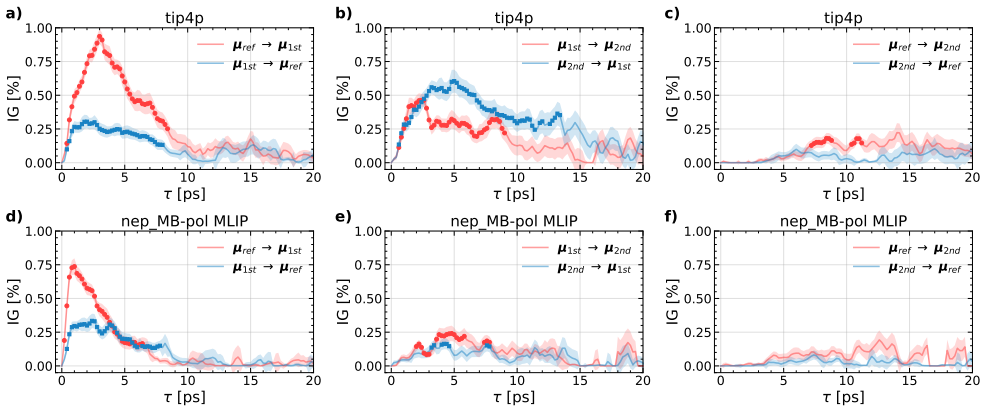
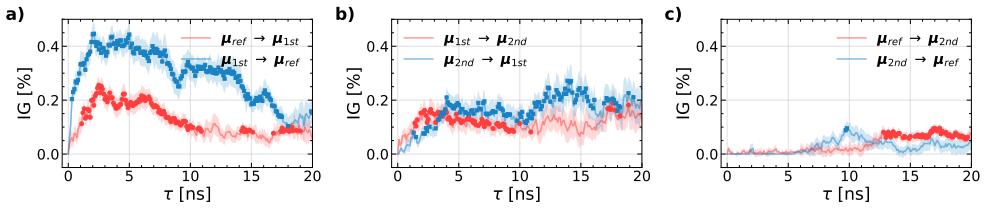
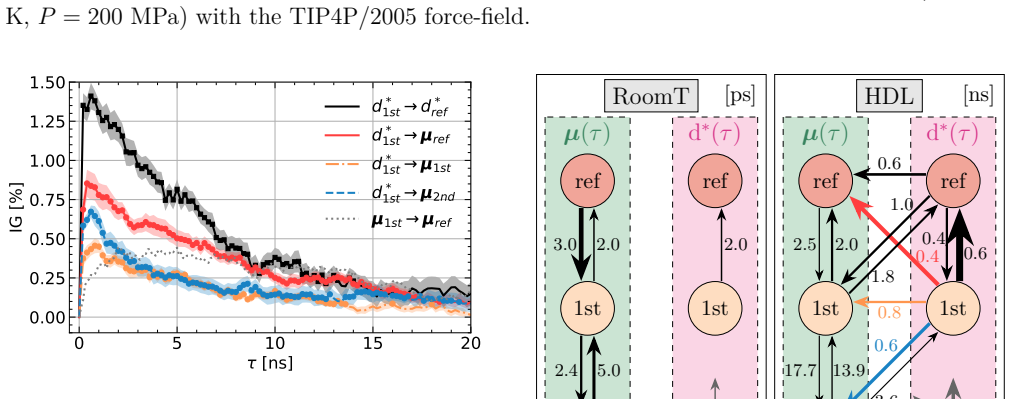
read the original abstract
In molecular liquids such as water, time-delayed influences between microscopic or mesoscopic variables are typically probed using time-correlation functions, which are symmetric under detailed balance and therefore blind to dynamical asymmetries. Here, we characterize waters dynamics using a causal inference metric that captures asymmetric couplings between collective variables. Analyzing equilibrium molecular dynamics simulations at ambient conditions and in the high-density liquid (HDL) regime of supercooled water, we uncover pronounced asymmetries in the couplings between orientational and translational degrees of freedom across multiple time and length scales. At room temperature, rotational modes remain largely decoupled from translations. In contrast, in the supercooled HDL regime, translational motions emerge as the primary drivers of the dynamics, suggesting facilitation-like relaxation mechanisms characteristic of glassy systems. These results reveal a qualitative reorganization of dynamical couplings across thermodynamic conditions, implying that molecular liquids at thermal equilibrium can exhibit an emergent directionality in their fluctuation couplings. As a consequence, our analysis reveals that external perturbations acting on specific degrees of freedom can induce a stronger arrow of time in the causal relations between translational and orientational modes.
Editorial analysis
A structured set of objections, weighed in public.
Referee Report
Summary. The paper applies a causal inference metric to equilibrium MD simulations of water to detect asymmetric time-delayed couplings between orientational and translational collective variables. It reports that at ambient conditions the modes are largely decoupled, whereas in the supercooled high-density liquid regime translational motions drive orientational dynamics, interpreted as an emergent arrow of time signaling facilitation-like glassy relaxation mechanisms.
Significance. If the detected asymmetries prove robust, the work would demonstrate that equilibrium molecular liquids can exhibit emergent directionality in fluctuation couplings across thermodynamic regimes, offering a new diagnostic for glassy dynamics without external driving and suggesting that targeted perturbations on specific degrees of freedom can amplify causal arrows.
major comments (2)
- [Methods] Methods section (causal metric implementation): No surrogate-data controls, convergence tests with respect to trajectory length, or sensitivity analyses to lag times and variable definitions are reported. In equilibrium MD obeying detailed balance, any net asymmetry must be shown to survive these checks; without them the central claim that translations become primary drivers in the HDL regime risks being an artifact of finite sampling or embedding choices.
- [Results] Results section (HDL-regime analysis): The qualitative reorganization of couplings is asserted without error bars, statistical significance tests, or explicit comparison of asymmetry magnitudes between ambient and HDL conditions. This weakens the interpretation that the change constitutes a hallmark of glassy facilitation, as the effect size and its robustness to post-hoc regime selection remain unquantified.
minor comments (2)
- [Abstract] Abstract: The specific causal inference metric (e.g., transfer entropy, Granger causality, or other) is not named, which would immediately orient readers.
- Figure captions and legends should explicitly label the time and length scales used for each panel to facilitate direct comparison with the text.
Simulated Author's Rebuttal
We thank the referee for the careful reading and constructive comments on our manuscript. The points raised highlight important aspects of methodological validation and quantitative rigor that will strengthen the presentation of our causal analysis. We address each major comment below and will incorporate the suggested improvements in the revised version.
read point-by-point responses
-
Referee: [Methods] Methods section (causal metric implementation): No surrogate-data controls, convergence tests with respect to trajectory length, or sensitivity analyses to lag times and variable definitions are reported. In equilibrium MD obeying detailed balance, any net asymmetry must be shown to survive these checks; without them the central claim that translations become primary drivers in the HDL regime risks being an artifact of finite sampling or embedding choices.
Authors: We agree that these controls are essential for establishing that the observed asymmetries are not artifacts. In the revised manuscript we will add surrogate-data tests by applying time-shuffling and phase-randomization to the collective-variable time series, confirming that the net causal asymmetry vanishes under these null models that preserve the equilibrium statistics. Convergence with respect to trajectory length will be demonstrated by repeating the analysis on progressively longer subsamples and showing stabilization of the metric values. Sensitivity to lag times will be quantified by scanning a range of lags around the reported values, and alternative variable definitions (different wavevectors and order-parameter choices) will be tested to confirm robustness of the HDL-regime driver role. These additions will directly address the concern that the asymmetry could arise from finite sampling or embedding choices. revision: yes
-
Referee: [Results] Results section (HDL-regime analysis): The qualitative reorganization of couplings is asserted without error bars, statistical significance tests, or explicit comparison of asymmetry magnitudes between ambient and HDL conditions. This weakens the interpretation that the change constitutes a hallmark of glassy facilitation, as the effect size and its robustness to post-hoc regime selection remain unquantified.
Authors: We acknowledge that the current results section would benefit from quantitative error estimates and direct comparisons. In the revision we will report error bars on all causal-metric values obtained via block bootstrapping over independent trajectory segments. Statistical significance of the difference in asymmetry between ambient and HDL conditions will be evaluated using permutation tests on the metric distributions. We will also tabulate the numerical magnitudes of the asymmetries in each regime to quantify the effect size and will test robustness by repeating the analysis across a small grid of nearby temperatures and densities that still fall within the HDL regime. These changes will allow a clearer assessment of whether the reorganization qualifies as a hallmark of glassy facilitation. revision: yes
Circularity Check
No circularity: external causal metric applied to independent MD data yields empirical observations
full rationale
The paper's central result is an empirical finding obtained by applying a causal inference metric (drawn from external literature) to equilibrium MD trajectories of water. The metric detects asymmetric couplings between orientational and translational collective variables at different thermodynamic conditions. No derivation step defines the metric in terms of the target asymmetries, fits parameters to a subset of the same data and then renames the output as a prediction, or reduces the claimed reorganization to a self-citation chain. The observed directionality is a direct output of the metric on the trajectories rather than a tautological restatement of the inputs. The analysis is therefore self-contained against external benchmarks and does not exhibit any of the enumerated circularity patterns.
Axiom & Free-Parameter Ledger
axioms (2)
- domain assumption Equilibrium molecular dynamics trajectories faithfully represent the real-time dynamics of water under the chosen thermodynamic conditions.
- domain assumption The chosen collective variables for orientation and translation are sufficient to capture the relevant dynamical couplings.
Reference graph
Works this paper leans on
-
[1]
Slow dynamics in supercooled water , url =
Francesco Sciortino , doi =. Slow dynamics in supercooled water , url =. Chemical Physics , number =. 2000 , bdsk-url-1 =
2000
-
[2]
The Journal of Chemical Physics , volume =
Kikutsuji, Takuma and Kim, Kang and Matubayasi, Nobuyuki , title =. The Journal of Chemical Physics , volume =. 2019 , month =. doi:10.1063/1.5095978 , url =
-
[3]
Dielectric Susceptibility of Liquid Water: Microscopic Insights from Coherent and Incoherent Neutron Scattering , author =. Phys. Rev. Lett. , volume =. 2016 , month =. doi:10.1103/PhysRevLett.117.185501 , url =
-
[4]
Loni Kringle and Wyatt A. Thornley and Bruce D. Kay and Greg A. Kimmel , doi =. Structural relaxation and crystallization in supercooled water from 170 to 260 K , url =. 2021 , bdsk-url-1 =. https://www.pnas.org/doi/pdf/10.1073/pnas.2022884118 , journal =
-
[5]
Wan, Quan and Spanu, Leonardo and Galli, Giulia A. and Gygi, Fran. Raman Spectra of Liquid Water from Ab Initio Molecular Dynamics: Vibrational Signatures of Charge Fluctuations in the Hydrogen Bond Network , url =. Journal of Chemical Theory and Computation , note =. 2013 , bdsk-url-1 =. doi:10.1021/ct4005307 , eprint =
-
[6]
Ito, Kaori and Moynihan, Cornelius T. and Angell, C. Austen , title =. Nature , year =. doi:10.1038/19042 , url =
-
[7]
Marcus, Yizhak and Hefter, Glenn , doi =. Ion Pairing , url =. 2006 , bdsk-url-1 =. https://doi.org/10.1021/cr040087x , journal =
-
[8]
The collective burst mechanism of angular jumps in liquid water , volume =. Nat Commun , author =. 2023 , note =. doi:10.1038/s41467-023-37069-9 , abstract =
-
[9]
Do. J. Chem. Theory Comput. , author =. 2023 , note =. doi:10.1021/acs.jctc.2c01205 , abstract =
-
[10]
The carbonyl-lock mechanism underlying non-aromatic fluorescence in biological matter , volume =. Nat Commun , author =. 2023 , note =. doi:10.1038/s41467-023-42874-3 , abstract =
-
[11]
Beyond. J. Phys. Chem. Lett. , author =. 2024 , note =. doi:10.1021/acs.jpclett.4c00383 , abstract =
-
[12]
Nucleation of. J. Phys. Chem. Lett. , author =. 2023 , note =. doi:10.1021/acs.jpclett.2c03512 , abstract =
-
[13]
Arginine multivalency stabilizes protein/. Protein Science , author =. 2021 , note =. doi:10.1002/pro.4109 , abstract =
-
[14]
Proceedings of the National Academy of Sciences , author =
Robust inference of causality in high-dimensional dynamical processes from the. Proceedings of the National Academy of Sciences , author =. 2024 , note =. doi:10.1073/pnas.2317256121 , abstract =
-
[15]
The photochemical reaction of phenol becomes ultrafast at the air–water interface , volume =. Nat. Chem. , author =. 2021 , note =. doi:10.1038/s41557-020-00619-5 , abstract =
-
[16]
Physical review letters , author =
Navigating at will on the water phase diagram , volume =. Physical review letters , author =. 2017 , note =
2017
-
[17]
The Journal of Chemical Physics , author =
Two-state thermodynamics and the possibility of a liquid-liquid phase transition in supercooled. The Journal of Chemical Physics , author =. 2016 , pages =. doi:10.1063/1.4944986 , abstract =
-
[18]
The Journal of Chemical Physics , author =
On the possible locus of the liquid–liquid critical point in real water from studies of supercooled water using the. The Journal of Chemical Physics , author =. 2023 , pages =. doi:10.1063/5.0147345 , abstract =
-
[19]
The Journal of Chemical Physics , author =
Widom line and the liquid–liquid critical point for the. The Journal of Chemical Physics , author =. 2010 , pages =. doi:10.1063/1.3506860 , abstract =
-
[20]
The Journal of Chemical Physics , author =
Free energy calculations and unbiased molecular dynamics targeting the liquid–liquid transition in water no man’s land , volume =. The Journal of Chemical Physics , author =. 2023 , pages =. doi:10.1063/5.0120789 , abstract =
-
[21]
A. J. Chem. Theory Comput. , author =. 2015 , note =. doi:10.1021/acs.jctc.5b00080 , abstract =
-
[22]
Observation of. Phys. Rev. Lett. , author =. 2007 , note =. doi:10.1103/PhysRevLett.99.148301 , abstract =
-
[23]
Why. J. Phys. Chem. B , author =. 2009 , note =. doi:10.1021/jp809521t , abstract =
-
[24]
A. J. Phys. Chem. B , author =. 2018 , note =. doi:10.1021/acs.jpcb.8b03644 , abstract =
-
[25]
Faraday Discuss. , author =. 1995 , note =. doi:10.1039/FD9950200435 , abstract =
-
[26]
Proceedings of the National Academy of Sciences , author =
Proton transfer through the water gossamer , volume =. Proceedings of the National Academy of Sciences , author =. 2013 , note =. doi:10.1073/pnas.1306642110 , abstract =
-
[27]
A. J. Phys. Chem. B , author =. 2011 , note =. doi:10.1021/jp205285t , abstract =
-
[28]
A. Science , author =. 2006 , note =. doi:10.1126/science.1122154 , abstract =
-
[29]
Density, thermal expansivity, and compressibility of liquid water from 0.deg. to 150.deg. J. Chem. Eng. Data , author =. 1975 , note =. doi:10.1021/je60064a005 , number =
-
[30]
Is there a liquid-liquid phase transition in supercooled water? , volume =. Europhys. Lett. , author =. 1998 , pages =. doi:10.1209/epl/i1998-00223-5 , abstract =
-
[31]
Evidence of a liquid–liquid phase transition in. Sci Rep , author =. 2022 , note =. doi:10.1038/s41598-022-09525-x , abstract =
-
[32]
Angewandte Chemie International Edition in English , author =
Anomalies of. Angewandte Chemie International Edition in English , author =. 1982 , keywords =. doi:10.1002/anie.198203153 , abstract =
-
[33]
Self-diffusion in normal and heavy water in the range 1-45.deg. , volume =. J. Phys. Chem. , author =. 1973 , pages =. doi:10.1021/j100624a025 , language =
-
[34]
Self-. J. Phys. Chem. , author =. 1965 , pages =. doi:10.1021/j100782a510 , language =
-
[35]
Temperature-dependent self-diffusion coefficients of water and six selected molecular liquids for calibration in accurate. Phys. Chem. Chem. Phys. , author =. 2000 , pages =. doi:10.1039/b005319h , number =
-
[36]
The Journal of Chemical Physics , author =
Self-. The Journal of Chemical Physics , author =. 1972 , pages =. doi:10.1063/1.1678198 , abstract =
-
[37]
Laage, Damien and Stirnemann, Guillaume and Sterpone, Fabio and Hynes, James T. , month = oct, year =. Water and. Frontiers in. doi:10.1364/LS.2009.LSWF1 , abstract =
-
[38]
PNAS Nexus , volume = 1, number = 2, pages =
Ranking the information content of distance measures , volume =. PNAS Nexus , author =. 2022 , keywords =. doi:10.1093/pnasnexus/pgac039 , abstract =
-
[39]
Automatic feature selection and weighting in molecular systems using. Nat Commun , author =. 2025 , note =. doi:10.1038/s41467-024-55449-7 , abstract =
-
[40]
Allosteric. J. Chem. Theory Comput. , author =. 2024 , note =. doi:10.1021/acs.jctc.4c01188 , abstract =
-
[41]
Investigating. Econometrica , author =. 1969 , note =. doi:10.2307/1912791 , abstract =
-
[42]
Gendron, Gaël and Witbrock, Michael and Dobbie, Gillian , month = jan, year =. A. doi:10.48550/arXiv.2302.00293 , abstract =
-
[43]
and Weller, Royal , month = jan, year =
Beckenbach, Edwin F. and Weller, Royal , month = jan, year =. Modern
-
[44]
An equation for continuous chaos , volume =. Physics Letters A , author =. 1976 , pages =. doi:10.1016/0375-9601(76)90101-8 , abstract =
-
[45]
, editor =
Lorenz, Edward N. , editor =. Predictability – a problem partly solved , isbn =. Predictability of. 2006 , doi =
2006
-
[46]
2006 , doi =
Predictability of. 2006 , doi =
2006
-
[47]
, month = mar, year =
Lorenz, Edward N. , month = mar, year =. Deterministic
-
[48]
Reliable detection of directional couplings using rank statistics , volume =. Phys. Rev. E , author =. 2009 , note =. doi:10.1103/PhysRevE.80.026217 , abstract =
-
[49]
Essays in
Investigating. Essays in. 2001 , doi =
2001
-
[50]
Measuring. Phys. Rev. Lett. , author =. 2000 , note =. doi:10.1103/PhysRevLett.85.461 , abstract =
-
[51]
Dynamical heterogeneity in supercooled water and its spectroscopic fingerprints , volume =. J. Chem. Phys. , author =. 2025 , keywords =. doi:10.1063/5.0288343 , abstract =
-
[52]
Computational. J. Chem. Inf. Model. , author =. 2026 , note =. doi:10.1021/acs.jcim.5c02497 , abstract =
-
[53]
The Journal of Chemical Physics , author =
Ion aggregation in high salt solutions. The Journal of Chemical Physics , author =. 2014 , pages =. doi:10.1063/1.4897638 , abstract =
-
[54]
The Journal of Chemical Physics , author =
Ion aggregation in high salt solutions. The Journal of Chemical Physics , author =. 2015 , pages =. doi:10.1063/1.4930608 , abstract =
-
[55]
The Journal of Chemical Physics , author =
Ion aggregation in high salt solutions. The Journal of Chemical Physics , author =. 2016 , pages =. doi:10.1063/1.4952648 , abstract =
-
[56]
Cross-correlations in the fluctuation–dissipation relation influence barrier-crossing dynamics , volume =. J. Chem. Phys. , author =. 2025 , pages =. doi:10.1063/5.0246295 , abstract =
-
[57]
A. J. Chem. Phys. , author =. 2024 , pages =. doi:10.1063/5.0203832 , abstract =
-
[58]
Dynamical coarse-grained models of molecular liquids and their ideal and non-ideal mixtures , volume =. J. Chem. Phys. , author =. 2023 , pages =. doi:10.1063/5.0163097 , abstract =
-
[59]
Cross-correlation corrected friction in generalized. J. Chem. Phys. , author =. 2022 , pages =. doi:10.1063/5.0093056 , abstract =
-
[60]
Cross-correlation corrected friction in (generalized). J. Chem. Phys. , author =. 2021 , pages =. doi:10.1063/5.0049324 , abstract =
-
[61]
Dynamical. J. Phys. Chem. B , author =. 2011 , note =. doi:10.1021/jp204889m , abstract =
-
[62]
Experimental evidence of a liquid-liquid transition in interfacial water , volume =. Europhys. Lett. , author =. 2005 , pages =. doi:10.1209/epl/i2004-10529-2 , abstract =
-
[63]
Analyzing multiple nonlinear time series with extended. Physics Letters A , author =. 2004 , pages =. doi:10.1016/j.physleta.2004.02.032 , abstract =
-
[64]
Kinetic moments method for the canonical ensemble distribution , volume =. Physics Letters A , author =. 1996 , pages =. doi:10.1016/0375-9601(95)00973-6 , abstract =
-
[65]
Polymorphic transitions in single crystals:. J. Appl. Phys. , author =. 1981 , pages =. doi:10.1063/1.328693 , abstract =
-
[66]
A general purpose model for the condensed phases of water:. J. Chem. Phys. , author =. 2005 , pages =. doi:10.1063/1.2121687 , abstract =
-
[67]
A force field of. J. Chem. Phys. , author =. 2019 , pages =. doi:10.1063/1.5121392 , abstract =
-
[68]
npj Comput Mater , author =. 2025 , note =. doi:10.1038/s41524-025-01777-1 , abstract =
-
[69]
Emergent facilitation and glassy dynamics in supercooled liquids , volume =. Proc. Natl. Acad. Sci. U.S.A. , author =. 2024 , pages =. doi:10.1073/pnas.2322592121 , abstract =
-
[70]
Dynamical facilitation governs glassy dynamics in suspensions of colloidal ellipsoids , volume =. Proc. Natl. Acad. Sci. U.S.A. , author =. 2014 , pages =. doi:10.1073/pnas.1413384111 , abstract =
-
[71]
The mechanism of the dielectric relaxation in water , volume =. Phys. Chem. Chem. Phys. , author =. 2016 , note =. doi:10.1039/C6CP02195F , abstract =
-
[72]
sigbjobo , month = apr, year =. paesanilab/. doi:10.5281/zenodo.7863744 , file =
-
[73]
and Teixeira, J
Chen, S.‐H. and Teixeira, J. , editor =. Structure and. Advances in. 1986 , doi =
1986
-
[74]
Collective. J. Phys. Chem. B , author =. 2011 , note =. doi:10.1021/jp111434u , abstract =
-
[75]
Correlation of. J. Phys. Chem. B , author =. 2013 , note =. doi:10.1021/jp404478y , abstract =
-
[76]
Structural studies of several distinct metastable forms of amorphous ice , volume =. Science , author =. 2002 , pmid =. doi:10.1126/science.1074178 , abstract =
-
[77]
Propagation of the polyamorphic transition of ice and the liquid–liquid critical point , volume =. Nature , author =. 2002 , note =. doi:10.1038/nature01106 , abstract =
-
[78]
Thermodynamics of supercooled water , volume =. J. Chem. Phys. , author =. 2012 , pages =. doi:10.1063/1.3690497 , abstract =
-
[79]
Slow. Phys. Rev. Lett. , author =. 1996 , note =. doi:10.1103/PhysRevLett.76.2730 , abstract =
-
[80]
A single-bond approach to orientation-dependent interactions and its implications for liquid water , volume =. J. Chem. Phys. , author =. 1999 , pages =. doi:10.1063/1.479540 , abstract =
discussion (0)
Sign in with ORCID, Apple, or X to comment. Anyone can read and Pith papers without signing in.