Recognition: unknown
Odour sensing in turbulent plumes with high-speed electronic nose and non-invasive ground truth
Pith reviewed 2026-05-10 01:38 UTC · model grok-4.3
The pith
A synchronized dataset pairs high-resolution laser imaging of turbulent acetone plumes with kilohertz electronic nose recordings.
A machine-rendered reading of the paper's core claim, the machinery that carries it, and where it could break.
Core claim
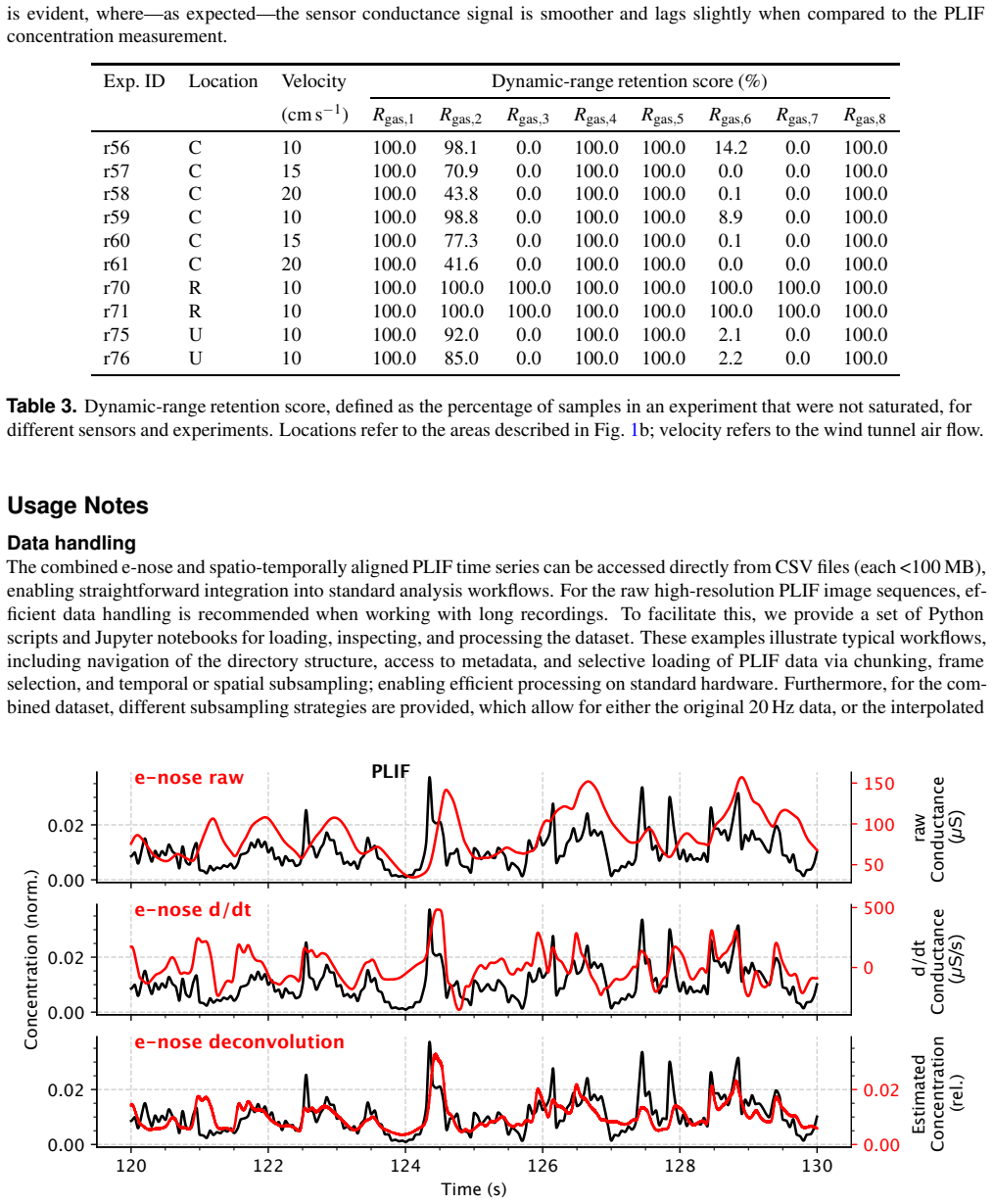
The authors provide a dataset combining planar laser-induced fluorescence measurements of an acetone tracer plume with synchronized recordings from a custom kilohertz-rate MEMS MOx electronic nose deployed in a laboratory wind tunnel. The PLIF system provides quantitative two-dimensional concentration fields at high spatial and temporal resolution, while the co-located e-nose records film resistance, heater currents, and environmental parameters with aligned timestamps. The dataset enables quantitative assessment of sensor dynamics, development and benchmarking of reconstruction and deconvolution algorithms, and data-driven modelling of plume structure.
What carries the argument
The synchronized PLIF and electronic nose dataset, which supplies quantitative concentration fields as ground truth alongside time-resolved sensor responses.
If this is right
- The effects of MOx sensor thermal and surface kinetics as low-pass filters on turbulent signals can be measured directly.
- Reconstruction and deconvolution algorithms can be developed and tested against the aligned concentration fields.
- Data-driven models of odour plume structure can incorporate realistic sensor inputs verified by imaging.
- High-speed sensing systems for robotics and monitoring can be evaluated using the benchmark recordings.
Where Pith is reading between the lines
- The dataset could support direct tests of how sensor placement or wind speed alters distortion patterns.
- Machine learning compensation models trained on these recordings might generalize to correct lag in field deployments.
- The concentration fields offer validation data for simulations of scalar mixing in turbulence.
- Similar synchronized setups with varied tracers could extend the approach to other chemical environments.
Load-bearing premise
The PLIF images give undistorted quantitative concentrations exactly at the sensor location and time, with timestamps aligned precisely enough for dynamic analysis.
What would settle it
Independent point measurements at the sensor site showing concentrations that differ from the PLIF-derived values, or synchronization offsets larger than the sensor response timescale, would invalidate the dataset for quantitative dynamics studies.
Figures


read the original abstract
Chemical sensing in real-world environments requires resolving rapidly fluctuating and spatially heterogeneous concentration fields. However, these dynamics are strongly distorted by widely used, low-cost metal-oxide (MOx) gas sensors, whose thermal and surface-kinetic response acts as a low-pass filter on the underlying concentration signal. Quantifying and compensating for these effects remains challenging, largely due to the lack of benchmark datasets that simultaneously capture the spatiotemporal structure of turbulent odour fields and the time-resolved response of point sensors. Here, we present a dataset combining planar laser-induced fluorescence (PLIF) measurements of an acetone tracer plume with synchronised recordings from a custom, kilohertz-rate microelectromechanical (MEMS) MOx electronic nose deployed in a laboratory wind tunnel. The PLIF system provides quantitative, two-dimensional concentration fields at high spatial and temporal resolution, while the co-located e-nose records film resistance, heater currents, and environmental parameters with aligned timestamps. The dataset enables quantitative assessment of sensor dynamics, development and benchmarking of reconstruction and deconvolution algorithms, and data-driven modelling of plume structure. All recordings, metadata, calibration files, and example analysis scripts are released in open, platform-independent formats. Together, these provide a valuable reference for researchers working in odour-guided robotics, environmental monitoring, computational fluid dynamics, and neuromorphic sensing, supporting the design and evaluation of high-speed odour-sensing systems.
Editorial analysis
A structured set of objections, weighed in public.
Referee Report
Summary. The manuscript describes the release of an open dataset that pairs planar laser-induced fluorescence (PLIF) measurements of an acetone tracer plume with synchronized high-rate recordings from a custom MEMS MOx electronic nose in a laboratory wind tunnel. The PLIF provides quantitative two-dimensional concentration fields, while the e-nose records film resistance, heater currents, and environmental parameters with aligned timestamps. Calibration files, metadata, and analysis scripts are also released.
Significance. This work is significant as it provides a valuable benchmark dataset for studying the dynamics of low-cost gas sensors in turbulent odour plumes, which is currently lacking. The combination of non-invasive quantitative ground truth with high-speed sensor data will support the development of compensation algorithms and data-driven models, benefiting fields like odour-guided robotics and environmental monitoring. The open release enhances reproducibility and accessibility. The stress-test concern on PLIF accuracy and temporal alignment does not land as a problem given the described co-located setup, standard acetone PLIF processing, and release of calibration files.
minor comments (2)
- [Abstract] The abstract would benefit from a brief mention of typical wind tunnel flow speeds or Reynolds numbers to contextualize the turbulent regime.
- [Dataset description] Explicit comparison of the temporal resolutions and sampling rates of the PLIF and e-nose systems would clarify the dataset's suitability for kilohertz-scale sensor dynamics studies.
Simulated Author's Rebuttal
We thank the referee for their positive and constructive review. We are pleased that the significance of the open benchmark dataset is recognized, particularly its value for studying MOx sensor dynamics in turbulent plumes and supporting related research in robotics and environmental monitoring. The recommendation for acceptance is appreciated.
Circularity Check
No significant circularity; experimental dataset release with no derivations or predictions
full rationale
The manuscript is a dataset paper whose central claim is the release of synchronized PLIF concentration fields and high-rate MOx sensor recordings from a wind-tunnel experiment. No equations, models, predictions, or parameter fits are presented. The abstract and description emphasize co-located deployment, timestamp alignment, open data formats, calibration files, and example scripts, all of which are direct experimental outputs rather than derived quantities. No self-citations, ansatzes, or uniqueness claims appear as load-bearing steps. The contribution is self-contained against external benchmarks (standard PLIF processing for acetone) and contains no internal reduction of outputs to inputs by construction.
Axiom & Free-Parameter Ledger
Reference graph
Works this paper leans on
-
[1]
Ishida, H., Wada, Y . & Matsukura, H. Chemical Sensing in Robo tic Applications: A Review. IEEE Sensors J. 12, 3163–3173, 10.1109/JSEN.2012.2208740 (2012)
-
[2]
Y amazoe, N. & Miura, N. Development of gas sensors for enviro nmental protection. IEEE Transactions on Components, Packag. Manuf. T echnol. Part A18, 252–256, 10.1109/95.390298 (1995)
-
[3]
Celani, A., Villermaux, E. & V ergassola, M. Odor Landscapes in Turbulent Environments. Phys. Rev. X 4, 041015, 10.1103/PhysRevX.4.041015 (2014)
-
[4]
Pannunzi, M. & Nowotny, T. Odor Stimuli: Not Just Chemical Id entity. Front. Physiol. 10, 1428, 10.3389/fphys.2019.01428 (2019)
-
[5]
Crimaldi, J. et al. Active sensing in a dynamic olfactory world. J. Comput. Neurosci. 50, 1–6, 10.1007/s10827-021-00798-1 (2022)
-
[6]
Ouyang, B., True, A. C., Crimaldi, J. P . & Ermentrout, B. Simp le olfactory navigation in air and water. J. Theor. Biol. 595, 111941, 10.1016/j.jtbi.2024.111941 (2024)
-
[7]
Fackrell, J. E. & Robins, A. G. The effects of source size on co ncentration fluctuations in plumes. Boundary-Layer Meteorol. 22, 335–350, 10.1007/BF00120014 (1982). 9/12
-
[8]
Mafra-Neto, A. & Cardé, R. T. Fine-scale structure of pherom one plumes modulates upwind orientation of flying moths. Nature 369, 142–144, 10.1038/369142a0 (1994)
-
[9]
Riffell, J. A. et al. Flower discrimination by pollinators in a dynamic chemical environment. Science 344, 1515–1518, 10.1126/science.1251041 (2014)
-
[10]
Schmuker, M., Bahr, V . & Huerta, R. Exploiting plume structu re to decode gas source distance using metal-oxide gas sensors. Sensors Actuators, B: Chem. 235, 636–646, 10.1016/j.snb.2016.05.098 (2016)
-
[11]
Hopfield, J. J. Olfactory computation and object perception . Proc. Natl. Acad. Sci. 88, 6462–6466, 10.1073/pnas.88.15.6462 (1991)
-
[12]
Ackels, T. et al. Fast odour dynamics are encoded in the olfactory system and g uide behaviour. Nature 593, 558–563, 10.1038/s41586-021-03514-2 (2021)
-
[13]
Tootoonian, S., True, A. C., Stark, E., Crimaldi, J. P . & Scha efer, A. T. Quantifying spectral information about source separation in multisource odour plumes. PLOS ONE 20, e0297754, 10.1371/journal.pone.0297754 (2025)
-
[14]
Korotcenkov, G. The role of morphology and crystallographi c structure of metal oxides in response of conductometric- type gas sensors. Mater. Sci. Eng. R: Reports 61, 1–39, 10.1016/j.mser.2008.02.001 (2008)
-
[15]
Gardner, E. L. W ., Gardner, J. W . & Udrea, F. Micromachined Th ermal Gas Sensors—A Review. Sensors 23, 681, 10.3390/s23020681 (2023)
-
[16]
Dennler, N. et al. High-speed odor sensing using miniaturized electronic nos e. Sci. Adv. 10, eadp1764, 10.1126/sciadv.adp1764 (2024)
-
[17]
France, K. K., Peddi, R., Dennler, N. & Daescu, O. Position: O lfaction standardization is essential for the advancement of embodied artificial intelligence. arXiv preprint arXiv:2506.00398 (2025)
-
[18]
V ergara, A. et al. On the performance of gas sensor arrays in open sampling syst ems using Inhibitory Support V ector Machines. Sensors Actuators, B: Chem. 185, 462–477, 10.1016/j.snb.2013.05.027 (2013)
-
[19]
Fonollosa, J., Rodríguez-Luján, I., Trincavelli, M., V erg ara, A. & Huerta, R. Chemical Discrimination in Turbulent Gas Mixtures with MOX Sensors V alidated by Gas Chromatograp hy-Mass Spectrometry. Sensors 14, 19336–19353, 10.3390/s141019336 (2014)
-
[20]
Deep Learning Based Calibration Time Reduction for MOS Gas S ensors with Transfer Learning
Robin, Y .et al. Deep Learning Based Calibration Time Reduction for MOS Gas S ensors with Transfer Learning. Atmo- sphere 13, 1614, 10.3390/atmos13101614 (2022)
-
[21]
Chemical gas sensor drift compensation using classifier ens embles
V ergara, A.et al. Chemical gas sensor drift compensation using classifier ens embles. Sensors Actuators B: Chem. 166- 167, 320–329, 10.1016/j.snb.2012.01.074 (2012)
-
[22]
Kumar, J. R. R. & Chouksey, P . Gas Sensor Array Drift in an E-No se System: A Dataset for Machine Learning Applica- tions. Int. J. on Recent Innov. Trends Comput. Commun. 11, 167–171, 10.17762/ijritcc.v11i6.7343 (2023)
-
[23]
Wörner, J., Eimler, J. & Pein-Hackelbusch, M. Long-term dri ft behavior in metal oxide gas sensor arrays: a one-year dataset from an electronic nose. Sci. Data 12, 1628, 10.1038/s41597-025-05993-8 (2025)
-
[24]
Dennler, N., Rastogi, S., Fonollosa, J., van Schaik, A. & Sch muker, M. Drift in a popular metal oxide sensor dataset re- veals limitations for gas classification benchmarks. Sensors Actuators B: Chem. 361, 131668, 10.1016/j.snb.2022.131668 (2022)
-
[25]
Dennler, N., van Schaik, A. & Schmuker, M. Limitations in odo ur recognition and generalization in a neuromorphic olfactory circuit. Nat. Mach. Intell. 6, 1451–1453, https://doi.org/10.1038/s42256-024-00952-1 (2024)
-
[26]
Dennler, N., True, A., V an Schaik, A. & Schmuker, M. Neuromor phic principles for machine olfaction. Neuromorphic Comput. Eng. 5, 023001, 10.1088/2634-4386/add0dc (2025)
-
[27]
Justus, K. A., Murlis, J. & Jones, C. Measurement of Odor-Plu me Structure in a Wind Tunnel Using a Photoionization Detector and a Tracer Gas. Environ. Fluid Mech. 115–142, 10.1023/A:1016227601019 (2002)
-
[28]
Drewnick, F. et al. Design of a mobile aerosol research laboratory and data proc essing tools for effective stationary and mobile field measurements. Atmospheric Meas. T ech.5, 1443–1457, 10.5194/amt-5-1443-2012 (2012)
-
[29]
Hargather, M. J. & Settles, G. S. Natural-background-orien ted schlieren imaging. Exp. fluids 48, 59–68, 10.1007/s00348-009-0709-3 (2010)
-
[30]
Connor, E. G., McHugh, M. K. & Crimaldi, J. P . Quantification o f airborne odor plumes using planar laser-induced fluorescence. Exp. Fluids 59, 137, 10.1007/s00348-018-2591-3 (2018). 10/12
-
[31]
Peng, J. B. et al. Visualization of Flow Field: Application of PLIF Technique . J. Spectrosc. 2018, 1–6, 10.1155/2018/8759898 (2018)
-
[32]
Álvarez Salvado, E. et al. Elementary sensory-motor transformations underlying olf actory navigation in walking fruit- flies. eLife 7, e37815, 10.7554/eLife.37815 (2018)
-
[33]
True, A. C. & Crimaldi, J. P . Distortion of passive scalar str ucture during suction-based plume sampling. Sensors Actuators B: Chem. 367, 132018, 10.1016/j.snb.2022.132018 (2022)
-
[34]
A., Murlis, J., Long, X., Li, W
Farrell, J. A., Murlis, J., Long, X., Li, W . & Carde, R. Filame nt-Based Atmospheric Dispersion Model to Achieve Short Time-Scale Structure of Odor Plumes:. Tech. Rep., Defense T echnical Information Center, Fort Belvoir, V A (2002). 10.21236/ADA399832
-
[35]
Monroy, J., Hernandez-Bennetts, V ., Fan, H., Lilienthal, A . & Gonzalez-Jimenez, J. GADEN: A 3D Gas Dispersion Simulator for Mobile Robot Olfaction in Realistic Environm ents. Sensors 17, 1479, 10.3390/s17071479 (2017)
-
[36]
Singh, S. H., V an Breugel, F., Rao, R. P . N. & Brunton, B. W . Emergent behaviour and neural dynamics in artificial agents tracking odour plumes. Nat. Mach. Intell. 5, 58–70, 10.1038/s42256-022-00599-w (2023)
-
[37]
Burton, G. C. The nonlinear large-eddy simulation method ap plied to sc ≈ 1 and sc ≫ 1 passive-scalar mixing. Phys. Fluids 20, https://doi.org/10.1063/1.2840199 (2008)
-
[38]
Donzis, D. & Y eung, P . Resolution effects and scaling in nume rical simulations of passive scalar mixing in turbulence. Phys. D: Nonlinear Phenom. 239, 1278–1287, https://doi.org/10.1016/j.physd.2009.09.024 (2010)
-
[39]
Monroy, J. G., González-Jiménez, J. & Blanco, J. L. Overcomi ng the Slow Recovery of MOX Gas Sensors through a System Modeling Approach. Sensors 12, 13664–13680, 10.3390/s121013664 (2012)
-
[40]
Fast Measurements with MOX Senso rs: A Least-Squares Approach to Blind Deconvolution
Martinez, Burgués & Marco. Fast Measurements with MOX Senso rs: A Least-Squares Approach to Blind Deconvolution. Sensors 19, 4029, 10.3390/s19184029 (2019)
-
[41]
Drix, D. & Schmuker, M. Resolving fast gas transients with me tal oxide sensors. ACS Sensors 10.1021/acssensors.0c02006 (2021)
-
[42]
Marjovi, A. & Marques, L. Multi-robot olfactory search in st ructured environments. Robotics Auton. Syst. 59, 867–881, 10.1016/j.robot.2011.07.010 (2011)
-
[43]
Vincent, T. A., Xing, Y ., Cole, M. & Gardner, J. W . Investigat ion of the response of high-bandwidth MOX sensors to gas plumes for application on a mobile robot in hazardous env ironments. Sensors Actuators B: Chem. 279, 351–360, 10.1016/j.snb.2018.08.125 (2019)
-
[44]
France, K. K. & Daescu, O. Olfactory Inertial Odometry: Meth odology for Effective Robot Navigation by Scent. In IEEE 2025 22nd International Conference on Ubiquitous Robots (U R), 51–58, 10.1109/UR65550.2025.11078037 (2025)
-
[45]
M., Thorson, J., Halliday, H., Milfor d, J
Collier-Oxandale, A. M., Thorson, J., Halliday, H., Milfor d, J. & Hannigan, M. Understanding the ability of low-cost MOx sensors to quantify ambient VOCs. Atmospheric Meas. T ech.12, 1441–1460, 10.5194/amt-12-1441-2019 (2019)
-
[46]
Khorramifar, A. et al. Environmental engineering applications of electronic nos e systems based on mox gas sensors. sensors 23, 5716, https://doi.org/10.3390/s23125716 (2023)
-
[47]
Diamond, A., Schmuker, M., Berna, A. Z., Trowell, S. & Nowotn y, T. Classifying continuous, real-time e-nose sensor data using a bio-inspired spiking network modelled on the in sect olfactory system. Bioinspiration & Biomimetics 11, 026002, 10.1088/1748-3190/11/2/026002 (2016)
-
[48]
Jürgensen, A.-M., Khalili, A., Chicca, E., Indiveri, G. & Na wrot, M. P . A neuromorphic model of olfactory processing and sparse coding in the Drosophila larva brain. Neuromorphic Comput. Eng. 1, 024008, 10.1088/2634-4386/ac3ba6 (2021)
-
[49]
Han, J.-K. et al. Artificial olfactory neuron for an in-sensor neuromorphic n ose. Adv. Sci. 9, 2106017, https://doi.org/10.1002/advs.202106017 (2022)
-
[50]
Shraiman, B. I. & Siggia, E. D. Scalar turbulence. Nature 405, 639–646, 10.1038/35015000 (2000)
-
[51]
V ogel, C. R. Computational Methods for Inverse Problems , vol. 23 of Frontiers in Applied Mathematics (SIAM, 2002)
2002
-
[52]
Ljung, L. System Identification. In Procházka, A., Uhlí ˇr, J., Rayner, P . W . J. & Kingsbury, N. G. (eds.) Signal Analysis and Prediction, 163–173, 10.1007/978-1-4612-1768-8_11 (1998)
-
[53]
Karpatne, A. et al. Theory-Guided Data Science: A New Paradigm for Scientific Di scovery from Data. IEEE Transactions on Knowl. Data Eng. 29, 2318–2331, 10.1109/TKDE.2017.2720168 (2017). 11/12
-
[54]
Hurst, D. & V assilicos, J. C. Scalings and decay of fractal-g enerated turbulence. Phys. Fluids 19, 035103, 10.1063/1.2676448 (2007)
-
[55]
Lozano, A., Yip, B. & Hanson, R. K. Acetone: a tracer for conce ntration measurements in gaseous flows by planar laser-induced fluorescence. Exp. Fluids 13, 369–376, 10.1007/bf00223244 (1992)
-
[56]
Fritsch, F. N. & Carlson, R. E. Monotone piecewise cubic inte rpolation. SIAM J. on Numer. Analysis 17, 238–246, https://doi.org/10.1137/0717021 (1980)
-
[57]
& and, A
Dennler, N., Stark, E., Güntner, A. & and, A. T. Dataset: Odou r sensing in turbulent plumes with high-speed electronic nose and non-invasive ground truth. ETH Zurich Research Col lection (2026). http://hdl.handle.net/20.500.11850/782611
2026
-
[58]
Husnain, A. U. et al. Gas concentration mapping and source localization for environmental monitoring through unmanned aerial systems using model-free reinforcement learning ag ents. PLOS ONE 19, e0296969, 10.1371/journal.pone.0296969 (2024). 12/12
discussion (0)
Sign in with ORCID, Apple, or X to comment. Anyone can read and Pith papers without signing in.