Recognition: unknown
Dai-Freed anomalies and level matching in heterotic asymmetric orbifolds
Pith reviewed 2026-05-10 02:03 UTC · model grok-4.3
The pith
The consistency conditions for asymmetric heterotic orbifolds arise exactly as the vanishing conditions for Dai-Freed anomalies computed from spin bordism.
A machine-rendered reading of the paper's core claim, the machinery that carries it, and where it could break.
Core claim
In the fermionic description the conditions for vanishing Dai-Freed anomalies are exactly the familiar level-matching constraints, together with the additional mod-2 conditions that appear for even m. These conditions are derived by computing the relevant spin-bordism invariants directly from the worldsheet data and are shown to be matched under bosonization for inner automorphisms of the E8 times E8 lattice theory.
What carries the argument
Spin-bordism invariants associated to the chiral action of Z_m on the worldsheet fermions (with symmetric action on the bosons).
If this is right
- Standard level-matching rules are re-derived as anomaly-cancellation requirements.
- Extra mod-2 conditions must be imposed whenever the cyclic order m is even.
- Anomaly cancellation is preserved under bosonization for inner automorphisms of the E8 lattice.
- Higher-genus fermion partition functions transform in a manner consistent with the bordism invariants.
Where Pith is reading between the lines
- The same bordism computation could be applied to non-cyclic discrete symmetries to generate new consistency conditions.
- This viewpoint may unify level-matching requirements across different heterotic constructions without separate case-by-case checks.
- One could test the equivalence by computing the bordism invariant for a concrete lattice automorphism already known to satisfy level matching.
Load-bearing premise
The symmetries act chirally on the fermions and symmetrically on the bosons, allowing the spin-bordism invariants to be read off from the worldsheet fields.
What would settle it
An explicit Z_m asymmetric orbifold model in which level matching holds yet a non-zero spin-bordism invariant is computed, or vice versa.
Figures
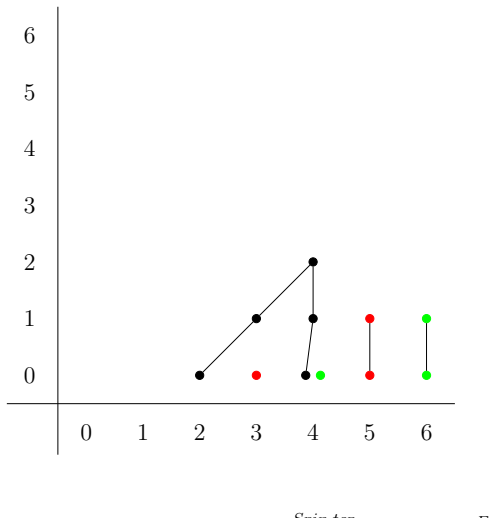
read the original abstract
We study asymmetric orbifolds of the $E_8\times E_8$ heterotic string from the perspective of worldsheet Dai-Freed anomalies. Focusing on cyclic symmetries $G = \mathbb{Z}_m$ that act chirally on the fermions and symmetrically on the bosons, we compute the corresponding spin-bordism invariants and derive the conditions for the vanishing of global anomalies from this perspective. In the fermionic description, these conditions are exactly the familiar level-matching constraints, together with the additional mod-2 conditions that appear for even $m$. We then discuss the same conditions from the transformation properties of higher-genus fermion partition functions and explain how the anomaly is matched under bosonization for a large class of inner automorphisms of the $E_8\times E_8$ lattice theory. This gives an interpretation of the standard consistency conditions for asymmetric heterotic orbifolds from the Dai-Freed anomaly perspective.
Editorial analysis
A structured set of objections, weighed in public.
Referee Report
Summary. The manuscript claims that for cyclic Z_m symmetries acting chirally on fermions and symmetrically on bosons in E8×E8 heterotic asymmetric orbifolds, the Dai-Freed anomaly vanishing conditions obtained from spin-bordism invariants exactly reproduce the standard level-matching constraints together with additional mod-2 conditions for even m. These conditions are also derived from the transformation properties of higher-genus fermion partition functions, with an explanation of anomaly matching under bosonization for a large class of inner automorphisms of the E8×E8 lattice theory.
Significance. If the central derivation holds, the result is significant because it recovers the known consistency conditions for asymmetric heterotic orbifolds from an independent topological route (spin bordism) rather than direct fitting or self-referential arguments. The explicit matching in the fermionic description and the discussion of bosonization provide a bridge between worldsheet anomalies and lattice automorphisms, which may facilitate generalization to other orbifold constructions.
major comments (1)
- [§4] §4 (spin-bordism computation): The central claim that the anomaly conditions match level-matching exactly depends on the explicit evaluation of the spin-bordism invariants for the Z_m action. The manuscript should include the step-by-step computation of the relevant bordism groups or invariants (including generators and how the chiral fermion action produces the mod-2 conditions for even m) to permit verification of the exact equivalence.
minor comments (2)
- The abstract could briefly indicate the range of m considered or note that the result holds for general m.
- [§5] In the bosonization discussion, an explicit example for a small inner automorphism (e.g., m=2) would clarify how the anomaly is matched.
Simulated Author's Rebuttal
We thank the referee for their careful reading of the manuscript and for the constructive comments. We address the major comment below.
read point-by-point responses
-
Referee: [§4] §4 (spin-bordism computation): The central claim that the anomaly conditions match level-matching exactly depends on the explicit evaluation of the spin-bordism invariants for the Z_m action. The manuscript should include the step-by-step computation of the relevant bordism groups or invariants (including generators and how the chiral fermion action produces the mod-2 conditions for even m) to permit verification of the exact equivalence.
Authors: We agree that a more explicit, step-by-step presentation of the spin-bordism computation would improve verifiability. In the revised version we will expand §4 with a dedicated subsection that (i) recalls the relevant spin bordism groups Ω^{spin}_d(BZ_m), (ii) identifies their generators, (iii) specifies the map induced by the chiral fermion action, and (iv) shows explicitly how this map yields the mod-2 conditions for even m. The added material will be self-contained and will not alter the original results. revision: yes
Circularity Check
Derivation recovers known level-matching via independent spin-bordism computation
full rationale
The paper computes spin-bordism invariants directly from the worldsheet action of Z_m symmetries (chiral on fermions, symmetric on bosons) and shows that anomaly cancellation reproduces the standard level-matching conditions plus mod-2 constraints for even m. This constitutes an alternative topological derivation of pre-existing consistency requirements rather than any self-definitional loop, fitted-parameter prediction, or load-bearing self-citation. The central claim remains independent of the target result; the match to known constraints is presented as a verification, not a construction by definition. No steps reduce by construction to the paper's own inputs.
Axiom & Free-Parameter Ledger
axioms (2)
- domain assumption Spin-bordism invariants detect the global anomalies of the worldsheet theory for the given symmetry actions.
- domain assumption The heterotic string fermions and bosons transform under the stated chiral/symmetric action of Z_m.
Forward citations
Cited by 1 Pith paper
-
String probes, simple currents, and the no global symmetries conjecture
Chiral simple current extensions on the worldsheet reproduce and generalize obstructions to gauging center one-form symmetries in 6d and 8d string compactifications while clarifying BPS particle requirements upon circ...
Reference graph
Works this paper leans on
-
[1]
Dixon, J.A
L.J. Dixon, J.A. Harvey, C. Vafa and E. Witten,Strings on Orbifolds,Nucl. Phys. B261(1985) 678
1985
-
[2]
Dixon, J.A
L.J. Dixon, J.A. Harvey, C. Vafa and E. Witten,Strings on Orbifolds. 2.,Nucl. Phys. B274(1986) 285
1986
-
[3]
Narain, M.H
K.S. Narain, M.H. Sarmadi and C. Vafa,Asymmetric Orbifolds,Nucl. Phys. B288 (1987) 551
1987
-
[4]
Narain, M.H
K.S. Narain, M.H. Sarmadi and C. Vafa,Asymmetric orbifolds: Path integral and operator formulations,Nucl. Phys. B356(1991) 163
1991
-
[5]
Vafa,Modular Invariance and Discrete Torsion on Orbifolds,Nucl
C. Vafa,Modular Invariance and Discrete Torsion on Orbifolds,Nucl. Phys. B273 (1986) 592
1986
-
[6]
Freed and C
D.S. Freed and C. Vafa,GLOBAL ANOMALIES ON ORBIFOLDS,Commun. Math. Phys.110(1987) 349
1987
-
[7]
I. Garc´ ıa-Etxebarria and M. Montero,Dai-Freed anomalies in particle physics, JHEP08(2019) 003 [1808.00009]
- [8]
- [9]
-
[10]
Classification of chiral fermionic CFTs of central charge≤16,
P. Boyle Smith, Y.-H. Lin, Y. Tachikawa and Y. Zheng,Classification of chiral fermionic CFTs of central charge≤16,SciPost Phys.16(2024) 058 [2303.16917]
-
[11]
Atiyah, V.K
M.F. Atiyah, V.K. Patodi and I.M. Singer,Spectral asymmetry and riemannian geometry. i,Math. Proc. Cambridge Philos. Soc.77(1975) 43
1975
-
[12]
Atiyah, V.K
M.F. Atiyah, V.K. Patodi and I.M. Singer,Spectral asymmetry and riemannian geometry. ii,Math. Proc. Cambridge Philos. Soc.78(1975) 405
1975
- [13]
-
[14]
Y. Tachikawa and K. Yonekura,Why are fractional charges of orientifolds compatible with Dirac quantization?,SciPost Phys.7(2019) 058 [1805.02772]
-
[15]
M. Dierigl, R. Minasian and D. Noviˇ ci´ c,Modified Abelian Gauge Theories, 2602.21282
-
[16]
Asymmetric orbifolds with vanishing one-loop vacuum energy
V. Larotonda, M. Montero and M. Tartaglia,Asymmetric orbifolds with vanishing one-loop vacuum energy,2602.07113
work page internal anchor Pith review Pith/arXiv arXiv
-
[17]
S. Monnier and G.W. Moore,Remarks on the Green–Schwarz Terms of Six-Dimensional Supergravity Theories,Commun. Math. Phys.372(2019) 963 [1808.01334]
-
[18]
M. Dierigl and M. Tartaglia,(Quadratically) Refined discrete anomaly cancellation, JHEP08(2025) 145 [2504.02934]
-
[19]
Davis and P
J.F. Davis and P. Kirk,Lecture Notes in Algebraic Topology, vol. 35 ofGraduate Studies in Mathematics, American Mathematical Society, Providence, RI (2001)
2001
- [20]
-
[21]
Alvarez-Gaume, G.W
L. Alvarez-Gaume, G.W. Moore and C. Vafa,Theta Functions, Modular Invariance and Strings,Commun. Math. Phys.106(1986) 1
1986
-
[22]
Bismut,The atiyah-singer index theorem for families of dirac operators,Invent
J. Bismut,The atiyah-singer index theorem for families of dirac operators,Invent. Math.83(1986) 91
1986
-
[23]
Beauville,Theta functions, old and new,Open problems and surveys of contemporary mathematics6(2013) 99
A. Beauville,Theta functions, old and new,Open problems and surveys of contemporary mathematics6(2013) 99
2013
-
[24]
Igusa,Theta Functions, vol
J.-I. Igusa,Theta Functions, vol. 194 ofGrundlehren der mathematischen Wissenschaften, Springer, Berlin (1972)
1972
- [25]
-
[26]
Harvey, G.W
J.A. Harvey, G.W. Moore and C. Vafa,QUASICRYSTALLINE COMPACTIFICATION,Nucl. Phys. B304(1988) 269
1988
-
[27]
Z.K. Baykara, H.-C. Tarazi and C. Vafa,Quasicrystalline string landscape,Phys. Rev. D111(2025) 086025 [2406.00129]. 33
-
[28]
Kac,Infinite-Dimensional Lie Algebras, Cambridge University Press, Cambridge, 3 ed
V.G. Kac,Infinite-Dimensional Lie Algebras, Cambridge University Press, Cambridge, 3 ed. (1990)
1990
-
[29]
Topological Defect Lines and Renormalization Group Flows in Two Dimensions
C.-M. Chang, Y.-H. Lin, S.-H. Shao, Y. Wang and X. Yin,Topological Defect Lines and Renormalization Group Flows in Two Dimensions,JHEP01(2019) 026 [1802.04445]
work page Pith review arXiv 2019
-
[30]
Y. Tachikawa,On gauging finite subgroups,SciPost Phys.8(2020) 015 [1712.09542]
-
[31]
J. Davighi, B. Gripaios and N. Lohitsiri,Anomalies of non-Abelian finite groups via cobordism,JHEP09(2022) 147 [2207.10700]
-
[32]
G. Aldazabal, E. Andr´ es, A. Font, K. Narain and I.G. Zadeh,Asymmetric orbifolds, rank reduction and heterotic islands,JHEP08(2025) 083 [2501.17228]
-
[33]
J.A. Harvey and G.W. Moore,An Uplifting Discussion of T-Duality,JHEP05 (2018) 145 [1707.08888]
-
[34]
P. Boyle Smith and J. Davighi,Bosonisation Cohomology: Spin Structure Summation in Every Dimension,2511.13718
-
[35]
E. Witten,Duality relations among topological effects in string theory,JHEP05 (2000) 031 [hep-th/9912086]
-
[36]
Eguchi and H
T. Eguchi and H. Ooguri,Chiral Bosonization on Riemann Surface,Phys. Lett. B 187(1987) 127
1987
-
[37]
Classification of abelian spin Chern-Simons theories
D. Belov and G.W. Moore,Classification of Abelian spin Chern-Simons theories, hep-th/0505235
work page internal anchor Pith review arXiv
- [38]
- [39]
-
[40]
A. Beaudry and J.A. Campbell,A guide for computing stable homotopy groups, 1801.07530. 34
discussion (0)
Sign in with ORCID, Apple, or X to comment. Anyone can read and Pith papers without signing in.