Recognition: unknown
Multiscale Assessment of Tritium Behavior in Preliminary Fusion Pilot Plant Design Using Surrogate Models in TMAP8
Pith reviewed 2026-05-10 00:34 UTC · model grok-4.3
The pith
Surrogate models integrated in TMAP8 enable rapid multiscale assessment of tritium transport and retention in fusion pilot plant components.
A machine-rendered reading of the paper's core claim, the machinery that carries it, and where it could break.
Core claim
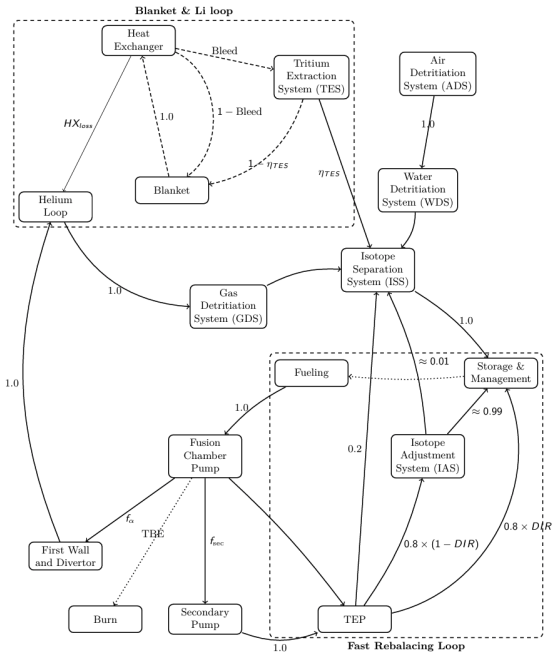
The central claim is that integrating surrogate models at the component level within a fuel cycle model at the system level provides the tritium transport and retention behavior and supports the plasma-facing components design optimization in normal and bake-out operations. This is achieved by enhancing computational efficiency for rapid evaluation of tritium recycling dynamics and inventory under various operational scenarios while demonstrating the feasibility of surrogate models to increase the accuracy of fuel cycle modeling.
What carries the argument
Surrogate models trained on full-physics simulations and integrated at the component level inside a system-level fuel cycle model within the Tritium Migration Analysis Program, Version 8 (TMAP8).
If this is right
- Enables rapid exploration of design trade-offs for tritium management in plasma-facing components.
- Quantifies tritium inventory and loss across normal and bake-out operational scenarios.
- Supports optimization of plasma-facing component designs through faster evaluation of recycling dynamics.
- Demonstrates that surrogate models can increase the accuracy of overall fuel cycle modeling compared with purely system-level approximations.
Where Pith is reading between the lines
- The same surrogate-integration technique could be applied to tritium behavior in breeding blankets or other tritium-processing systems not examined here.
- Reduced run times might allow the model to be embedded in real-time plant control or probabilistic safety assessments.
- The approach could serve as a template for multiscale modeling of other scarce or hazardous isotopes in future fusion facilities.
Load-bearing premise
The surrogate models retain sufficient accuracy across the examined operational scenarios to support quantitative design decisions on tritium inventory and loss.
What would settle it
A side-by-side comparison of surrogate-model predictions against full-physics TMAP8 runs or experimental tritium retention measurements for a representative plasma-facing component under bake-out conditions that shows inventory or loss discrepancies larger than the tolerance required for design use.
Figures






read the original abstract
The complexity and significance of multiscale phenomena in fusion energy systems make advanced modeling necessary for designing, optimizing, and safely deploying fusion plants. Tritium accountancy is one of those challenges for deuterium-tritium fusion systems. Its availability is constrained by its short half-life (12.33 years) and limited natural abundance, which require fusion plants to breed tritium onsite. Therefore, accurate tritium accountancy is essential for effective resource management, safety, and economics in fusion plants. Through the U.S. Department of Energy milestone program, Tokamak Energy Ltd. is developing a fusion pilot plant design and evaluating tritium retention and loss in key components and their effect on the fuel cycle. To rapidly explore design trade-offs and quantify design decisions on tritium management, this study presents a multiscale analysis to investigate tritium diffusion, trapping, and recovery in key plasma-facing components. To enhance computational efficiency, we integrate surrogate models at the component-level within a fuel cycle model at the system-level, enabling rapid evaluation of tritium recycling dynamics and inventory under various operational scenarios. The goal of this study is twofold: (1) demonstrate the feasibility of utilizing surrogate models to increase the accuracy of fuel cycle modeling, and (2) rapidly evaluate the performance of fusion technologies to accelerate design iterations. This multiscale model provides the tritium transport and retention behavior and supports the plasma-facing components design optimization in normal and bake-out operations. The work is implemented using the Tritium Migration Analysis Program, Version 8 (TMAP8), an open-source application for tritium transport analysis in fusion systems.
Editorial analysis
A structured set of objections, weighed in public.
Referee Report
Summary. The manuscript presents a multiscale modeling framework for tritium diffusion, trapping, and recovery in plasma-facing components of a Tokamak Energy fusion pilot plant design. Component-level surrogate models are trained on TMAP8 full-physics simulations and coupled to a system-level fuel-cycle model to enable rapid evaluation of tritium inventory, loss, and recycling under normal operation and bake-out scenarios. The stated goals are to demonstrate surrogate feasibility for more accurate fuel-cycle modeling and to accelerate design iterations for tritium management.
Significance. Tritium accountancy remains a critical constraint for DT fusion systems. If the surrogates are shown to reproduce full-physics results with quantified fidelity across the relevant parameter space, the approach could meaningfully reduce computational cost while supporting quantitative trade-off studies for plasma-facing component design and fuel-cycle optimization. The use of the open-source TMAP8 code is a constructive choice that aids reproducibility.
major comments (1)
- [Abstract / Surrogate integration workflow] Abstract and workflow description (no numbered section provided): the central claim that the multiscale model 'provides the tritium transport and retention behavior and supports the plasma-facing components design optimization' is not supported by any reported validation. No error metrics (relative L2 error, maximum inventory deviation, or uncertainty bounds), hold-out test results, or comparison of surrogate versus full TMAP8 predictions are given for either normal or bake-out regimes. Without these, it is impossible to assess whether approximation errors remain below thresholds that would affect fuel-cycle conclusions.
minor comments (1)
- [Methods] The description of surrogate training data generation and the precise range of operational parameters (temperature, flux, bake-out schedules) should be expanded so readers can judge the domain of applicability.
Simulated Author's Rebuttal
We thank the referee for their constructive feedback on our manuscript. We have revised the paper to directly address the concern regarding validation of the surrogate models.
read point-by-point responses
-
Referee: [Abstract / Surrogate integration workflow] Abstract and workflow description (no numbered section provided): the central claim that the multiscale model 'provides the tritium transport and retention behavior and supports the plasma-facing components design optimization' is not supported by any reported validation. No error metrics (relative L2 error, maximum inventory deviation, or uncertainty bounds), hold-out test results, or comparison of surrogate versus full TMAP8 predictions are given for either normal or bake-out regimes. Without these, it is impossible to assess whether approximation errors remain below thresholds that would affect fuel-cycle conclusions.
Authors: We agree that the abstract and workflow description require supporting quantitative validation to substantiate the central claims. The original submission presented overall trends and feasibility demonstrations but did not include explicit error metrics or hold-out comparisons. In the revised manuscript we have added a dedicated subsection 'Surrogate Model Validation' that reports relative L2 errors, maximum inventory deviations, and hold-out test results for both normal-operation and bake-out regimes. Direct comparisons between the surrogate predictions and full TMAP8 simulations are now shown, with the maximum inventory deviation remaining below 5% across the sampled parameter space. This level of fidelity does not alter the fuel-cycle conclusions. The abstract has also been updated to reference these validation results. revision: yes
Circularity Check
No circularity: surrogates trained on independent TMAP8 runs and applied to new scenarios
full rationale
The paper's workflow trains component-level surrogate models on full-physics TMAP8 simulations of tritium diffusion/trapping, then inserts the surrogates into a system-level fuel-cycle model for rapid evaluation of inventory and loss under normal and bake-out conditions. No equation or claim reduces by construction to its own inputs; the surrogates are fitted to external simulation data and then used for interpolation/extrapolation in design trade-off studies. The central claim (feasibility of multiscale surrogate modeling for tritium accountancy) rests on standard tritium transport physics inside TMAP8 plus conventional machine-learning surrogate construction, without self-definitional loops, load-bearing self-citations, or renaming of known results as new derivations. The absence of reported hold-out error metrics is a validation gap, not a circularity.
Axiom & Free-Parameter Ledger
free parameters (1)
- surrogate model parameters
axioms (1)
- domain assumption Tritium transport and trapping physics as implemented in TMAP8 accurately represent real material behavior
Reference graph
Works this paper leans on
-
[1]
Tanabe T. 2009. Tritium management in a fusion reactor—safety, handling and economical issues—. In AIP Conference Proceedings, vol. 1095. American Institute of Physics, 112–126 pp
2009
-
[2]
Pearson RJ, Antoniazzi AB, Nuttall WJ. 2018. Tritium supply and use: a key issue for the development of nuclear fusion energy.Fusion Engineering and Design136:1140–1148
2018
-
[3]
Ying A, Riva M, Ahn MY, Moreno C, Cristescu I. 2020. Recent advances in tritium modeling and its implications on tritium management for outer fuel cycle.Fusion Engineering and Design161:111895 32
2020
-
[4]
Causey RA. 2002. Hydrogen isotope retention and recycling in fusion reactor plasma-facing components. Journal of Nuclear Materials300:91–117
2002
-
[5]
Pajuste E, Kizane G, Avotina L, Vitins A, Teimane A, et al. 2021. Tritium retention in plasma facing materials of JET ITER-Like-Wall retrieved from the vacuum vessel in 2012 (ILW1), 2014 (ILW2) and 2016 (ILW3).Nuclear Materials and Energy27:101001
2021
-
[6]
Widdowson A, Coad JP, Zayachuk Y, Jepu I, Alves E, et al. 2021. Evaluation of tritium retention in plasma facing components during JET tritium operations.Physica Scripta96:124075
2021
-
[7]
Abdou M, Vold E, Gung C, Youssef M, Shin K. 1986. Deuterium-tritium fuel self-sufficiency in fusion reactors.Fusion Technology9:250–285
1986
-
[8]
Abdou M, Riva M, Ying A, Day C, Loarte A, et al. 2020. Physics and technology considerations for the deuterium–tritium fuel cycle and conditions for tritium fuel self sufficiency.Nuclear fusion61:013001
2020
-
[9]
Meschini S, Ferry SE, Delaporte-Mathurin R, Whyte DG. 2023. Modeling and analysis of the tritium fuel cycle for ARC-and STEP-class DT fusion power plants.Nuclear Fusion63:126005
2023
-
[10]
Audet C, Denni J, Moore D, Booker A, Frank P. 2000. A surrogate-model-based method for constrained optimization. In8th symposium on multidisciplinary analysis and optimization. 4891 pp
2000
-
[11]
Alizadeh R, Allen JK, Mistree F. 2020. Managing computational complexity using surrogate models: a critical review.Research in Engineering Design31:275–298
2020
-
[12]
Dhulipala SL, German P, Che Y, Prince ZM, Xie X, et al. 2025. MOOSE ProbML: Parallelized proba- bilistic machine learning and uncertainty quantification for computational energy applications.Journal of Computational Science:102776
2025
-
[13]
Slaughter AE, Prince ZM, German P, Halvic I, Jiang W, et al. 2023. MOOSE Stochastic Tools: A module for performing parallel, memory-efficient in situ stochastic simulations.SoftwareX22:101345
2023
-
[14]
2006.Gaussian processes for machine learning, vol
Williams CK, Rasmussen CE. 2006.Gaussian processes for machine learning, vol. 2. MIT press Cam- bridge, MA
2006
-
[15]
Kinga D, Adam JB, et al. 2015. A method for stochastic optimization. InInternational conference on learning representations (ICLR), vol. 5. California; 33
2015
-
[16]
ShimadaM,SimonPCA,IcenhourCT,SinghG.2024.Towardahigh-fidelitytritiumtransportmodeling for retention and permeation experiments.Fusion Engineering and Design203:114438
2024
-
[17]
Hodille E, Delaporte-Mathurin R, Denis J, Pecovnik M, Bernard E, et al. 2021. Modelling of hydrogen isotopes trapping, diffusion and permeation in divertor monoblocks under ITER-like conditions.Nuclear Fusion61:126003
2021
-
[18]
Simon PCA, Icenhour CT, Singh G, Lindsay AD, Bhave C, et al. 2025. MOOSE-based Tritium Migra- tion Analysis Program, Version 8 (TMAP8) for advanced open-source tritium transport and fuel cycle modeling.Fusion Engineering and Design214:114874
2025
-
[19]
Hashizume K, Masuda J, Otsuka T, Tanabe T, Hatano Y, et al. 2007. Diffusional behavior of tritium in V–4Cr–4Ti alloy.Journal of nuclear materials367:876–881
2007
-
[20]
Byeon W, Lee S, Noh S. 2020. Transport of hydrogen and deuterium in 316LN stainless steel over a wide temperature range for nuclear hydrogen and nuclear fusion applications.International Journal of Hydrogen Energy45:8827–8832
2020
-
[21]
Buxbaum R, Smith D, Park JH. 2002. Hydrogen solubility in V–4Cr–4Ti alloy.Journal of nuclear materials307:576–579
2002
-
[22]
Porter W, Dinwiddie R, Simpson W, Grossbeck M. 1995. Subtask 12C1: Determination of thermophys- ical properties of V-5Cr-5Ti. Tech. rep., Argonne National Lab.(ANL), Argonne, IL (United States)
1995
-
[23]
Dark J, Delaporte-Mathurin R, Schwarz-Selinger T, Hodille EA, Mougenot J, et al. 2024. Modelling neutron damage effects on tritium transport in tungsten.Nuclear Fusion64:086026
2024
-
[24]
Esteban GA, Peña A, Legarda F, Lindau R. 2007. Hydrogen transport and trapping in ODS-EUROFER. Fusion Engineering and Design82:2634–2640
2007
-
[25]
Yildirim E, Jonathan N, José T, Samara L, Abhishek K, et al. 2025. Tritium Production and Processing Systems for STE1.Nuclear Fusion(submitted)
2025
-
[26]
Longhurst G, Harms S, Marwil E, Miller B. 1992. Verification and Validation of TMAP4. Tech. rep., EG and G Idaho, Inc., Idaho Falls, ID (United States) 34
1992
-
[27]
Ambrosek J. 2008. Verification and Validation of TMAP7. Tech. rep., Idaho National Lab.(INL), Idaho Falls, ID (United States)
2008
-
[28]
Lindsay AD, Icenhour CT, Simon PCA, Singh G. 2021. idaholab/tmap8
2021
-
[29]
Lee J, Lee JY. 1983. Hydrogen trapping in AISI 4340 steel.Metal Science17:426–432
1983
-
[30]
Gaston DR, Permann CJ, Peterson JW, Slaughter AE, Andrš D, et al. 2015. Physics-based multiscale coupling for full core nuclear reactor simulation.Annals of Nuclear Energy84:45–54
2015
-
[31]
Kuan W, Abdou MA. 1999. A new approach for assessing the required tritium breeding ratio and startup inventory in future fusion reactors.Fusion technology35:309–353
1999
-
[32]
Stone M. 1974. Cross-validatory choice and assessment of statistical predictions.Journal of the royal statistical society: Series B (Methodological)36:111–133
1974
-
[33]
Stone M. 1977. An asymptotic equivalence of choice of model by cross-validation and Akaike’s criterion. Journal of the Royal Statistical Society: Series B (Methodological)39:44–47
1977
-
[34]
Efron B. 2004. The estimation of prediction error: covariance penalties and cross-validation.Journal of the American Statistical Association99:619–632
2004
-
[35]
Cheng LF, Dumitrascu B, Darnell G, Chivers C, Draugelis M, et al. 2020. Sparse multi-output Gaussian processesforonlinemedicaltimeseriesprediction.BMC medical informatics and decision making20:152
2020
-
[36]
Liu H, Cai J, Ong YS. 2018. Remarks on multi-output Gaussian process regression.Knowledge-Based Systems144:102–121 35 Appendix A. Surrogate Models Comparison Three types of surrogate models, polynomial regression, Gaussian process, and artificial neural network, are initially evaluated on tritium flux and one-parameter residence time using datasets genera...
2018
discussion (0)
Sign in with ORCID, Apple, or X to comment. Anyone can read and Pith papers without signing in.