Recognition: unknown
The General Antiparticle Spectrometer (GAPS) Antarctic Balloon Payload
Pith reviewed 2026-05-10 02:58 UTC · model grok-4.3
The pith
The GAPS balloon payload identifies low-energy cosmic-ray antinuclei by tracking energy loss, exotic atom capture, X-ray emission, and annihilation products.
A machine-rendered reading of the paper's core claim, the machinery that carries it, and where it could break.
Core claim
The GAPS instrument realizes its particle identification by measuring energy loss along the track of an incoming antinucleus as it slows and is captured into an exotic atom, then detecting the de-excitation X-rays and nuclear annihilation products, using a silicon tracker and time-of-flight system to separate rare signals from abundant positive-nucleus backgrounds within balloon constraints.
What carries the argument
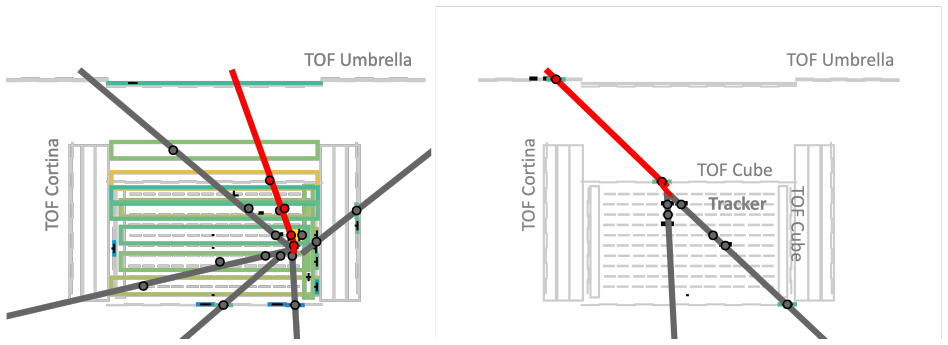
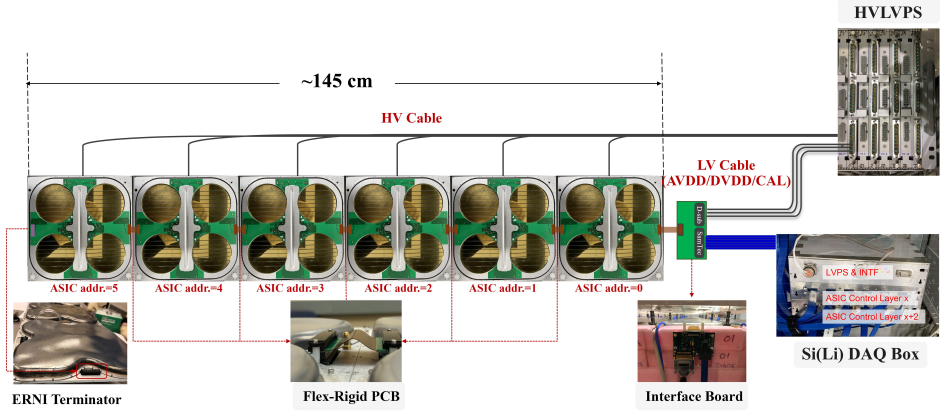
The Tracker of more than 1000 custom silicon strip detectors combined with the plastic scintillator time-of-flight system, which together supply velocity and energy resolution, stopping power, particle tracking, and X-ray identification.
Load-bearing premise
The combination of silicon-tracker energy-loss, TOF velocity, X-ray identification, and annihilation-product detection can reliably separate the rare antinucleus signals from the abundant positive-nucleus backgrounds under actual high-altitude flight conditions and background rates.
What would settle it
Flight data in which the observed X-ray energies or annihilation signatures fail to match the expected lines and multiplicities for captured antinuclei, or in which known particle species are misidentified at rates exceeding design predictions, would falsify the claimed identification capability.
Figures





read the original abstract
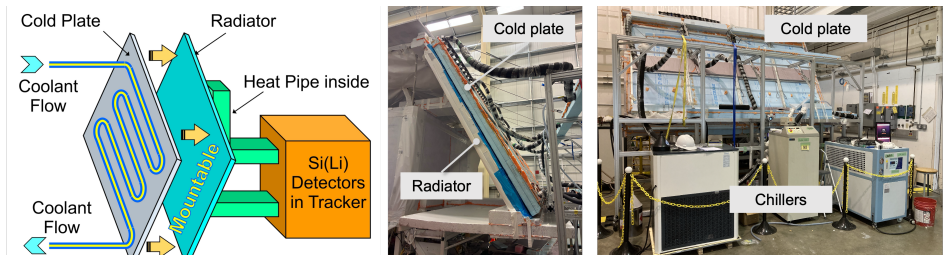
The General Antiparticle Spectrometer (GAPS) is an Antarctic stratospheric balloon mission designed to provide unmatched sensitivity to low-energy (<0.25 GeV/n) cosmic-ray antiprotons, antideuterons, and antihelium nuclei as signatures of dark matter. The distinctive GAPS particle identification technique relies on measuring the energy loss along the track of an incoming antinucleus as it slows down and is captured into an exotic atom, and then detecting the de-excitation X-rays and the nuclear annihilation products. This measurement is realized using a Tracker composed of more than 1000 custom silicon strip detectors and a plastic scintillator time-of-flight (TOF) system instrumenting more than 40m$^2$. Together, these subsystems provide the velocity and energy resolution, stopping power, particle tracking, and X-ray identification necessary to distinguish rare antinucleus signals from the abundant positive-nucleus backgrounds, all within the constraints of a high-altitude mission. A multi-loop capillary heat pipe system has been developed to maintain the tracker operating temperature with significant mass and power savings over a conventional pump-based system. The first GAPS science payload flew for 25 days during the 2025/26 NASA Antarctic balloon campaign. We detail the design, integration, and commissioning of the payload prior to flight.
Editorial analysis
A structured set of objections, weighed in public.
Referee Report
Summary. The paper describes the design, integration, and pre-flight commissioning of the GAPS Antarctic balloon payload for measuring low-energy cosmic-ray antinuclei. It details a silicon-strip tracker (>1000 detectors), a >40 m² plastic-scintillator TOF system, and a multi-loop capillary heat-pipe thermal control system that together enable the distinctive identification technique of tracking energy loss, exotic-atom formation, X-ray de-excitation, and annihilation products. The manuscript notes that the first science payload completed a 25-day flight in the 2025/26 NASA Antarctic campaign but focuses exclusively on hardware realization and ground testing.
Significance. If the described subsystems achieve the intended performance, the work is significant for documenting a novel, low-energy antinucleus detection method that could deliver unique constraints on dark-matter models via cosmic-ray antiprotons, antideuterons, and antihelium. The engineering solution for thermal management via capillary heat pipes is a concrete strength that reduces mass and power compared with conventional systems and may be adopted by other balloon payloads.
major comments (2)
- [Abstract / particle identification technique] Abstract and particle-identification description: the central claim that the silicon-tracker + TOF + X-ray + annihilation combination 'provides the velocity and energy resolution, stopping power, particle tracking, and X-ray identification necessary to distinguish rare antinucleus signals from the abundant positive-nucleus backgrounds' is asserted without any quantitative support (dE/dx resolution, X-ray tagging efficiency, misidentification rate, or Monte Carlo results). This is load-bearing for the stated unmatched sensitivity.
- [Flight description and commissioning] Flight and commissioning section: although the 25-day flight is mentioned, the manuscript supplies no in-flight background rates at ~40 km, no combined identification efficiencies, and no validation data from the actual flight conditions, leaving the practical background-rejection performance unverified.
minor comments (2)
- [Hardware description] The manuscript would benefit from a table summarizing key specifications (number of Si strips, TOF area, operating temperature, power budget) for quick reference.
- [Introduction] A brief reference to prior GAPS technical notes or test-beam results would help readers locate the quantitative performance studies that are cited only implicitly.
Simulated Author's Rebuttal
We thank the referee for the careful and constructive review of our manuscript on the GAPS payload. The comments correctly identify areas where the presentation of the particle identification approach and the scope of the flight discussion can be strengthened. We respond to each major comment below and will incorporate revisions as indicated.
read point-by-point responses
-
Referee: [Abstract / particle identification technique] Abstract and particle-identification description: the central claim that the silicon-tracker + TOF + X-ray + annihilation combination 'provides the velocity and energy resolution, stopping power, particle tracking, and X-ray identification necessary to distinguish rare antinucleus signals from the abundant positive-nucleus backgrounds' is asserted without any quantitative support (dE/dx resolution, X-ray tagging efficiency, misidentification rate, or Monte Carlo results). This is load-bearing for the stated unmatched sensitivity.
Authors: We agree that the abstract and introductory description would be strengthened by explicit quantitative support. Detailed performance figures for dE/dx resolution in the silicon tracker, X-ray tagging efficiency, misidentification rates, and Monte Carlo background-rejection studies are documented in our earlier GAPS technique papers. In the revised manuscript we will insert a concise summary paragraph (with references) that extracts the key quantitative results from ground commissioning data and simulations to directly underpin the abstract claim. revision: yes
-
Referee: [Flight description and commissioning] Flight and commissioning section: although the 25-day flight is mentioned, the manuscript supplies no in-flight background rates at ~40 km, no combined identification efficiencies, and no validation data from the actual flight conditions, leaving the practical background-rejection performance unverified.
Authors: The manuscript is deliberately scoped to the design, integration, and pre-flight commissioning of the payload; the single sentence noting the completed 25-day flight supplies only contextual information that the instrument reached the field. In-flight background rates, combined efficiencies, and flight-condition validation data are not included because they lie outside the present paper’s focus and will appear in dedicated science-result publications. We will revise the introduction and abstract to state the paper’s scope explicitly and to remove any implication that flight performance metrics are provided here. revision: yes
Circularity Check
No circularity: purely descriptive instrument paper
full rationale
The GAPS paper is a technical description of payload hardware, integration, and commissioning with no equations, parameter fits, predictions, or mathematical derivations present. Claims about particle identification rely on stated design properties of the tracker and TOF subsystems rather than any reduction to fitted inputs or self-referential definitions. No load-bearing self-citations, uniqueness theorems, or ansatzes appear in the text. The manuscript therefore contains no steps that reduce by construction to their own inputs and is self-contained as an engineering report.
Axiom & Free-Parameter Ledger
Reference graph
Works this paper leans on
-
[1]
Mori, K.et al.A novel antimatter detector based on X-ray deexcitation of exotic atoms.The Astro- physical Journal566, 604–616 (2002). arXiv:astro- ph/0109463
-
[2]
Hailey, C. J. An indirect search for dark matter using antideuterons: the GAPS experiment.New Journal of Physics11, 105022 (2009)
2009
-
[3]
J.et al.Antideuteron based dark mat- ter search with GAPS: Current progress and future prospects.Advances in Space Research51, 290–296 (2013)
Hailey, C. J.et al.Antideuteron based dark mat- ter search with GAPS: Current progress and future prospects.Advances in Space Research51, 290–296 (2013)
2013
-
[4]
Antideuterons as a Signature of Supersymmetric Dark Matter
Donato, F., Fornengo, N. & Salati, P. Antideuterons as a signature of supersymmetric dark matter.Phys. Rev. D62, 043003 (2000). arXiv:hep-ph/9904481
work page Pith review arXiv 2000
-
[5]
Donato, F., Fornengo, N. & Maurin, D. Antideuteron fluxes from dark matter annihilation in diffusion mod- els.Phys. Rev. D78, 043506 (2008). arXiv:0803.2640
-
[6]
Donato, F., Korsmeier, M. & Di Mauro, M. Pre- scriptions on antiproton cross section data for precise theoretical antiproton flux predictions.Phys. Rev. D 96, 043007 (2017). arXiv:1704.03663
-
[7]
von Doetinchemet al., JCAP08, 035 (2020), arXiv:2002.04163 [astro-ph.HE]
von Doetinchem, P.et al.Cosmic-ray antinuclei as messengers of new physics: status and outlook for the new decade.Journal of Cosmology and Astroparticle Physics2020, 035–035 (2020). arXiv:2002.04163
-
[8]
Aramaki, T.et al.Antideuteron sensitivity for the GAPS experiment.Astroparticle Physics74, 6–13 (2016). arXiv:1506.02513
-
[9]
Aramaki, T.et al.Potential for precision measure- ment of low-energy antiprotons with GAPS for dark 17 matter and primordial black hole physics.Astropar- ticle Physics59, 12–17 (2014). arXiv:1401.8245
-
[10]
Rogers, F.et al.Sensitivity of the GAPS experiment to low-energy cosmic-ray antiprotons.Astroparticle Physics145, 102791 (2023). arXiv:2206.12991
-
[11]
Saffold, N.et al.Cosmic antihelium-3 nuclei sensi- tivity of the GAPS experiment.Astroparticle Physics 130, 102580 (2021). arXiv:2012.05834
-
[12]
Sakai, K.et al.Search for antideuterons of cosmic origin using the bess-polar ii magnetic-rigidity spec- trometer.Phys. Rev. Lett.132, 131001 (2024)
2024
-
[13]
Hailey, C. J.et al.Accelerator testing of the general antiparticle spectrometer; a novel approach to indi- rect dark matter detection.JCAP2006, 007 (2006). arXiv:astro-ph/0509587
-
[14]
Aramaki, T.et al.A measurement of atomic X- ray yields in exotic atoms and implications for an antideuteron-based dark matter search.Astroparticle Physics49, 52–62 (2013). arXiv:1303.3871
-
[15]
von Doetinchem, P.et al.The flight of the GAPS prototype experiment.Astroparticle Physics54, 93– 109 (2014). arXiv:1307.3538
- [16]
-
[17]
Fuke, H.et al.The pGAPS experiment: An en- gineering balloon flight of prototype GAPS.Ad- vances in Space Research53, 1432–1437 (2014). arXiv:1303.0380
-
[18]
& Miyazaki, Y
Fuke, H., Okazaki, S., Ogawa, H. & Miyazaki, Y. Balloon Flight Demonstration of an Oscillating Heat Pipe.Journal of Astronomical Instrumentation6, 1740006–231 (2017)
2017
-
[19]
Okazaki, S.et al.Balloon flight test of a low- temperature radiator.Journal of Evolving Space Ac- tivities2, 177 (2024)
2024
-
[20]
Abe, K.et al.Measurement of the Cosmic-Ray An- tiproton Spectrum at Solar Minimum with a Long- Duration Balloon Flight over Antarctica.Physics Re- view Letters108, 051102 (2012). arXiv:1107.6000
work page Pith review arXiv 2012
-
[21]
Picozza, P.et al.Pamela – a payload for antimatter matter exploration and light-nuclei astrophysics.As- troparticle Physics27, 296–315 (2007). arXiv:astro- ph/0608697
-
[22]
Aguilar, M.et al.The alpha magnetic spectrometer (ams) on the international space station: Part ii — results from the first seven years.Physics Reports 894, 1–116 (2021)
2021
-
[23]
Munini, R.et al.The antinucleus annihilation recon- struction algorithm of the gaps experiment.Astropar- ticle Physics133, 102640 (2021). arXiv:2109.00753
- [24]
-
[25]
Fuke, H.et al.Development of a cooling system for GAPS using oscillating heat pipe.Transac- tions JSASS Aerospace Technology, Japan14, 17–26 (2016)
2016
-
[26]
& Takahashi, N
Okazaki, S., Fuke, H., Miyazaki, Y. & Takahashi, N. Meter-scale multi-loop capillary heat pipe.Applied Thermal Engineering141, 20–28 (2018)
2018
-
[27]
& Ogawa, H
Fuke, H., Okazaki, S., Kondo, M., Kawachi, A. & Ogawa, H. Low-power, large-scale distributed hybrid thermal system to cool silicon detectors in the gaps instrument. In2019 IEEE Nuclear Science Sympo- sium and Medical Imaging Conference (NSS/MIC), 1–3 (2019)
2019
-
[28]
Fuke, H.et al.Operation concept of the gaps thermal control system.Journal of Evolving Space Activities 2, 156 (2024)
2024
-
[29]
Fuke, H.et al.Thermal control system to eas- ily cool the gaps balloon-borne instrument on the ground.Journal of Evolving Space Activities1, 2 (2023). arXiv:2212.12862
-
[30]
Perez, K.et al.Fabricationoflow-cost, large-areapro- totype Si(Li) detectors for the GAPS experiment.Nu- clear Instruments and Methods in Physics Research A 905, 12–21 (2018). arXiv:1807.07912
-
[31]
Rogers, F.et al.Large-area Si(Li) detectors for X- ray spectrometry and particle tracking in the GAPS experiment.Journal of Instrumentation14, P10009 (2019). arXiv:1906.00054
-
[32]
Xiao, M.et al.Large-Scale Detector Testing for the GAPS Si(Li) Tracker.IEEE Transactions on Nuclear Science70, 2125–2133 (2023). arXiv:2305.00283
-
[33]
Saffold, N.et al.Passivation of Si(Li) detectors operated above cryogenic temperatures for space- based applications.Nuclear Instruments and Meth- ods in Physics Research A997, 165015 (2021). arXiv:2102.06168
-
[34]
Manghisoni, M.et al.A 32-channels readout asic for x-ray spectrometry and tracking in the gaps exper- iment.IEEE Transactions on Nuclear Science1–1 (2023). 18
2023
-
[35]
Manghisoni, M.et al.Low-noise analog channel for the readout of the si(li) detector of the gaps exper- iment.IEEE Transactions on Nuclear Science1–1 (2021)
2021
-
[36]
Manghisoni, M., Comotti, D., Gaioni, L., Ratti, L. & Re, V. Dynamic compression of the signal in a charge sensitive amplifier: From concept to design. IEEE Transactions on Nuclear Science62, 2318–2326 (2015)
2015
-
[37]
Manghisoni, M., Comotti, D., Gaioni, L., Ratti, L. & Re, V. Dynamic compression of the signal in a charge sensitive amplifier: Experimental results. IEEE Transactions on Nuclear Science65, 636–644 (2018)
2018
-
[38]
Stricker-Shaver, D., Ritt, S. & Pichler, B. J. Novel calibration method for switched capacitor arrays en- ables time measurements with sub-picosecond reso- lution.IEEE Transactions on Nuclear Science61, 3607–3617 (2014). arXiv:1405.4975
-
[39]
Pordes, R.et al.The open science grid. InJ. Phys. Conf. Ser., vol. 78 of78, 012057 (2007)
2007
-
[40]
In2009 WRI World Congress on Com- puter Science and Information Engineering, vol
Sfiligoi, I.et al.The pilot way to grid resources using glideinwms. In2009 WRI World Congress on Com- puter Science and Information Engineering, vol. 2 of 2, 428–432 (2009)
2009
-
[41]
OSG. Ospool. https://doi.org/10.21231/906P-4D78 (2006)
-
[42]
OSG. Open science data federation. osg. https://doi.org/10.21231/0KVZ-VE57 (2015). 19
discussion (0)
Sign in with ORCID, Apple, or X to comment. Anyone can read and Pith papers without signing in.