Recognition: unknown
Crosscap Defects
Pith reviewed 2026-05-10 01:40 UTC · model grok-4.3
The pith
Crosscap defects arise from Z2 quotients of spacetime and generalize real projective space CFT to higher codimensions.
A machine-rendered reading of the paper's core claim, the machinery that carries it, and where it could break.
Core claim
Crosscap defects are defined by quotienting spacetime by a Z2 automorphism with a p-dimensional fixed locus. They preserve an SO(p+1,1) times PO(d-p) subgroup of the conformal group and admit three operator product expansion channels in two-point functions: bulk, image, and defect. The associated conformal blocks match those of standard defect CFT up to a redefinition of the cross ratios. In the O(N) model at the Gaussian and Wilson-Fisher fixed points in the epsilon expansion, the CFT data are computed explicitly as a function of p, showing that displacement and tilt operators are absent for generic p and that these defects realize conformal manifolds without exactly marginal operators.
What carries the argument
The Z2 automorphism quotient of spacetime that creates a p-dimensional fixed locus, producing crosscap defects with bulk-image-defect OPE channels.
If this is right
- The crosscap crossing equations can be solved using existing defect conformal blocks after a simple redefinition of cross ratios.
- Explicit CFT data including operator dimensions and OPE coefficients are available as functions of p in the epsilon expansion of the O(N) model.
- Displacement and tilt operators do not appear for generic values of p, unlike in standard defect setups.
- These defects provide concrete examples of defect conformal manifolds that exist without exactly marginal operators.
Where Pith is reading between the lines
- Crosscap defects might serve as probes for discrete symmetries in holographic duals of CFTs.
- Generalizations to other finite groups or orbifolds could yield further classes of defects with reduced symmetry.
- Absence of displacement operators may simplify correlation functions in these setups compared to ordinary defects.
Load-bearing premise
The Z2 quotient produces well-defined higher-codimension defects that preserve the stated symmetry and whose conformal blocks match defect CFT blocks after cross ratio redefinition.
What would settle it
A direct computation in a specific CFT showing that displacement operators appear at generic p, or that the block decomposition requires additional structures beyond the defect blocks.
Figures




read the original abstract
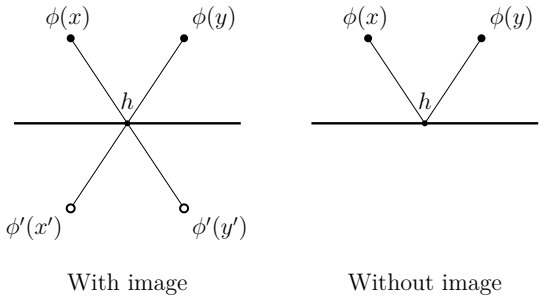
We introduce a novel class of defects, termed {\it crosscap defects}, in conformal field theory (CFT) in general dimensions. These arise from quotienting the spacetime by a $\mathbb{Z}_2$ automorphism, and provide higher-codimension generalisations of CFT on real projective space ($\mathbb{RP}^{d}$). Crosscap defects extend along a $p$-dimensional fixed locus of the $\mathbb{Z}_2$ action and preserve an $SO(p+1,1)\times PO(d-p)$ subgroup of the conformal group. The two-point functions of operators in this setup exhibit three operator product expansion channels: bulk, image, and defect. These lead to several {\it crosscap crossing equations}, which we present. We analyse conformal block decompositions and show that the blocks are identical to defect CFT blocks up to a redefinition of cross ratios. As concrete examples, we study crosscap defects in the $O(N)$ model at the Gaussian and Wilson--Fisher fixed points in the $\varepsilon$-expansion. We compute explicitly the associated CFT data as a function of $p$ and find that, unlike standard defects, displacement and tilt operators are absent for generic $p$. They provide examples of defect conformal manifolds without exactly marginal operators.
Editorial analysis
A structured set of objections, weighed in public.
Referee Report
Summary. The manuscript introduces crosscap defects in CFTs in general dimensions, constructed by quotienting spacetime by a Z2 automorphism whose fixed locus is p-dimensional. These defects preserve an SO(p+1,1) × PO(d-p) subgroup and generalize CFT on RP^d to higher codimensions. The two-point functions admit three OPE channels (bulk, image, defect), leading to crosscap crossing equations. The paper shows that the associated conformal blocks coincide with standard defect CFT blocks after a redefinition of cross ratios. As examples, it considers crosscap defects in the O(N) model at the Gaussian and Wilson-Fisher fixed points, performing explicit ε-expansion computations of the CFT data as a function of p. It concludes that, unlike ordinary defects, displacement and tilt operators are absent for generic p, yielding examples of defect conformal manifolds without exactly marginal operators.
Significance. If the construction and block equivalence hold, the work supplies a new, systematically constructible family of defects whose operator content can be computed perturbatively. The explicit ε-expansion results for the O(N) model furnish concrete, p-dependent CFT data and demonstrate the absence of displacement/tilt operators, which is a structurally interesting feature. The observation that these defects realize conformal manifolds without marginal operators adds a concrete example to the literature on defect RG flows and moduli spaces. The reduction of the crossing problem to ordinary defect blocks via cross-ratio redefinition, if rigorously established, would streamline future analyses of similar quotients.
major comments (2)
- [§2] §2 (construction of the crosscap defect): The central claim that quotienting by the Z2 automorphism produces a consistent higher-codimension defect preserving SO(p+1,1)×PO(d-p) with three OPE channels whose blocks are identical to defect CFT blocks after cross-ratio redefinition is load-bearing for all subsequent results. The manuscript must supply an explicit check that the image-channel contributions are fully captured by the redefinition and that conformal invariance is preserved for non-integer p and in the ε-expansion; without this, the crossing equations and the derived absence of displacement/tilt operators do not follow.
- [§4] §4 (ε-expansion in the O(N) model): The explicit computation of CFT data as a function of p and the statement that displacement and tilt operators are absent for generic p rely on the block equivalence established in §2. If the image channel introduces additional structures not accounted for by the cross-ratio map, the reported operator dimensions and the conclusion that these are defect conformal manifolds without exactly marginal operators would require revision.
minor comments (2)
- [Abstract] The abstract and introduction would benefit from a short table or diagram summarizing the three OPE channels and the corresponding cross ratios for the crosscap geometry.
- [§3] Notation for the PO(d-p) factor and the precise definition of the cross ratios after redefinition should be stated once in a dedicated paragraph to avoid repeated parenthetical explanations.
Simulated Author's Rebuttal
We thank the referee for their careful reading of the manuscript and for the constructive comments. We address the major points below and will revise the paper accordingly to strengthen the presentation.
read point-by-point responses
-
Referee: [§2] §2 (construction of the crosscap defect): The central claim that quotienting by the Z2 automorphism produces a consistent higher-codimension defect preserving SO(p+1,1)×PO(d-p) with three OPE channels whose blocks are identical to defect CFT blocks after cross-ratio redefinition is load-bearing for all subsequent results. The manuscript must supply an explicit check that the image-channel contributions are fully captured by the redefinition and that conformal invariance is preserved for non-integer p and in the ε-expansion; without this, the crossing equations and the derived absence of displacement/tilt operators do not follow.
Authors: We appreciate the referee's emphasis on the need for explicit verification of this foundational step. The construction in §2 defines the Z2 quotient explicitly on the embedding coordinates, identifies the p-dimensional fixed locus, and confirms the preserved symmetry subgroup by checking which conformal transformations commute with the identification. The three channels (bulk, image, defect) follow directly from the possible contractions in the two-point function. The block equivalence is obtained by a change of cross ratios that maps the image-channel kinematics onto the standard defect bulk channel; this redefinition is algebraic and holds independently of the value of p. Conformal invariance for non-integer p follows from the analytic continuation of the SO(p+1,1) algebra, which is well-defined for the relevant range of p. The ε-expansion is performed with p kept as a continuous parameter while d = 4 − ε, so the perturbative consistency is inherited from the underlying symmetry. To make this fully explicit, we will add a short appendix (or subsection) that verifies the crossing equations for the free scalar theory, confirming that the image contributions are completely accounted for by the cross-ratio map and that no extra structures arise. revision: yes
-
Referee: [§4] §4 (ε-expansion in the O(N) model): The explicit computation of CFT data as a function of p and the statement that displacement and tilt operators are absent for generic p rely on the block equivalence established in §2. If the image channel introduces additional structures not accounted for by the cross-ratio map, the reported operator dimensions and the conclusion that these are defect conformal manifolds without exactly marginal operators would require revision.
Authors: The ε-expansion results in §4 are derived from the crossing equations whose blocks have been identified with ordinary defect blocks via the cross-ratio redefinition. The absence of displacement and tilt operators follows from the representation theory of the preserved SO(p+1,1) × PO(d−p) symmetry: for generic p these operators would have to transform in representations that are not present in the spectrum. Because the block equivalence holds (as will be further documented in the revision), the perturbative data and the conclusion that the defects realize conformal manifolds without exactly marginal operators remain valid. We will expand the discussion in §4 to include a brief recap of how the symmetry constraints eliminate the displacement/tilt operators and to tabulate a few additional intermediate steps of the ε-expansion for transparency. revision: yes
Circularity Check
No significant circularity; new defect class and perturbative CFT data derived independently
full rationale
The derivation begins with an explicit definition of crosscap defects via Z2 quotient of spacetime, leading directly to the preserved symmetry subgroup, three OPE channels, and crosscap crossing equations. Conformal block equivalence to standard defect blocks is shown by explicit redefinition of cross ratios, without reducing to fitted inputs or prior self-citations. The explicit CFT data (including absence of displacement/tilt operators for generic p) is obtained from independent epsilon-expansion computations at the Gaussian and Wilson-Fisher fixed points of the O(N) model, which rely on standard perturbative techniques rather than self-referential assumptions or renamings. The construction is self-contained against external benchmarks and does not invoke load-bearing self-citations or ansatze smuggled from prior work.
Axiom & Free-Parameter Ledger
axioms (2)
- domain assumption Conformal invariance of the underlying theory
- domain assumption Existence of a Z2 automorphism of spacetime with a p-dimensional fixed locus
invented entities (1)
-
crosscap defects
no independent evidence
Reference graph
Works this paper leans on
-
[1]
The Conformal Bootstrap: Theory, Numerical Techniques, and Applications
D. Poland, S. Rychkov, and A. Vichi, “The conformal bootstrap: Theory, numerical techniques, and applications,” Rev. Mod. Phys. 91 (2019) 015002 , arXiv:1805.04405
work page Pith review arXiv 2019
-
[2]
The bootstrap program for boundary CFTd,
P. Liendo, L. Rastelli, and B. C. van Rees, “The bootstrap program for boundary CFTd,” JHEP 07 (2013) 113 , arXiv:1210.4258
-
[3]
F. Gliozzi, P. Liendo, M. Meineri, and A. Rago, “Boundary and interface CFTs from the conformal bootstrap,” JHEP 05 (2015) 036 , arXiv:1502.07217. [Erratum: JHEP 12, 093 (2021)]
- [4]
-
[5]
The Conformal Bootstrap at Finite Temperature
L. Iliesiu, M. Koloğlu, R. Mahajan, E. Perlmutter, and D. Simmons-Duffin, “The conformal bootstrap at finite temperature,” JHEP 10 (2018) 070 , arXiv:1802.10266
work page Pith review arXiv 2018
-
[6]
Bootstrapping critical Ising model on three-dimensional real projective space,
Y. Nakayama, “Bootstrapping critical Ising model on three-dimensional real projective space,” Phys. Rev. Lett. 116 no. 14, (2016) 141602 , arXiv:1601.06851
-
[7]
ϵ-expansion in critical ϕ3-theory on real projective space from conformal field theory,
C. Hasegawa and Y. Nakayama, “ ϵ-expansion in critical ϕ3-theory on real projective space from conformal field theory,” Mod. Phys. Lett. A 32 no. 07, (2017) 1750045 , arXiv:1611.06373. 46
-
[8]
Crossing kernels for boundary and crosscap CFTs,
M. Hogervorst, “Crossing kernels for boundary and crosscap CFTs,” arXiv:1703.08159
-
[9]
C. Hasegawa and Y. Nakayama, “Three ways to solve critical ϕ4 theory on 4 −ϵ dimensional real projective space: perturbation, bootstrap, and Schwinger-Dyson equation,” Int. J. Mod. Phys. A 33 no. 08, (2018) 1850049 , arXiv:1801.09107
-
[10]
Aspects of CFTs on real projective space,
S. Giombi, H. Khanchandani, and X. Zhou, “Aspects of CFTs on real projective space,” J. Phys. A 54 no. 2, (2021) 024003 , arXiv:2009.03290
-
[11]
Klein bottles and simple currents,
L. R. Huiszoon, A. N. Schellekens, and N. Sousa, “Klein bottles and simple currents,” Phys. Lett. B 470 (1999) 95–102 , hep-th/9909114
-
[12]
Boundaries, crosscaps and simple currents,
J. Fuchs, L. R. Huiszoon, A. N. Schellekens, C. Schweigert, and J. Walcher, “Boundaries, crosscaps and simple currents,” Phys. Lett. B 495 (2000) 427–434 , hep-th/0007174
-
[13]
Notes on orientifolds of rational conformal field theories,
I. Brunner and K. Hori, “Notes on orientifolds of rational conformal field theories,” JHEP 07 (2004) 023 , hep-th/0208141
-
[14]
W. Harada, J. Kaidi, Y. Kusuki, and Y. Liu, “New crosscap states,” arXiv:2508.18357
-
[15]
Half-BPS crosscap defects in N = 4 super Yang–Mills
N. Drukker, S. Komatsu, and A. Wallberg, “Half-BPS crosscap defects in N = 4 super Yang–Mills. ” In progress
-
[16]
Spinning conformal correlators,
M. S. Costa, J. Penedones, D. Poland, and S. Rychkov, “Spinning conformal correlators,” JHEP 11 (2011) 071 , arXiv:1107.3554
-
[17]
Dynamical derivation of vacuum operator-product expansion in Euclidean conformal quantum field theory,
V. K. Dobrev, V. B. Petkova, S. G. Petrova, and I. T. Todorov, “Dynamical derivation of vacuum operator-product expansion in Euclidean conformal quantum field theory,” Physical Review D 13 no. 4, (Feb., 1976) 887–912
1976
- [18]
-
[19]
Bootstrapping the 3d Ising twist defect,
D. Gaiotto, D. Mazac, and M. F. Paulos, “Bootstrapping the 3d Ising twist defect,” JHEP 03 (2014) 100 , arXiv:1310.5078
-
[20]
The ϵ-expansion of the codimension two twist defect from conformal field theory,
S. Yamaguchi, “The ϵ-expansion of the codimension two twist defect from conformal field theory,” PTEP 2016 no. 9, (2016) 091B01 , arXiv:1607.05551
-
[21]
Monodromy defects from hyperbolic space,
S. Giombi, E. Helfenberger, Z. Ji, and H. Khanchandani, “Monodromy defects from hyperbolic space,” JHEP 02 (2022) 041 , arXiv:2102.11815
-
[22]
Entanglement entropy and conformal field theory,
P. Calabrese and J. Cardy, “Entanglement entropy and conformal field theory,” J. Phys. A 42 (2009) 504005 , arXiv:0905.4013
-
[23]
Continuous family of conformal field theories and exactly marginal operators,
S. Komatsu, Y. Kusuki, M. Meineri, and H. Ooguri, “Continuous family of conformal field theories and exactly marginal operators,” arXiv:2512.11045
-
[24]
Probing magnetic line defects with two-point functions,
A. Gimenez-Grau, “Probing magnetic line defects with two-point functions,” arXiv:2212.02520
-
[25]
Local bulk operators in AdS/CFT: A Holographic description of the black hole interior,
A. Hamilton, D. N. Kabat, G. Lifschytz, and D. A. Lowe, “Local bulk operators in AdS/CFT: A Holographic description of the black hole interior,” Phys. Rev. D 75 (2007) 106001 , hep-th/0612053. [Erratum: Phys.Rev.D 75, 129902 (2007)]. 47
- [26]
-
[27]
Operator product expansion for conformal defects,
M. Fukuda, N. Kobayashi, and T. Nishioka, “Operator product expansion for conformal defects,” JHEP 01 (2018) 013 , arXiv:1710.11165
-
[28]
A tale of two uplifts: Parisi-Sourlas with defects,
K. Ghosh and E. Trevisani, “A tale of two uplifts: Parisi-Sourlas with defects,” JHEP 03 (2026) 067 , arXiv:2508.18356
-
[29]
Conformal field theories near a boundary in general dimensions,
D. M. McA vity and H. Osborn, “Conformal field theories near a boundary in general dimensions,” Nucl. Phys. B 455 (1995) 522–576 , cond-mat/9505127
-
[30]
Conformal four point functions and the operator product expansion,
F. A. Dolan and H. Osborn, “Conformal four point functions and the operator product expansion,” Nucl. Phys. B 599 (2001) 459–496 , hep-th/0011040
-
[31]
Surface defects in the O(N ) model,
M. Trépanier, “Surface defects in the O(N ) model,” JHEP 09 (2023) 074 , arXiv:2305.10486
-
[32]
Notes on a surface defect in the O(N ) model,
S. Giombi and B. Liu, “Notes on a surface defect in the O(N ) model,” JHEP 12 (2023) 004 , arXiv:2305.11402
-
[33]
Phases of surface defects in scalar field theories,
A. Raviv-Moshe and S. Zhong, “Phases of surface defects in scalar field theories,” JHEP 08 (2023) 143 , arXiv:2305.11370
-
[34]
E. de Sabbata, N. Drukker, and A. Stergiou, “Transdimensional defects,” arXiv:2411.17809
-
[35]
Line and surface defects for the free scalar field,
E. Lauria, P. Liendo, B. C. Van Rees, and X. Zhao, “Line and surface defects for the free scalar field,” JHEP 01 (2021) 060 , arXiv:2005.02413
-
[36]
Bootstrapping boundary-localized interactions,
C. Behan, L. Di Pietro, E. Lauria, and B. C. Van Rees, “Bootstrapping boundary-localized interactions,” JHEP 12 (2020) 182 , arXiv:2009.03336
-
[37]
Localized magnetic field in the O(N ) model,
G. Cuomo, Z. Komargodski, and M. Mezei, “Localized magnetic field in the O(N ) model,” JHEP 02 (2022) 134 , arXiv:2112.10634
-
[38]
The epsilon expansion of the O(N ) model with line defect from conformal field theory,
T. Nishioka, Y. Okuyama, and S. Shimamori, “The epsilon expansion of the O(N ) model with line defect from conformal field theory,” JHEP 03 (2023) 203 , arXiv:2212.04076
-
[39]
Analytic bootstrap for magnetic impurities,
L. Bianchi, D. Bonomi, E. de Sabbata, and A. Gimenez-Grau, “Analytic bootstrap for magnetic impurities,” JHEP 05 (2024) 080 , arXiv:2312.05221
-
[40]
The critical O(N ) CFT: Methods and conformal data,
J. Henriksson, “The critical O(N ) CFT: Methods and conformal data,” Phys. Rept. 1002 (2023) 1–72 , arXiv:2201.09520
-
[41]
A Lorentzian inversion formula for defect CFT,
P. Liendo, Y. Linke, and V. Schomerus, “A Lorentzian inversion formula for defect CFT,” JHEP 08 (2020) 163 , arXiv:1903.05222
-
[42]
Analytic bootstrap for the localized magnetic field,
L. Bianchi, D. Bonomi, and E. de Sabbata, “Analytic bootstrap for the localized magnetic field,” JHEP 04 (2023) 069 , arXiv:2212.02524
-
[43]
Critical exponents in 3.99 dimensions,
K. G. Wilson and M. E. Fisher, “Critical exponents in 3.99 dimensions,” Phys. Rev. Lett. 28 (1972) 240–243
1972
-
[44]
An Approach to the evaluation of three and four point ladder diagrams,
N. I. Usyukina and A. I. Davydychev, “An Approach to the evaluation of three and four point ladder diagrams,” Phys. Lett. B 298 (1993) 363–370
1993
-
[45]
Boundaries and interfaces with localized cubic interactions in the O(N ) model,
S. Harribey, I. R. Klebanov, and Z. Sun, “Boundaries and interfaces with localized cubic interactions in the O(N ) model,” JHEP 10 (2023) 017 , arXiv:2307.00072. 48
-
[46]
Multiscalar critical models with localised cubic interactions,
S. Harribey, W. H. Pannell, and A. Stergiou, “Multiscalar critical models with localised cubic interactions,” arXiv:2407.20326
-
[47]
Mellin space bootstrap for global symmetry,
P. Dey, A. Kaviraj, and A. Sinha, “Mellin space bootstrap for global symmetry,” JHEP 07 (2017) 019 , arXiv:1612.05032
-
[48]
The Pomeranchuk singularity in nonabelian gauge theories,
E. A. Kuraev, L. N. Lipatov, and V. S. Fadin, “The Pomeranchuk singularity in nonabelian gauge theories,” Sov. Phys. JETP 45 (1977) 199–204
1977
-
[49]
The Pomeranchuk singularity in quantum chromodynamics,
I. I. Balitsky and L. N. Lipatov, “The Pomeranchuk singularity in quantum chromodynamics,” Sov. J. Nucl. Phys. 28 (1978) 822–829
1978
-
[50]
Line defect RG flows in theε expansion
W. H. Pannell and A. Stergiou, “Line defect RG flows in the εexpansion,” JHEP 06 (2023) 186 , arXiv:2302.14069
-
[51]
L. F. Alday and J. Maldacena, “Comments on gluon scattering amplitudes via AdS/CFT,” JHEP 11 (2007) 068 , arXiv:0710.1060
-
[52]
J. Polchinski and J. Sully, “Wilson loop renormalization group flows,” JHEP 10 (2011) 059, arXiv:1104.5077
-
[53]
Non-supersymmetric Wilson loop in N = 4 SYM and defect 1d CFT,
M. Beccaria, S. Giombi, and A. Tseytlin, “Non-supersymmetric Wilson loop in N = 4 SYM and defect 1d CFT,” JHEP 03 (2018) 131 , arXiv:1712.06874
-
[54]
A study of quantum field theories in AdS at finite coupling,
D. Carmi, L. Di Pietro, and S. Komatsu, “A study of quantum field theories in AdS at finite coupling,” JHEP 01 (2019) 200 , arXiv:1810.04185
-
[55]
CFT in AdS and boundary RG flows,
S. Giombi and H. Khanchandani, “CFT in AdS and boundary RG flows,” JHEP 11 (2020) 118 , arXiv:2007.04955
-
[56]
Finite-coupling spectrum of O(N ) model in AdS,
J. Dujava and P. Vaško, “Finite-coupling spectrum of O(N ) model in AdS,” JHEP 12 (2025) 036 , arXiv:2503.16345
-
[57]
Taming mass gaps with anti-de Sitter space,
C. Copetti, L. Di Pietro, Z. Ji, and S. Komatsu, “Taming mass gaps with anti-de Sitter space,” Phys. Rev. Lett. 133 no. 8, (2024) 081601 , arXiv:2312.09277
-
[58]
The analytic bootstrap and AdS superhorizon locality,
A. L. Fitzpatrick, J. Kaplan, D. Poland, and D. Simmons-Duffin, “The analytic bootstrap and AdS superhorizon locality,” JHEP 12 (2013) 004 , arXiv:1212.3616
-
[59]
Z. Komargodski and A. Zhiboedov, “Convexity and Liberation at Large Spin,” JHEP 11 (2013) 140 , arXiv:1212.4103
-
[60]
Universality at large transverse spin in defect CFT
M. Lemos, P. Liendo, M. Meineri, and S. Sarkar, “Universality at large transverse spin in defect CFT,” JHEP 09 (2018) 091 , arXiv:1712.08185
work page Pith review arXiv 2018
-
[61]
Analyticity in spin in conformal theories,
S. Caron-Huot, “Analyticity in spin in conformal theories,” JHEP 09 (2017) 078 , arXiv:1703.00278
-
[62]
D. Carmi and S. Caron-Huot, “A Conformal dispersion relation: correlations from absorption,” JHEP 09 (2020) 009 , arXiv:1910.12123
-
[63]
Conformal dispersion relations for defects and boundaries,
L. Bianchi and D. Bonomi, “Conformal dispersion relations for defects and boundaries,” SciPost Phys. 15 no. 2, (2023) 055 , arXiv:2205.09775
-
[64]
A dispersion relation for defect CFT,
J. Barrat, A. Gimenez-Grau, and P. Liendo, “A dispersion relation for defect CFT,” JHEP 02 (2023) 255 , arXiv:2205.09765
-
[65]
Superintegrability of d-dimensional Conformal Blocks,
M. Isachenkov and V. Schomerus, “Superintegrability of d-dimensional Conformal Blocks,” Phys. Rev. Lett. 117 no. 7, (2016) 071602 , arXiv:1602.01858. 49
-
[66]
Harmony of spinning conformal blocks,
V. Schomerus, E. Sobko, and M. Isachenkov, “Harmony of spinning conformal blocks,” JHEP 03 (2017) 085 , arXiv:1612.02479
-
[67]
Harmonic analysis and mean field theory,
D. Karateev, P. Kravchuk, and D. Simmons-Duffin, “Harmonic analysis and mean field theory,” JHEP 10 (2019) 217 , arXiv:1809.05111
-
[68]
Gaudin models and multipoint conformal blocks: general theory,
I. Buric, S. Lacroix, J. A. Mann, L. Quintavalle, and V. Schomerus, “Gaudin models and multipoint conformal blocks: general theory,” JHEP 10 (2021) 139 , arXiv:2105.00021
-
[69]
Classification of homogeneous conformally flat riemannian manifolds,
D. V. Alekseevskii and B. N. Kimel’fel’d, “Classification of homogeneous conformally flat riemannian manifolds,” Mathematical notes of the Academy of Sciences of the USSR 24 (1978) 559–562
1978
-
[70]
T. Takayanagi, “Holographic dual of BCFT,” Phys. Rev. Lett. 107 (2011) 101602 , arXiv:1105.5165
-
[71]
M. Fujita, T. Takayanagi, and E. Tonni, “Aspects of AdS/BCFT,” JHEP 11 (2011) 043, arXiv:1108.5152
-
[72]
Holography, entanglement entropy, and conformal field theories with boundaries or defects,
K. Jensen and A. O’Bannon, “Holography, entanglement entropy, and conformal field theories with boundaries or defects,” Phys. Rev. D 88 no. 10, (2013) 106006 , arXiv:1309.4523
-
[73]
Towards a C-theorem in defect CFT,
N. Kobayashi, T. Nishioka, Y. Sato, and K. Watanabe, “Towards a C-theorem in defect CFT,” JHEP 01 (2019) 039 , arXiv:1810.06995
-
[74]
Holographic defect CFTs with Dirichlet end-of-the-world branes,
H. Nakayama and T. Nishioka, “Holographic defect CFTs with Dirichlet end-of-the-world branes,” arXiv:2509.22270
-
[75]
Holographic dual of crosscap conformal field theory,
Z. Wei, “Holographic dual of crosscap conformal field theory,” JHEP 03 (2025) 086 , arXiv:2405.03755. 50
discussion (0)
Sign in with ORCID, Apple, or X to comment. Anyone can read and Pith papers without signing in.