Recognition: unknown
Scaling at Chiral Clock Criticality via Entanglement Renormalization
Pith reviewed 2026-05-10 01:04 UTC · model grok-4.3
The pith
MERA calculations extract scaling dimensions that vary continuously with the chiral parameter in the Z3 clock model, starting from the 3-state Potts point.
A machine-rendered reading of the paper's core claim, the machinery that carries it, and where it could break.
Core claim
We employ the Multiscale Entanglement Renormalization Ansatz (MERA) tensor network to investigate a critical line of continuous quantum phase transitions of the Z3 chiral clock model. This critical line is believed to be described by a slow renormalization group flow from the 3-state Potts fixed point to another fixed point that features anisotropic scaling of space and time. We use the variational principle to construct a MERA representation of the model's ground state, from which we obtain the ground state energy and the set of scaling operators and their scaling dimensions. These scaling dimensions determine the critical exponents of the model, and we study these critical exponents and 0.
What carries the argument
The MERA variational tensor network, which optimizes a hierarchical representation of the ground state and directly yields the low-energy scaling operators and their dimensions from the optimized tensors.
If this is right
- Critical exponents of the chiral clock model change continuously with the chiral parameter rather than remaining fixed at their Potts values.
- The model realizes an effective intermediate scaling regime whose data can be extracted numerically before the flow reaches the putative anisotropic fixed point.
- The two-fixed-point hypothesis remains viable if the flow time scale is long compared with the length scales accessible to finite-bond-dimension MERA.
- MERA supplies concrete numerical values for the effective dimensions that any continuum description of the critical line must reproduce.
Where Pith is reading between the lines
- The same MERA protocol could be applied to other one-dimensional models suspected of slow RG flows to test whether smooth effective scaling data is a generic signature.
- The extracted dimensions provide a concrete target for analytic constructions of an anisotropic conformal field theory that might describe the infrared fixed point.
- If the flow is indeed slow, finite-size or finite-bond-dimension artifacts may systematically underestimate the distance to the second fixed point, suggesting a need for extrapolation in both system size and bond dimension.
Load-bearing premise
A finite-bond-dimension MERA ansatz continues to capture the true low-energy scaling operators accurately even when the underlying renormalization-group flow between fixed points is slow.
What would settle it
An independent calculation at larger bond dimension or by an unrelated method that finds a discontinuous jump in one or more scaling dimensions at a finite chiral parameter value.
Figures



read the original abstract
We employ the Multiscale Entanglement Renormalization Ansatz (MERA) tensor network to investigate a critical line of continuous quantum phase transitions of the $\mathbb{Z}_3$ chiral clock model. This critical line is believed to be described by a slow renormalization group flow from the 3-state Potts fixed point to another fixed point that features anisotropic scaling of space and time. We use the variational principle to construct a MERA representation of the model's ground state, from which we obtain the ground state energy and the set of scaling operators and their scaling dimensions. These scaling dimensions determine the critical exponents of the model, and we study these critical exponents and other scaling data as a function of the model's chiral parameter. We find a set of effective scaling data that smoothly varies starting from the Potts data as the chiral parameter is increased. Within the context of our approach, we discuss how this result may nevertheless be consistent with the two fixed point hypothesis provided the renormalization group flow is sufficiently slow. Our findings demonstrate MERA's effectiveness in capturing the complex low-energy physics of the chiral clock model and in extracting field theory data for an anisotropic continuum theory.
Editorial analysis
A structured set of objections, weighed in public.
Referee Report
Summary. The manuscript employs variational MERA tensor networks to study the critical line of the Z_3 chiral clock model. It extracts ground-state energies and scaling dimensions of operators as a function of the chiral parameter, reports that these effective scaling data vary smoothly away from the 3-state Potts values, and argues that the observations remain consistent with the two-fixed-point scenario provided the RG flow is sufficiently slow.
Significance. If the finite-bond-dimension MERA faithfully reproduces the low-energy scaling operators throughout the critical line, the work supplies concrete numerical data on how critical exponents drift along a line of slow RG flow and illustrates the utility of entanglement renormalization for extracting field-theory data in models with anisotropic scaling. The approach is technically non-trivial and directly addresses a long-standing question in the literature on chiral clock criticality.
major comments (2)
- [§4 and §3.2] §4 (Numerical results) and §3.2 (Scaling operator extraction): the scaling dimensions and critical exponents are presented without any reported bond-dimension convergence tests, finite-χ extrapolations, or error estimates on the extracted eigenvalues. Given the skeptic's concern that finite-χ truncation can impose an effective IR cutoff that itself varies with the chiral parameter, this omission directly undermines that the observed smooth drift reflects continuum physics rather than an artifact of the ansatz.
- [§5] §5 (Discussion of two-fixed-point hypothesis): the claim that the smooth variation is consistent with slow flow to an anisotropic fixed point relies on the MERA ground state remaining faithful even when relevant/marginal operators have long correlation lengths. No diagnostic is provided (e.g., correlation-length estimates versus χ or comparison of the MERA entanglement spectrum with expected CFT data) to test this assumption.
minor comments (2)
- [Figure captions and §4.1] Figure captions and §4.1 should explicitly state the bond dimension(s) χ employed for each data point and whether the same χ was used across the entire critical line.
- [§2 and §3] The notation for the chiral parameter and the precise definition of the scaling dimensions (e.g., which eigenvalues of the MERA transfer operator are retained) could be clarified in §2 and §3 to improve reproducibility.
Simulated Author's Rebuttal
We thank the referee for their careful reading of the manuscript and for highlighting these important points regarding numerical convergence and diagnostics. We address each major comment below and will revise the manuscript accordingly to strengthen the presentation of our results.
read point-by-point responses
-
Referee: [§4 and §3.2] §4 (Numerical results) and §3.2 (Scaling operator extraction): the scaling dimensions and critical exponents are presented without any reported bond-dimension convergence tests, finite-χ extrapolations, or error estimates on the extracted eigenvalues. Given the skeptic's concern that finite-χ truncation can impose an effective IR cutoff that itself varies with the chiral parameter, this omission directly undermines that the observed smooth drift reflects continuum physics rather than an artifact of the ansatz.
Authors: We agree that the absence of explicit bond-dimension convergence tests and error estimates is a limitation in the current presentation. In the revised manuscript we will add a dedicated subsection (or appendix) reporting the scaling dimensions and ground-state energies for a range of bond dimensions χ at several representative points along the critical line. We will include finite-χ extrapolations where feasible and provide conservative error estimates derived from the variation between successive χ values. This will allow readers to assess whether the observed smooth drift in effective scaling data persists in the large-χ limit and is not an artifact of the finite-χ truncation. revision: yes
-
Referee: [§5] §5 (Discussion of two-fixed-point hypothesis): the claim that the smooth variation is consistent with slow flow to an anisotropic fixed point relies on the MERA ground state remaining faithful even when relevant/marginal operators have long correlation lengths. No diagnostic is provided (e.g., correlation-length estimates versus χ or comparison of the MERA entanglement spectrum with expected CFT data) to test this assumption.
Authors: We acknowledge that the manuscript would benefit from additional diagnostics to support the assumption that the MERA remains faithful under slow RG flow. In the revision we will include estimates of the correlation length extracted from the MERA tensors (via the transfer operator or two-point functions) as a function of both χ and the chiral parameter. We will also add a comparison of the low-lying entanglement spectrum at the 3-state Potts point with known CFT predictions, and briefly discuss its evolution along the line. These additions will provide concrete evidence that the variational MERA captures the expected long-distance physics even when correlation lengths are large. revision: yes
Circularity Check
No significant circularity: scaling dimensions extracted directly from variational MERA optimization
full rationale
The paper's core results—ground-state energy and scaling dimensions—are obtained by applying the variational principle to a finite-bond-dimension MERA ansatz for the chiral clock Hamiltonian and then diagonalizing the renormalization superoperators to read off operator dimensions. These quantities are numerical outputs of the tensor-network optimization; they are not defined in terms of the two-fixed-point hypothesis, nor are they fitted to reproduce any target scaling data. The subsequent discussion that the observed smooth drift remains compatible with a slow RG flow to an anisotropic fixed point is an interpretive remark that draws on external literature rather than a deductive step that reduces the result to its own inputs. No self-definitional loop, fitted-input-as-prediction, or load-bearing self-citation chain appears in the derivation.
Axiom & Free-Parameter Ledger
free parameters (1)
- MERA bond dimension
axioms (1)
- domain assumption The critical line of the Z3 chiral clock model is described by a slow renormalization-group flow from the 3-state Potts fixed point to an anisotropic fixed point.
Reference graph
Works this paper leans on
-
[1]
The disordered–IC bound- ary is of Kosterlitz–Thouless type, while the ordered–IC boundary is of Pokrovskii–Talapov type [5, 6, 8]
intervenes between the topological (ordered) and triv- ial (paramagnetic) phases. The disordered–IC bound- ary is of Kosterlitz–Thouless type, while the ordered–IC boundary is of Pokrovskii–Talapov type [5, 6, 8]. The iDMRG method provides precise determination of critical couplings by systematically scanning the correla- tion length as a function off, wh...
-
[2]
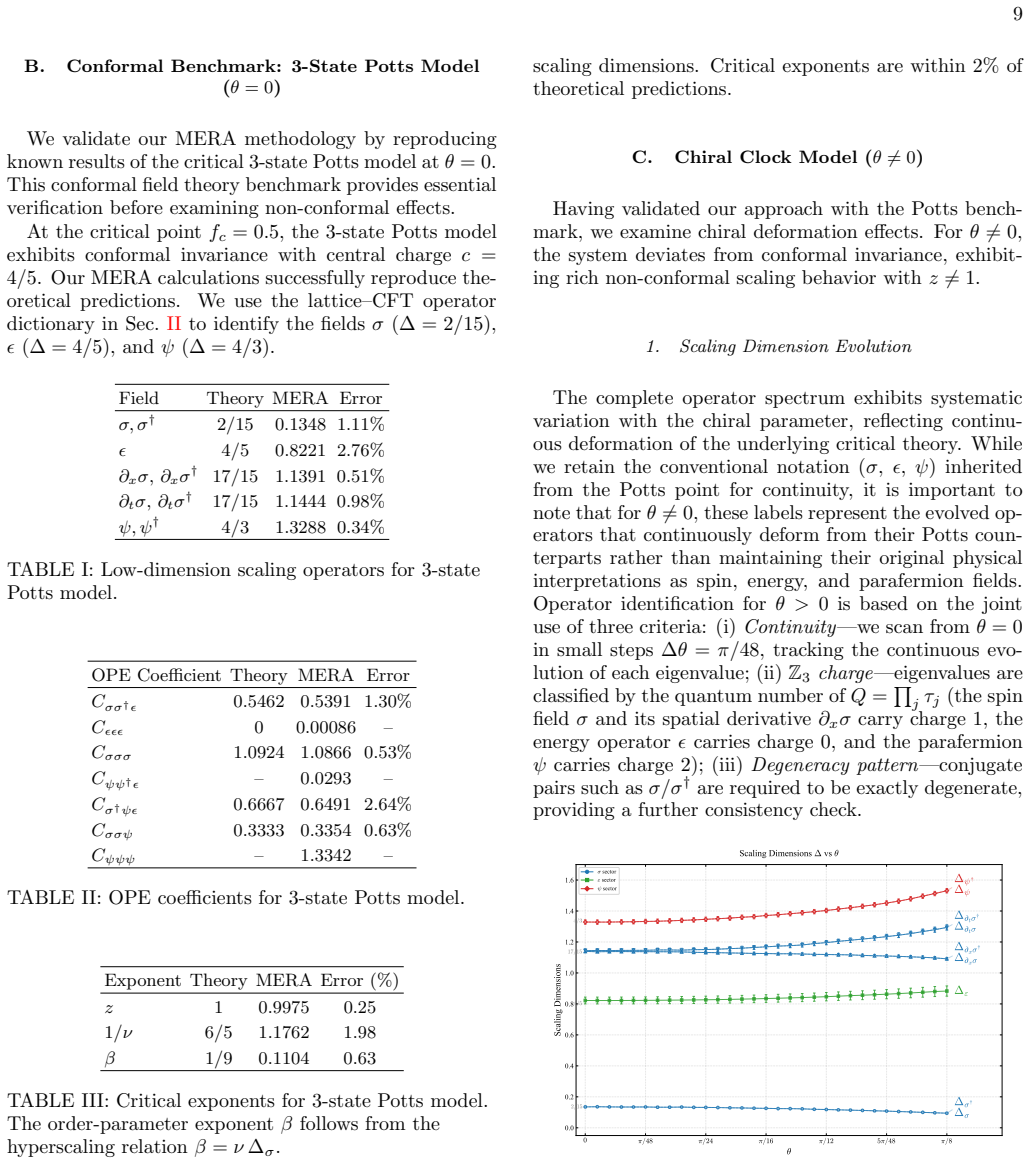
Scaling Dimension Evolution The complete operator spectrum exhibits systematic variation with the chiral parameter, reflecting continu- ous deformation of the underlying critical theory. While we retain the conventional notation (σ,ϵ,ψ) inherited from the Potts point for continuity, it is important to note that forθ̸= 0, these labels represent the evolved...
-
[3]
The dynamical exponentzexhibits distinct scaling regimes: z(θ) = ∆ ∂tσ(θ)−∆ σ(θ) (20) For small chiral anglesθ≲π/16,zremains close to unity
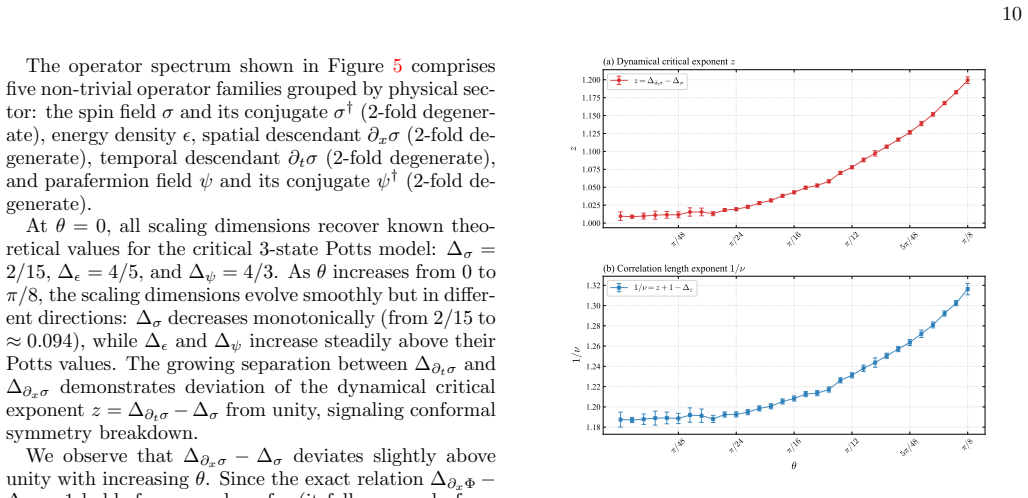
Critical Exponents and Dynamical Scaling Critical exponents, particularly the dynamical critical exponentzand correlation length exponentν, charac- terize universal scaling behavior near quantum critical points. The dynamical exponentzexhibits distinct scaling regimes: z(θ) = ∆ ∂tσ(θ)−∆ σ(θ) (20) For small chiral anglesθ≲π/16,zremains close to unity. For ...
-
[4]
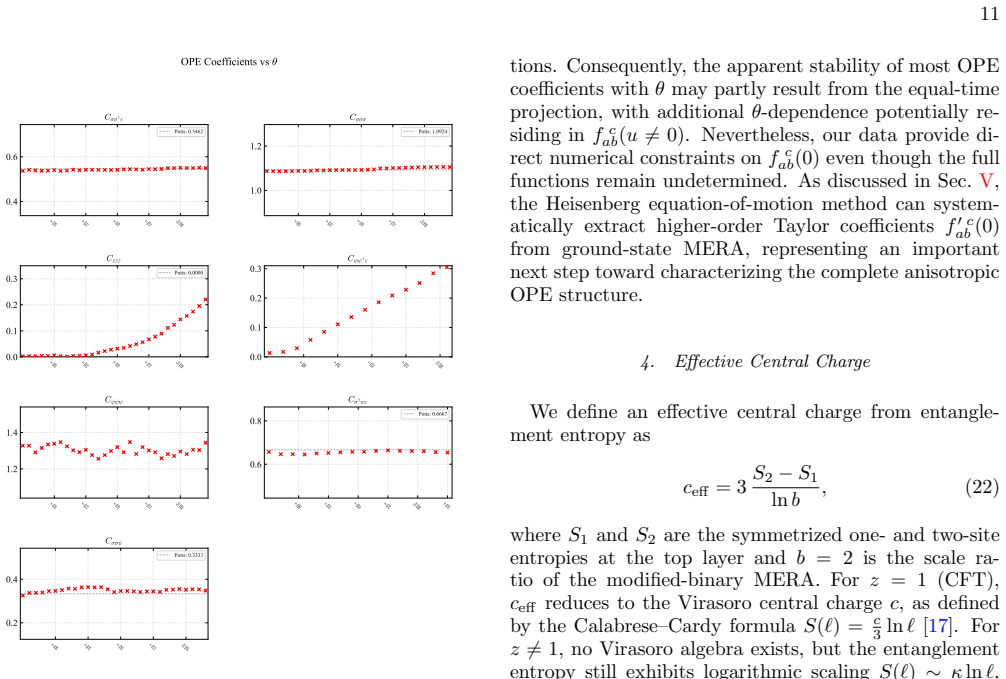
Operator Product Expansion Coefficients The operator product expansion coefficients encode fu- sion rules and correlation function structure of the critical theory. 11 π 48 π 24 π 16 π 12 5π 48 /uni00000013/uni00000011/uni00000017 /uni00000013/uni00000011/uni00000019 Cσσ ε /uni00000033/uni00000052/uni00000057/uni00000057/uni00000056/uni0000001d/uni0000000...
-
[5]
Forz= 1 (CFT), ceff reduces to the Virasoro central chargec, as defined by the Calabrese–Cardy formulaS(ℓ) = c 3 lnℓ[17]
Effective Central Charge We define an effective central charge from entangle- ment entropy as ceff = 3 S2 −S 1 lnb ,(22) whereS 1 andS 2 are the symmetrized one- and two-site entropies at the top layer andb= 2 is the scale ra- tio of the modified-binary MERA. Forz= 1 (CFT), ceff reduces to the Virasoro central chargec, as defined by the Calabrese–Cardy fo...
-
[6]
Dutta, G
A. Dutta, G. Aeppli, B. K. Chakrabarti, U. Divakaran, T. F. Rosenbaum, and D. Sen,Quantum Phase Transi- tions in Transverse Field Spin Models: From Statistical Physics to Quantum Information(Cambridge University Press, 2015)
2015
-
[7]
Sachdev,Quantum phase transitions, 2nd ed
S. Sachdev,Quantum phase transitions, 2nd ed. (Cam- bridge University Press, 2011)
2011
-
[8]
Ostlund, Phys
S. Ostlund, Phys. Rev. B24, 398 (1981)
1981
-
[9]
D. A. Huse, Phys. Rev. B24, 5180 (1981)
1981
-
[10]
R. Samajdar, S. Choi, H. Pichler, M. D. Lukin, and S. Sachdev, Phys. Rev. A98, 023614 (2018), arXiv:1806.01867 [cond-mat.str-el]
- [11]
-
[12]
Au-Yang, B
H. Au-Yang, B. M. McCoy, J. H. H. Perk, S. Tang, and M.-L. Yan, Phys. Lett. A123, 219 (1987)
1987
-
[13]
S. Whitsitt, R. Samajdar, and S. Sachdev, Phys. Rev. B 98, 205118 (2018), arXiv:1808.07056 [cond-mat.str-el]
- [14]
-
[15]
Baiguera, Aspects of Non-Relativistic Quantum Field Theories (2023), arXiv:2311.00027 [hep-th]
S. Baiguera, Aspects of Non-Relativistic Quantum Field Theories (2023), arXiv:2311.00027 [hep-th]
-
[16]
E. M. Lifshitz, Zh. Eksp. Teor. Fiz.11, 255 (1941)
1941
-
[17]
P. C. Hohenberg and B. I. Halperin, Rev. Mod. Phys.49, 435 (1977)
1977
-
[18]
Cardy,Scaling and renormalization in statistical physics, Cambridge Lecture Notes in Physics, Vol
J. Cardy,Scaling and renormalization in statistical physics, Cambridge Lecture Notes in Physics, Vol. 5 (Cambridge University Press, 1996)
1996
-
[19]
G. Vidal, Phys. Rev. Lett.99, 220405 (2007), arXiv:cond- mat/0512165 [cond-mat.str-el]
-
[20]
G. Evenbly and G. Vidal, Phys. Rev. Lett.102, 180406 (2009), arXiv:0811.0879 [cond-mat.str-el]
- [21]
-
[22]
P. Calabrese and J. Cardy, J. Stat. Mech.2004, P06002 (2004), arXiv:hep-th/0405152 [hep-th]
-
[23]
Holographic Derivation of Entanglement Entropy from AdS/CFT
S. Ryu and T. Takayanagi, Phys. Rev. Lett.96, 181602 (2006), arXiv:hep-th/0603001 [hep-th]
work page Pith review arXiv 2006
-
[24]
Vidal,Class of Quantum Many-Body States That Can Be Efficiently Simulated,Phys
G. Vidal, Phys. Rev. Lett.101, 110501 (2008), arXiv:quant-ph/0610099 [quant-ph]
-
[25]
J. Haegeman, T. J. Osborne, H. Verschelde, and F. Ver- straete, Entanglement renormalization for quantum fields (2011), arXiv:1102.5524 [hep-th]
-
[26]
Swingle,Entanglement renormalization and holography,Phys
B. Swingle, Phys. Rev. D86, 065007 (2012), arXiv:0905.1317 [cond-mat.str-el]
-
[27]
G. Evenbly and G. Vidal, Quantum Criticality with the Multi-scale Entanglement Renormalization Ansatz (2011), arXiv:1109.5334 [quant-ph]
-
[28]
R. Orus, Annals Phys.349, 117 (2014), arXiv:1306.2164 [cond-mat.str-el]
- [29]
-
[30]
A. Milsted and G. Vidal, Phys. Rev. B96, 245105 (2017), arXiv:1706.01436 [cond-mat.str-el]
-
[31]
Swingle, J
B. Swingle, J. McGreevy, and S. Xu, Phys. Rev. B93, 205159 (2016)
2016
-
[32]
Bernien, S
H. Bernien, S. Schwartz, A. Keesling, H. Levine, A. Om- ran, H. Pichler, S. Choi, A. S. Zibrov, M. Endres, M. Greiner, V. Vuleti´ c, and M. D. Lukin, Nature551, 579 (2017)
2017
-
[33]
Keesling, A
A. Keesling, A. Omran, H. Levine, H. Bernien, H. Pich- ler, S. Choi, R. Samajdar, S. Schwartz, P. Silvi, S. Sachdev, P. Zoller, M. Endres, M. Greiner, V. Vuleti´ c, and M. D. Lukin, Nature568, 207 (2019)
2019
-
[34]
Ebadi, T
S. Ebadi, T. T. Wang, H. Levine, A. Keesling, G. Se- meghini, A. Omran, D. Bluvstein, R. Samajdar, H. Pich- ler, W. W. Ho, S. Choi, S. Sachdev, M. Greiner, V. Vuleti´ c, and M. D. Lukin, Nature595, 227 (2021)
2021
-
[35]
J. McCabe and T. Wydro, Int. J. Mod. Phys. A13, 1013 (1998), arXiv:cond-mat/9507033
work page internal anchor Pith review arXiv 1998
-
[36]
P. H. Ginsparg, Applied conformal field theory (1988), arXiv:hep-th/9108028
work page Pith review arXiv 1988
-
[37]
H. A. Kramers and G. H. Wannier, Phys. Rev.60, 252 (1941)
1941
-
[38]
H. A. Kramers and G. H. Wannier, Phys. Rev.60, 263 (1941)
1941
-
[39]
P. Fendley, J. Stat. Mech.1211, P11020 (2012), arXiv:1209.0472 [cond-mat.str-el]
-
[40]
J. Alicea and P. Fendley, Ann. Rev. Condensed Matter Phys.7, 119 (2016), arXiv:1504.02476 [cond-mat.str-el]
-
[41]
Fradkin,Field Theories of Condensed Matter Physics, 2nd ed
E. Fradkin,Field Theories of Condensed Matter Physics, 2nd ed. (Cambridge University Press, 2013)
2013
-
[42]
Affleck and F
I. Affleck and F. D. M. Haldane, Phys. Rev. B36, 5291 (1987)
1987
-
[43]
G. Evenbly and G. Vidal, Phys. Rev. B79, 144108 (2009), arXiv:0803.0180 [cond-mat.str-el]
-
[44]
J. L. Cardy, Nuclear Physics B389, 577–586 (1993)
1993
-
[45]
R. S. K. Mong, D. J. Clarke, J. Alicea, N. H. Lindner, and P. Fendley, Journal of Physics A: Mathematical and Theoretical47, 452001 (2014)
2014
-
[46]
Singh and G
S. Singh and G. Vidal, Phys. Rev. B88, 121108 (2013)
2013
-
[47]
Weichselbaum, Annals of Physics327, 2972 (2012)
A. Weichselbaum, Annals of Physics327, 2972 (2012)
2012
-
[48]
Singh, N
S. Singh, N. A. McMahon, and G. K. Brennen, Phys. Rev. B99, 195139 (2019)
2019
-
[49]
Czech, G
B. Czech, G. Evenbly, L. Lamprou, S. McCandlish, X.- l. Qi, J. Sully, and G. Vidal, Phys. Rev. B94, 085101 (2016)
2016
-
[50]
Evenbly and G
G. Evenbly and G. Vidal, Phys. Rev. Lett.115, 200401 (2015)
2015
-
[51]
C. Geng, H.-Y. Hu, and Y. Zou, Mach. Learn. Sci. Tech. 3, 015020 (2022), arXiv:2110.03898 [quant-ph]. Appendix A: Appendix
-
[52]
Notation:udenotes the disentangler,ωandvthe isometries,χthe bond di- mension, and (ρ AB, ρBA) the top-layer density matrices used for warm starts
Details of MERA implementation This subsection summarizes the concrete numerical protocols used in our calculations. Notation:udenotes the disentangler,ωandvthe isometries,χthe bond di- mension, and (ρ AB, ρBA) the top-layer density matrices used for warm starts. Convergence criterion at fixed(θ, f ∗).For every criti- cal point (θ, f∗) the MERA optimizati...
-
[53]
The relative change of the lowest ten scaling dimen- sions (excluding the identity) is≤0.5%
-
[54]
relative change
The relative change of a predefined set of primary OPE coefficients is<1%. Here “relative change” refers to|x (t) −x (t−1)|/|x(t)|for the tracked quantityxat two consecutive checkpoints (indexed byt). The monitored OPE set consists of the lowest-lying channels used in the main text. Progressive bond-dimension ramp at the firstθ.For the firstθvalue we adop...
-
[55]
Optimization Algorithm The optimization of MERA tensors is realized as a fully differentiable program implemented inPyTorch. Each training epoch begins with a short Evenbly–Vidal sweep that supplies a low-energy seed, after which all tensors are refined simultaneously by Riemannian gradi- ent descent on the Stiefel manifold following the frame- work of [4...
-
[56]
residuals
Error Analysis and Statistical Reliability We quantify uncertainties via a pragmatic, three- pronged robustness analysis tailored to MERA: (i) aθ=0 conformal benchmark that sets a baseline accuracy; (ii) internal consistency diagnostics that check exact rela- tions and symmetry-implied degeneracies; and (iii) statis- tical variability estimated from repea...
discussion (0)
Sign in with ORCID, Apple, or X to comment. Anyone can read and Pith papers without signing in.