Recognition: unknown
High-order harmonic generation in argon driven by short laser pulses: effects of post-pulse propagation and windowing
Pith reviewed 2026-05-10 00:33 UTC · model grok-4.3
The pith
The HHG spectrum below argon's ionization threshold depends on post-pulse propagation time and windowing choices rather than being a uniquely fixed observable.
A machine-rendered reading of the paper's core claim, the machinery that carries it, and where it could break.
Core claim
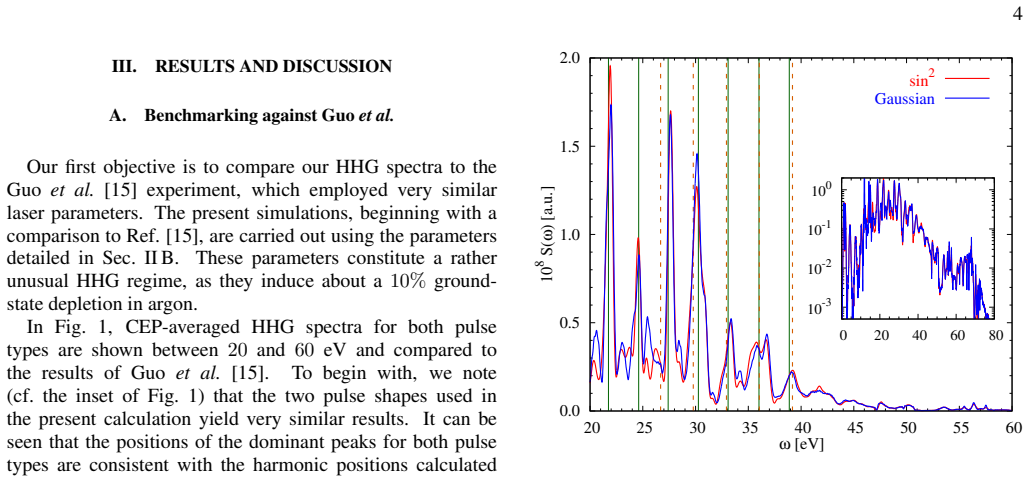
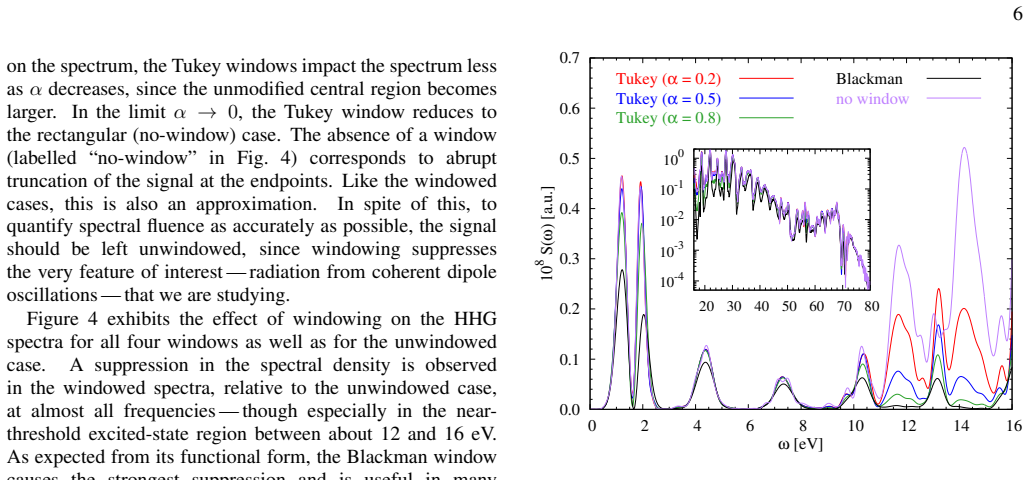
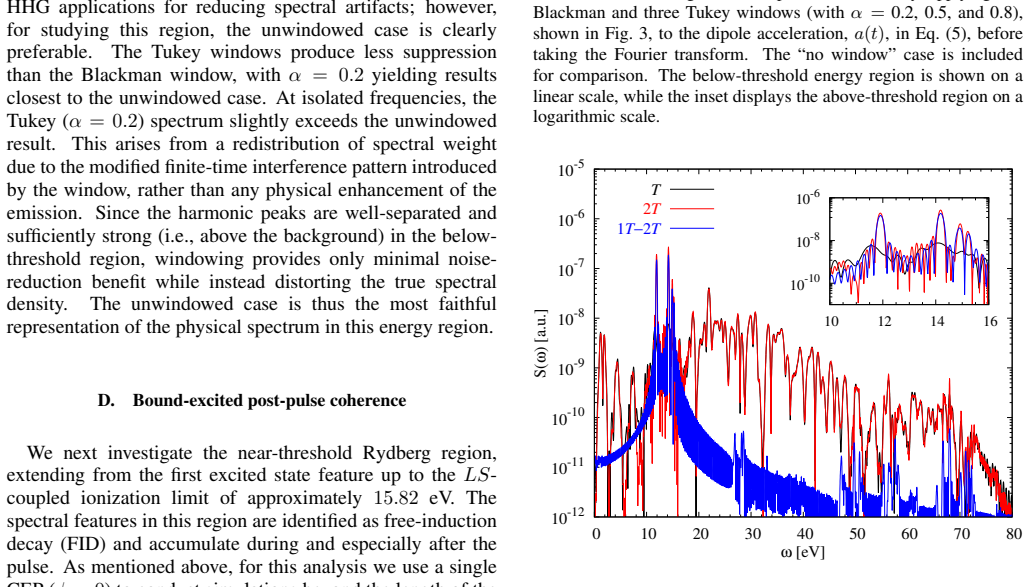
Ab initio RMT calculations for argon driven by a 6-cycle sin-squared pulse or a Gaussian pulse at 850 nm and 2.3 times 10 to the 14 W per square centimeter produce the standard harmonic comb above the 15.82 eV ionization threshold together with strong carrier-envelope-phase sensitivity. Below threshold the spectrum is generated by residual coherent dipole oscillations that persist after the driving pulse; these oscillations are captured in the time-dependent solution, and the resulting spectral features change when the post-pulse propagation interval is lengthened or when the dipole signal is multiplied by a different window before Fourier transformation. The authors therefore conclude that,
What carries the argument
The dependence of the below-threshold HHG spectrum on post-pulse propagation duration and spectral windowing, which arises because residual coherent dipole oscillations continue after the laser pulse and are converted into frequency-domain features by the chosen analysis window.
If this is right
- The harmonic structure above the ionization threshold remains stable against changes in post-pulse propagation time and windowing.
- Any comparison between calculated and measured spectra below threshold must state the propagation time and window parameters used.
- Both the sine-squared and Gaussian pulse shapes exhibit strong carrier-envelope-phase sensitivity in the above-threshold region.
- The RMT method treats the residual oscillations as physical free-induction decay rather than as numerical noise.
Where Pith is reading between the lines
- The same analysis dependence may appear in HHG spectra of other atoms or molecules, suggesting that low-energy features require standardized reporting of propagation and window parameters across studies.
- Experimental measurements could vary the detection window after the pulse to map the decay time of these coherent oscillations directly.
- Earlier interpretations of below-threshold harmonics in the literature might need re-examination to confirm consistency with the analysis choices employed in each case.
Load-bearing premise
The spectral features below the ionization threshold are produced mainly by residual coherent dipole oscillations that the RMT method models correctly, and not by numerical artifacts from propagation or windowing.
What would settle it
A calculation in which lengthening the post-pulse propagation time or changing the window function leaves the below-threshold spectrum unchanged would falsify the claim that these features depend on analysis choices.
Figures

read the original abstract
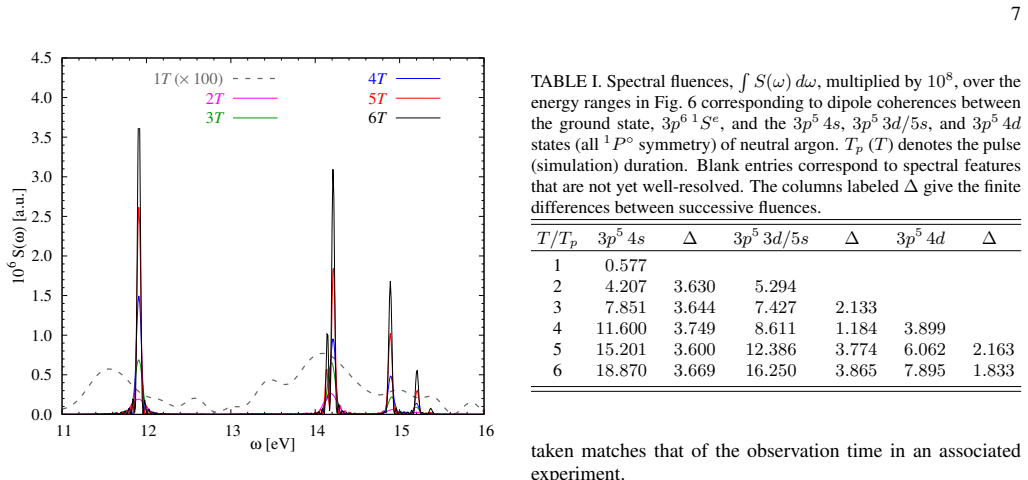
We present ab initio calculations using the $R$-matrix with time dependence (RMT) method for high-order harmonic generation (HHG) in argon in a short, intense pulse regime. The calculations employ a $6$-cycle $\sin^2$ pulse at $850$ nm with peak intensity $2.3\times 10^{14}$ W/cm$^2$ and, for comparison with the experiment by Guo et al. [J. Phys. B: At. Mol. Opt. Phys. 51, 034006 (2018)], a Gaussian pulse with the same frequency and peak intensity. Both pulse shapes yield the expected harmonic structure in the region above the ionization threshold (approximately $15.82$ eV in $LS$-coupling). The spectra exhibit strong carrier-envelope-phase (CEP) sensitivity. The energy region leading up to the ionization threshold contains spectral features arising from residual coherent dipole oscillations (free-induction decay) that strongly depend on spectral windowing and the post-pulse propagation time. We show that the HHG spectrum, particularly below the ionization threshold, is a defined quantity that depends on analysis choices rather than being a uniquely determined observable. Comparison between theoretical predictions and experimental observations in this energy regime, therefore, requires explicit specification of these parameters.
Editorial analysis
A structured set of objections, weighed in public.
Referee Report
Summary. The manuscript reports ab initio RMT calculations of high-order harmonic generation (HHG) in argon driven by short laser pulses (6-cycle sin² at 850 nm, 2.3×10¹⁴ W/cm², and a Gaussian pulse for experimental comparison). It demonstrates expected harmonic structure and CEP sensitivity above the ionization threshold (~15.82 eV), while showing that spectral features below threshold arise from residual coherent dipole oscillations (free-induction decay) and depend strongly on spectral windowing and post-pulse propagation time. The central claim is that the HHG spectrum below threshold is analysis-dependent rather than a uniquely determined observable, requiring explicit specification of these parameters for theory-experiment comparison.
Significance. If the numerical results hold, the finding that below-threshold HHG features are not intrinsic but depend on analysis choices has clear significance for strong-field atomic physics: it provides a concrete explanation for discrepancies between theory and experiment in the sub-threshold region and calls for standardized reporting of windowing and propagation parameters. The ab initio RMT approach and direct comparison to the Guo et al. (2018) experiment add practical value, though the impact hinges on confirming that the observed dependence is physical rather than numerical.
major comments (2)
- [Numerical methods / post-pulse propagation results] § on numerical methods and post-pulse results: The central claim that below-threshold features reflect physical free-induction decay (and are therefore analysis-dependent) requires that RMT accurately captures residual coherent oscillations for times much longer than the pulse duration. No convergence tests with respect to inner-region basis size, time-step, or outer-region propagation length are presented to rule out artifacts from basis truncation, artificial boundary conditions, or numerical dispersion; without these, the demonstrated dependence on windowing and post-pulse time could be at least partly numerical.
- [Results / experimental comparison] Comparison to experiment (Guo et al.): The theoretical spectra are compared to the experimental data without stating the precise post-pulse propagation duration and window function applied to the RMT dipole signal. Given the paper's own demonstration of strong sensitivity to these choices, the level of agreement or disagreement cannot be assessed quantitatively.
minor comments (2)
- [Abstract] The abstract states that both pulse shapes 'yield the expected harmonic structure' above threshold but does not quantify the CEP values or range explored in the calculations.
- [Figure captions] Figure captions for the below-threshold spectra should explicitly list the window functions (e.g., Gaussian width) and post-pulse times used, to improve reproducibility.
Simulated Author's Rebuttal
We thank the referee for their careful reading of the manuscript and for the constructive comments. We address each major point below and have revised the manuscript to strengthen the presentation of the numerical methods and the experimental comparison.
read point-by-point responses
-
Referee: [Numerical methods / post-pulse propagation results] § on numerical methods and post-pulse results: The central claim that below-threshold features reflect physical free-induction decay (and are therefore analysis-dependent) requires that RMT accurately captures residual coherent oscillations for times much longer than the pulse duration. No convergence tests with respect to inner-region basis size, time-step, or outer-region propagation length are presented to rule out artifacts from basis truncation, artificial boundary conditions, or numerical dispersion; without these, the demonstrated dependence on windowing and post-pulse time could be at least partly numerical.
Authors: We agree that explicit convergence tests are necessary to support the claim that the residual dipole oscillations are physical. In the revised manuscript we add a dedicated subsection on numerical convergence. We demonstrate that the below-threshold spectral features remain stable when the inner-region basis size is increased by 50%, the time step is halved, and the outer-region propagation length is extended by a factor of two beyond the longest post-pulse time shown. These tests confirm that the oscillations persist and are not due to basis truncation or numerical dispersion. The dependence on windowing and post-pulse time is therefore retained as a physical effect. revision: yes
-
Referee: [Results / experimental comparison] Comparison to experiment (Guo et al.): The theoretical spectra are compared to the experimental data without stating the precise post-pulse propagation duration and window function applied to the RMT dipole signal. Given the paper's own demonstration of strong sensitivity to these choices, the level of agreement or disagreement cannot be assessed quantitatively.
Authors: We accept that the comparison requires explicit specification of the analysis parameters. In the revised manuscript we state that the RMT dipole signal for the Gaussian-pulse case was propagated for 200 optical cycles after the pulse peak and multiplied by a Hann window of width equal to the full propagation interval before Fourier transformation. With these parameters now given, the level of agreement with the Guo et al. data can be assessed quantitatively, and the same parameters can be used by other groups for future comparisons. revision: yes
Circularity Check
No significant circularity; results are direct outputs of RMT simulations
full rationale
The paper reports ab initio RMT calculations of HHG spectra for specific pulse shapes and intensities. The central observation—that below-threshold features vary with post-pulse propagation time and windowing—is obtained by explicitly varying those analysis parameters within the same computational framework and inspecting the resulting spectra. No equations reduce to their own inputs by construction, no fitted parameters are relabeled as predictions, and no load-bearing uniqueness theorems or ansatzes are imported via self-citation. The derivation chain consists of standard time-dependent Schrödinger equation propagation followed by Fourier analysis; the dependence on analysis choices is demonstrated rather than assumed or fitted. This is a self-contained computational result with no circular reduction.
Axiom & Free-Parameter Ledger
axioms (2)
- domain assumption The R-matrix with time dependence (RMT) method accurately models the time-dependent laser-atom interaction and post-pulse dynamics in argon.
- standard math Standard quantum mechanical treatment of atomic states in LS-coupling applies without significant relativistic or multi-electron correlation effects beyond the method's scope.
Reference graph
Works this paper leans on
-
[1]
P. B. Corkum, Phys. Rev. Lett.71, 1994 (1993)
1994
-
[2]
Lewenstein, P
M. Lewenstein, P. Balcou, M. Y . Ivanov, A. L’Huillier, and P. B. Corkum, Phys. Rev. A49, 2117 (1994)
1994
-
[3]
P. M. Paul, E. S. Toma, P. Breger, G. Mullot, F. Aug´e, P. Balcou, H. G. Muller, and P. Agostini, Science292, 1689 (2001)
2001
-
[4]
Krausz and M
F. Krausz and M. Ivanov, Rev. Mod. Phys.81, 163 (2009)
2009
-
[5]
A. C. Brown, G. S. Armstrong, J. Benda, D. D. Clarke, J. Wragg, K. R. Hamilton, Z. Maˇs´ın, J. D. Gorfinkiel, and H. W. van der Hart, Comp. Phys. Commun.250, 107062 (2020)
2020
-
[6]
D. D. A. Clarke, H. W. van der Hart, and A. C. Brown, Phys. Rev. A97, 023413 (2018)
2018
-
[7]
Hassouneh, N
O. Hassouneh, N. B. Tyndall, J. Wragg, H. W. van der Hart, and A. C. Brown, Phys. Rev. A98, 043419 (2018). 9
2018
-
[8]
Finger, D
K. Finger, D. Atri-Schuller, N. Douguet, K. Bartschat, and K. R. Hamilton, Phys. Rev. A106, 063113 (2022)
2022
-
[9]
A. T. Bondy, S. Saha, J. C. Del Valle, A. Harth, N. Douguet, K. R. Hamilton, and K. Bartschat, Phys. Rev. A109, 043113 (2024)
2024
-
[10]
Pauly, A
T. Pauly, A. T. Bondy, K. R. Hamilton, N. Douguet, X.-M. Tong, D. Chetty, and K. Bartschat, Phys. Rev. A102, 013116 (2020)
2020
-
[11]
K. C. Kulander and T. N. Rescigno, Comput. Phys. Commun. 63, 523 (1991)
1991
-
[12]
X. M. Tong and C. D. Lin, J. Phys. B: At. Mol. Opt. Phys.38, 2593 (2005)
2005
-
[13]
Mauritsson, M
J. Mauritsson, M. B. Gaarde, and K. J. Schafer, Phys. Rev. A 72, 013401 (2005)
2005
-
[14]
K. J. Schafer, inStrong Field Laser Physics, edited by T. Brabec (Springer, 2009) pp. 111–145
2009
-
[15]
C. Guo, A. Harth, S. Carlstr ¨om, Y .-C. Cheng, S. Mikaelsson, E. M ˚arsell, C. Heyl, M. Miranda, M. Gisselbrecht, M. B. Gaarde,et al., J. Phys. B: At. Mol. Opt. Phys.51, 034006 (2018)
2018
-
[16]
S. Camp, K. J. Schafer, and M. B. Gaarde, Phys. Rev. A92, 013404 (2015)
2015
-
[17]
Beaulieu, D
S. Beaulieu, D. Comtois, E. Bond, S. Boudreau, S. Descˆoteaux, K. Khalili, C. Schouder, A. Azarm, B. E. Schmidt, F. L ´egar´e, D. M. Villeneuve, and H. J. W ¨orner, Phys. Rev. Lett.117, 203001 (2016)
2016
-
[18]
H. Yun, J. H. Mun, S. I. Hwang, S. B. Park, I. A. Ivanov, C. H. Nam, and K. T. Kim, Nat. Photon.12, 620 (2018)
2018
-
[19]
S. Peng, Y . Chen, Y . Li, G. Fan, X. Xie, F. He, and Z. Tao, Phys. Rev. Lett.134, 123203 (2025)
2025
-
[20]
R. N. Bracewell,The Fourier Transform and Its Applications (McGraw-Hill, 2000)
2000
-
[21]
R. B. Blackman and J. W. Tukey,The Measurement of Power Spectra: From the Point of View of Communications Engineering(Dover, New York, 1959) pp. 98–99
1959
-
[22]
F. J. Harris, Proc. IEEE66, 51 (1978)
1978
-
[23]
Higuet, H
J. Higuet, H. Ruf, N. Thir´e, R. Cireasa, E. Constant, E. Cormier, D. Descamps, E. M ´evel, S. Petit, B. Pons, Y . Mairesse, and B. Fabre, Phys. Rev. A83, 053401 (2011)
2011
-
[24]
E. A. Gibson, A. Paul, N. Wagner, R. Tobey, D. Gaudiosi, S. Backus, I. P. Christov, H. C. Kapteyn, and M. M. Murnane, Phys. Rev. Lett.92, 033001 (2004)
2004
-
[25]
P. G. Burke and K. T. Taylor, J. Phys. B: At. Mol. Phys.8, 2620 (1975)
1975
-
[26]
C. J. Joachain, N. J. Kylstra, and R. M. Potvliege,Atoms in Intense Laser Fields(Cambridge University Press, 2012)
2012
-
[27]
D. A. Telnov, K. E. Sosnova, E. Rozenbaum, and S.-I. Chu, Phys. Rev. A87, 053406 (2013)
2013
-
[28]
J. D. Jackson,Classical Electrodynamics, 3rd ed. (Wiley, 1999)
1999
-
[29]
Kramida, Y
A. Kramida, Y . Ralchenko, J. Reader,et al., NIST Atomic Spectra Database (ver. 5.12) (2024)
2024
-
[30]
A. D. Bandrauk, S. Chelkowski, D. J. Diestler, J. Manz, and K.-J. Yuan, Phys. Rev. A79, 023403 (2009)
2009
-
[31]
Han and L
Y .-C. Han and L. B. Madsen, Phys. Rev. A81, 063430 (2010)
2010
discussion (0)
Sign in with ORCID, Apple, or X to comment. Anyone can read and Pith papers without signing in.