Recognition: unknown
Prospects for measuring exclusive diffractive η,η' at the LHC
Pith reviewed 2026-05-10 00:26 UTC · model grok-4.3
The pith
Measuring exclusive diffractive production of η and η' at the LHC can test the spin structure of the pomeron.
A machine-rendered reading of the paper's core claim, the machinery that carries it, and where it could break.
Core claim
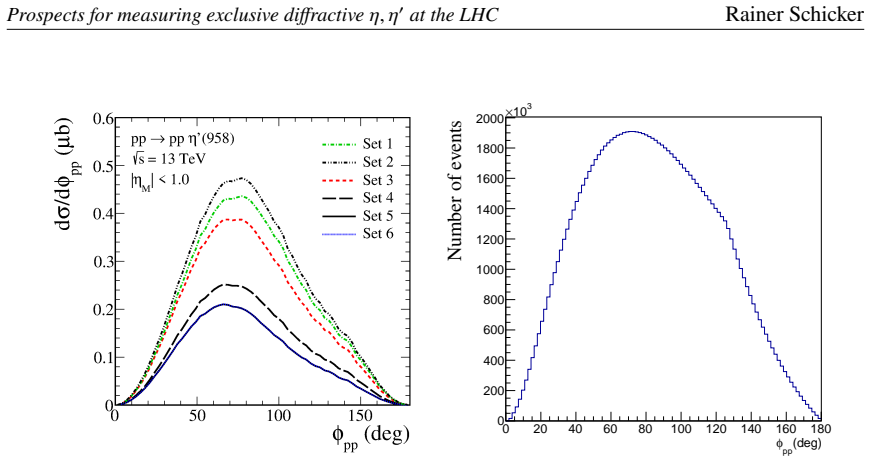
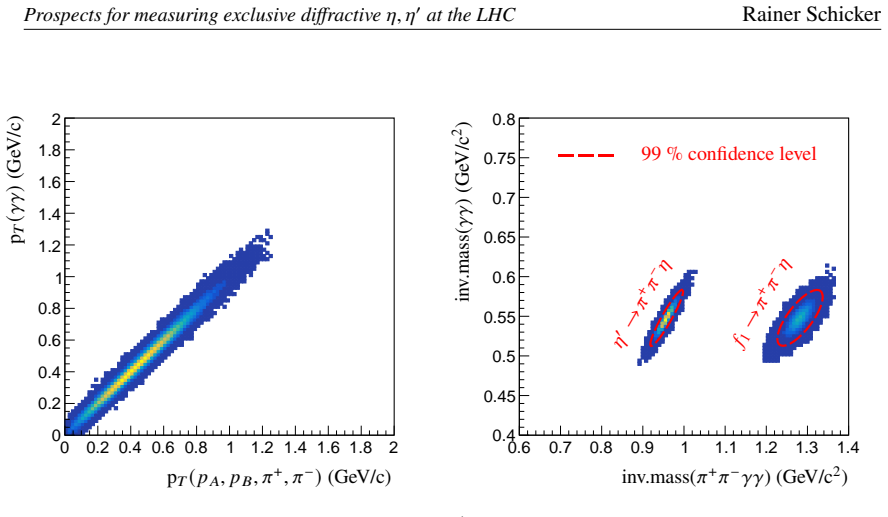
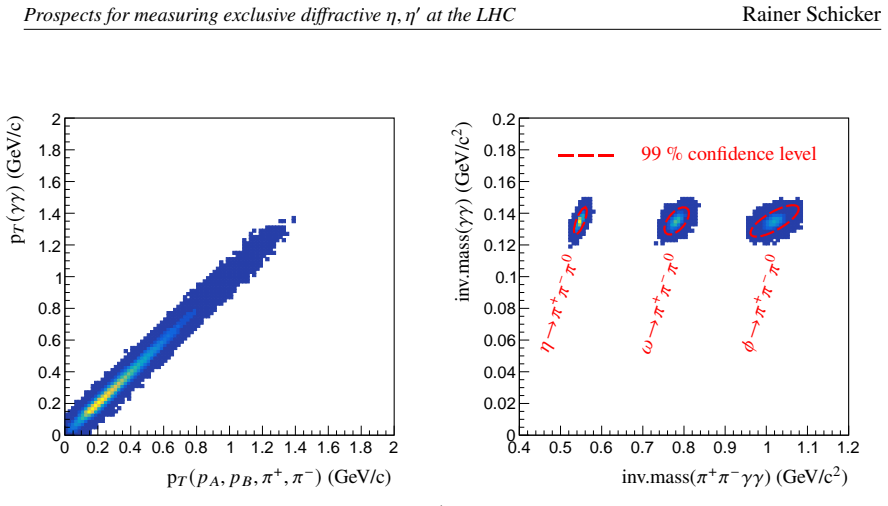
Central exclusive diffractive production at the LHC is dominated by pomeron-pomeron fusion, and the Regge description of the pomeron allows the spin structure to be probed by identifying pseudoscalar mesons η and η' in these events through their production rates and angular distributions, using detectors for forward protons and the central region.
What carries the argument
Pomeron-pomeron fusion in central exclusive production, identified by forward scattered protons and isolated midrapidity activity, serving as a probe for pomeron spin via pseudoscalar meson channels.
If this is right
- Production cross sections for η and η' in pomeron-pomeron fusion can be calculated and compared to measured rates.
- Angular distributions of the mesons will distinguish between different possible spin assignments for the pomeron.
- Forward proton detectors combined with central tracking will enable event selection for these exclusive channels.
- Success would confirm the Regge framework applicability at LHC energies for diffractive processes.
Where Pith is reading between the lines
- Similar measurements could be extended to other light mesons to map pomeron couplings more broadly.
- The approach might connect to tests of diffractive production mechanisms for heavier states like glueballs.
- If the spin structure is determined, it would constrain models of high-energy scattering in QCD.
Load-bearing premise
Pomeron-pomeron fusion dominates central exclusive production at LHC energies and the Regge spin description can be tested directly through the observed meson rates and distributions.
What would settle it
If data show that non-pomeron contributions dominate the central exclusive η or η' signals or that the mesons cannot be cleanly isolated from backgrounds with forward proton tagging, the proposed test of pomeron spin structure would fail.
Figures



read the original abstract
Central exclusive diffractive production in proton-proton collisions at hadron colliders is characterised by hadronic activity at or close to midrapidity, and by the two forward scattered protons, or their remnants. In such events, no particles are produced between the midrapidity system and the forward beam particles. These events can hence be identified with appropriately placed detectors for measuring the forward scattered protons, or their remnants, and a detector system covering the midrapidity range. At the energies of the LHC, central diffractive production in proton-proton collisions is dominated by pomeron-pomeron fusion. The description of the pomeron within the Regge approach is summarized, and the feasibility of identifying pseudoscalar mesons $\eta,\eta'$ in pomeron-pomeron fusion is studied for determining the spin structure of the pomeron.
Editorial analysis
A structured set of objections, weighed in public.
Referee Report
Summary. The manuscript is a prospects study examining the feasibility of identifying exclusive central diffractive production of the pseudoscalar mesons η and η' via pomeron-pomeron fusion in pp collisions at LHC energies. It summarizes the Regge phenomenology of the pomeron, assumes dominance of double-pomeron exchange for central exclusive production, and explores how measurements of these channels (using forward proton tagging and central detectors) could constrain the pomeron spin structure.
Significance. If the feasibility claims are placed on a quantitative footing, the work could provide a targeted test of pomeron spin in a controlled diffractive environment, complementing existing CEP data and Regge models. The approach leverages standard assumptions in the field (DPE dominance at LHC energies) and focuses on clean final states, which is a strength for a forward-looking proposal. However, the current lack of explicit rate, acceptance, and background calculations limits its immediate impact.
major comments (2)
- [Feasibility study (post-Regge summary)] The feasibility assessment (main text following the Regge summary) asserts that η,η' can be identified in pomeron-pomeron fusion but provides no explicit cross-section estimates, detector acceptance calculations, efficiency numbers, or background rejection studies. Without these, the central claim that the channels are measurable and useful for spin-structure constraints cannot be evaluated quantitatively.
- [Introduction and Regge description] The manuscript states that the measurements would determine the pomeron spin structure but does not specify the observables (e.g., differential distributions, ratios, or angular correlations) or the fitting procedure that would extract spin information from the data. This leaves the link between measurement and physics goal underspecified.
minor comments (2)
- [Abstract] The abstract would benefit from a brief quantitative statement on expected event yields or significance at nominal LHC luminosities to make the prospects claim more concrete.
- [Regge pomeron description] Notation for the pomeron trajectory and spin factors should be defined explicitly on first use rather than relying solely on references to prior literature.
Simulated Author's Rebuttal
We thank the referee for the careful reading and constructive comments on our prospects study. The manuscript focuses on the Regge-theoretic framework for pomeron-pomeron fusion and the qualitative feasibility of using η and η' final states to probe pomeron spin properties, leveraging the clean experimental signature of central exclusive production. Below we address the major comments point by point. We are prepared to incorporate clarifications and additional discussion in a revised version.
read point-by-point responses
-
Referee: The feasibility assessment (main text following the Regge summary) asserts that η,η' can be identified in pomeron-pomeron fusion but provides no explicit cross-section estimates, detector acceptance calculations, efficiency numbers, or background rejection studies. Without these, the central claim that the channels are measurable and useful for spin-structure constraints cannot be evaluated quantitatively.
Authors: We agree that quantitative Monte Carlo studies with full detector simulation would provide stronger support for experimental feasibility. Our manuscript is a theoretical prospects paper that summarizes the Regge phenomenology of the pomeron and outlines how the clean final states of η and η' (with forward proton tagging) could in principle constrain pomeron spin, building on established DPE dominance at LHC energies and existing CEP measurements. We reference order-of-magnitude cross sections from analogous processes (e.g., exclusive π⁰ production) in the literature rather than performing new simulations, as the latter would require specific experimental collaboration and detector modeling beyond the scope of this work. We will add a dedicated paragraph in the revised manuscript providing rough rate estimates based on published DPE cross sections at √s = 13 TeV and discussing the standard background rejection via forward proton tagging and rapidity gaps, while noting that detailed acceptance and efficiency studies remain for future experimental proposals. revision: partial
-
Referee: The manuscript states that the measurements would determine the pomeron spin structure but does not specify the observables (e.g., differential distributions, ratios, or angular correlations) or the fitting procedure that would extract spin information from the data. This leaves the link between measurement and physics goal underspecified.
Authors: We thank the referee for highlighting this point. The link is implicit in the Regge framework presented: for pseudoscalar mesons produced via pomeron-pomeron fusion, the pomeron spin-parity affects the t-dependence of the differential cross section and the azimuthal angular correlations between the outgoing protons and the central system. We will revise the text to explicitly list the key observables—dσ/dt distributions and the cos(φ) modulation in the central rapidity region—and describe a straightforward comparison to Regge model predictions with different spin assumptions (e.g., vector vs. tensor pomeron) via χ² fitting of the measured distributions. This clarification will be added in the introduction and feasibility section of the revised manuscript. revision: yes
Circularity Check
No significant circularity; prospects study rests on established external framework
full rationale
The paper presents a feasibility study for identifying exclusive diffractive η and η' production in pomeron-pomeron fusion at the LHC to constrain pomeron spin structure within the Regge approach. It summarizes the standard Regge pomeron description from prior literature and examines detector-level identification without performing any derivation that reduces by construction to fitted inputs, self-defined quantities, or a chain of self-citations. The assumption of pomeron-pomeron dominance at LHC energies is stated as a field-standard expectation supported by existing CEP data, not derived internally. No load-bearing step equates a prediction to its own inputs or imports uniqueness via author-overlapping citations in a manner that closes a loop. The work is self-contained as a proposal relying on independent external benchmarks.
Axiom & Free-Parameter Ledger
axioms (1)
- domain assumption Pomeron-pomeron fusion dominates central exclusive production at LHC energies
Reference graph
Works this paper leans on
-
[1]
Donnachie, H.G
A. Donnachie, H.G. Dosch, P.V. Landshoff, and O. Nachtmann.Pomeron physics and QCD, Camb. Mono. Part. Nucl. Phys.19(2002)
2002
-
[2]
Workmanet al., (Particle Data Group), Prog.Theor.Exp.Phys, 2022, 083C01 (2022)
R.L. Workmanet al., (Particle Data Group), Prog.Theor.Exp.Phys, 2022, 083C01 (2022)
2022
-
[3]
Antchevet al.), Eur.Phys.J.C79, (2019)no.10,861
TOTEM Coll., (G. Antchevet al.), Eur.Phys.J.C79, (2019)no.10,861
2019
-
[4]
Abelevet al.), Eur.Phys.J.C73, (2013) no.6, 2456
ALICE Coll., (B. Abelevet al.), Eur.Phys.J.C73, (2013) no.6, 2456
2013
-
[5]
Ewerz, M
C. Ewerz, M. Maniatis, O. Nachtmann, Annals Phys. 342 (2014) 31
2014
-
[6]
Donnachie, P.V
A. Donnachie, P.V. Landshoff, Phys.Lett. B727 (2013) 500
2013
-
[7]
Donnachie, P.V
A. Donnachie, P.V. Landshoff, Nucl. Phys. B303(1988) 634
1988
-
[8]
A.Bolz,C.Ewerz,M,Maniatis,O.Nachtmann,M.Sauter,A.Schöning,Ann.Phys.344(2014) 301
2014
-
[9]
Adamczyket al., STAR Collaboration, Phys
L. Adamczyket al., STAR Collaboration, Phys. Lett. B719(2013) 62
2013
-
[10]
Ewerz, P
C. Ewerz, P. Lebiedowicz, O. Nachtmann, A. Szczurek, Phys. Lett. B763 (2016) 382
2016
-
[11]
Lebiedowicz, O
P. Lebiedowicz, O. Nachtmann, A. Szczurek, Ann. Phys. 344(2014) 301
2014
-
[12]
O.Nachtmann,Centralexclusiveproductionofetaandeta’mesonsindiffractiveproton-proton collisions at the LHC within the tensor pomeron approach, these proceedings
-
[13]
Lebiedowicz, O
P. Lebiedowicz, O. Nachtmann, A. Szczurek, Phys. Rev. D 112 (2025) 3, 034016
2025
-
[14]
Pascal Hermes, ALICE high𝛽∗-optics options, EMMI RRTF Meeting, Heidelberg, feb 17, 2025
2025
-
[15]
BESIII Coll., Measurement of the matrix elements for the decays𝜂′ →𝜂𝜋 +𝜋− and𝜂 ′ → 𝜂𝜋 0𝜋0, Phys. Rev. D 97, (2018) 012003. 8
2018
discussion (0)
Sign in with ORCID, Apple, or X to comment. Anyone can read and Pith papers without signing in.