Recognition: unknown
SPRAY: A smoothed particle radiation hydrodynamics code for modeling high intensity laser-plasma interactions
Pith reviewed 2026-05-09 23:22 UTC · model grok-4.3
The pith
A mesh-free particle code simulates high-intensity laser-plasma interactions using smoothed particle hydrodynamics.
A machine-rendered reading of the paper's core claim, the machinery that carries it, and where it could break.
Core claim
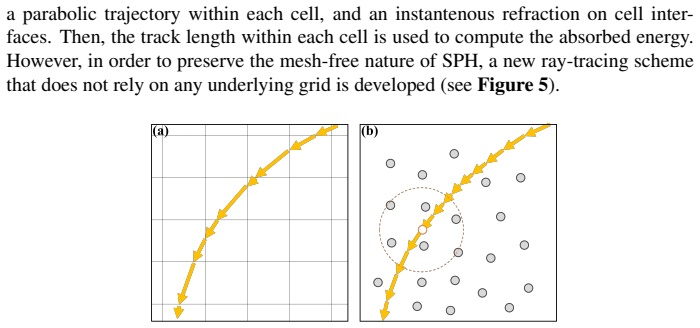
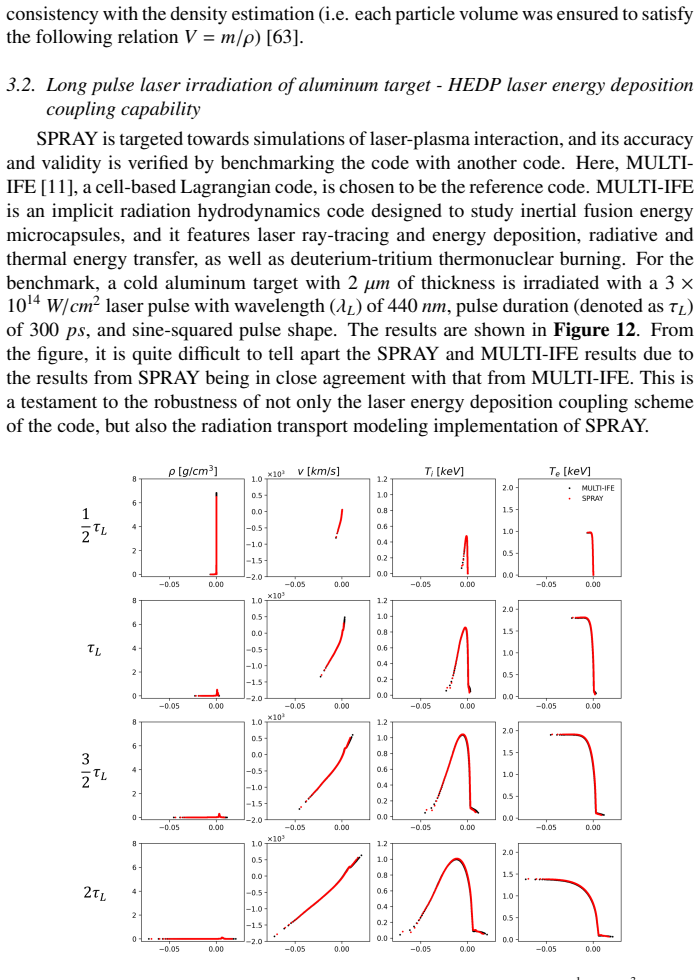
SPRAY is a massively parallel GPU-accelerated SPH-based radiation hydrodynamics code for high intensity laser-plasma interactions. Its tailored SPH formulations for the RHD governing equations are solved via a time-dependent, flux-limited diffusion method. A new laser energy coupling module based on the WKB approximation is implemented with a totally mesh-free ray-tracing scheme applicable for arbitrary geometry and dimensions. Accuracy is shown through benchmark problems, and the work represents the first use of the SPH method for such simulations in high energy density physics.
What carries the argument
Smoothed particle hydrodynamics discretization of radiation hydrodynamics equations together with a WKB-based mesh-free ray-tracing module for laser energy deposition.
If this is right
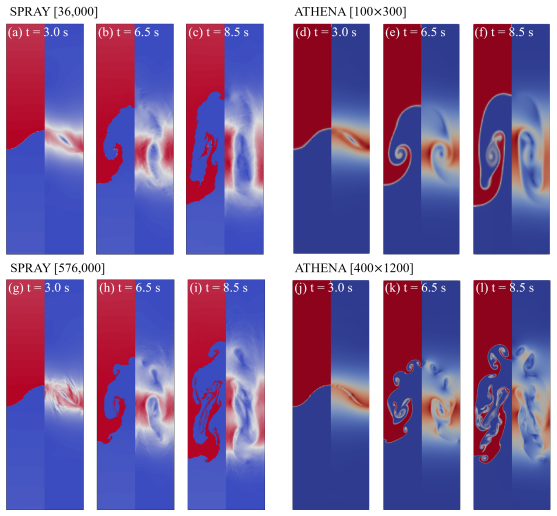
- Simulations of laser-irradiated targets can follow highly deformed geometries caused by instabilities without grid distortion errors.
- The mesh-free ray-tracing allows laser energy coupling to be modeled in targets of any shape or dimension.
- The code supplies a foundation for adding beam-beam interaction modeling and multi-group radiation transport in later versions.
Where Pith is reading between the lines
- Particle-based methods may extend naturally to other high-energy-density flows that involve extreme shape changes.
- Coupling the code to data from laser facilities could support predictive modeling for inertial confinement fusion studies.
- GPU scaling opens the possibility of three-dimensional runs at resolutions difficult for many traditional codes.
Load-bearing premise
The custom SPH formulations and WKB ray-tracing module accurately capture laser energy deposition and radiation transport in complex unstable flows.
What would settle it
A controlled laser-plasma experiment measuring energy absorption or instability growth rates in a simple target geometry that deviates substantially from SPRAY predictions would show the formulations miss essential physics.
Figures









read the original abstract
Here we report the development of SPRAY, a massively parallel GPU accelerated, smoothed particle hydrodynamics (SPH)-based, radiation hydrodynamics (RHD) code designed specifically for simulating high intensity laser-plasma interactions. When a target is irradiated by an intense laser, highly complex fluid deformation occurs due to instabilities, which is challenging to study numerically. SPRAY is particle-based, mesh-free, and Lagrangian, which addresses numerical issues that posed difficulties to existing methods. Its SPH formulations for RHD governing equations are tailored toward accurate and reliable simulations of laser-target irradiation phenomena, and are solved via a time-dependent, flux-limited diffusion method. A new laser energy coupling module, which is based on the Wentzel-Kramers-Brillouin (WKB) approximation, is implemented with a totally mesh-free ray-tracing scheme that is applicable for arbitrary geometry and dimensions. The accuracy and reliability of the code are demonstrated with a series of benchmark problems. To the authors' knowledge, this is the first attempt to employ SPH method for simulations of laser-plasma interactions in high energy density physics research. Possible expansions to the code, such as laser beam-beam interaction modeling and more sophisticated multi-group radiation transport are left for future development.
Editorial analysis
A structured set of objections, weighed in public.
Referee Report
Summary. The manuscript introduces SPRAY, a massively parallel GPU-accelerated smoothed particle hydrodynamics (SPH) code for radiation hydrodynamics (RHD) tailored to high-intensity laser-plasma interactions. It employs customized SPH discretizations of the RHD equations solved with a time-dependent flux-limited diffusion method, together with a new mesh-free ray-tracing module based on the WKB approximation for laser energy deposition. The Lagrangian, mesh-free formulation is motivated by the need to handle complex fluid deformations arising from instabilities in laser-irradiated targets. Accuracy and reliability are asserted through a series of benchmark problems, with the work positioned as the first application of SPH methods to laser-plasma interactions in high-energy-density physics.
Significance. If the validation is strengthened, SPRAY would provide a novel Lagrangian tool for modeling laser-plasma interactions where mesh-based methods encounter difficulties with large deformations and arbitrary geometries. The GPU-parallel implementation and mesh-free WKB ray-tracing module represent practical advances for the field. The paper correctly identifies the potential of particle methods for this regime, but the current absence of quantitative validation metrics limits the immediate significance of the contribution.
major comments (2)
- [Abstract] Abstract: The claim that 'the accuracy and reliability of the code are demonstrated with a series of benchmark problems' is unsupported by any quantitative metrics, error bars, convergence rates, or direct comparisons to analytic solutions or established grid-based RHD codes. This is load-bearing for the central assertion that the tailored SPH-RHD formulations and WKB module correctly capture laser energy deposition and radiation transport.
- [Abstract] Abstract and validation description: No indication is given that the benchmarks include multi-mode Rayleigh-Taylor or Kelvin-Helmholtz growth, 3D arbitrary targets, or regimes near critical density where the WKB approximation and particle-based diffusion may be stressed. Without such tests, the applicability to the complex, unstable flows advertised in the introduction cannot be assessed.
minor comments (1)
- [Abstract] The abstract states that possible expansions such as laser beam-beam interaction modeling are left for future work; a brief discussion of current limitations (e.g., single-group radiation transport) would help readers evaluate the code's present scope.
Simulated Author's Rebuttal
We thank the referee for their constructive review and for recognizing the novelty of applying SPH to high-intensity laser-plasma interactions along with the practical value of the GPU-parallel implementation and mesh-free WKB module. We address each major comment below and indicate the revisions planned for the next manuscript version.
read point-by-point responses
-
Referee: [Abstract] Abstract: The claim that 'the accuracy and reliability of the code are demonstrated with a series of benchmark problems' is unsupported by any quantitative metrics, error bars, convergence rates, or direct comparisons to analytic solutions or established grid-based RHD codes. This is load-bearing for the central assertion that the tailored SPH-RHD formulations and WKB module correctly capture laser energy deposition and radiation transport.
Authors: We agree that the original abstract phrasing overstated the strength of the validation. The body of the manuscript presents benchmark problems with comparisons to analytic solutions and reference results, but these lack the quantitative error norms, convergence rates, and side-by-side grid-code comparisons the referee correctly identifies as necessary. In the revised manuscript we have modified the abstract to state that the formulations are verified through benchmark problems and have added explicit quantitative metrics (L2 error norms, convergence studies, and direct comparisons) to the validation section. revision: yes
-
Referee: [Abstract] Abstract and validation description: No indication is given that the benchmarks include multi-mode Rayleigh-Taylor or Kelvin-Helmholtz growth, 3D arbitrary targets, or regimes near critical density where the WKB approximation and particle-based diffusion may be stressed. Without such tests, the applicability to the complex, unstable flows advertised in the introduction cannot be assessed.
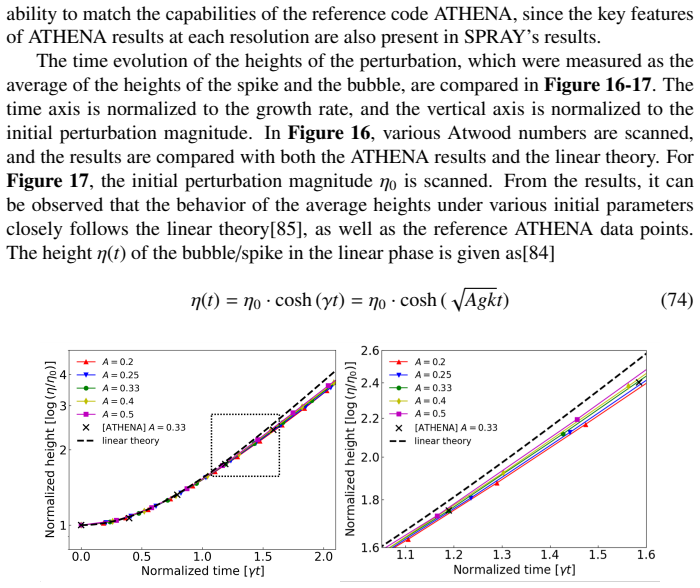
Authors: The current benchmarks are limited to 1D radiation transport, laser absorption, and simplified 2D hydrodynamic problems chosen to verify the core SPH-RHD discretizations, flux-limited diffusion, and mesh-free WKB ray-tracing. We acknowledge that multi-mode Rayleigh-Taylor and Kelvin-Helmholtz growth, fully 3D arbitrary targets, and near-critical-density regimes would provide stronger evidence for the complex flows highlighted in the introduction. These tests lie beyond the scope of the present initial implementation and are identified as future work. In the revised manuscript we have expanded the validation description to state the current scope explicitly and added a limitations subsection discussing the regimes where the WKB and diffusion approximations require caution. revision: partial
Circularity Check
No circularity: new SPH-RHD implementation and WKB ray-tracing rest on standard methods plus external benchmarks
full rationale
The paper develops SPRAY by adapting standard SPH discretizations to the radiation hydrodynamics equations (solved with time-dependent flux-limited diffusion) and adding a mesh-free WKB ray-tracing module for laser energy deposition. These are presented as tailored formulations for laser-plasma problems, with accuracy asserted via a series of benchmark problems rather than any self-referential fitting or prediction that reduces to the input data by construction. No load-bearing self-citations, uniqueness theorems imported from the authors' prior work, or ansatzes smuggled via citation appear in the provided text. The novelty claim ('first attempt to employ SPH method for simulations of laser-plasma interactions') is an external assertion of priority, not a derivation step. The code's Lagrangian particle nature is motivated by physical requirements of large deformations, not by re-labeling its own outputs. This is a self-contained implementation paper whose central results do not collapse to its own fitted values or definitions.
Axiom & Free-Parameter Ledger
free parameters (1)
- SPH numerical parameters such as smoothing length and artificial viscosity coefficients
axioms (2)
- domain assumption Flux-limited diffusion method for solving time-dependent radiation hydrodynamics equations
- domain assumption Wentzel-Kramers-Brillouin (WKB) approximation for laser propagation and energy coupling
Reference graph
Works this paper leans on
-
[1]
D. R. Paul, High-Energy-Density Physics, Springer Berlin Heidelberg,
-
[2]
URL:http://link.springer.com/10.1007/3-540-29315-9. doi:10.1007/3-540-29315-9
-
[3]
Larsen, Foundations of High-Energy-Density Physics, Cambridge Uni- versity Press, 2017
J. Larsen, Foundations of High-Energy-Density Physics, Cambridge Uni- versity Press, 2017. URL:https://www.cambridge.org/core/product/ identifier/9781316403891/type/book. doi:10.1017/9781316403891
-
[4]
Colvin, J
J. Colvin, J. Larsen, Extreme Physics, Cambridge University Press,
-
[5]
URL:https://www.cambridge.org/core/product/identifier/ 9781139095150/type/book. doi:10.1017/CBO9781139095150
-
[6]
A. B. Zylstra, O. A. Hurricane, D. A. Callahan, A. L. Kritcher, J. E. Ralph, H. F. Robey, J. S. Ross, C. V . Young, K. L. Baker, D. T. Casey, T. D¨oppner, L. Divol, M. Hohenberger, S. L. Pape, A. Pak, P. K. Patel, R. Tommasini, S. J. Ali, P. A. Amendt, L. J. Atherton, B. Bachmann, D. Bailey, L. R. Benedetti, L. B. Hopkins, R. Betti, S. D. Bhandarkar, J. B...
2022
-
[7]
L. F. Wang, W. H. Ye, W. Y . Zhang, X. T. He, Numerical investigation of nonlin- ear ablative single-mode Rayleigh–Taylor instability in the presence of preheat- ing, Physica Scripta T155 (2013) 014018
2013
-
[8]
J. W. Bates, A. J. Schmitt, M. Karasik, S. T. Zalesak, Numerical simulations of the ablative Rayleigh-Taylor instability in planar inertial-confinement-fusion targets using the FastRad3D code, Physics of Plasmas 23 (2016) 122701
2016
-
[9]
Fryxell, K
B. Fryxell, K. Olson, P. Ricker, F. X. Timmes, M. Zingale, D. Q. Lamb, P. MacNe- ice, R. Rosner, J. W. Truran, H. Tufo, FLASH: An adaptive mesh hydrodynamics code for modeling astrophysical thermonuclear flashes, The Astrophysical Jour- nal Supplement Series 131 (2000) 273–334
2000
-
[10]
van der Holst, G
B. van der Holst, G. T ´oth, I. V . Sokolov, K. G. Powell, J. P. Holloway, E. S. Myra, Q. Stout, M. L. Adams, J. E. Morel, S. Karni, B. Fryxell, R. P. Drake, CRASH: A block-adaptive-mesh code for radiative shock hydrodynamics—implementation and verification, The Astrophysical Journal Supplement Series 194 (2011) 23
2011
-
[11]
Gittings, R
M. Gittings, R. Weaver, M. Clover, T. Betlach, N. Byrne, R. Coker, E. Dendy, R. Hueckstaedt, K. New, W. R. Oakes, D. Ranta, R. Stefan, The RAGE radiation- hydrodynamic code, Computational Science & Discovery 1 (2008) 015005
2008
-
[12]
Ramis, K
R. Ramis, K. Eidmann, J. Meyer-ter-Vehn, S. H ¨uller, MULTI-fs – a computer code for laser–plasma interaction in the femtosecond regime, Computer Physics Communications 183 (2012) 637–655. 38
2012
-
[13]
Ramis, J
R. Ramis, J. Meyer-ter-Vehn, MULTI-IFE—a one-dimensional computer code for inertial fusion energy (IFE) target simulations, Computer Physics Communi- cations 203 (2016) 226–237
2016
-
[14]
J. T. Larsen, S. M. Lane, HY ADES—a plasma hydrodynamics code for dense plasma studies, Journal of Quantitative Spectroscopy and Radiative Transfer 51 (1994) 179–186
1994
-
[15]
M. M. Marinak, G. D. Kerbel, N. A. Gentile, O. Jones, D. Munro, S. Pollaine, T. R. Dittrich, S. W. Haan, Three-dimensional HYDRA simulations of National Ignition Facility targets, Physics of Plasmas 8 (2001) 2275–2280
2001
-
[16]
L. B. Lucy, A numerical approach to the testing of the fission hypothesis, The Astronomical Journal 82 (1977) 1013
1977
-
[17]
R. A. Gingold, J. J. Monaghan, Smoothed particle hydrodynamics: theory and application to non-spherical stars, Monthly Notices of the Royal Astronomical Society 181 (1977) 375–389
1977
-
[18]
J. J. Monaghan, Smoothed particle hydrodynamics, Annual Review of Astron- omy and Astrophysics 30 (1992) 543–574
1992
-
[19]
J. J. Monaghan, Smoothed particle hydrodynamics, Reports on Progress in Physics 68 (2005) 1703–1759
2005
-
[20]
M. B. Liu, G. R. Liu, Z. Zong, An overview on smoothed particle hydrodynamics, International Journal of Computational Methods 05 (2008) 135–188
2008
-
[21]
Springel, Smoothed particle hydrodynamics in astrophysics, Annual Review of Astronomy and Astrophysics 48 (2010) 391–430
V . Springel, Smoothed particle hydrodynamics in astrophysics, Annual Review of Astronomy and Astrophysics 48 (2010) 391–430
2010
-
[22]
M. B. Liu, G. R. Liu, Smoothed particle hydrodynamics (SPH): An overview and recent developments, Archives of Computational Methods in Engineering 17 (2010) 25–76
2010
-
[23]
Monaghan, Smoothed particle hydrodynamics and its diverse applications, Annual Review of Fluid Mechanics 44 (2012) 323–346
J. Monaghan, Smoothed particle hydrodynamics and its diverse applications, Annual Review of Fluid Mechanics 44 (2012) 323–346
2012
-
[24]
D. J. Price, Smoothed particle hydrodynamics and magnetohydrodynamics, Jour- nal of Computational Physics 231 (2012) 759–794
2012
-
[25]
Shadloo, G
M. Shadloo, G. Oger, D. L. Touz ´e, Smoothed particle hydrodynamics method for fluid flows, towards industrial applications: Motivations, current state, and challenges, Computers & Fluids 136 (2016) 11–34
2016
-
[26]
S. J. Lind, B. D. Rogers, P. K. Stansby, Review of smoothed particle hydro- dynamics: towards converged Lagrangian flow modelling, Proceedings of the Royal Society A: Mathematical, Physical and Engineering Sciences 476 (2020) 20190801. 39
2020
-
[27]
L. D. G. Sigalotti, J. Klapp, M. G. Gesteira, The mathematics of smoothed par- ticle hydrodynamics (SPH) consistency, Frontiers in Applied Mathematics and Statistics 7 (2021) 79
2021
-
[28]
Kessel-Deynet, A
O. Kessel-Deynet, A. Burkert, Ionizing radiation in smoothed particle hydrody- namics, Monthly Notices of the Royal Astronomical Society 315 (2000) 713–721
2000
-
[29]
Susa, Smoothed particle hydrodynamics coupled with radiation transfer, Pub- lications of the Astronomical Society of Japan 58 (2006) 445–460
H. Susa, Smoothed particle hydrodynamics coupled with radiation transfer, Pub- lications of the Astronomical Society of Japan 58 (2006) 445–460
2006
-
[30]
Hasegawa, M
K. Hasegawa, M. Umemura, START: smoothed particle hydrodynamics with tree-based accelerated radiative transfer, Monthly Notices of the Royal Astro- nomical Society 407 (2010) 2632–2644
2010
-
[31]
Altay, R
G. Altay, R. A. C. Croft, I. Pelupessy, SPHRAY: a smoothed particle hydrody- namics ray tracer for radiative transfer, Monthly Notices of the Royal Astronom- ical Society 386 (2008) 1931–1946
2008
-
[32]
A. H. Pawlik, J. Schaye, TRAPHIC – radiative transfer for smoothed particle hydrodynamics simulations, Monthly Notices of the Royal Astronomical Society 389 (2008) 651–677
2008
-
[33]
C. D. Levermore, G. C. Pomraning, A flux-limited diffusion theory, The Astro- physical Journal 248 (1981) 321
1981
-
[34]
C. L. Fryer, G. Rockefeller, M. S. Warren, SNSPH: A parallel three-dimensional smoothed particle radiation hydrodynamics code, The Astrophysical Journal 643 (2006) 292–305
2006
-
[35]
S. C. Whitehouse, M. R. Bate, J. J. Monaghan, A faster algorithm for smoothed particle hydrodynamics with radiative transfer in the flux-limited diffusion ap- proximation, Monthly Notices of the Royal Astronomical Society 364 (2005) 1367–1377
2005
-
[36]
Mayer, G
L. Mayer, G. Lufkin, T. Quinn, J. Wadsley, Fragmentation of gravitationally unstable gaseous protoplanetary disks with radiative transfer, The Astrophysical Journal 661 (2007) L77–L80
2007
-
[37]
Petkova, V
M. Petkova, V . Springel, Simulations of galaxy formation with radiative trans- fer: hydrogen reionization and radiative feedback, Monthly Notices of the Royal Astronomical Society (2010) no–no
2010
-
[38]
T. K. Chan, T. Theuns, R. Bower, C. Frenk, Smoothed particle radiation hydro- dynamics: two-moment method with local eddington tensor closure, Monthly Notices of the Royal Astronomical Society 505 (2021) 5784–5814
2021
-
[39]
S. C. Whitehouse, M. R. Bate, Smoothed particle hydrodynamics with radiative transfer in the flux-limited diffusion approximation, Monthly Notices of the Royal Astronomical Society 353 (2004) 1078–1094. 40
2004
-
[40]
B. R. Bassett, J. M. Owen, T. A. Brunner, Efficient smoothed particle radiation hydrodynamics II: Radiation hydrodynamics, Journal of Computational Physics 429 (2021) 109994
2021
-
[41]
B. R. Bassett, J. M. Owen, T. A. Brunner, Efficient smoothed particle radiation hydrodynamics I: Thermal radiative transfer, Journal of Computational Physics 429 (2021) 109996
2021
-
[42]
T. W. Johnston, J. M. Dawson, Correct values for high-frequency power absorp- tion by inverse bremsstrahlung in plasmas, Physics of Fluids 16 (1973) 722–722
1973
-
[43]
Eliezer, The Interaction of High-Power Lasers With Plasmas, volume 45, IOP Publishing, 2003
S. Eliezer, The Interaction of High-Power Lasers With Plasmas, volume 45, IOP Publishing, 2003. URL:https://iopscience.iop.org/article/10.1088/ 0741-3335/45/2/701. doi:10.1088/0741-3335/45/2/701
-
[44]
T. B. Kaiser, Laser ray tracing and power deposition on an unstructured three- dimensional grid, Physical Review E 61 (2000) 895–905
2000
-
[45]
A. Kemp, J. Meyer-ter-Vehn, An equation of state code for hot dense matter, based on the QEOS description, Nuclear Instruments and Methods in Physics Re- search Section A: Accelerators, Spectrometers, Detectors and Associated Equip- ment 415 (1998) 674–676
1998
-
[46]
Eidmann, Radiation transport and atomic physics modeling in high-energy- density laser-produced plasmas, Laser and Particle Beams 12 (1994) 223–244
K. Eidmann, Radiation transport and atomic physics modeling in high-energy- density laser-produced plasmas, Laser and Particle Beams 12 (1994) 223–244
1994
-
[47]
Y . B. Jo, S.-H. Park, H. Y . Choi, H.-W. Jung, Y .-J. Kim, E. S. Kim, SOPHIA: Development of lagrangian-based CFD code for nuclear thermal-hydraulics and safety applications, Annals of Nuclear Energy 124 (2019) 132–149
2019
-
[48]
S.-H. Park, Y . B. Jo, Y . Ahn, H. Y . Choi, T. S. Choi, S.-S. Park, H. S. Yoo, J. W. Kim, E. S. Kim, Development of multi-GPU–based smoothed particle hydrody- namics code for nuclear thermal hydraulics and safety: Potential and challenges, Frontiers in Energy Research 8 (2020)
2020
-
[49]
Wendland, Piecewise polynomial, positive definite and compactly supported radial functions of minimal degree, Advances in Computational Mathematics 4 (1995) 389–396
H. Wendland, Piecewise polynomial, positive definite and compactly supported radial functions of minimal degree, Advances in Computational Mathematics 4 (1995) 389–396
1995
-
[50]
Dehnen, H
W. Dehnen, H. Aly, Improving convergence in smoothed particle hydrodynamics simulations without pairing instability, Monthly Notices of the Royal Astronom- ical Society 425 (2012) 1068–1082
2012
-
[51]
S. J. Cummins, M. Rudman, An SPH projection method, Journal of Computa- tional Physics 152 (1999) 584–607
1999
-
[52]
B. W. Ritchie, P. A. Thomas, Multiphase smoothed-particle hydrodynamics, Monthly Notices of the Royal Astronomical Society 323 (2001) 743–756. 41
2001
-
[53]
Marri, S
S. Marri, S. D. M. White, Smoothed particle hydrodynamics for galaxy-formation simulations: improved treatments of multiphase gas, of star formation and of supernovae feedback, Monthly Notices of the Royal Astronomical Society 345 (2003) 561–574
2003
-
[54]
Hernquist, N
L. Hernquist, N. Katz, TREESPH: A unification of SPH with the hierarchical tree method, The Astrophysical Journal Supplement Series 70 (1989) 419
1989
-
[55]
Brookshaw, A method of calculating radiative heat diffusion in particle simu- lations, Publications of the Astronomical Society of Australia 6 (1985) 207–210
L. Brookshaw, A method of calculating radiative heat diffusion in particle simu- lations, Publications of the Astronomical Society of Australia 6 (1985) 207–210
1985
-
[56]
H. F. Schwaiger, An implicit corrected SPH formulation for thermal diffusion with linear free surface boundary conditions, International Journal for Numerical Methods in Engineering 75 (2008) 647–671
2008
-
[57]
Fatehi, M
R. Fatehi, M. Manzari, Error estimation in smoothed particle hydrodynamics and a new scheme for second derivatives, Computers & Mathematics with Applica- tions 61 (2011) 482–498
2011
-
[58]
Biriukov, D
S. Biriukov, D. J. Price, Stable anisotropic heat conduction in smoothed particle hydrodynamics, Monthly Notices of the Royal Astronomical Society 483 (2019) 4901–4909
2019
-
[59]
P. W. Cleary, J. J. Monaghan, Conduction modelling using smoothed particle hydrodynamics, Journal of Computational Physics 148 (1999) 227–264
1999
-
[60]
Eidmann, J
K. Eidmann, J. M. ter Vehn, T. Schlegel, S. H ¨uller, Hydrodynamic simulation of subpicosecond laser interaction with solid-density matter, Physical Review E 62 (2000) 1202–1214
2000
-
[61]
H. A. van der V orst, Bi-CGSTAB: A fast and smoothly converging variant of Bi- CG for the solution of nonsymmetric linear systems, SIAM Journal on Scientific and Statistical Computing 13 (1992) 631–644
1992
-
[62]
Y . Saad, M. H. Schultz, Gmres: A generalized minimal residual algorithm for solving nonsymmetric linear systems, SIAM Journal on Scientific and Statistical Computing 7 (1986) 856–869
1986
-
[63]
Monaghan, Simulating free surface flows with SPH, Journal of Computational Physics 110 (1994) 399–406
J. Monaghan, Simulating free surface flows with SPH, Journal of Computational Physics 110 (1994) 399–406
1994
-
[64]
J. Shao, H. Li, G. Liu, M. Liu, An improved SPH method for modeling liquid sloshing dynamics, Computers & Structures 100-101 (2012) 18–26
2012
-
[65]
Monaghan, SPH and Riemann solvers, Journal of Computational Physics 136 (1997) 298–307
J. Monaghan, SPH and Riemann solvers, Journal of Computational Physics 136 (1997) 298–307
1997
-
[66]
J. Morel, Diffusion-limit asymptotics of the transport equation, the p1/3 equa- tions, and two flux-limited diffusion theories, Journal of Quantitative Spec- troscopy and Radiative Transfer 65 (2000) 769–778. 42
2000
-
[67]
Y .-F. Jiang, An implicit finite volume scheme to solve the time-dependent radi- ation transport equation based on discrete ordinates, The Astrophysical Journal Supplement Series 253 (2021) 49
2021
-
[68]
S. H. Menon, C. Federrath, M. R. Krumholz, R. Kuiper, B. D. Wibking, M. Jung, VETTAM: a scheme for radiation hydrodynamics with adaptive mesh refinement using the variable eddington tensor method, Monthly Notices of the Royal Astro- nomical Society 512 (2022) 401–423
2022
-
[69]
Shepard, A two-dimensional interpolation function for irregularly-spaced data, ACM Press, 1968, pp
D. Shepard, A two-dimensional interpolation function for irregularly-spaced data, ACM Press, 1968, pp. 517–524. URL:http://portal.acm.org/citation. cfm?doid=800186.810616. doi:10.1145/800186.810616
-
[70]
J. K. Chen, J. E. Beraun, T. C. Carney, A corrective smoothed particle method for boundary value problems in heat conduction, International Journal for Numerical Methods in Engineering 46 (1999) 231–252
1999
-
[71]
M. Liu, W. Xie, G. Liu, Modeling incompressible flows using a finite particle method, Applied Mathematical Modelling 29 (2005) 1252–1270
2005
-
[72]
Reinhardt, J
C. Reinhardt, J. Stadel, Numerical aspects of giant impact simulations, Monthly Notices of the Royal Astronomical Society 467 (2017) 4252–4263
2017
-
[73]
Ruiz-Bonilla, J
S. Ruiz-Bonilla, J. Borrow, V . R. Eke, J. A. Kegerreis, R. J. Massey, T. D. Sandnes, L. F. A. Teodoro, Dealing with density discontinuities in planetary SPH simulations, Monthly Notices of the Royal Astronomical Society 512 (2022) 4660–4668
2022
-
[74]
Barecasco, H
A. Barecasco, H. Terissa, C. F. Naa, Simple free-surface detection in two and three-dimensional SPH solver, arXiv (2013)
2013
-
[75]
R. M. More, K. H. Warren, D. A. Young, G. B. Zimmerman, A new quotidian equation of state (QEOS) for hot dense matter, The Physics of Fluids 31 (1988) 3059–3078
1988
-
[76]
Pfalzner, An Introduction to Inertial Confinement Fusion, CRC Press, 2006
S. Pfalzner, An Introduction to Inertial Confinement Fusion, CRC Press, 2006. URL:https://www.taylorfrancis.com/books/9781420011845. doi:10. 1201/9781420011845
-
[77]
Barnes, P
J. Barnes, P. Hut, A hierarchical O(N log N) force-calculation algorithm, Nature 324 (1986) 446–449
1986
-
[78]
Hernquist, Performance characteristics of tree codes, The Astrophysical Jour- nal Supplement Series 64 (1987) 715
L. Hernquist, Performance characteristics of tree codes, The Astrophysical Jour- nal Supplement Series 64 (1987) 715
1987
-
[79]
D. J. Price, J. Wurster, T. S. Tricco, C. Nixon, S. Toupin, A. Pettitt, C. Chan, D. Mentiplay, G. Laibe, S. Glover, C. Dobbs, R. Nealon, D. Liptai, H. Worpel, C. Bonnerot, G. Dipierro, G. Ballabio, E. Ragusa, C. Federrath, R. Iaconi, T. Re- ichardt, D. Forgan, M. Hutchison, T. Constantino, B. Ayliffe, K. Hirsh, G. Lodato, PHANTOM: A smoothed particle hydr...
2018
-
[80]
Gafton, S
E. Gafton, S. Rosswog, A fast recursive coordinate bisection tree for neighbour search and gravity, Monthly Notices of the Royal Astronomical Society 418 (2011) 770–781
2011
discussion (0)
Sign in with ORCID, Apple, or X to comment. Anyone can read and Pith papers without signing in.