Recognition: unknown
Impact of nuclear deformation on particle production in Ne+Ne collisions at texorpdfstring{five}{sqrt(sNN)=5.36 TeV} from AMPT-SM
Pith reviewed 2026-05-10 00:39 UTC · model grok-4.3
The pith
Nuclear deformation of neon changes bulk observables in collisions by only 2-6 percent.
A machine-rendered reading of the paper's core claim, the machinery that carries it, and where it could break.
Core claim
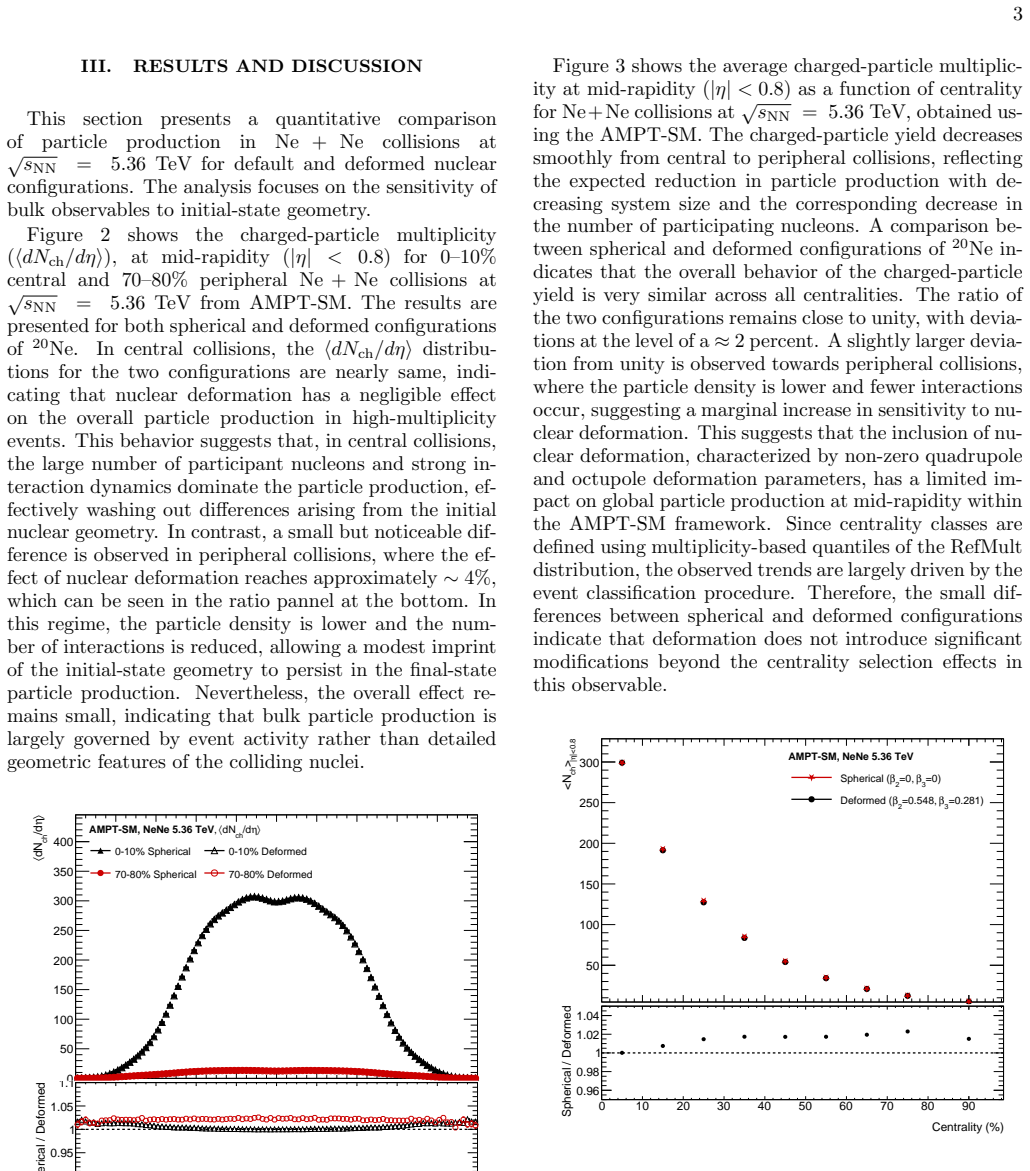
In Ne+Ne collisions at sqrt(s_NN) = 5.36 TeV simulated with AMPT-SM, the influence of initial-state nuclear deformation on bulk observables such as dN_ch/deta, dN/dy, pT spectra, <pT>, and particle ratios is subleading. Differences between spherical and deformed 20Ne configurations remain small at the level of 2%-6%, with slightly enhanced sensitivity in peripheral collisions. The collective dynamics and hadrochemical composition are primarily governed by the overall system density and interaction dynamics.
What carries the argument
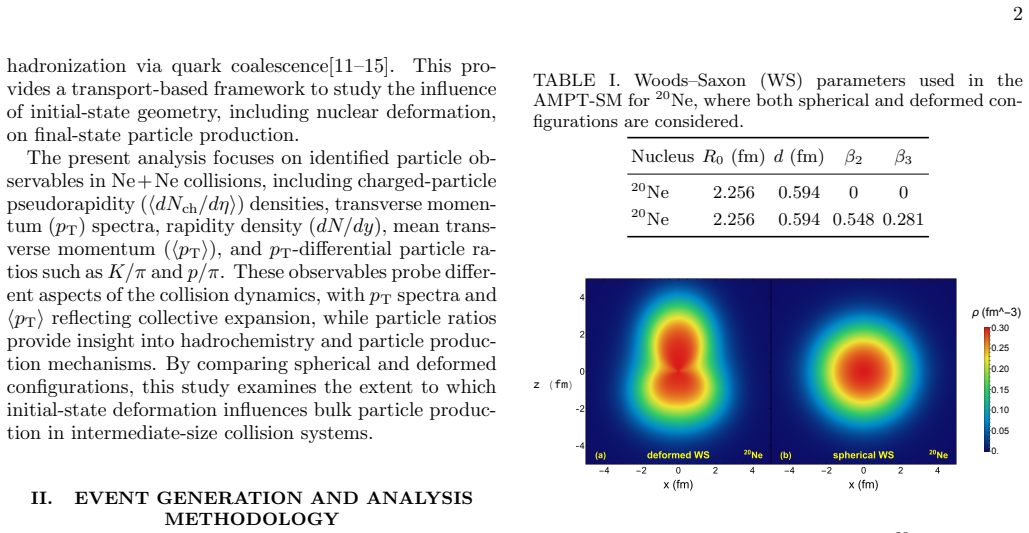
Comparison of spherical versus deformed initial nuclear geometries for 20Ne within the AMPT string-melting transport model.
If this is right
- All bulk observables exhibit the expected dependence on event activity, including smooth multiplicity scaling.
- Mass ordering in mean transverse momentum persists independently of nuclear shape.
- Characteristic features of radial flow and quark coalescence appear in the pT spectra for both configurations.
- Particle ratios such as K/π and p/π show only minor changes with deformation.
- Sensitivity to deformation remains slightly higher in peripheral than in central collisions.
Where Pith is reading between the lines
- Observables tied to initial geometry such as anisotropic flow coefficients could display stronger deformation dependence than the bulk yields studied here.
- Repeating the comparison in hydrodynamic models would test whether the density-dominance conclusion is framework-independent.
- Analogous calculations for other light nuclei such as oxygen would clarify if the subleading role of deformation is general for small systems.
- LHC data on Ne+Ne collisions could serve as a direct experimental test of the predicted 2-6 percent window.
Load-bearing premise
The AMPT-SM model with its chosen parameters and string-melting implementation accurately reproduces the relevant particle production dynamics for both spherical and deformed neon configurations.
What would settle it
Direct LHC measurement of charged-particle pseudorapidity density in peripheral Ne+Ne collisions showing differences larger than 6 percent between deformed and spherical initial conditions would challenge the subleading conclusion.
Figures


read the original abstract
We present a systematic study of particle production in $Ne+Ne$ collisions at $\sqrt{s_{\mathrm{NN}}} = 5.36$ TeV using the A Multi-Phase Transport (AMPT) model with string melting (SM) configuration. The analysis compares spherical and deformed configurations of ${}^{20}\mathrm{Ne}$ to investigate the influence of initial-state nuclear deformation on bulk observables. Charged-particle pseudorapidity ($\langle dN_{\mathrm{ch}}/d\eta \rangle$) densities, identified particle yields ($dN/dy$), transverse momentum ($p_T$) spectra, mean transverse momentum ($\langle p_{\mathrm{T}} \rangle$), and $p_{\mathrm{T}}$-differential particle ratios ($K/\pi$ and $p/\pi$) are studied as functions of multiplicity and centrality. The results show that all observables exhibit the expected dependence on event activity, including smooth multiplicity scaling, mass ordering in $\langle p_{\mathrm{T}} \rangle$, and characteristic features associated with radial flow and quark coalescence. Differences between the two configurations on bulk observables remain small across all observables, typically at the level of a 2\%--6\% percent, with slightly enhanced sensitivity observed in peripheral collisions. These findings suggest that, within the AMPT-SM framework, the collective dynamics and hadrochemical composition are primarily governed by the overall system density and interaction dynamics, while the influence of initial-state deformation is subleading. This study provides a baseline for understanding deformation effects in light-ion collision systems and highlights the limited sensitivity of bulk observables to initial nuclear geometry in transport-based approaches.
Editorial analysis
A structured set of objections, weighed in public.
Referee Report
Summary. The manuscript uses the AMPT model with string melting (AMPT-SM) to simulate Ne+Ne collisions at √sNN = 5.36 TeV, comparing spherical and deformed configurations of 20Ne. It reports that bulk observables—including charged-particle pseudorapidity densities, identified-particle yields, pT spectra, mean pT, and particle ratios—show the expected multiplicity and centrality dependence, with differences between the two nuclear configurations remaining small (typically 2–6%), and concludes that initial-state deformation is subleading relative to overall system density and interaction dynamics within this framework.
Significance. If the central claim holds, the work supplies a useful baseline for light-ion collision studies, indicating that bulk observables in transport models are largely insensitive to quadrupole deformation in 20Ne. This could help interpret upcoming LHC data on Ne+Ne systems and underscores the dominance of geometric overlap and partonic dynamics over nuclear shape. The quantitative 2–6% window is only moderately supported, however, because the manuscript provides no error bars, tuning details, or direct data comparisons.
major comments (2)
- [Model description and Results sections] The conclusion that deformation effects are subleading (2–6% differences) is load-bearing on the assumption that AMPT-SM with its chosen parameters and string-melting implementation produces unbiased results for both spherical and deformed 20Ne. No section validates the model against experimental data or alternative calculations for spherical Ne+Ne (or analogous light-ion systems) at this or lower energies, nor tests stability of the relative difference under variations of the parton scattering cross section or coalescence parameters. This leaves open the possibility that the reported window is an artifact of the specific tuning rather than a robust statement about collective dynamics.
- [Abstract and Results] The abstract states that 'slightly enhanced sensitivity' appears in peripheral collisions, yet the manuscript supplies no quantitative measure (e.g., percentage difference versus centrality or multiplicity class) or figure/table isolating this trend. Without such detail, the claim that peripheral collisions show greater sensitivity cannot be assessed and weakens the overall statement that deformation remains subleading across all observables.
minor comments (2)
- [Abstract] The abstract and text repeatedly cite '2%–6% percent'; the redundant 'percent' should be removed for clarity.
- [Results] No error bars or statistical uncertainties are mentioned for any of the reported differences or observables; adding them would strengthen the quantitative statements.
Simulated Author's Rebuttal
We thank the referee for the careful reading and constructive comments, which will help strengthen the manuscript. We respond point-by-point to the major comments below.
read point-by-point responses
-
Referee: [Model description and Results sections] The conclusion that deformation effects are subleading (2–6% differences) is load-bearing on the assumption that AMPT-SM with its chosen parameters and string-melting implementation produces unbiased results for both spherical and deformed 20Ne. No section validates the model against experimental data or alternative calculations for spherical Ne+Ne (or analogous light-ion systems) at this or lower energies, nor tests stability of the relative difference under variations of the parton scattering cross section or coalescence parameters. This leaves open the possibility that the reported window is an artifact of the specific tuning rather than a robust statement about collective dynamics.
Authors: We agree that additional context on model applicability would improve the paper. The AMPT-SM model has been extensively validated against data in heavy-ion collisions at comparable LHC energies in prior literature; we will add relevant references and a short discussion in the Model section. Direct experimental data for Ne+Ne at 5.36 TeV do not yet exist, so absolute validation for this system is not possible. However, the reported differences are strictly relative (same parameters and implementation for both nuclear shapes), which isolates the geometric deformation effect from absolute tuning. We will add a brief statement noting that relative observables of this type are expected to be robust against moderate parameter variations, as they arise primarily from initial geometry rather than hadronic details. This will be a partial revision. revision: partial
-
Referee: [Abstract and Results] The abstract states that 'slightly enhanced sensitivity' appears in peripheral collisions, yet the manuscript supplies no quantitative measure (e.g., percentage difference versus centrality or multiplicity class) or figure/table isolating this trend. Without such detail, the claim that peripheral collisions show greater sensitivity cannot be assessed and weakens the overall statement that deformation remains subleading across all observables.
Authors: We thank the referee for identifying this gap in presentation. The results do indicate modestly larger relative differences in peripheral events (approaching the upper end of the 2–6% range), but these were not isolated in a dedicated table or plot. We will add a new table (or figure panel) in the Results section that explicitly shows the percentage differences between spherical and deformed configurations as a function of centrality class. We will also revise the abstract to state the trend more quantitatively and precisely. This addresses the concern directly and will be a full revision for this point. revision: yes
Circularity Check
No circularity: direct simulation comparison of model configurations
full rationale
The paper executes AMPT-SM transport simulations for two fixed initial nuclear density profiles (spherical vs. deformed 20Ne) and reports the resulting differences in bulk observables. All reported quantities are direct Monte Carlo outputs; no parameters are fitted to the Ne+Ne data within the paper, no equations are solved that reduce to the input deformation by construction, and no self-citation chain is invoked to justify uniqueness or an ansatz. The central claim (deformation effects are subleading) is an empirical observation from the two runs rather than a derived identity. This is the expected non-circular outcome for a controlled numerical experiment.
Axiom & Free-Parameter Ledger
free parameters (1)
- Deformation parameters of 20Ne
axioms (1)
- domain assumption AMPT-SM with string melting correctly models the space-time evolution and hadronization in Ne+Ne collisions
Reference graph
Works this paper leans on
-
[1]
Collective flow and viscosity in relativistic heavy-ion collisions
U. Heinz and R. Snellings, “Collective flow and viscosity in relativistic heavy-ion collisions”,Ann. Rev. Nucl. Part. Sci.63(2013) 123–151
2013
-
[2]
Strongly coupled quark–gluon plasma in heavy ion collisions
E. Shuryak, “Strongly coupled quark–gluon plasma in heavy ion collisions”,Rev. Mod. Phys.89(2017) 035001
2017
-
[3]
Enhanced production of multi-strange hadrons in high-multiplicity proton–proton collisions
A. Collaboration, “Enhanced production of multi-strange hadrons in high-multiplicity proton–proton collisions”,Nature Phys.13(2017) 535–539. 7
2017
-
[4]
Observation of long-range near-side angular correlations in proton–proton collisions at the lhc
C. Collaboration, “Observation of long-range near-side angular correlations in proton–proton collisions at the lhc”,JHEP09(2010) 091
2010
-
[5]
Observation of long-range near-side angular correlations in p–pb collisions
C. Collaboration, “Observation of long-range near-side angular correlations in p–pb collisions”,Phys. Lett. B 718(2013) 795–814
2013
-
[6]
Measurement of long-range multi-particle correlations in small systems
A. Collaboration, “Measurement of long-range multi-particle correlations in small systems”,Phys. Rev. Lett.116(2016) 172301
2016
-
[7]
Heavy ion collisions: The big picture
W. v. d. S. W. Busza, K. Rajagopal, “Heavy ion collisions: The big picture”,Ann. Rev. Nucl. Part. Sci. 68(2018) 339–376
2018
-
[8]
Small system collectivity in relativistic hadronic and nuclear collisions
J. L. Nagle and W. A. Zajc, “Small system collectivity in relativistic hadronic and nuclear collisions”,Ann. Rev. Nucl. Part. Sci.68(2018) 211–235
2018
-
[9]
Experimental overview on small collision systems at the lhc
C. Loizides, “Experimental overview on small collision systems at the lhc”,Nucl. Phys. A956(2016) 200–207
2016
-
[10]
First results from o–o collisions at the lhc
A. Collaboration, “First results from o–o collisions at the lhc”,Phys. Rev. C(2022)
2022
-
[11]
A multi-phase transport model for relativistic heavy ion collisions
Z.-W. L. et al., “A multi-phase transport model for relativistic heavy ion collisions”,Phys. Rev. C72 (2005) 064901
2005
-
[12]
Dynamics of identified particles production in oxygen–oxygen collisions at √sNN = 7 TeV using EPOS4
A. M. Khan, M. U. Ashraf, H. M. Alfanda, and M. U. Aslam, “Dynamics of identified particles production in oxygen–oxygen collisions at √sNN = 7 TeV using EPOS4”,Eur. Phys. J. A60no. 10, (2024) 207, arXiv:2402.13843 [hep-ph]
-
[13]
M. U. Ashraf, A. M. Khan, J. Singh, G. Nigmatkulov, H. Roch, and S. Kabana, “Multiplicity dependence of (multi-)strange hadrons in oxygen-oxygen collisions at sNN=7 TeV using EPOS4 and AMPT”,Chin. J. Phys. 98(2025) 768–777,arXiv:2406.04096 [hep-ph]
-
[14]
Predictions for identified hadron (π ±, k± andp( p)) production and collective dynamics in oxygen–oxygen collisions at√sN N = 7 tev with epos4, ampt-sm, and angantyr in pythia 8
R. Bashir, R. Shehzadi, and M. U. Ashraf, “Predictions for identified hadron (π ±, k± andp( p)) production and collective dynamics in oxygen–oxygen collisions at√sN N = 7 tev with epos4, ampt-sm, and angantyr in pythia 8”,European Physical Journal Plus140no. 12, (2025) 1211
2025
-
[15]
Pb–pb collisions at lhc energies in a multiphase transport model
J. Xu and C. M. Ko, “Pb–pb collisions at lhc energies in a multiphase transport model”,Phys. Rev. C83 (2011) 034904
2011
-
[16]
A Multi-phase transport model for relativistic heavy ion collisions
Z.-W. Lin, C. M. Ko, B.-A. Li, B. Zhang, and S. Pal, “A Multi-phase transport model for relativistic heavy ion collisions”,Phys. Rev. C72(2005) 064901, arXiv:nucl-th/0411110
-
[17]
HIJING: A Monte Carlo model for multiple jet production in p p, p A and A A collisions
X.-N. Wang and M. Gyulassy, “HIJING: A Monte Carlo model for multiple jet production in p p, p A and A A collisions”,Phys. Rev. D44(1991) 3501–3516
1991
-
[18]
Formation of superdense hadronic matter in high-energy heavy ion collisions
B.-A. Li and C. M. Ko, “Formation of superdense hadronic matter in high-energy heavy ion collisions”, Phys. Rev. C52(1995) 2037–2063, arXiv:nucl-th/9505016
-
[19]
Zhang, ZPC 1.0.1: A Parton cascade for ultrarelativistic heavy ion collisions, Comput
B. Zhang, “ZPC 1.0.1: A Parton cascade for ultrarelativistic heavy ion collisions”,Comput. Phys. Commun.109(1998) 193–206, arXiv:nucl-th/9709009
-
[20]
Pb-Pb collisions at √sN N = 2.76 TeV in a multiphase transport model
J. Xu and C. M. Ko, “Pb-Pb collisions at √sN N = 2.76 TeV in a multiphase transport model”,Phys. Rev. C83 (2011) 034904,arXiv:1101.2231 [nucl-th]
-
[21]
Triangular flow in heavy ion collisions in a multiphase transport model
J. Xu and C. M. Ko, “Triangular flow in heavy ion collisions in a multiphase transport model”,Phys. Rev. C84(2011) 014903,arXiv:1103.5187 [nucl-th]
-
[22]
A Comparison Study of Collisions at Relativistic Energies Involving Light Nuclei
H.-C. Wang, S.-J. Li, J. Xu, and Z.-Z. Ren, “A Comparison Study of Collisions at Relativistic Energies Involving Light Nuclei”,Universe11no. 9, (2025) 296, arXiv:2508.19681 [nucl-th]
discussion (0)
Sign in with ORCID, Apple, or X to comment. Anyone can read and Pith papers without signing in.