Recognition: unknown
Science from the In Situ Exploration of the Proxima Centauri System
Pith reviewed 2026-05-09 23:58 UTC · model grok-4.3
The pith
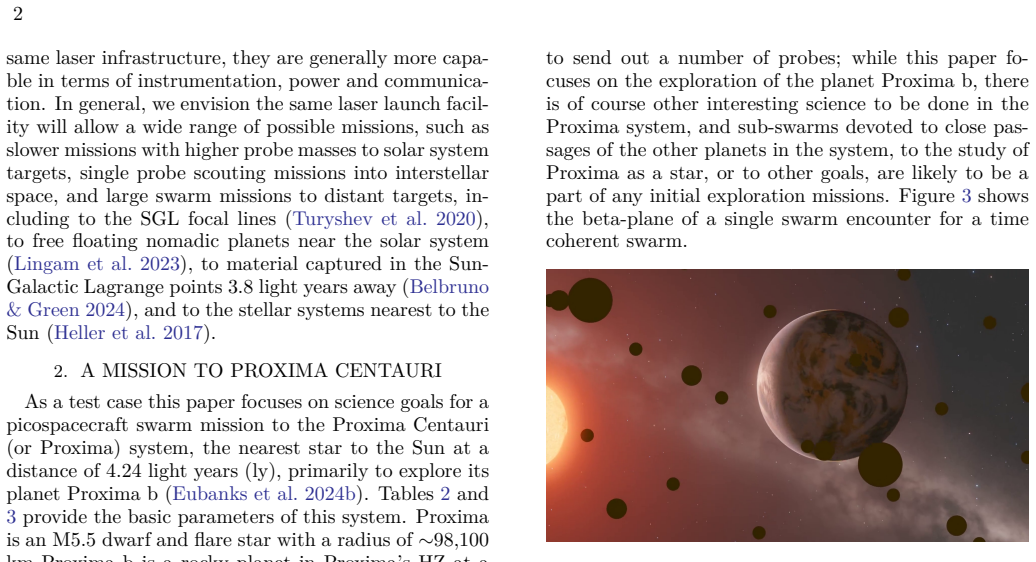
Gram-scale picospacecraft swarms propelled by lasers can image Proxima b at gigapixel resolution during relativistic flybys.
A machine-rendered reading of the paper's core claim, the machinery that carries it, and where it could break.
Core claim
Interstellar exploration at near-relativistic speeds will be possible using beamed energy laser propulsion, enabling gram-mass picospacecraft to explore deep space. For the target planet Proxima b in the habitable zone of Proxima Centauri, a picospacecraft swarm could deliver gigapixel resolution of the target exoplanets even with fast flybys. Initial small spacecraft expeditions would provide a substantial science return, including the ability to detect surface biology or a technological civilization.
What carries the argument
Coracle laser-sail picospacecraft swarms, small gram-mass vehicles using laser sails for acceleration to near-relativistic velocities and rapid flyby data collection.
If this is right
- Even brief flybys can yield gigapixel resolution images of exoplanets like Proxima b.
- Surface biology on Proxima b could be detected through such imaging.
- Signs of a technological civilization could be identified if present.
- Science data can be obtained both en route to the system and during the flyby.
- Small, initial expeditions offer meaningful scientific returns without requiring large spacecraft.
Where Pith is reading between the lines
- Deploying these swarms could provide data years or decades earlier than larger, slower missions.
- The technique might apply to exploring other nearby stars beyond Proxima Centauri.
- Data relay and swarm coordination challenges during high-speed passes require further engineering solutions.
- Combining this with traditional astronomy could give a more complete picture of habitable zone planets.
Load-bearing premise
Laser systems can accelerate and maintain control over gram-mass picospacecraft at near-relativistic speeds while allowing the swarm to collect and transmit data in the short time of a flyby.
What would settle it
An experiment or simulation showing that picospacecraft cannot maintain formation or transmit gigapixel-level data during a seconds-long flyby at high speeds would disprove the central claim.
Figures





read the original abstract
In the future interstellar exploration at near-relativistic speeds will be possible using beamed energy laser propulsion. With this, spacecraft as small as gm mass picospacecraft become candidates for the exploration of deep space, with a trade space of velocity and mission duration versus mass. Here, we examine the potential science return from interstellar expeditions with Coracle laser-sail picospacecraft swarms and show how even with fast flybys at near relativistic velocities, a picospacecraft swarm could deliver gigapixel resolution of the target exoplanets. Our mission target is the planet Proxima b in the habitable zone (HZ) of the red dwarf Proxima Centauri, the tertiary (and nearest) component of the nearest star system, {\alpha} Centauri. We explore science returns from such an expedition, both en route to Proxima and at the Proxima system, and conclude that initial small spacecraft expeditions would provide a substantial science return, including the ability to detect surface biology or a technological civilization, should either or both be established on the target planet.
Editorial analysis
A structured set of objections, weighed in public.
Referee Report
Summary. The manuscript proposes that laser-propelled gram-mass picospacecraft swarms (termed Coracle) can achieve gigapixel-resolution imaging of Proxima b during near-relativistic flybys, delivering substantial science return en route and in the Proxima Centauri system, including the potential to detect surface biology or technological civilizations on the habitable-zone planet.
Significance. If the engineering assumptions on propulsion, swarm control, and imaging hold, the work would offer a useful trade-space framework for evaluating the scientific payoff of initial interstellar picospacecraft missions, emphasizing that even short-duration flybys could yield high-resolution data and biosignature or technosignature searches beyond what remote observations provide.
major comments (2)
- [Abstract] Abstract and the central imaging claim: the assertion that a picospacecraft swarm can deliver gigapixel resolution during seconds-scale near-relativistic flybys rests on order-of-magnitude estimates without supplied error budgets, Monte Carlo simulations, or quantitative treatment of laser beam pointing accuracy, sail stability, swarm formation maintenance, or relativistic aberration effects on the focal-plane geometry.
- [Mission concept / trade studies] The weakest assumption section (laser propulsion reliability for gram-mass craft): the paper treats reliable acceleration to near-relativistic speeds, swarm coherence, and data return as feasible without referencing specific experimental results, pointing budgets, or power-aperture requirements that would be needed to close the link budget for high-resolution imaging.
minor comments (2)
- [Abstract] Notation for spacecraft mass (gm vs. g) and velocity scaling should be standardized and defined at first use.
- [Trade space discussion] The manuscript would benefit from an explicit table summarizing the key free parameters (spacecraft mass, flyby velocity, laser aperture) and their assumed ranges.
Simulated Author's Rebuttal
We thank the referee for their constructive and detailed comments. These have prompted us to clarify the scope and assumptions of our conceptual study. We address each major comment below and have revised the manuscript accordingly.
read point-by-point responses
-
Referee: [Abstract] Abstract and the central imaging claim: the assertion that a picospacecraft swarm can deliver gigapixel resolution during seconds-scale near-relativistic flybys rests on order-of-magnitude estimates without supplied error budgets, Monte Carlo simulations, or quantitative treatment of laser beam pointing accuracy, sail stability, swarm formation maintenance, or relativistic aberration effects on the focal-plane geometry.
Authors: The manuscript is framed as a high-level exploration of scientific return from near-relativistic picospacecraft flybys, using order-of-magnitude estimates to bound the imaging potential. We acknowledge that a full engineering analysis would require error budgets, Monte Carlo modeling of pointing and stability, and explicit treatment of relativistic aberration. In the revised version we have expanded the abstract to emphasize the order-of-magnitude nature of the claims, added a dedicated subsection on key assumptions and uncertainties (including brief quantitative estimates for pointing accuracy and aberration effects drawn from the literature), and cited relevant work on sail dynamics and swarm control. Comprehensive Monte Carlo simulations and detailed error propagation remain outside the scope of this initial science-focused study. revision: partial
-
Referee: [Mission concept / trade studies] The weakest assumption section (laser propulsion reliability for gram-mass craft): the paper treats reliable acceleration to near-relativistic speeds, swarm coherence, and data return as feasible without referencing specific experimental results, pointing budgets, or power-aperture requirements that would be needed to close the link budget for high-resolution imaging.
Authors: We agree that the propulsion and data-return assumptions are stated at a high level. The paper's primary contribution is the assessment of science return under those assumptions rather than a closed engineering design. In revision we have added citations to existing experimental and conceptual work on gram-scale laser sails (including Breakthrough Starshot-related studies) and inserted a short trade-study paragraph on link-budget closure for gigapixel data return. We have also clarified that swarm coherence and acceleration reliability are treated as external technology milestones. Detailed pointing budgets and full power-aperture calculations for the ground-based laser array are not performed here, as they depend on hardware parameters not yet specified; we note this limitation explicitly in the revised text. revision: partial
Circularity Check
No circularity: prospective concept paper with no self-referential derivations or fitted predictions
full rationale
The paper is a forward-looking concept study outlining potential science returns from hypothetical laser-propelled picospacecraft swarms to Proxima b. It discusses trade-offs in velocity, mass, and imaging resolution at relativistic speeds but does not present any mathematical derivation chain, parameter fits, or predictions that reduce to the paper's own inputs by construction. No equations redefine outputs as inputs, no fitted parameters are relabeled as independent predictions, and self-citations (if present) do not load-bear the central claims as unverified uniqueness theorems. The analysis remains self-contained as an exploratory discussion of engineering assumptions and science opportunities without circular reduction.
Axiom & Free-Parameter Ledger
free parameters (2)
- spacecraft mass
- flyby velocity
axioms (2)
- domain assumption Laser beams can accelerate and steer gram-mass sails to near-relativistic speeds with sufficient precision for swarm operations.
- domain assumption A swarm of picospacecraft can coordinate to produce gigapixel composite images during a seconds-long flyby.
invented entities (1)
-
Coracle laser-sail picospacecraft swarms
no independent evidence
Reference graph
Works this paper leans on
-
[1]
Four Sub-Earth Planets Orbiting Barnard's Star from MAROON-X and ESPRESSO. Ap. J. Lett. , keywords =. doi:10.3847/2041-8213/adb8d5 , archivePrefix =. 2503.08095 , primaryClass =
-
[2]
Evidence for a Distant Giant Planet in the Solar System. Astron. J. , keywords =. doi:10.3847/0004-6256/151/2/22 , archivePrefix =. 1601.05438 , primaryClass =
-
[3]
The Inclination of the Planetary System Relative to the Solar Equator May Be Explained by the Presence of Planet 9. Astron. J. , keywords =. doi:10.3847/1538-3881/153/1/27 , archivePrefix =. 1607.05111 , primaryClass =
-
[4]
Generation of Highly Inclined Trans-Neptunian Objects by Planet Nine. Astrophys. J. Lett. , keywords =. doi:10.3847/2041-8205/833/1/L3 , archivePrefix =. 1610.04992 , primaryClass =
-
[5]
Injection of Inner Oort Cloud Objects into the Distant Kuiper Belt by Planet Nine. Astrophys. J. Lett. , keywords =. doi:10.3847/2041-8213/abee1f , archivePrefix =. 2104.05799 , primaryClass =
-
[6]
Colors of Life in the Clouds: Biopigments of Atmospheric Microorganisms as a New Signature to Detect Life on Planets like Earth. Astrophys. Journal Letters , year = 2025, month= "November", volume =. doi:10.3847/2041-8213/ae129a
-
[7]
New Extreme Trans-Neptunian Objects: Toward a Super-Earth in the Outer Solar System. Astron. J. , keywords =. doi:10.3847/1538-3881/152/6/221 , archivePrefix =. 1608.08772 , primaryClass =
-
[8]
Corralling a Distant Planet with Extreme Resonant Kuiper Belt Objects. Astrophys. J. Lett. , keywords =. doi:10.3847/2041-8205/824/2/L22 , archivePrefix =. 1603.02196 , primaryClass =
-
[9]
Constraints on the location of a possible 9th planet derived from the Cassini data. Astron. Astrophys. , keywords =. doi:10.1051/0004-6361/201628227 , archivePrefix =. 1602.06116 , primaryClass =
-
[10]
Interaction Cross Sections and Survival Rates for Proposed Solar System Member Planet Nine. Astrophys. J. Lett. , keywords =. doi:10.3847/2041-8205/823/1/L3 , archivePrefix =. 1602.08496 , primaryClass =
-
[11]
Universe , year = 2020, month = aug, volume =
The Astrobiology of Alien Worlds: Known and Unknown Forms of Life. Universe , year = 2020, month = aug, volume =. doi:10.3390/universe6090130 , adsurl =
-
[12]
A review of exoplanetary biosignatures. Phys. Rep. , keywords =. doi:10.1016/j.physrep.2017.08.003 , archivePrefix =. 1710.03976 , primaryClass =
-
[13]
Phosphine as a Biosignature Gas in Exoplanet Atmospheres. Astrobiology , keywords =. doi:10.1089/ast.2018.1954 , archivePrefix =. 1910.05224 , primaryClass =
-
[14]
Detectability of biosignatures on LHS 1140 b. Astron. Astrophys. , keywords =. doi:10.1051/0004-6361/202039663 , archivePrefix =. 2012.11426 , primaryClass =
-
[15]
Biosignature Gases in H _ 2 -dominated Atmospheres on Rocky Exoplanets. Astrophys. J. , keywords =. doi:10.1088/0004-637X/777/2/95 , archivePrefix =. 1309.6016 , primaryClass =
-
[16]
2021 , publisher=
Life in the Cosmos: From Biosignatures to Technosignatures. 2021 , publisher=
2021
-
[18]
Cometary Isotopic Measurements. Space Sci. Rev. , keywords =. doi:10.1007/s11214-015-0156-9 , adsurl =
-
[19]
Earth Moon and Planets , keywords =
Isotopic Ratios in Comets: Status and Perspectives. Earth Moon and Planets , keywords =. doi:10.1007/s11038-009-9322-y , adsurl =
-
[20]
Galactic chemical evolution and the oxygen isotopic composition of the solar system. Meteorit. Planet. Sci. , keywords =. doi:10.1111/j.1945-5100.2012.01410.x , archivePrefix =. 1207.7337 , primaryClass =
-
[21]
Is there an exoplanet in the Solar system?. Mon. Not. R. Astron. Soc. , keywords =. doi:10.1093/mnrasl/slw075 , archivePrefix =. 1603.07247 , primaryClass =
-
[22]
Observational Constraints on the Orbit and Location of Planet Nine in the Outer Solar System. Astrophys. J. Lett. , keywords =. doi:10.3847/2041-8205/824/2/L23 , archivePrefix =. 1603.05712 , primaryClass =
-
[23]
Observational Constraints on Planet Nine: Cassini Range Observations. Astron. J. , keywords =. doi:10.3847/0004-6256/152/4/94 , archivePrefix =. 1604.03180 , primaryClass =
-
[24]
Dynamical Evolution Induced by Planet Nine. Astron. J. , keywords =. doi:10.3847/1538-3881/aa937c , archivePrefix =. 1710.01804 , primaryClass =
-
[25]
Preliminary constraints on the location of the recently hypothesized new planet of the Solar System from planetary orbital dynamics. Astrophys. Space Sci. , keywords =. doi:10.1007/s10509-016-2993-8 , archivePrefix =. 1512.05288 , primaryClass =
-
[26]
Orbital Clustering in the Distant Solar System. Astron. J. , keywords =. doi:10.3847/1538-3881/aaf051 , archivePrefix =. 1901.07115 , primaryClass =
-
[27]
Finding Planet Nine: a Monte Carlo approach. Mon. Not. R. Astron. Soc. , keywords =. doi:10.1093/mnrasl/slw049 , archivePrefix =. 1603.06520 , primaryClass =
-
[28]
Evaluating the Dynamical Stability of Outer Solar System Objects in the Presence of Planet Nine. Astron. J. , keywords =. doi:10.3847/1538-3881/aa7aa2 , archivePrefix =. 1706.06609 , primaryClass =
-
[29]
Solar Obliquity Induced by Planet Nine: Simple Calculation. Astron. J. , keywords =. doi:10.3847/0004-6256/152/6/215 , archivePrefix =. 1608.01421 , primaryClass =
-
[30]
arXiv e-prints , keywords =
Cost-Optimal System Performance Maps for Laser-Accelerated Sailcraft. arXiv e-prints , keywords =
-
[31]
Low-cost precursor of an interstellar mission. Astron. Astrophys. , keywords =. doi:10.1051/0004-6361/202038687 , archivePrefix =. 2007.12814 , primaryClass =
-
[32]
Constraints on planetary and asteroid-mass primordial black holes from continuous gravitational-wave searches. Phys. Rev. D , keywords =. doi:10.1103/PhysRevD.105.062008 , archivePrefix =. 2110.06188 , primaryClass =
-
[33]
Cosmologists in Search of Planet Nine: The Case for CMB Experiments. Astrophys. J. Lett. , keywords =. doi:10.3847/2041-8205/822/1/L2 , archivePrefix =. 1602.05963 , primaryClass =
-
[34]
Dynamical impact of the Planet Nine scenario: N-body experiments. Mon. Not. R. Astron. Soc. , keywords =. doi:10.1093/mnrasl/slw078 , archivePrefix =. 1604.06241 , primaryClass =
-
[35]
Evolution and magnitudes of candidate Planet Nine. Astron. Astrophys. , keywords =. doi:10.1051/0004-6361/201628350 , archivePrefix =. 1602.07465 , primaryClass =
-
[36]
Making Planet Nine: Pebble Accretion at 250-750 AU in a Gravitationally Unstable Ring. Astrophys. J. , keywords =. doi:10.3847/0004-637X/825/1/33 , archivePrefix =. 1603.08008 , primaryClass =
-
[37]
Making Planet Nine: A Scattered Giant in the Outer Solar System. Astrophys. J. , keywords =. doi:10.3847/0004-637X/826/1/64 , archivePrefix =. 1603.08010 , primaryClass =
-
[38]
Observational Bias and the Clustering of Distant Eccentric Kuiper Belt Objects. Astron. J. , keywords =. doi:10.3847/1538-3881/aa79f4 , archivePrefix =. 1706.04175 , primaryClass =
-
[39]
The planet nine hypothesis. Phys. Rep. , keywords =. doi:10.1016/j.physrep.2019.01.009 , archivePrefix =. 1902.10103 , primaryClass =
-
[40]
OSSOS. VI. Striking Biases in the Detection of Large Semimajor Axis Trans-Neptunian Objects. Astron. J. , keywords =. doi:10.3847/1538-3881/aa7aed , archivePrefix =. 1706.05348 , primaryClass =
-
[41]
A Search for Planet Nine using the Zwicky Transient Facility Public Archive. Astron. J. , keywords =. doi:10.3847/1538-3881/ac32dd , archivePrefix =. 2110.13117 , primaryClass =
-
[42]
The small satellites of Pluto as observed by New Horizons. Science , keywords =. doi:10.1126/science.aae0030 , archivePrefix =. 1604.05366 , primaryClass =
-
[43]
The Pluto system: Initial results from its exploration by New Horizons. Science , keywords =. doi:10.1126/science.aad1815 , archivePrefix =. 1510.07704 , primaryClass =
-
[44]
Reorientation of Sputnik Planitia implies a subsurface ocean on Pluto. Nature , keywords =. doi:10.1038/nature20148 , archivePrefix =. 1903.05574 , primaryClass =
-
[45]
The sun diver: Combining solar sails with the Oberth effect. Am. J. Phys. , keywords =. doi:10.1119/10.0002178 , archivePrefix =. 2009.12659 , primaryClass =
-
[46]
Mini-Magnetospheric Plasma Propulsion: Tapping the energy of the solar wind for spacecraft propulsion. J. Geophys. Res. , keywords =. doi:10.1029/1999JA000334 , adsurl =
-
[47]
Exploring the Kuiper Belt with sun-diving solar sails. Acta Astronaut. , keywords =. doi:10.1016/j.actaastro.2019.02.019 , archivePrefix =. 1810.00407 , primaryClass =
-
[48]
Low-Power Laser Sailing for Fast-Transit Space Flight. Nano Lett. , year = 2022, month = feb, volume =. doi:10.1021/acs.nanolett.1c04188 , adsurl =
-
[49]
The Pluto System After New Horizons. Annu. Rev. Astron. Astrophys. , keywords =. doi:10.1146/annurev-astro-081817-051935 , archivePrefix =. 1712.05669 , primaryClass =
-
[50]
2014, in Protostars and Planets VI, ed
The Pluto System After New Horizons. doi:10.2458/azu\_uapress\_9780816540945 , adsurl =
-
[51]
The atmosphere of Pluto as observed by New Horizons. Science , keywords =. doi:10.1126/science.aad8866 , archivePrefix =. 1604.05356 , primaryClass =
-
[52]
Assessment of Ammonia as a Biosignature Gas in Exoplanet Atmospheres. Astrobiology , keywords =. doi:10.1089/ast.2020.2358 , archivePrefix =. 2107.12424 , primaryClass =
-
[53]
Habitability and Biosignatures of Hycean Worlds. Astrophys. J. , keywords =. doi:10.3847/1538-4357/abfd9c , archivePrefix =. 2108.10888 , primaryClass =
-
[55]
2021, The Astrophysical Journal Letters, 921, L8, doi: 10.3847/2041-8213/ac1f92
Unveiling Shrouded Oceans on Temperate sub-Neptunes via Transit Signatures of Solubility Equilibria versus Gas Thermochemistry. Astrophys. J. Lett. , keywords =. doi:10.3847/2041-8213/ac1f92 , archivePrefix =. 2108.04745 , primaryClass =
-
[56]
2018, ApJ, 853, 163, doi: 10.3847/1538-4357/aa9f1e
Compositional Imprints in Density-Distance-Time: A Rocky Composition for Close-in Low-mass Exoplanets from the Location of the Valley of Evaporation. Astrophys. J. , keywords =. doi:10.3847/1538-4357/aa9f1e , archivePrefix =. 1706.00251 , primaryClass =
-
[57]
Irradiated Ocean Planets Bridge Super-Earth and Sub-Neptune Populations. Astrophys. J. Lett. , keywords =. doi:10.3847/2041-8213/ab9530 , archivePrefix =. 2002.05243 , primaryClass =
-
[58]
The nature of the radius valley. Hints from formation and evolution models. Astron. Astrophys. , keywords =. doi:10.1051/0004-6361/202039141 , archivePrefix =. 2008.05513 , primaryClass =
-
[59]
The California-Kepler Survey. VII. Precise Planet Radii Leveraging Gaia DR2 Reveal the Stellar Mass Dependence of the Planet Radius Gap. Astron. J. , keywords =. doi:10.3847/1538-3881/aae828 , archivePrefix =. 1805.01453 , primaryClass =
-
[60]
The Orbit of Planet Nine. Astron. J. , keywords =. doi:10.3847/1538-3881/ac2056 , archivePrefix =. 2108.09868 , primaryClass =
-
[61]
The Secular Dynamics of TNOs and Planet Nine Interactions. Astron. J. , keywords =. doi:10.3847/1538-3881/aae83b , archivePrefix =. 1806.06867 , primaryClass =
-
[62]
Hyperbolic comets as an indicator of a hypothetical planet 9 in the solar system. Adv. Space Res. , keywords =. doi:10.1016/j.asr.2022.02.001 , adsurl =
-
[63]
Tilting Uranus via Secular Spin-Orbit Resonance with Planet 9. Planet. Sci. J. , keywords =
-
[64]
arXiv e-prints , keywords =
Further support and a candidate location for Planet 9. arXiv e-prints , keywords =
-
[65]
Searching for giant planets in the outer Solar System with far-infrared all-sky surveys. Mon. Not. R. Astron. Soc. , keywords =. doi:10.1093/mnras/stac2044 , archivePrefix =. 2207.09985 , primaryClass =
-
[66]
Limits on the Detection of Planet Nine in the Dark Energy Survey. Astron. J. , keywords =. doi:10.3847/1538-3881/ac5c56 , archivePrefix =. 2203.07642 , primaryClass =
-
[67]
Oxygen Isotopes in the Solar System. Space Sci. Rev. , keywords =. doi:10.1023/A:1024669116828 , adsurl =
-
[68]
Oxygen Isotopes and Sampling of the Solar System. Space Sci. Rev. , keywords =. doi:10.1007/s11214-020-0645-3 , adsurl =
-
[69]
The fastest routes of approach to dwarf planet Sedna for study its surface and composition at the close range. Acta Astronaut. , year = 2022, month = mar, volume =. doi:10.1016/j.actaastro.2021.12.011 , archivePrefix =. 2112.11506 , primaryClass =
-
[70]
Achieving the required mobility in the solar system through direct fusion drive. Acta Astronaut. , keywords =. doi:10.1016/j.actaastro.2020.04.047 , archivePrefix =. 2002.12686 , primaryClass =
-
[71]
Exploration of trans-Neptunian objects using the Direct Fusion Drive. Acta Astronaut. , keywords =. doi:10.1016/j.actaastro.2020.09.022 , archivePrefix =. 2009.12633 , primaryClass =
-
[72]
Return to the Kuiper Belt: Launch Opportunities from 2025 to 2040. J. Spacecraft Rockets , keywords =. doi:10.2514/1.A34329 , archivePrefix =. 1810.07811 , primaryClass =
-
[73]
Analysis of mission opportunities to Sedna in 2029-2034. Adv. Space Res. , keywords =. doi:10.1016/j.asr.2021.05.035 , archivePrefix =. 2112.13017 , primaryClass =
-
[74]
A Survey of Mission Opportunities to Trans-Neptunian Objects. J. Br. Interplanet. Soc. , keywords =
-
[75]
Prospects for Future Exploration of the Trans-Neptunian Region. Bull. Am. Astron. Soc. , year = 2021, volume =. doi:10.3847/25c2cfeb.5950ca1c , adsurl =
-
[76]
Blackbody Radiation from Isolated Neptunes. Astrophys. J. Lett. , keywords =. doi:10.3847/2041-8205/822/1/L11 , archivePrefix =. 1603.02876 , primaryClass =
-
[77]
Planet Nine, dark matter and MOND. Astrophys. Space Sci. , keywords =. doi:10.1007/s10509-016-2815-z , adsurl =
-
[78]
Extreme trans-Neptunian objects and the Kozai mechanism: signalling the presence of trans-Plutonian planets. Mon. Not. R. Astron. Soc. , keywords =. doi:10.1093/mnrasl/slu084 , archivePrefix =. 1406.0715 , primaryClass =
-
[79]
Nature 507(7493), 471–474 (2014) https://doi.org/10.1038/nature13156
A Sedna-like body with a perihelion of 80 astronomical units. Nature , year = 2014, month = mar, volume =. doi:10.1038/nature13156 , adsurl =
-
[80]
The fates of Solar system analogues with one additional distant planet. Mon. Not. R. Astron. Soc. , keywords =. doi:10.1093/mnras/stw2170 , archivePrefix =. 1608.07580 , primaryClass =
-
[81]
The observation of large semi-major axis Centaurs: Testing for the signature of a planetary-mass solar companion. Icarus , keywords =. doi:10.1016/j.icarus.2015.06.020 , adsurl =
-
[82]
arXiv e-prints , keywords =
The Brute-Force Search for Planet Nine. arXiv e-prints , keywords =
discussion (0)
Sign in with ORCID, Apple, or X to comment. Anyone can read and Pith papers without signing in.