Recognition: unknown
On Rent Dissipation in Dynamic Multi-battle Contests
Pith reviewed 2026-05-09 23:22 UTC · model grok-4.3
The pith
Exchangeability of contest structure causes discouragement and incomplete rent dissipation in dynamic multi-battle contests unless a specific condition is met.
A machine-rendered reading of the paper's core claim, the machinery that carries it, and where it could break.
Core claim
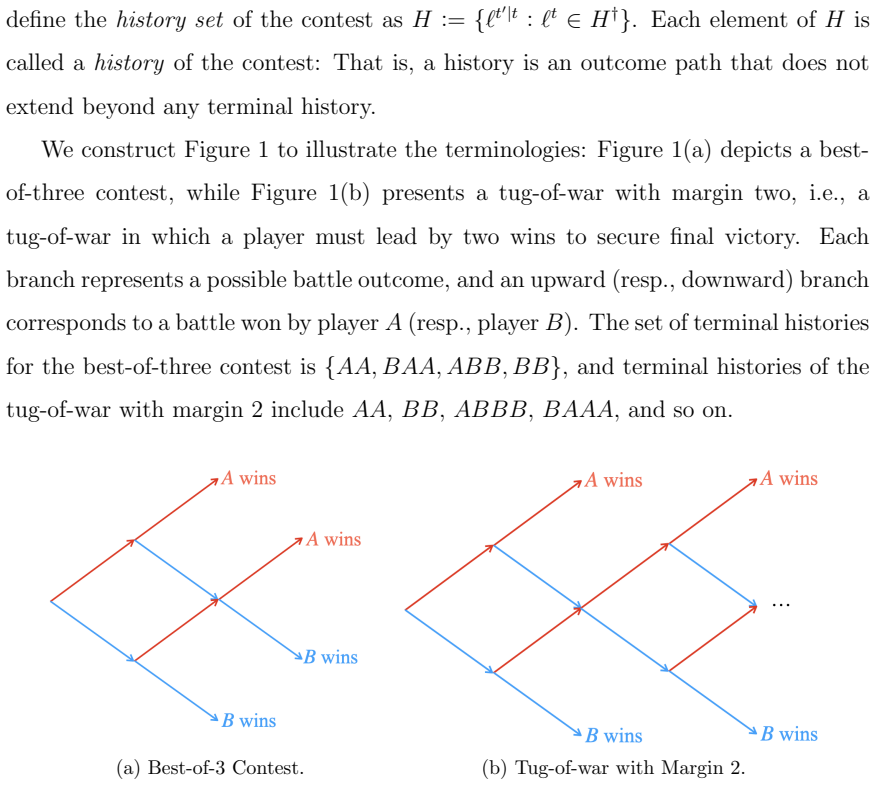
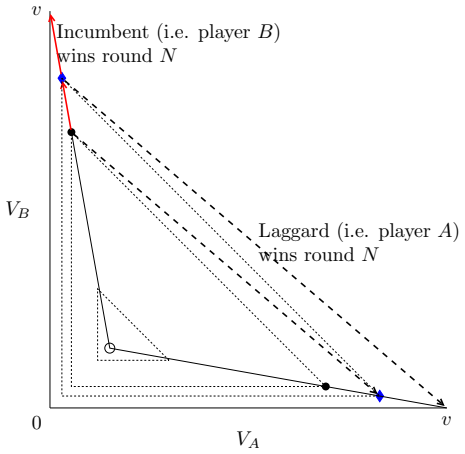
We identify a structural property, exchangeability, that contributes to the discouragement effect in dynamic multi-battle contests such as tug-of-war and best-of-K series. This effect prevents full rent dissipation even when the series can extend infinitely. Leveraging this insight, we establish a necessary and sufficient condition for almost-full rent dissipation. As an application, we introduce the iterated incumbency contest, which illustrates how volatility in the surrounding environment sustains dynamic incentives and generates almost-full rent dissipation.
What carries the argument
Exchangeability, the structural property under which the contest's battle sequence permits symmetric strategic responses that reinforce discouragement from early leads or losses.
If this is right
- In exchangeable structures the discouragement effect persists and total effort stays below the level needed for full rent dissipation.
- A necessary and sufficient condition identifies exactly when almost-full dissipation occurs despite the possibility of infinite battles.
- The iterated incumbency contest achieves high dissipation because changing environmental conditions break the usual discouragement pattern.
- The framework applies to effort levels in repeated competitive settings such as sports series or business rivalries.
Where Pith is reading between the lines
- Contest organizers could introduce non-exchangeable elements to raise total effort from participants.
- The condition may extend to sequential decisions in bargaining or military campaigns.
- Lab experiments could simulate exchangeable versus non-exchangeable structures to measure differences in effort.
- Broader models of competition could use the condition to predict resource use in multi-stage games.
Load-bearing premise
The discouragement effect arises mainly from the exchangeability property under standard assumptions of rational dynamic play by contestants.
What would settle it
An empirical or experimental observation of full rent dissipation in an exchangeable contest structure with infinite possible duration would contradict the necessary condition for almost-full dissipation.
Figures

read the original abstract
We study dynamic multi-battle contests and examine how the contest structure shapes dynamic incentives and determines the extent of rent dissipation. A discouragement effect often arises -- such as in tug-of-war and best-of-$K$ contests -- preventing full rent dissipation even when the series can extend infinitely. We identify a structural property, exchangeability, that contributes to the effect. Leveraging this insight, we establish a necessary and sufficient condition for almost-full rent dissipation. As an application, we introduce the iterated incumbency contest, which illustrates how volatility in the surrounding environment sustains dynamic incentives and generates almost-full rent dissipation, and thus offers insights into various competitive phenomena.
Editorial analysis
A structured set of objections, weighed in public.
Referee Report
Summary. The paper studies dynamic multi-battle contests and how contest structure shapes dynamic incentives and rent dissipation. It identifies a discouragement effect in structures such as tug-of-war and best-of-K contests, introduces exchangeability as a structural property contributing to this effect, establishes a necessary and sufficient condition for almost-full rent dissipation, and applies the framework to an iterated incumbency contest where environmental volatility sustains incentives and produces near-complete rent dissipation.
Significance. If the central derivations hold, the work supplies a general structural criterion for rent dissipation in dynamic contests rather than relying on special functional forms. The identification of exchangeability as a driver of the discouragement effect is a useful organizing insight, and the application to iterated incumbency contests links the theory to observable competitive phenomena. The absence of ad-hoc parameters or invented entities in the stated framework is a positive feature.
minor comments (2)
- [Abstract] Abstract: the claim of a necessary and sufficient condition is stated without any equation, definition of exchangeability, or outline of the proof strategy. Adding a compact mathematical statement would improve accessibility while preserving the abstract's brevity.
- [Introduction] The manuscript should clarify whether the necessary-and-sufficient condition is derived under the standard dynamic-incentive model alone or requires additional restrictions on payoff functions; a brief remark in the introduction or §2 would remove ambiguity.
Simulated Author's Rebuttal
We thank the referee for the careful reading of the manuscript and the positive assessment. The referee's summary accurately reflects the paper's focus on how contest structure, particularly exchangeability, generates a discouragement effect in dynamic multi-battle contests and the necessary and sufficient condition for almost-full rent dissipation. The recommendation for minor revision is noted, and we will incorporate any editorial or minor clarifications in the revised version.
Circularity Check
No significant circularity in derivation chain
full rationale
The paper identifies exchangeability as a structural property of certain contest formats and derives from it a necessary and sufficient condition for almost-full rent dissipation in dynamic multi-battle settings. No load-bearing step reduces by construction to a fitted parameter, self-definition, or self-citation chain; the condition is presented as following from the identified property applied to the general dynamic-incentive framework. The iterated-incumbency application is offered as an illustration rather than a fitted prediction. The derivation remains self-contained against external benchmarks of contest theory.
Axiom & Free-Parameter Ledger
axioms (2)
- domain assumption Players are rational and maximize expected payoffs in a dynamic setting
- domain assumption Contest structures can be classified by the exchangeability property
Reference graph
Works this paper leans on
-
[1]
2019 , journal=
Multi-battle contests, finite automata, and the tug-of-war , author=. 2019 , journal=
2019
-
[2]
Economic Inquiry , volume=
Two-player asymmetric contests with ratio-form contest success functions , author=. Economic Inquiry , volume=. 2004 , publisher=
2004
-
[3]
Review of Economic Design , volume=
Tullock and Hirshleifer: a meeting of the minds , author=. Review of Economic Design , volume=. 2007 , publisher=
2007
-
[4]
European Journal of Political Economy , volume=
Equilibria and comparative statics in two-player contests , author=. European Journal of Political Economy , volume=. 2005 , publisher=
2005
-
[5]
Theoretical Economics , volume=
On the optimal design of biased contests , author=. Theoretical Economics , volume=. 2020 , publisher=
2020
-
[6]
Economic Theory , volume=
Equilibria in rent-seeking contests with homogeneous success functions , author=. Economic Theory , volume=. 2006 , publisher=
2006
-
[7]
Journal of Public Economics , volume=
Primaries and the New Hampshire effect , author=. Journal of Public Economics , volume=. 2006 , publisher=
2006
-
[8]
Journal of Political Economy , volume=
A comparison of tournaments and contracts , author=. Journal of Political Economy , volume=. 1983 , publisher=
1983
-
[9]
Games and Economic Behavior , volume=
Multi-battle contests , author=. Games and Economic Behavior , volume=. 2009 , publisher=
2009
-
[10]
2009 , publisher=
The Theory of Incentives: The Principal-Agent Model , author=. 2009 , publisher=
2009
-
[11]
Journal of Mathematical Economics , volume=
Perseverance and suspense in tug-of-war , author=. Journal of Mathematical Economics , volume=. 2021 , publisher=
2021
-
[12]
Revue d'
Dynamic contests and the discouragement effect , author=. Revue d'. 2012 , publisher=
2012
-
[13]
Journal of Political Economy , volume=
Rank-order tournaments as optimum labor contracts , author=. Journal of Political Economy , volume=. 1981 , publisher=
1981
-
[14]
and Grant, B
Grant, Peter R. and Grant, B. Rosemary , journal=. Annual variation in Finch numbers, foraging and food supply on Isla Daphne Major, Gal. 1980 , doi=
1980
-
[15]
Evolutionary Theory , volume=
A new evolutionary law , author=. Evolutionary Theory , volume=
-
[16]
The Review of Economic Studies , volume=
Racing with uncertainty , author=. The Review of Economic Studies , volume=. 1987 , doi=
1987
-
[17]
American Economic Review , volume=
Team contests with multiple pairwise battles , author=. American Economic Review , volume=. 2015 , doi=
2015
-
[18]
2000 , note=
Continuing wars of attrition , author=. 2000 , note=
2000
-
[19]
2005 , note=
Equilibrium and efficiency in the tug-of-war , author=. 2005 , note=
2005
-
[20]
2006 , note=
Continuing wars of attrition , author=. 2006 , note=
2006
-
[21]
Economic Inquiry , volume=
Contests with stochastic abilities , author=. Economic Inquiry , volume=. 2010 , publisher=
2010
-
[22]
Gelder, Alan , journal=. From. 2014 , publisher=
2014
-
[23]
and Solomon, Alex , journal=
Klumpp, Tilman and Konrad, Kai A. and Solomon, Alex , journal=. The dynamics of majoritarian. 2019 , publisher=
2019
-
[24]
2015 , doi=
Fu, Qiang and Ke, Changxia and Tan, Fangfang , journal=. 2015 , doi=
2015
-
[25]
2016 , note=
Eternal peace in the tug-of-war? , author=. 2016 , note=
2016
-
[26]
Games and Economic Behavior , volume=
A tug-of-war team contest , author=. Games and Economic Behavior , volume=. 2017 , publisher=
2017
-
[27]
Annales d'Economie et de Statistique , volume=
Biased contests and moral hazard: Implications for career profiles , author=. Annales d'Economie et de Statistique , volume=
-
[28]
Games and Economic Behavior , volume=
Contests with multiple rounds , author=. Games and Economic Behavior , volume=. 2005 , publisher=
2005
-
[29]
Games and Economic Behavior , volume=
Tournaments with midterm reviews , author=. Games and Economic Behavior , volume=. 2009 , publisher=
2009
-
[30]
Games and Economic Behavior , volume=
Information feedback in a dynamic tournament , author=. Games and Economic Behavior , volume=. 2010 , publisher=
2010
-
[31]
Journal of Economics & Management Strategy , volume=
Feedback and motivation in dynamic tournaments , author=. Journal of Economics & Management Strategy , volume=. 2010 , publisher=
2010
-
[32]
Journal of Economics & Management Strategy , volume=
Feedback in tournaments under commitment problems , author=. Journal of Economics & Management Strategy , volume=. 2010 , publisher=
2010
-
[33]
Journal of Labor Economics , volume=
Interim performance feedback in multistage tournaments: The optimality of partial disclosure , author=. Journal of Labor Economics , volume=. 2011 , publisher=
2011
discussion (0)
Sign in with ORCID, Apple, or X to comment. Anyone can read and Pith papers without signing in.