Recognition: 2 theorem links
· Lean TheoremSub-Neptunes Show a Stronger Correlation with Cold Jupiters than Super-Earths Especially in Metal-rich Systems
Pith reviewed 2026-05-12 03:50 UTC · model grok-4.3
The pith
Inner sub-Neptunes correlate with cold Jupiters around metal-rich stars at 99.95 percent , unlike super-Earths.
A machine-rendered reading of the paper's core claim, the machinery that carries it, and where it could break.
Core claim
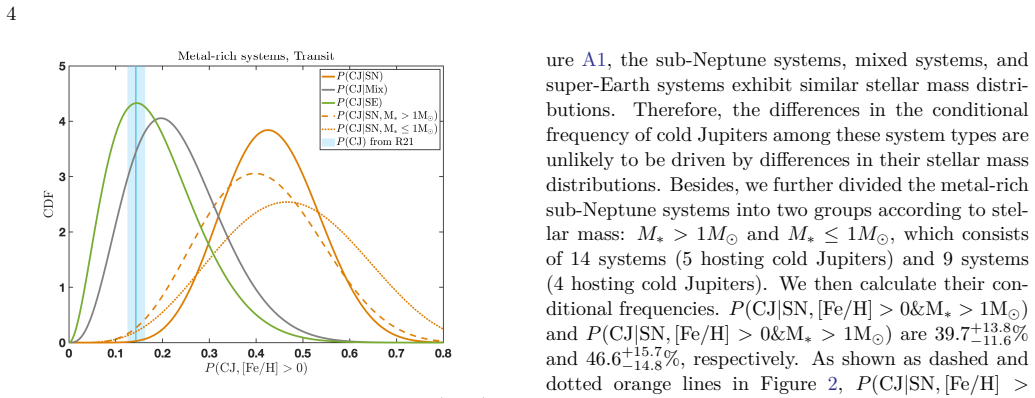
Around transiting metal-rich stars, P(CJ|SN, [Fe/H]>0) equals 42.6^{+10.6}_{-9.9} percent while P(CJ|SE, [Fe/H]>0) equals 14.5^{+12.7}_{-6.9} percent; the former exceeds the field giant frequency and yields a positive correlation at 99.95 percent , whereas the latter matches the field rate and shows no correlation. A homogeneous Kepler-Keck subsample and radial-velocity data for massive inner planets reproduce the same contrast. Metal-rich disks are expected to produce both outer cold Jupiters and inner planets with larger radii and masses more efficiently.
What carries the argument
Conditional occurrence rates P(CJ|SN) and P(CJ|SE) of cold Jupiters given only inner sub-Neptunes or only super-Earths, evaluated separately for stars with [Fe/H] greater than zero.
If this is right
- Metal-rich systems with inner sub-Neptunes host cold Jupiters at roughly three times the rate of super-Earth systems.
- Stellar metallicity shapes the joint occurrence of outer cold Jupiters and larger inner planets.
- The radius valley separates populations whose outer companions follow different statistical relations.
- The contrast persists in a homogeneous Kepler-Keck subsample and in radial-velocity detections of massive inner planets.
- Metal-rich disks form both cold Jupiters and inner planets above the valley more efficiently than metal-poor disks.
Where Pith is reading between the lines
- Planet-formation models should tie the efficiency of both inner sub-Neptune growth and outer giant formation to the same disk metallicity parameter.
- Targeted radial-velocity monitoring of known sub-Neptunes around metal-rich stars offers a higher-yield search strategy for cold Jupiters than blind surveys.
- The lack of correlation for super-Earths may indicate that they form after the disk has lost much of its solid material, reducing the chance of giant-planet formation.
- Extending the same conditional-probability test to stars with [Fe/H] below zero could reveal whether the correlation reverses or disappears at low metallicity.
Load-bearing premise
The transiting and radial-velocity samples are free of selection biases that would preferentially detect cold Jupiters around sub-Neptune hosts or misclassify planets near the radius valley, and the metallicity cut cleanly separates distinct formation regimes.
What would settle it
A larger, bias-controlled sample of metal-rich stars in which the cold-Jupiter rate is statistically indistinguishable between sub-Neptune hosts and super-Earth hosts would falsify the reported difference in correlations.
Figures



read the original abstract
Correlations between the inner small planets and cold giants encodes the formation and evolution of planetary systems. It remains unclear if the correlation differs on the two sides of the radius valley. In this work, we compute the conditional frequency of cold Jupiters in systems with only inner sub-Neptunes $P(\rm CJ|SN)$ and those with only inner super-Earths $P(\rm CJ|SE)$. We find that, around transiting sample around metal-rich stars, $P(\rm CJ|SN, [Fe/H]>0)$ and $P(\rm CJ|SE, [Fe/H]>0)$ are $42.6^{+10.6}_{-9.9}\%$ and $14.5^{+12.7}_{-6.9}\%$. Comparing with the field giant frequency ($14.3^{+2.0}_{-1.8}\%$), we show that inner sub-Neptunes and cold Jupiters exhibit a significant positive correlation for metal-rich systems with a confidence level of 99.95\%, whereas this correlation is absent for systems with super-Earths. We also consider a homogeneous Kepler-Keck subsample and derive similar results, with $P(\rm CJ|SN, [Fe/H]>0)$ of $45.8^{+18.6}_{-16.3}\%$ and $P(\rm CJ|SE, [Fe/H]>0)$ of $13.3^{+17.0}_{-6.8}\%$. Radial velocity sample shows consistent results, with metal-rich systems hosting massive inner planets exhibiting a strong positive correlation (confidence level of 99.11\%) with outer cold Jupiters ($P(\rm CJ|M_{p}>10M_\oplus, [Fe/H]>0) = 34.6^{+11.0}_{-9.1}\%$). These results can be naturally understood since metal-rich disks are expected to more efficiently produce both outer cold Jupiters and inner planets with larger radii and masses. Our findings highlight the critical role of stellar metallicity in shaping planetary architectures, particularly for large/massive planets.
Editorial analysis
A structured set of objections, weighed in public.
Referee Report
Summary. The paper computes empirical conditional probabilities of hosting cold Jupiters (CJ) given only inner sub-Neptunes (SN) versus only inner super-Earths (SE) in metal-rich ([Fe/H]>0) stars, using Kepler transiting and radial-velocity samples. It reports P(CJ|SN, [Fe/H]>0) = 42.6^{+10.6}_{-9.9}% (significantly above the field rate of 14.3^{+2.0}_{-1.8}%) versus P(CJ|SE, [Fe/H]>0) = 14.5^{+12.7}_{-6.9}%, claiming 99.95% confidence for a positive SN-CJ correlation only in metal-rich systems; analogous results hold in a homogeneous Kepler-Keck subsample and for massive inner planets (M_p > 10 M_⊕) in the RV sample. The findings are interpreted as evidence that metal-rich disks efficiently form both larger inner planets and outer cold giants.
Significance. If the conditional frequencies prove robust, the result supplies direct observational support for metallicity as a key driver of planetary architecture, linking inner-planet radius/mass to outer-giant occurrence and thereby constraining core-accretion plus migration scenarios. The consistency across independent samples (full transit, homogeneous transit, RV) and the strictly empirical (non-parametric) approach are strengths that would make the work a useful reference for formation studies.
major comments (3)
- [Sample definition and conditional-probability calculation] The partitioning of the transiting sample into 'only SN' versus 'only SE' systems (used to obtain the quoted P(CJ|SN, [Fe/H]>0) and P(CJ|SE, [Fe/H]>0)) must demonstrate that radius-valley misclassification near 1.6–2 R_⊕ and the presence of mixed systems do not differentially affect the two subsamples; any such leakage would directly bias the reported 99.95% confidence difference.
- [Statistical methods and results] The derivation of the 99.95% confidence level (and the asymmetric uncertainties on all quoted percentages) is not fully specified; the manuscript must show whether binomial statistics, bootstrap resampling, or Monte Carlo trials were used and whether they incorporate possible covariance between inner-planet transit detectability and outer-planet RV sensitivity once [Fe/H] is fixed.
- [Discussion of observational biases] Potential selection bias arising from metallicity-dependent completeness in the Kepler survey or from differing RV follow-up cadences for SN versus SE hosts is not quantified; if stars with detectable sub-Neptunes receive systematically more intensive giant-planet monitoring, the elevated P(CJ|SN, [Fe/H]>0) could be partly artificial.
minor comments (2)
- [Throughout] The exact period and mass cuts defining 'cold Jupiters' and the precise [Fe/H] threshold should be restated in the main text (not only the abstract) for reproducibility.
- [Results] Table or figure presenting the raw counts (number of SN hosts with/without CJ, etc.) for each metallicity bin would allow readers to verify the conditional frequencies directly.
Simulated Author's Rebuttal
We thank the referee for their thoughtful and constructive comments, which have prompted us to strengthen the clarity and robustness of our analysis. We respond point-by-point to the major comments below.
read point-by-point responses
-
Referee: The partitioning of the transiting sample into 'only SN' versus 'only SE' systems (used to obtain the quoted P(CJ|SN, [Fe/H]>0) and P(CJ|SE, [Fe/H]>0)) must demonstrate that radius-valley misclassification near 1.6–2 R_⊕ and the presence of mixed systems do not differentially affect the two subsamples; any such leakage would directly bias the reported 99.95% confidence difference.
Authors: We define 'only SN' systems as those with at least one transiting planet in 1.6–4 R_⊕ and none in 1–1.6 R_⊕ (and symmetrically for 'only SE'), explicitly excluding mixed systems from both subsamples. To test radius-valley sensitivity, we re-ran the analysis with boundaries shifted to 1.5 R_⊕ and 1.7 R_⊕; the conditional probabilities shift by <5% and the 99.95% significance is preserved. We will add these robustness tests, including a new figure, to the revised methods section. revision: yes
-
Referee: The derivation of the 99.95% confidence level (and the asymmetric uncertainties on all quoted percentages) is not fully specified; the manuscript must show whether binomial statistics, bootstrap resampling, or Monte Carlo trials were used and whether they incorporate possible covariance between inner-planet transit detectability and outer-planet RV sensitivity once [Fe/H] is fixed.
Authors: The 99.95% level was computed via 10,000 Monte Carlo draws from binomial posteriors on the CJ counts in each subsample, taking the fraction of trials where P(CJ|SN, [Fe/H]>0) exceeds the field rate; asymmetric uncertainties are the 16–84 percentiles of the resulting distribution. Because CJ detections are from independent RV surveys and we condition on [Fe/H], covariance with Kepler transit sensitivity is expected to be negligible. We will expand the statistical methods section with the full procedure and pseudocode. revision: yes
-
Referee: Potential selection bias arising from metallicity-dependent completeness in the Kepler survey or from differing RV follow-up cadences for SN versus SE hosts is not quantified; if stars with detectable sub-Neptunes receive systematically more intensive giant-planet monitoring, the elevated P(CJ|SN, [Fe/H]>0) could be partly artificial.
Authors: Kepler completeness versus metallicity is already incorporated via the occurrence-rate literature we cite, and we compute all quantities inside fixed [Fe/H] bins. RV monitoring for cold Jupiters is drawn from unbiased long-term surveys that do not condition on inner-planet type; the same RV catalog is used for both subsamples. Results remain consistent in the homogeneous Kepler-Keck subsample with uniform follow-up. We will add a quantitative bias estimate in the discussion using published completeness curves, showing the effect is at most a few percent. revision: partial
Circularity Check
No circularity: empirical conditional probabilities computed directly from observed samples
full rationale
The paper's central results are direct empirical frequencies P(CJ|SN, [Fe/H]>0) = 42.6% etc. obtained by partitioning the Kepler transiting sample and RV follow-up detections into disjoint categories (only sub-Neptunes vs. only super-Earths) and counting cold-Jupiter occurrences within each bin. No equations, fitted parameters, or models are defined in terms of the target probabilities and then reused to 'predict' them. No self-citation chain, uniqueness theorem, or ansatz is invoked to justify the partitioning or the final confidence levels. The derivation is therefore a straightforward statistical summary of external data and remains self-contained.
Axiom & Free-Parameter Ledger
free parameters (1)
- [Fe/H]>0 metallicity threshold
Lean theorems connected to this paper
-
IndisputableMonolith/Cost/FunctionalEquation.leanwashburn_uniqueness_aczel unclear?
unclearRelation between the paper passage and the cited Recognition theorem.
We model the detections using binomial statistics and adopt a flat prior... f(P;a,b)=1/B(a,b) P^{a-1}(1-P)^{b-1}
-
IndisputableMonolith/Foundation/RealityFromDistinction.leanreality_from_one_distinction unclear?
unclearRelation between the paper passage and the cited Recognition theorem.
metal-rich disks are expected to more efficiently produce both outer cold Jupiters and inner planets with larger radii and masses
What do these tags mean?
- matches
- The paper's claim is directly supported by a theorem in the formal canon.
- supports
- The theorem supports part of the paper's argument, but the paper may add assumptions or extra steps.
- extends
- The paper goes beyond the formal theorem; the theorem is a base layer rather than the whole result.
- uses
- The paper appears to rely on the theorem as machinery.
- contradicts
- The paper's claim conflicts with a theorem or certificate in the canon.
- unclear
- Pith found a possible connection, but the passage is too broad, indirect, or ambiguous to say the theorem truly supports the claim.
Reference graph
Works this paper leans on
-
[1]
Weiss, L. M. 2020, AJ, 160, 108, doi: 10.3847/1538-3881/aba18a
-
[2]
2023, A&A, 674, A178, doi: 10.1051/0004-6361/202245040
Bitsch, B., & Izidoro, A. 2023, A&A, 674, A178, doi: 10.1051/0004-6361/202245040
-
[3]
S., Naponiello, L., Pezzetta, E., et al
Bonomo, A. S., Naponiello, L., Pezzetta, E., et al. 2025, A&A, 700, A126, doi: 10.1051/0004-6361/202452523
-
[4]
No excess of cold Jupiters in small planet systems
Bonomo, A. S., Dumusque, X., Massa, A., et al. 2023, A&A, 677, A33, doi: 10.1051/0004-6361/202346211
-
[5]
Bryan, M. L., Knutson, H. A., Lee, E. J., et al. 2019, AJ, 157, 52, doi: 10.3847/1538-3881/aaf57f
-
[6]
Bryan, M. L., & Lee, E. J. 2024, ApJL, 968, L25, doi: 10.3847/2041-8213/ad5013
-
[7]
Bryan, M. L., & Lee, E. J. 2025, ApJL, 982, L7, doi: 10.3847/2041-8213/adb0bd
-
[8]
2024b, Nature Astronomy, 8, 463, doi: 10.1038/s41550-023-02183-7
Burn, R., Mordasini, C., Mishra, L., et al. 2024, Nature Astronomy, 8, 463, doi: 10.1038/s41550-023-02183-7
-
[9]
Chachan, Y., & Lee, E. J. 2023, ApJL, 952, L20, doi: 10.3847/2041-8213/ace257
-
[10]
2025, A&A, 701, A94, doi: 10.1051/0004-6361/202555380
Chen, D.-C., Mordasini, C., Emsenhuber, A., et al. 2025, A&A, 701, A94, doi: 10.1051/0004-6361/202555380
-
[11]
2022, AJ, 163, 249, doi: 10.3847/1538-3881/ac641f
Chen, D.-C., Xie, J.-W., Zhou, J.-L., et al. 2022, AJ, 163, 249, doi: 10.3847/1538-3881/ac641f
-
[12]
Chen, D.-C., Xie, J.-W., Zhou, J.-L., et al. 2023, Proceedings of the National Academy of Science, 120, e2304179120, doi: 10.1073/pnas.2304179120
-
[13]
2023, The European Physical Journal Plus, 138, 181, doi: 10.1140/epjp/s13360-023-03784-x 17
Emsenhuber, A., Mordasini, C., & Burn, R. 2023, European Physical Journal Plus, 138, 181, doi: 10.1140/epjp/s13360-023-03784-x
-
[14]
2021, A&A, 656, A69, doi: 10.1051/0004-6361/202038553
Emsenhuber, A., Mordasini, C., Burn, R., et al. 2021, A&A, 656, A69, doi: 10.1051/0004-6361/202038553
-
[15]
Fischer, D. A., & Valenti, J. 2005, ApJ, 622, 1102, doi: 10.1086/428383
-
[16]
Fulton, B. J., Petigura, E. A., Howard, A. W., et al. 2017, AJ, 154, 109, doi: 10.3847/1538-3881/aa80eb
-
[17]
2024, Chinese Journal of Space Science, 44, 400, doi: 10.11728/cjss2024.03.yg05
Ge, J., Chen, W., Chen, Y., et al. 2024, Chinese Journal of Space Science, 44, 400, doi: 10.11728/cjss2024.03.yg05
-
[18]
Ginzburg, S., Schlichting, H. E., & Sari, R. 2016, ApJ, 825, 29, doi: 10.3847/0004-637X/825/1/29
-
[19]
Ginzburg, S., Schlichting, H. E., & Sari, R. 2018, MNRAS, 476, 759, doi: 10.1093/mnras/sty290 10
-
[20]
Schlichting, H. E. 2024, MNRAS, 531, 3698, doi: 10.1093/mnras/stae1376
-
[21]
Ho, C. S. K., & Van Eylen, V. 2023, MNRAS, 519, 4056, doi: 10.1093/mnras/stac3802
-
[22]
2018, ApJ, 853, 163, doi: 10.3847/1538-4357/aa9f1e
Jin, S., & Mordasini, C. 2018, ApJ, 853, 163, doi: 10.3847/1538-4357/aa9f1e
-
[23]
Johnson, J. A., Aller, K. M., Howard, A. W., & Crepp, J. R. 2010, PASP, 122, 905, doi: 10.1086/655775
-
[24]
Lammers, C., & Winn, J. N. 2026, AJ, 171, 18, doi: 10.3847/1538-3881/ae21de
-
[25]
Lee, E. J., & Connors, N. J. 2021, ApJ, 908, 32, doi: 10.3847/1538-4357/abd6c7
-
[26]
Lopez, E. D., & Fortney, J. J. 2013, ApJ, 776, 2, doi: 10.1088/0004-637X/776/1/2
-
[27]
Lopez, E. D., & Fortney, J. J. 2014, ApJ, 792, 1, doi: 10.1088/0004-637X/792/1/1
-
[28]
Mayor, M., Marmier, M., Lovis, C., et al. 2011, arXiv e-prints, arXiv:1109.2497, doi: 10.48550/arXiv.1109.2497
-
[29]
2012b, A&A, 547, A111, doi: 10.1051/0004-6361/201118457
Mordasini, C., Alibert, Y., Klahr, H., & Henning, T. 2012, A&A, 547, A111, doi: 10.1051/0004-6361/201118457
-
[30]
D., Pascucci, I., Apai, D., & Ciesla, F
Mulders, G. D., Pascucci, I., Apai, D., & Ciesla, F. J. 2018, AJ, 156, 24, doi: 10.3847/1538-3881/aac5ea
-
[31]
Owen, J. E., & Murray-Clay, R. 2018, MNRAS, 480, 2206, doi: 10.1093/mnras/sty1943
-
[32]
Owen, J. E., & Wu, Y. 2013, ApJ, 775, 105, doi: 10.1088/0004-637X/775/2/105
-
[33]
Owen, J. E., & Wu, Y. 2017, ApJ, 847, 29, doi: 10.3847/1538-4357/aa890a
-
[34]
2014, Experimental Astronomy, 38, 249, doi: 10.1007/s10686-014-9383-4
Rauer, H., Catala, C., Aerts, C., et al. 2014, Experimental Astronomy, 38, 249, doi: 10.1007/s10686-014-9383-4
-
[35]
Rosenthal, L. J., Fulton, B. J., Hirsch, L. A., et al. 2021, ApJS, 255, 8, doi: 10.3847/1538-4365/abe23c
-
[36]
Rosenthal, L. J., Knutson, H. A., Chachan, Y., et al. 2022, ApJS, 262, 1, doi: 10.3847/1538-4365/ac7230 Van Eylen, V., Agentoft, C., Lundkvist, M. S., et al. 2018, MNRAS, 479, 4786, doi: 10.1093/mnras/sty1783
-
[37]
Venturini, J., Guilera, O. M., Haldemann, J., Ronco, M. P., & Mordasini, C. 2020, A&A, 643, L1, doi: 10.1051/0004-6361/202039141
-
[38]
Weiss, L. M., Isaacson, H., Howard, A. W., et al. 2024, ApJS, 270, 8, doi: 10.3847/1538-4365/ad0cab
-
[39]
Proceedings of the National Academy of Science , keywords =
Zeng, L., Jacobsen, S. B., Sasselov, D. D., et al. 2019, Proceedings of the National Academy of Science, 116, 9723, doi: 10.1073/pnas.1812905116
-
[40]
2019, ApJ, 873, 8, doi: 10.3847/1538-4357/ab0205
Zhu, W. 2019, ApJ, 873, 8, doi: 10.3847/1538-4357/ab0205
-
[41]
2022, AJ, 164, 5, doi: 10.3847/1538-3881/ac6f59
Zhu, W. 2022, AJ, 164, 5, doi: 10.3847/1538-3881/ac6f59
-
[42]
2024, Research in Astronomy and Astrophysics, 24, 045013, doi: 10.1088/1674-4527/ad3132
Zhu, W. 2024, Research in Astronomy and Astrophysics, 24, 045013, doi: 10.1088/1674-4527/ad3132
-
[43]
2018, ApJ, 860, 101, doi: 10.3847/1538-4357/aac6d5
Zhu, W., Petrovich, C., Wu, Y., Dong, S., & Xie, J. 2018, ApJ, 860, 101, doi: 10.3847/1538-4357/aac6d5
-
[44]
2018, AJ, 156, 92, doi: 10.3847/1538-3881/aad22a
Zhu, W., & Wu, Y. 2018, AJ, 156, 92, doi: 10.3847/1538-3881/aad22a
discussion (0)
Sign in with ORCID, Apple, or X to comment. Anyone can read and Pith papers without signing in.