Recognition: unknown
Convex Duality in Perturbed Utility Route Choice
Pith reviewed 2026-05-09 23:17 UTC · model grok-4.3
The pith
The constrained utility maximization problem in perturbed route choice admits an unconstrained concave dual with a differentiable objective.
A machine-rendered reading of the paper's core claim, the machinery that carries it, and where it could break.
Core claim
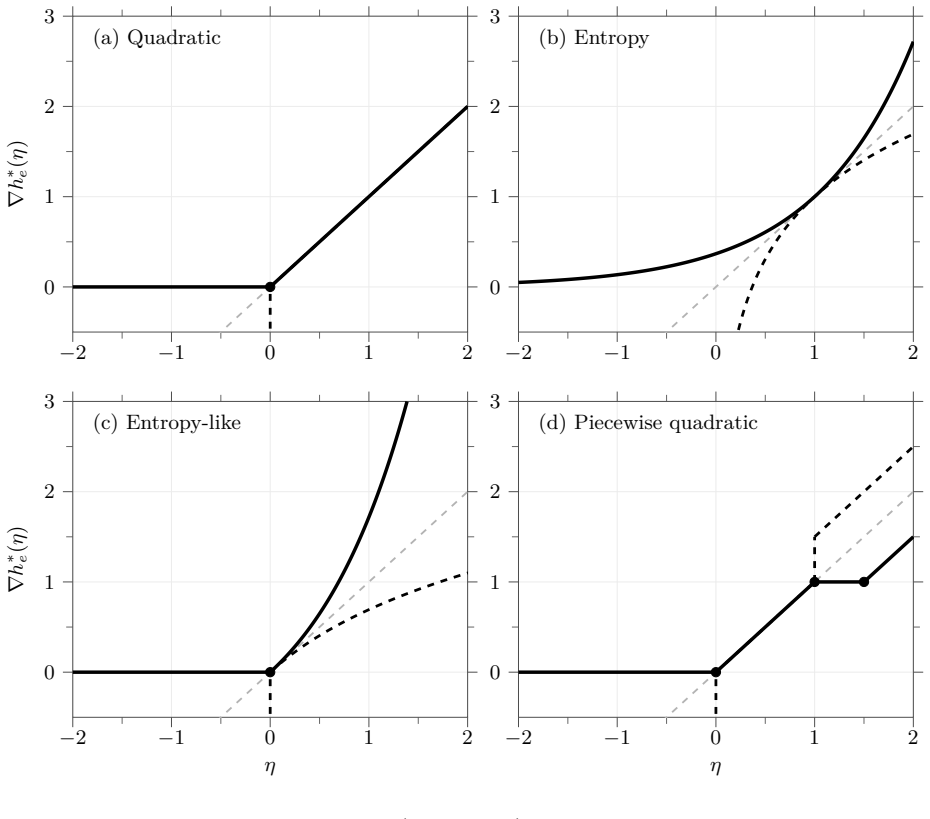
The traveler's constrained, potentially non-smooth utility maximization problem admits a dual formulation: an unconstrained concave maximization problem with a differentiable objective. The unique optimal flow can be recovered link-by-link from any dual solution via the convex conjugates of link perturbation functions.
What carries the argument
The convex dual formulation that converts the primal constrained maximization into an unconstrained concave maximization whose solutions recover primal flows via convex conjugates of the link perturbation functions.
If this is right
- Gradient-based optimization becomes applicable to large-scale networks without explicit constraint handling.
- Sensitivity analysis with respect to parameters can be performed rapidly using derivatives of the dual objective.
- The model exhibits a structural analogy to current flow in electrical circuits.
- Optimal flows are unique and can be obtained directly from any dual optimum on a link-by-link basis.
Where Pith is reading between the lines
- The same duality approach could be tested on other network-based choice models that share the convex perturbation structure.
- Numerical implementations might benefit from warm-starting the dual solver when network parameters change slightly.
- The circuit analogy suggests that iterative methods borrowed from electrical network analysis could accelerate convergence on very large graphs.
Load-bearing premise
The link perturbation functions are convex and satisfy the conditions that allow convex conjugates to exist and recover the unique primal solution.
What would settle it
On a small test network with explicit convex perturbation functions, compute a dual solution, recover the candidate flows via the conjugates, and verify whether those flows achieve the original constrained utility maximum and satisfy all flow-conservation constraints.
Figures



read the original abstract
This paper develops a highly general convex duality framework for the perturbed utility route choice (PURC) model. We show that the traveler's constrained, potentially non-smooth utility maximization problem admits a dual formulation: an unconstrained concave maximization problem with a differentiable objective. The unique optimal flow can be recovered link-by-link from any dual solution via the convex conjugates of link perturbation functions. These properties enable efficient gradient-based optimization for large-scale networks and fast computation for sensitivity analysis. Finally, the framework reveals a structural analogy between PURC and current flow in electrical circuits.
Editorial analysis
A structured set of objections, weighed in public.
Referee Report
Summary. The paper develops a convex duality framework for the perturbed utility route choice (PURC) model. It establishes that the traveler's constrained, potentially non-smooth utility maximization problem admits a dual formulation as an unconstrained concave maximization problem whose objective is differentiable. The unique optimal flow is recoverable link-by-link from any dual solution via the convex conjugates of the link perturbation functions. These properties support efficient gradient-based optimization on large networks, fast sensitivity analysis, and reveal a structural analogy between PURC and current flow in electrical circuits.
Significance. If the stated duality, differentiability, and single-valued recovery properties hold under the paper's assumptions, the work offers a useful theoretical tool for transportation economics and network modeling. Transforming a constrained non-smooth primal into an unconstrained differentiable dual enables scalable computation and sensitivity analysis on large networks, which are practically important. The explicit use of convex conjugates for link-wise recovery and the circuit analogy are strengths that could facilitate further applications and cross-field connections.
major comments (1)
- Abstract and main duality theorems: The central claims state that the dual objective is differentiable and that the optimal flow is uniquely recoverable link-by-link from any dual solution via convex conjugates. In standard convex analysis, the conjugate f* is differentiable at y precisely when the argmax defining it is unique, which holds if the perturbation function is strictly convex (or satisfies equivalent conditions yielding a singleton subdifferential). The abstract and reader's weakest assumption indicate only convexity of the link perturbation functions. If the theorems assume only convexity without strict convexity or equivalent conditions ensuring unique argmax, the dual need not be differentiable everywhere and recovery may be set-valued rather than single-valued. This directly affects the gradient-based optimization and 'from any dual solution' recovery guarantees. Please (i
Simulated Author's Rebuttal
We thank the referee for their careful reading and valuable comments on the assumptions underlying our convex duality results. We address the major comment below and have revised the manuscript to clarify the conditions required for differentiability and unique recovery.
read point-by-point responses
-
Referee: Abstract and main duality theorems: The central claims state that the dual objective is differentiable and that the optimal flow is uniquely recoverable link-by-link from any dual solution via convex conjugates. In standard convex analysis, the conjugate f* is differentiable at y precisely when the argmax defining it is unique, which holds if the perturbation function is strictly convex (or satisfies equivalent conditions yielding a singleton subdifferential). The abstract and reader's weakest assumption indicate only convexity of the link perturbation functions. If the theorems assume only convexity without strict convexity or equivalent conditions ensuring unique argmax, the dual need not be differentiable everywhere and recovery may be set-valued rather than single-valued. This directly affects the gradient-based optimization and 'from any dual solution' recovery guarantees. Please (i
Authors: We agree with the referee's observation from convex analysis: differentiability of the conjugate (and thus of the dual objective) and single-valuedness of the argmax require strict convexity (or equivalent conditions such as strong convexity or a singleton subdifferential). Our manuscript states convexity of the link perturbation functions as the baseline assumption in the abstract and introduction, but the main duality theorems (e.g., Theorems 3.1–3.3) and the recovery result rely on the stronger condition to guarantee the claimed properties everywhere. We will revise the abstract, Section 2, and the theorem statements to explicitly require strict convexity of the perturbation functions. We will also add a remark noting that under mere convexity the dual objective is concave and subdifferentiable but may fail to be differentiable at some points, with recovery becoming set-valued. These changes make the assumptions precise without altering the core results, which hold under the strengthened hypothesis. The revisions have been incorporated in the updated manuscript. revision: yes
Circularity Check
No circularity: standard convex duality derivation from primal assumptions
full rationale
The paper presents a convex duality framework for the PURC model, deriving an unconstrained concave dual maximization problem with differentiable objective from the traveler's constrained utility maximization via convex conjugates of link perturbation functions. This follows directly from standard convex analysis under the stated convexity assumptions on perturbations, without any self-definitional loops, fitted parameters renamed as predictions, or load-bearing self-citations that reduce the central claim to its own inputs. The unique flow recovery is a consequence of the conjugate properties under the paper's technical conditions, not a tautology. The derivation chain is self-contained as mathematical application rather than circular.
Axiom & Free-Parameter Ledger
axioms (1)
- domain assumption Link perturbation functions are convex and admit convex conjugates that recover the primal solution.
Reference graph
Works this paper leans on
-
[1]
Almost everywhere existence of the second differential of a convex function and some properties of convex surfaces connected with it,
Aleksandrov, A. D.(1939): “Almost everywhere existence of the second differential of a convex function and some properties of convex surfaces connected with it,”Uchenye Zapiski Leningrad Gos. Univ., Math. Ser, 6, 3–35
1939
-
[2]
Identification with additively separable heterogeneity,
Allen, R. and J. Rehbeck(2019): “Identification with additively separable heterogeneity,” Econometrica, 87, 1021–1054
2019
-
[3]
Hicksian complementarity and perturbed utility models,
——— (2020): “Hicksian complementarity and perturbed utility models,”Economic Theory Bulletin, 8, 245–261
2020
-
[4]
Markovian traffic equilibrium,
Baillon, J. B. and R. Cominetti(2008): “Markovian traffic equilibrium,”Mathematical Programming, 111, 33–56
2008
-
[5]
Alternatives to Dial’s logit assignment algorithm,
Bell, M. G.(1995): “Alternatives to Dial’s logit assignment algorithm,”Transportation Research Part B, 29, 287–295
1995
-
[6]
Activity Based Travel Demand Model Systems,
Ben-Akiva, M. E. and J. L. Bowman(1998): “Activity Based Travel Demand Model Systems,” inEquilibrium and Advanced Transportation Modelling, ed. by P. Marcotte and S. Nguyen, Boston, MA: Springer US, 27–46
1998
-
[7]
8, Athena Scientific
Bertsekas, D.(1998):Network Optimization: Continuous and Discrete Models, vol. 8, Athena Scientific. [5, 10] ——— (2009):Convex Optimization Theory, vol. 1, Athena Scientific
1998
-
[8]
Learning with Fenchel-Young losses,
Blondel, M., A. F. T. Martins, and V. Niculae(2020): “Learning with Fenchel-Young losses,”Journal of Machine Learning Research, 21, 1–69
2020
-
[9]
The relaxation method of finding the common point of convex sets and its application to the solution of problems in convex programming,
Bregman, L.(1967): “The relaxation method of finding the common point of convex sets and its application to the solution of problems in convex programming,”USSR Computational Mathematics and Mathematical Physics, 7, 200–217
1967
-
[10]
Transit Assignment for Congested Public Trans- port Systems: An Equilibrium Model,
de Cea, J. and E. Fernández(1993): “Transit Assignment for Congested Public Trans- port Systems: An Equilibrium Model,”Transportation Science, 27, 133–147, publisher: INFORMS
1993
-
[11]
A probabilistic multipath traffic assignment algorithm which obviates path enumeration,
Dial, R. B.(1971): “A probabilistic multipath traffic assignment algorithm which obviates path enumeration,”Transportation Research, 5, 83–111
1971
-
[12]
A link based network route choice model with unrestricted choice set,
29 Fosgerau, M., E. Frejinger, and A. Karlstrom(2013): “A link based network route choice model with unrestricted choice set,”Transportation Research Part B: Methodological, 56, 70–80
2013
-
[13]
Bikeability and the induced demand for cycling,
Fosgerau, M., M. Łukawska, M. Paulsen, and T. K. Rasmussen(2023): “Bikeability and the induced demand for cycling,”Proceedings of the National Academy of Sciences, 120, e2220515120. [2, 4, 6, 8] Fosgerau, M. and D. L. McF adden(2012): “A theory of the perturbed consumer with general budgets,”NBER Working Paper, 1–27, publisher: National Bureau of Economic...
2023
-
[14]
Sensitivity Analysis of the Perturbed Utility Stochastic Traffic Equilibrium,
Fosgerau, M., N. Nielsen, M. Paulsen, T. K. Rasmussen, and R. Yao(2025): “Sensitivity Analysis of the Perturbed Utility Stochastic Traffic Equilibrium,” . [3, 4, 21, 22] Fosgerau, M., M. Paulsen, and T. K. Rasmussen(2022): “A perturbed utility route choice model,”Transportation Research Part C: Emerging Technologies, 136, 103514. [2, 4, 8] Fosgerau, M., R...
2025
-
[15]
Stochastic Choice and Revealed Perturbed Utility,
Fudenberg, D., R. Iijima, and T. Strzalecki(2015): “Stochastic Choice and Revealed Perturbed Utility,”Econometrica, 83, 2371–2409
2015
-
[16]
Hiriart-Urruty, J.-B. and C. Lemaréchal(2004):Fundamentals of Convex Analysis, Springer Science & Business Media
2004
-
[17]
On the global convergence of stochastic fictitious play,
Hofbauer, J. and W. H. Sandholm(2002): “On the global convergence of stochastic fictitious play,”Econometrica, 70, 2265–2294
2002
-
[18]
Classical descriptive set theory,
Kechris, A. S.(1995): “Classical descriptive set theory,” inClassical descriptive set theory, New York, NY: Springer New York, Graduate texts in mathematics, 156, 1st ed
1995
-
[19]
A method of integrating correlation structures for a generalized recursive route choice model,
Mai, T.(2016): “A method of integrating correlation structures for a generalized recursive route choice model,”Transportation Research Part B: Methodological, 93, 146–161
2016
-
[20]
Econometric Models of Probabilistic Choice,
McF adden, D.(1981): “Econometric Models of Probabilistic Choice,” inStructural Analysis of Discrete Data with Econometric Applications, ed. by C. Manski and D. McFadden, Cambridge, MA, USA: MIT Press, 198–272, iSSN: 00219398
1981
-
[21]
137, Springer
Nesterov, Y.(2018):Lectures on convex optimization, vol. 137, Springer
2018
-
[22]
Markovian traffic equilibrium assign- ment based on network generalized extreme value model,
Oyama, Y., Y. Hara, and T. Akamatsu(2022): “Markovian traffic equilibrium assign- ment based on network generalized extreme value model,”Transportation Research Part B: Methodological, 155, 135–159
2022
-
[23]
Sensitivity Analysis of Aggregated Variational Inequality Problems, with Application to Traffic Equilibria,
Patriksson, M. and R. T. Rockafellar(2003): “Sensitivity Analysis of Aggregated Variational Inequality Problems, with Application to Traffic Equilibria,”Transportation Science, 37, 56–68, publisher: INFORMS
2003
-
[24]
Route choice modeling: Past, present and future research directions,
Prato, C. G.(2009): “Route choice modeling: Past, present and future research directions,” Journal of Choice Modelling, 2, 65–100, iSBN: 1755-5345. [2, 4] Ran, B. and D. Boyce(1996):Modeling Dynamic Transportation Networks, Berlin, Heidelberg: Springer
2009
-
[25]
Estimating the Number of s-t Paths in a Graph,
Roberts, B. and D. Kroese(2007): “Estimating the Number of s-t Paths in a Graph,” Journal of Graph Algorithms and Applications, 11, 195–214
2007
-
[26]
Computation of Equilibrium Over Transportation Networks: The Case of Disaggregate Demand Models,
Rockafellar, R. T.(1970):Convex Analysis, vol. 28, Princeton University Press. [11, 14, 20, 33, 34, 35, 36, 37, 38] ——— (1984):Network Flows and Monotropic Optimization, John Wiley & Sons. [2, 3, 5, 6, 14, 16] Sheffi, Y. and C. F. Daganzo(1980): “Computation of Equilibrium Over Transportation Networks: The Case of Disaggregate Demand Models,”Transportatio...
1970
-
[27]
Cyclic flows, Markov process and stochastic traffic assignment,
31 Shen, W., H. M. Zhang, and T. Akamatsu(1996): “Cyclic flows, Markov process and stochastic traffic assignment,”Transportation Research Record, 30, 1–34, iSBN: 0191-2615
1996
-
[28]
Small, K. A. and E. T. Verhoef(2007):Urban transportation economics, London and New York: Harwood Academic Publishers
2007
-
[29]
How McFadden met Rockafellar and learned to do more with less,
Sørensen, J. R.-V. and M. Fosgerau(2022): “How McFadden met Rockafellar and learned to do more with less,”Journal of Mathematical Economics, 100, 102629
2022
-
[30]
Sensitivity Analysis for Equilibrium Network Flow,
Tobin, R. L. and T. L. Friesz(1988): “Sensitivity Analysis for Equilibrium Network Flow,”Transportation Science, 22, 242–250, publisher: INFORMS
1988
-
[31]
Traffic restraint, road pricing and network equilibrium,
Yang, H. and M. G. H. Bell(1997): “Traffic restraint, road pricing and network equilibrium,”Transportation Research Part B: Methodological, 31, 303–314
1997
-
[32]
Perturbed utility stochastic traffic assignment,
Yao, R., M. Fosgerau, M. Paulsen, and T. Rasmussen(2024): “Perturbed utility stochastic traffic assignment,”Transportation Science,
2024
-
[33]
A tutorial on recursive models for analyzing and predicting path choice behavior,
[2, 4, 8, 18] Zalinescu, C.(2002):Convex analysis in general vector spaces, World scientific. [39, 40] Zimmermann, M. and E. Frejinger(2020): “A tutorial on recursive models for analyzing and predicting path choice behavior,”EURO Journal on Transportation and Logistics, 9, 100004, arXiv:1905.00883 [stat]
-
[34]
Letf : Rn→[−∞,∞]be an extended real-valued function onRn
32 Appendices A Convex Analysis Preliminaries For easy reference, we summarize key definitions from convex analysis following Rockafellar (1970). Letf : Rn→[−∞,∞]be an extended real-valued function onRn. Theepigraphof fis epif:={(x,µ)∈Rn×R|f(x)⩽µ}, the set of points on or above the graph off. If epif is convex inRn+1, thenf isconvex. The effective domaino...
1970
-
[35]
Since the network is strongly connected, there is a positive path P :o→dfrom the traveler’s origino to the destinationd
LetLdenote the set of flows satisfying flow conservation L:={x∈RE|Ax=b}={x∈RE|Ax= b},(20) which is both closed and convex. Since the network is strongly connected, there is a positive path P :o→dfrom the traveler’s origino to the destinationd. Fix such a positive path, and define the vectorx∈RE by settingxe equal to the number of times the linke∈Eis 2The ...
1970
-
[36]
34 used when following this path
for details. 34 used when following this path. Then bothx∈Landx∈RE + = domH (Lemma 4), implying that the traveler’s problem (TP) is feasible. The problem (TP) is therefore equivalent to: Minimizef(x)over flowsx∈RE, where the objective functionfis defined onRE by f(x) :=⟨c,x⟩+H(x) +δL(x),x∈R E, andδL :RE→[0,∞]denotes the (convex) indicator ofL, defined by ...
1970
-
[37]
It follows from properness thatrf(z) =∞for eachz̸=0E, meaning thatf is closed proper convex with no (nonzero) direction of recession. Rockafellar (1970, Theorem 27.2) therefore shows that the optimal primal valuep = inff is finite and attained, and the primal optimal solution ˆX = argminf is non-empty and convex (and compact). Solution uniqueness then fol...
1970
-
[38]
Lemma 3 shows thath is closed proper convex, which implies that its conjugateh∗is closed proper convex (Rockafellar, 1970, Theorem 12.2)
Fix e∈Eand suppress thee subscript to ease notation(h := he). Lemma 3 shows thath is closed proper convex, which implies that its conjugateh∗is closed proper convex (Rockafellar, 1970, Theorem 12.2). The subdifferentials of closed proper convex conjugate pairs are inverse to each other, in thatη∈∂h(ξ)if and only ifξ∈∂h∗(η) (Rockafellar, 1970, Corollary 23...
1970
-
[39]
It follows thath is bothco-finite(Rockafellar, 1970, p
1970
-
[40]
253), which translate intoh∗beingfinite(i.e., real- valued) (Rockafellar, 1970, Corollary 13.3.1) andessentially differentiable(Rockafellar, 1970, Theorem 26.3), respectively
andessentially strictly convex(Rockafellar, 1970, p. 253), which translate intoh∗beingfinite(i.e., real- valued) (Rockafellar, 1970, Corollary 13.3.1) andessentially differentiable(Rockafellar, 1970, Theorem 26.3), respectively. Finiteness and essential differentiability yields (ordinary) 35 differentiability (Rockafellar, 1970, p. 251). We identify the d...
1970
-
[41]
Using Lemma 2 and Rockafellar (1970, Theorem 5.7), we see that(TP*) is (also implicitly) unconstrained and involves maximization of a differentiable concave criterion function
To arrive at the form in (TP*), rewrite the dual functiong at u∈RV\{d}as follows: g(u) = inf x∈RE {⟨c,x⟩+H(x) +⟨u,b−Ax⟩}=⟨b,u⟩+ inf x∈RE { c⊤x−u⊤Ax+H(x) } =⟨b,u⟩−sup x∈RE { x⊤(A⊤u−c)−H(x) } =⟨b,u⟩−H∗(A⊤u−c), where the last equality stems from the definition(2) of a conjugate. Using Lemma 2 and Rockafellar (1970, Theorem 5.7), we see that(TP*) is (also imp...
1970
-
[42]
The proof of the theorem is twofold. We first verify a weak version of Slater’s condition, which will serve as our constraint qualification, and then apply Karush- Kuhn-Tucker theory to arrive at the claimed properties. Towards Slater’s condition, recall the numberingE ={e1,e 2,...,e|E|}of the links, and the notationv(e)for the initial node of linke∈E, to...
1970
-
[43]
For the expression (8), fix an optimal dual solutionˆu∈ˆU
ThatˆU is a closed set follows from H∗being finite convex (Lemma 2), hence a continuous function (Rockafellar, 1970, Corollary 10.1.1). For the expression (8), fix an optimal dual solutionˆu∈ˆU. Again using Rockafellar (1970, Theorem 28.4) and the fact thatˆu is a Kuhn–Tucker vector for (TP), we see that the optimal flow satisfies ˆx∈argmin x∈RE L(ˆu,x), ...
1970
-
[44]
By Theorem 2,g is concave
By (9), the gradient ofg atu is∇g(u)=b−A∇H∗(A⊤u−c). By Theorem 2,g is concave. Hence, by Alexandrov’s theorem (Aleksandrov, 1939), it is almost everywhere twice differentiable. At a pointu of twice differentiability, the Hessian of gis precisely the expression in (11). Proof of Theorem
1939
-
[45]
Item (2).Consider the convex indicator δL : RE→[0,∞]of the feasibility set L in (20)
We establish Items (2), (1) and (3) in that order. Item (2).Consider the convex indicator δL : RE→[0,∞]of the feasibility set L in (20). 37 Absorbing the conservation constraint into the objective viaδL and using the definition of the conjugate, for anyc∈RE we can write p(c) = inf x∈RE {⟨c,x⟩+H(x) +δL(x)} =−sup x∈RE {⟨−c,x⟩−[H(x) +δL(x)]}=−(H+δL)∗(−c). As...
1970
-
[46]
The Banach-space formulation is convenient forhandlingweighted ℓ2 normsandtheirdualsinaunifiedway
The proof will rely on the notion of strong convexity in Banach spaces as defined in Zalinescu (2002, Section 3.5). The Banach-space formulation is convenient forhandlingweighted ℓ2 normsandtheirdualsinaunifiedway. Specifically, let ∥·∥µ: RE→R+ denote the{µe}-weightedℓ2 norm∥x∥µ:= (∑ e∈Eµe|xe|2)1/2. As∥·∥µis equivalent to the ordinary Euclidean norm(∥·∥),...
2002
discussion (0)
Sign in with ORCID, Apple, or X to comment. Anyone can read and Pith papers without signing in.