Recognition: unknown
Causal-Transformer with Adaptive Mutation-Locking for Early Prediction of Acute Kidney Injury
Pith reviewed 2026-05-10 00:56 UTC · model grok-4.3
The pith
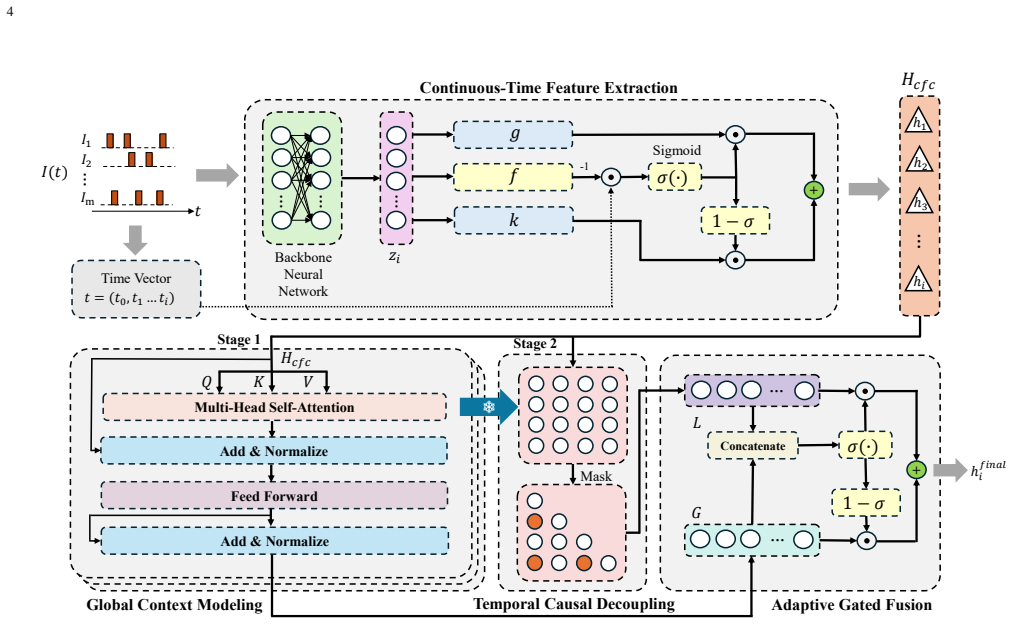
CT-Former combines continuous-time state tracking with a causal attention module to predict acute kidney injury from irregular data while outputting a directed matrix of historical causes.
A machine-rendered reading of the paper's core claim, the machinery that carries it, and where it could break.
Core claim
CT-Former shows that a transformer equipped with continuous-time evolution and a dedicated Causal-Attention module can generate a directed structural causal matrix that traces the exact historical onset of severe physiological shocks, thereby supplying native clinical interpretability together with improved accuracy over existing sequential models.
What carries the argument
The Causal-Attention module, which replaces uninterpretable hidden-state aggregation by producing a directed structural causal matrix that identifies and traces the historical causes of predicted risk.
If this is right
- Irregularly sampled data can be processed without imputation bias, yielding more reliable risk forecasts.
- Clear causal pathways appear between past anomalies and current predictions, allowing clinicians to inspect specific triggers.
- A two-stage training protocol separates optimization of the causal-fusion step from the rest of the model.
- Prediction quality exceeds that of prior sequential architectures while adding built-in traceability.
Where Pith is reading between the lines
- The same continuous-time causal structure could be tested on other irregularly sampled clinical outcomes such as sepsis or cardiac events.
- If the generated matrices consistently align with known physiology, they might help identify modifiable risk windows for targeted interventions.
- Widespread use of such native causal outputs could reduce reluctance to rely on deep models for time-sensitive decisions.
Load-bearing premise
The continuous-time state evolution mechanism follows patient trajectories without bias and the causal matrix it produces accurately identifies the true historical causes of the predicted risk.
What would settle it
A direct check showing that the historical shocks highlighted in the causal matrix do not match documented physiological events in the same patient records, or that disabling the matrix generation removes any accuracy gain.
Figures






read the original abstract
Accurate early prediction of Acute Kidney Injury (AKI) is critical for timely clinical intervention. However, existing deep learning models struggle with irregularly sampled data and suffer from the opaque "black-box" nature of sequential architectures, strictly limiting clinical trust. To address these challenges, we propose CT-Former, integrating continuous-time modeling with a Causal-Transformer. To handle data irregularity without biased artificial imputation, our framework utilizes a continuous-time state evolution mechanism to naturally track patient temporal trajectories. To resolve the black-box problem, our Causal-Attention module abandons uninterpretable hidden state aggregation. Instead, it generates a directed structural causal matrix to identify and trace the exact historical onset of severe physiological shocks. By establishing clear causal pathways between historical anomalies and current risk predictions, CT-Former provides native clinical interpretability. Training follows a decoupled two-stage protocol to optimize the causal-fusion process independently. Extensive experiments on the MIMIC-IV cohort (N=18,419) demonstrate that CT-Former significantly outperforms state-of-the-art baselines. The results confirm that our explicitly transparent architecture offers an accurate and trustworthy tool for clinical decision-making.
Editorial analysis
A structured set of objections, weighed in public.
Referee Report
Summary. The paper proposes CT-Former, a Causal-Transformer architecture that combines continuous-time state evolution with a Causal-Attention module for early AKI prediction on the MIMIC-IV cohort (N=18,419). It claims to avoid imputation bias for irregular sampling by tracking patient trajectories in continuous time and to deliver native clinical interpretability by replacing hidden-state aggregation with a directed structural causal matrix that traces historical physiological shocks. A decoupled two-stage training protocol optimizes the causal-fusion process, and experiments are reported to show significant outperformance over state-of-the-art baselines.
Significance. If the predictive gains and causal-tracing claims are rigorously validated, the work would offer a concrete step toward trustworthy, interpretable models for time-series clinical prediction, addressing both data irregularity and black-box limitations that currently hinder adoption in AKI monitoring.
major comments (2)
- [Abstract / Causal-Attention module] Abstract and Causal-Attention description: the directed structural causal matrix is generated from attention weights without any stated identifiability conditions, causal regularization, or validation against known physiological graphs or intervention data; attention matrices remain correlational, so the claim that the matrix 'identifies and traces the exact historical onset of severe physiological shocks' is not secured and directly weakens the native-interpretability advantage.
- [Abstract / continuous-time state evolution mechanism] Continuous-time state evolution claim: the mechanism is asserted to track trajectories 'without biased artificial imputation,' yet no sensitivity analysis to missingness patterns, comparison against ground-truth trajectories, or ablation isolating the continuous-time component versus discrete baselines is referenced; this leaves the no-bias assertion unverified on the irregularly sampled MIMIC-IV data.
minor comments (1)
- [Abstract] The abstract states 'significantly outperforms' without any numerical metrics, baseline names, or statistical test details; these should be summarized with effect sizes and p-values even in the abstract for immediate assessment.
Simulated Author's Rebuttal
We thank the referee for the constructive feedback on our manuscript. We address each major comment below with our responses and indicate the revisions we will incorporate to improve clarity and rigor.
read point-by-point responses
-
Referee: Abstract and Causal-Attention description: the directed structural causal matrix is generated from attention weights without any stated identifiability conditions, causal regularization, or validation against known physiological graphs or intervention data; attention matrices remain correlational, so the claim that the matrix 'identifies and traces the exact historical onset of severe physiological shocks' is not secured and directly weakens the native-interpretability advantage.
Authors: We acknowledge that attention weights capture statistical dependencies rather than satisfying formal identifiability conditions for causality. The Causal-Attention module replaces opaque hidden-state aggregation with an explicit directed matrix that maps historical inputs to predictions, thereby providing structural transparency. In the revised manuscript, we will update the abstract and the Causal-Attention section to describe the matrix as tracing learned directed dependencies instead of claiming exact causal identification of physiological shocks. We will add a limitations paragraph noting the correlational basis and the value of future validation against physiological graphs or intervention data. revision: yes
-
Referee: Continuous-time state evolution claim: the mechanism is asserted to track trajectories 'without biased artificial imputation,' yet no sensitivity analysis to missingness patterns, comparison against ground-truth trajectories, or ablation isolating the continuous-time component versus discrete baselines is referenced; this leaves the no-bias assertion unverified on the irregularly sampled MIMIC-IV data.
Authors: The continuous-time state evolution is formulated to propagate patient states continuously, eliminating the need for imputation steps. We agree that additional empirical checks are warranted. In the revision we will insert a sensitivity analysis across different missingness patterns and an ablation study that compares the full model against discrete-time counterparts to isolate the continuous-time contribution. Direct comparison to ground-truth continuous trajectories is not possible with the observational MIMIC-IV records; we will instead emphasize the theoretical avoidance of imputation bias together with the observed performance gains. revision: yes
Circularity Check
No circularity detected; claims rest on architectural design rather than self-referential reductions.
full rationale
The paper describes a continuous-time state evolution mechanism and a Causal-Attention module that outputs a directed structural causal matrix, with training via a decoupled two-stage protocol. These elements are introduced as design choices to handle irregular data and provide interpretability, without any equations, definitions, or self-citations that equate the matrix generation or risk predictions back to their own inputs by construction. No fitted parameters are relabeled as independent predictions, and no uniqueness theorems or ansatzes are imported from prior author work in a load-bearing way. The derivation chain remains self-contained, with the matrix presented as an emergent output of the attention mechanism rather than a tautological fit.
Axiom & Free-Parameter Ledger
Reference graph
Works this paper leans on
-
[1]
Acute kidney injury,
C. Ronco, R. Bellomo, and J. A. Kellum, “Acute kidney injury,”The Lancet, vol. 394, no. 10212, pp. 1949–1964, 2019
1949
-
[2]
Bellomo, C
R. Bellomo, C. Ronco, J. A. Kellumet al., “Acute renal failure– definition, outcome measures, animal models, fluid therapy and informa- tion technology needs: the second international consensus conference of the acute dialysis quality initiative (adqi) group,”Critical Care, vol. 8, no. 4, p. R204, 2004
2004
-
[3]
Self-supervised transformer for sparse and irregularly sampled multivariate clinical time series,
S. Tipirneni and C. K. Reddy, “Self-supervised transformer for sparse and irregularly sampled multivariate clinical time series,” inProceedings of the 2022 ACM Conference on Health, Inference, and Learning, 2022, pp. 146–154
2022
-
[4]
An Empirical Evaluation of Generic Convolutional and Recurrent Networks for Sequence Modeling
S. Bai, J. Z. Kolter, and V . Koltun, “An empirical evaluation of generic convolutional and recurrent networks for sequence modeling,”arXiv preprint arXiv:1803.01271, 2018
work page internal anchor Pith review arXiv 2018
-
[5]
Acute kidney injury network: report of an initiative to improve outcomes in acute kidney injury,
R. L. Mehta, J. A. Kellum, S. V . Shahet al., “Acute kidney injury network: report of an initiative to improve outcomes in acute kidney injury,”Critical Care, vol. 11, no. 2, p. R31, 2007
2007
-
[6]
Structure causal models and LLMs integration in medical visual question answering,
Z. Xu, Q. Li, W. Nie, W. Wang, and A. Liu, “Structure causal models and LLMs integration in medical visual question answering,”IEEE Transactions on Medical Imaging, 2025
2025
-
[7]
KDIGO clinical practice guidelines for acute kidney injury,
A. Khwaja, “KDIGO clinical practice guidelines for acute kidney injury,” Nephron Clinical Practice, vol. 120, no. 4, pp. c179–c184, 2012
2012
-
[8]
Long short-term memory,
S. Hochreiter and J. Schmidhuber, “Long short-term memory,”Neural Computation, vol. 9, no. 8, pp. 1735–1780, 1997
1997
-
[9]
Random forests,
L. Breiman, “Random forests,”Machine Learning, vol. 45, no. 1, pp. 5–32, 2001
2001
-
[10]
Temporal and spatial analysis in early sepsis prediction via causal disentanglements,
Q. Li, D. Li, W. Nie, H. Jiao, Z. Wu, and A. Liu, “Temporal and spatial analysis in early sepsis prediction via causal disentanglements,”IEEE Transactions on Knowledge and Data Engineering, vol. 37, no. 8, pp. 4860–4872, Aug. 2025
2025
-
[11]
Xgboost: A scalable tree boosting system,
T. Chen and C. Guestrin, “Xgboost: A scalable tree boosting system,” inProceedings of the 22nd ACM SIGKDD International Conference on Knowledge Discovery and Data Mining, 2016, pp. 785–794
2016
-
[12]
Attention is all you need,
A. Vaswani, N. Shazeer, N. Parmar, J. Uszkoreit, L. Jones, A. N. Gomez, Ł. Kaiser, and I. Polosukhin, “Attention is all you need,” inAdvances in Neural Information Processing Systems, vol. 30, 2017
2017
-
[13]
Neural ordinary differential equations,
R. T. Q. Chen, Y . Rubanova, J. Bettencourtet al., “Neural ordinary differential equations,”Advances in Neural Information Processing Systems, vol. 31, 2018
2018
-
[14]
Latent ordinary differential equations for irregularly-sampled time series,
Y . Rubanova, R. T. Q. Chen, and D. K. Duvenaud, “Latent ordinary differential equations for irregularly-sampled time series,”Advances in Neural Information Processing Systems, vol. 32, 2019
2019
-
[15]
An introduction to roc analysis,
T. Fawcett, “An introduction to roc analysis,”Pattern Recognition Letters, vol. 27, no. 8, pp. 861–874, 2006
2006
-
[16]
The precision-recall plot is more informa- tive than the roc plot when evaluating binary classifiers on imbalanced datasets,
T. Saito and M. Rehmsmeier, “The precision-recall plot is more informa- tive than the roc plot when evaluating binary classifiers on imbalanced datasets,”PloS One, vol. 10, no. 3, p. e0118432, 2015
2015
-
[17]
The relationship between precision-recall and roc curves,
J. Davis and M. Goadrich, “The relationship between precision-recall and roc curves,” inProceedings of the 23rd International Conference on Machine Learning, 2006, pp. 233–240
2006
-
[18]
”why should i trust you?
M. T. Ribeiro, S. Singh, and C. Guestrin, “”why should i trust you?” explaining the predictions of any classifier,” inProceedings of the 22nd ACM SIGKDD International Conference on Knowledge Discovery and Data Mining, 2016, pp. 1135–1144
2016
-
[19]
A unified approach to interpreting model predictions,
S. M. Lundberg and S.-I. Lee, “A unified approach to interpreting model predictions,”Advances in Neural Information Processing Systems, vol. 30, 2017
2017
-
[20]
RETAIN: An interpretable predictive model for healthcare using reverse time attention mechanism,
E. Choi, M. T. Bahadori, J. Sunet al., “RETAIN: An interpretable predictive model for healthcare using reverse time attention mechanism,” Advances in Neural Information Processing Systems, vol. 29, 2016
2016
-
[21]
Attention is not explanation,
S. Jain and B. C. Wallace, “Attention is not explanation,” inProceedings of the 2019 Conference of the North American Chapter of the Associ- ation for Computational Linguistics: Human Language Technologies, Volume 1 (Long and Short Papers), 2019, pp. 3543–3556
2019
-
[22]
Directly modeling missing data in sequences with rnns: Improved classification of clinical time series,
Z. C. Lipton, D. Kale, and R. Wetzel, “Directly modeling missing data in sequences with rnns: Improved classification of clinical time series,” inMachine Learning for Healthcare Conference. PMLR, 2016, pp. 253–270
2016
-
[23]
Recurrent neural networks for multivariate time series with missing values,
Z. Che, S. Purushotham, K. Cho, D. Sontag, and Y . Liu, “Recurrent neural networks for multivariate time series with missing values,” Scientific Reports, vol. 8, no. 1, p. 6085, 2018
2018
-
[24]
A clinically applicable approach to continuous prediction of future acute kidney injury,
N. Toma ˇsev, X. Glorot, J. W. Raeet al., “A clinically applicable approach to continuous prediction of future acute kidney injury,”Nature, vol. 572, no. 7767, pp. 116–119, 2019
2019
-
[25]
Recurrent Kalman networks: Factorized inference in high-dimensional deep feature spaces,
P. Becker, H. Pandya, G. Gebhardtet al., “Recurrent Kalman networks: Factorized inference in high-dimensional deep feature spaces,” inInter- national Conference on Machine Learning. PMLR, 2019, pp. 544–552
2019
-
[26]
Explaining individual predictions when features are dependent: More accurate approximations to shapley values,
K. Aas, M. Jullum, and A. Løland, “Explaining individual predictions when features are dependent: More accurate approximations to shapley values,”Artificial Intelligence, vol. 298, p. 103502, 2021
2021
-
[27]
Timeshap: Explaining recurrent models through sequence perturba- tions,
J. Bento, M. Saleiro, A. F. Cruz, M. A. Figueiredo, and P. Bizarro, “Timeshap: Explaining recurrent models through sequence perturba- tions,” inProceedings of the 27th ACM SIGKDD Conference on Knowl- edge Discovery & Data Mining, 2021, pp. 2565–2573
2021
-
[28]
MIMIC-IV, a freely accessible electronic health record dataset,
A. E. W. Johnson, L. Bulgarelli, L. Shenet al., “MIMIC-IV, a freely accessible electronic health record dataset,”Scientific Data, vol. 10, no. 1, p. 1, 2023
2023
-
[29]
Liquid time- constant networks,
R. Hasani, M. Lechner, A. Amini, D. Rus, and R. Grosu, “Liquid time- constant networks,” vol. 35, no. 9, pp. 7657–7666, 2021
2021
-
[30]
Closed-form continuous-time neural networks,
R. Hasani, M. Lechner, A. Amini, L. Liebenwein, A. Ray, M. Tsut- sui, H. Monfared, M. Tretschk, R. Grosu, and D. Rus, “Closed-form continuous-time neural networks,”Nature Machine Intelligence, vol. 4, no. 11, pp. 992–1003, 2022
2022
-
[31]
Contiformer: Continuous-time transformer for irregular time series modeling,
Y . Chen, K. Ren, Y . Wang, Y . Fang, W. Sun, and D. Li, “Contiformer: Continuous-time transformer for irregular time series modeling,” in Advances in Neural Information Processing Systems, vol. 36, 2023
2023
-
[32]
Irregular multivariate time series forecasting: A transformable patching graph neural networks approach,
W. Zhang, C. Yin, H. Liu, X. Zhou, and H. Xiong, “Irregular multivariate time series forecasting: A transformable patching graph neural networks approach,” inProc. 41st Int. Conf. Mach. Learn. (ICML), vol. 235. Vienna, Austria: PMLR, 2024
2024
-
[33]
Epidemiology of acute kidney injury in critically ill children and young adults,
A. Kaddourah, R. K. Basu, S. M. Bagshaw, S. L. Goldstein, and A. Investigators, “Epidemiology of acute kidney injury in critically ill children and young adults,”New England Journal of Medicine, vol. 376, no. 1, pp. 11–20, 2017
2017
-
[34]
Epidemiology of acute kidney injury in critically ill patients: the multinational aki-epi study,
E. A. Hoste, S. M. Bagshaw, R. Bellomo, C. M. Cely, R. Colman, D. N. Cruz, K. Edipidis, L. G. Forni, C. D. Gomersall, D. Govil et al., “Epidemiology of acute kidney injury in critically ill patients: the multinational aki-epi study,”Intensive Care Medicine, vol. 41, no. 8, pp. 1411–1423, 2015
2015
-
[35]
Explainable artificial intelligence model to predict acute critical illness from electronic health records,
S. M. Lauritsen, M. Kristensen, M. V . Olsenet al., “Explainable artificial intelligence model to predict acute critical illness from electronic health records,”Nature Communications, vol. 11, no. 1, p. 3852, 2020
2020
-
[36]
Causal inference model for accurate medical diagnosis in coronary artery bypass graft operation,
Q. Zhang, W. Zhang, Q. Li, Y . Bai, W. Nie, and K. Xie, “Causal inference model for accurate medical diagnosis in coronary artery bypass graft operation,”Artificial Intelligence in Medicine, vol. 167, p. 103150, 2025
2025
-
[37]
CSRA: Controlled Spectral Residual Augmentation for Robust Sepsis Prediction
H. Guo, R. Chang, H. Jiao, W. Nie, Z. Zhang, and Y . Shen, “Csra: Controlled spectral residual augmentation for robust sepsis prediction,” arXiv:2604.14532, 2026
work page internal anchor Pith review Pith/arXiv arXiv 2026
-
[38]
Mask-guided attention regulation for anatomically consistent counterfactual cxr synthesis,
Z. Zhang, W. Nie, H. Guo, and Y . Su, “Mask-guided attention regulation for anatomically consistent counterfactual cxr synthesis,” arXiv:2603.04130, 2026
-
[39]
Explainable temporal inference for irregular multivariate time series. a case study for early prediction of multidrug resistance,
O. Escudero-Arnanz, C. Soguero-Ruiz, J. ´Alvarez-Rodr´ıguez, and A. G. Marques, “Explainable temporal inference for irregular multivariate time series. a case study for early prediction of multidrug resistance,”IEEE Transactions on Biomedical Engineering, vol. 73, no. 2, pp. 720–731, 2026
2026
-
[40]
An explainable ai approach for breast cancer metastasis prediction based on clinicopathological data,
I. Maouche, L. S. Terrissa, K. Benmohammed, and N. Zerhouni, “An explainable ai approach for breast cancer metastasis prediction based on clinicopathological data,”IEEE Transactions on Biomedical Engineering, vol. 70, no. 12, pp. 3321–3329, 2023
2023
discussion (0)
Sign in with ORCID, Apple, or X to comment. Anyone can read and Pith papers without signing in.